
Blog
D253 Task 1: Becoming an Effective Values Based Leader, Complete Guide and Example


If you searched for wgu d253 task 1 because the Corollary Marketing Inc scenario left you unsure how to connect a personality survey to a hiring decision, you are asking the right question. D253 Task 1 asks you to do three distinct things inside one submission: interpret your own VIA Character Strengths results, declare the three values that define you as a leader, and then apply both of those to a specific ethical situation involving a passed over employee. Students who treat these as three separate essays instead of one connected argument tend to lose points on the parts that tie everything together.
This guide walks through the actual current requirements for d253 task 1 wgu, section by section, with a d253 task 1 example for every part of the submission. If you want a specialist to check your draft before you submit it, our WGU leadership assignment writers are available for a fast, confidential review.
D253 WGU Task 1: Course and Scenario Overview
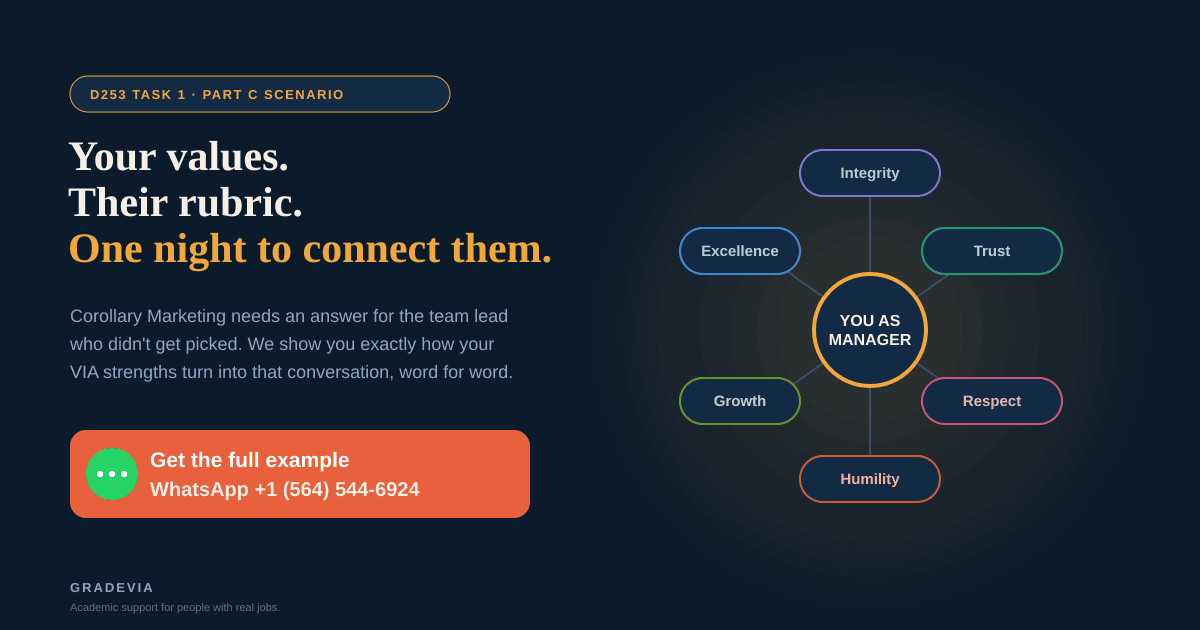
D253 asks you to step into a specific role rather than write about leadership in the abstract. You are the newly promoted customer service manager at Corollary Marketing Inc, a company that has published six core values: excellence, integrity, humility, trust, growth, and respect. The scenario places you in the middle of a hiring decision. You have just chosen a new team lead from among your direct reports, and you now have to communicate that decision to the person who was not selected, in a way that reflects both your own values and the company’s stated values.
This is not a generic leadership essay prompt. Every part of the task, from the character strengths reflection to the final conversation, is meant to build toward that one moment: explaining a hiring decision to someone who did not get the promotion, without compromising what you say you stand for.
D253 Task 1 Assignment
Introduction
Values-based leaders consider their values in every facet of leadership. Values dictate how they lead, govern culture, make decisions, develop employees, and measure performance, as well as a variety of other applications. Yet challenges arise that can sometimes entice leaders to compromise their values. For this task, you will use the provided scenario in which you assume the role of the newly promoted customer service manager for Corollary Marketing Inc. and complete tasks that will help you to develop as an effective values-based leader.Corollary Marketing Inc. Company Values:
- Excellence: In character, decision-making, and service to our clients and customers, we strive for distinction and actions of which we can be proud. Each of the following values contributes to this overriding charge.
- Integrity: We do the right thing, regardless of whether someone is watching. Our word is our bond; we carry a duty of care and responsibility to act ethically.
- Humility: We conduct our work without our egos. Our actions embody respect, humility, authenticity, and openness and invite feedback and input. We actively seek ideas and feedback from employees and value every voice and contribution.
- Trust: We extend the belief and feeling that others can be relied upon. We strive to be trustworthy by showing compassion and consistency and by communicating with care and truthfulness. We are authentic and transparent.
- Growth: Our best today may not be good enough tomorrow, and we continually seek to improve. Both personally and professionally, we aim to accelerate employee learning so that we can become better able to meet customer and company needs.
- Respect: We believe that each person (employee, customer, vendor, etc.) has value and rights. We act based on facts and always assume positive intent. We celebrate the differences in people and seek to utilize each person’s unique knowledge, skills, abilities, and perspectives.
Scenario
Refer to the “D253 Task 1 Scenario” supporting document to complete this performance assessment.A. Complete the VIA Character Strengths Survey using the “VIA Character Strengths Survey” web link and use the results of the survey to complete the following:Note: Remember that this VIA Character Strengths Survey is not a test but rather a feedback tool. There is no wrong answer, so respond genuinely. If you download a copy of your survey results, you will receive a list of 24 items in order of your personal strengths, with the first five being your signature strengths and the last five being your lesser strengths. Refer to the attached “D253 VIA Character Strength Survey Instructions” supporting document for additional information on accessing the survey.1. Describe an experience in which you used one of your five signature strengths (i.e., the first five) from the survey results to overcome a challenge.Note: Consider experiences from a school, volunteer, personal, or professional setting.a. Explain how you could apply the strength identified in part A1 as a values-based leader in your new position as the customer service manager from the scenario.2. Describe an experience in which being stronger in one of your five lesser strengths (i.e., the last five) from the survey results could have positively influenced the outcome.Note: Consider experiences from a school, volunteer, personal, or professional setting.a. Explain how improving the lesser strength identified in part A2 will help accelerate your values-based leadership abilities in your new position as the customer service manager.b. List three actions you can take to grow in the area identified in part A2.B. To set the tone for your new team, explain to them who you are as a values-based leader by doing the following:1. List your top three values as a values-based leader from the “List of Values” web link.Note: When listing your top three values, consider those values you hold most important.a. Explain how you will demonstrate each of the values listed in part B1 to serve both the team and the organization in the scenario.
C. Based on your understanding of who you are as a leader after completing parts A and B, do the following:1. Discuss one leadership challenge relevant to ethics and values that you could face as the new customer service manager regarding selecting and announcing the new team lead.Note: Consider your purpose as a new leader, ethical principles, relevant stakeholders, your expectations and point of view, and any assumptions you have made.2. Discuss how you, as the customer service manager, would use one of your top three values from part B1 and one of the company’s values in a conversation about the hiring decision with the person who was not selected as the team lead.Note: Consider values, ethical responsibility, and personal and professional consequences.D. Acknowledge sources, using in-text citations and references, for content that is quoted, paraphrased, or summarized.E. Demonstrate professional communication in the content and presentation of your submission.
D253 Task 1 WGU Task Snapshot
| Feature | Detail |
|---|---|
| Task title | Becoming an Effective Values Based Leader |
| Scenario | Corollary Marketing Inc, newly promoted customer service manager |
| Assessment used | VIA Character Strengths Survey |
| Company values | Excellence, integrity, humility, trust, growth, respect |
| Core deliverable | A written response addressing Parts A through E |
| Central conflict | Explaining a team lead hiring decision to the employee who was not selected |
Values Based Leadership D253 Task 1: Why the Scenario Matters
Values based leadership research describes leaders whose decisions, culture setting, and follower development are all filtered through an explicit set of personal values rather than through convenience or short term incentives. Copeland (2014) traced how this approach emerged as a response to a wave of ethical failures among charismatic executives who were skilled communicators but weak on integrity. The Corollary Marketing scenario is built around exactly that tension. It would be easy to announce a hiring decision in a way that avoids discomfort. A values based leader has to do it in a way that holds up under Corollary’s own stated commitment to integrity, humility, and respect, even when the outcome disappoints someone.
D253 Task 1 Requirements Breakdown
The task has five lettered requirements. Each maps to its own rubric aspect, so skipping a sub part, even a short one, tends to cost more than writing that sub part briefly.
Part A: VIA Character Strengths and Values Based Leadership
You complete the VIA Character Strengths Survey and receive a ranked list of 24 strengths, with your top five listed as signature strengths and your bottom five listed as lesser strengths. Part A has two halves.
A1: Describe an experience using a signature strength. Pick one of your top five strengths and describe a real situation, school, volunteer, personal, or professional, where that strength helped you overcome a challenge.
A1a: Apply that strength to the new role. Explain how you would use that same strength as a values based leader in your new position as customer service manager.
A2: Describe an experience involving a lesser strength. Pick one of your bottom five strengths and describe a situation where having more of that strength would have changed the outcome for the better.
A2a: Explain how growing that strength helps your leadership. Connect the improvement directly to your effectiveness as a values based leader in the customer service manager role.
A2b: List three growth actions. Name three concrete steps you could take to strengthen that lesser strength.
Part B: Defining Your Top Three Values as a Values Based Leader
Using the “List of Values” resource, you select your top three personal values, the ones you consider most important to how you lead. For each value, you explain how you will demonstrate it in a way that serves both your team and the organization inside the scenario. This is where your submission starts to distinguish itself from a generic reflection. Vague value statements like “I value honesty” earn far less than value statements tied to a specific behavior you will repeat as the customer service manager.
D253 Task 1 Part C: The Ethical Leadership Challenge
Part C is where the earlier sections come together. It has two pieces.
C1: Discuss an ethical leadership challenge tied to the hiring decision. Identify one leadership challenge relevant to ethics and values that you could face as the new manager while selecting and announcing the new team lead. Consider your purpose as a new leader, relevant ethical principles, the stakeholders involved, your own expectations, and any assumptions you are making.
C2: Discuss the conversation with the employee who was not selected. Explain how you, as the customer service manager, would use one of your top three personal values from Part B and one of Corollary Marketing’s stated values in that specific conversation. Consider the ethical responsibility involved and the personal and professional consequences of how that conversation goes.
Part D: Source Acknowledgment
Any content you quote, paraphrase, or summarize needs an in-text citation and a matching reference entry.
Part E: Professional Communication
Your submission needs to read clearly and professionally throughout, consistent with the tone expected of a manager addressing a real workplace situation.
D253 Task 1 Example: Sample Language for Each Section
Part A1 and A1a Example
One of my signature strengths from the VIA survey is perspective. During a previous role coordinating a cross functional project, two team members disagreed sharply about how to prioritize a client request, and the disagreement was starting to affect the rest of the team. I stepped back from the immediate conflict, asked each person what outcome mattered most to them, and helped them see that both priorities could be sequenced rather than treated as competing.
The project moved forward without either person feeling dismissed. As the new customer service manager at Corollary Marketing, I would apply this same strength when team members disagree about how to handle escalated customer complaints, using perspective to find the shared goal underneath a surface level disagreement rather than picking a side too quickly.
Part B Example
One of my top three values is transparency. As the customer service manager, I will demonstrate transparency by explaining the reasoning behind team decisions, including staffing and role changes, rather than announcing outcomes without context. This serves the team because it reduces speculation and rebuilds trust faster after a difficult decision, and it serves Corollary Marketing because transparency directly supports the company’s stated value of trust, which depends on communicating with care and truthfulness even when the message is not the one someone wanted to hear.
D253 Task 1 Part C Example
The leadership challenge I anticipate in selecting and announcing the new team lead is balancing fairness to both candidates with the operational needs of the department. My purpose as a new leader is to build credibility quickly, and that credibility depends on the team believing the decision was made on merit rather than favoritism. The relevant stakeholders include the candidate selected, the candidate not selected, and the rest of the team who will be watching how the decision is communicated.
I have to be careful about the assumption that a private conversation alone will be sufficient. Ethical leadership research emphasizes that leaders are judged as much by the fairness of their process as by the outcome itself (Brown & Treviño, 2006), which means how I communicate this decision matters as much as the decision itself.
In the conversation with the employee who was not selected, I would rely on my value of transparency alongside Corollary Marketing’s stated value of respect. I would explain the specific criteria used in the decision rather than offering a vague explanation, and I would acknowledge the employee’s contributions directly rather than minimizing them to soften the message. Handling this conversation poorly carries real professional consequences, including disengagement or turnover from a valued team member, so the ethical responsibility here is not just to be honest but to be honest in a way that preserves the employee’s dignity and their reason to stay invested in the team.
D253 Task 1 Template: How to Structure Your Submission
Use the lettered structure from the task itself as your outline rather than inventing your own headings. A clean structure keeps every rubric aspect easy for an evaluator to locate.
- Introduction naming the scenario and your role at Corollary Marketing
- Part A1: Signature strength experience
- Part A1a: Application to the new role
- Part A2: Lesser strength experience
- Part A2a: Application to leadership growth
- Part A2b: Three growth actions
- Part B: Top three values and how each will be demonstrated
- Part C1: The ethical leadership challenge
- Part C2: The conversation with the employee who was not selected
- References
Keeping the submission in this order also makes it easier to check your own work against Part D and Part E before you upload, since each section is short enough to review for citations and tone individually.
Common Mistakes That Keep Students From Getting D253 Task 1 Passed
Treating Part A as a personality summary instead of a story. The task asks for an experience, a specific moment where the strength or its absence changed an outcome, not a description of what the strength means.
Choosing values in Part B that are not genuinely personal. Picking values because they sound impressive rather than because they reflect real decision making tends to produce vague, unconvincing application statements in the second half of Part B.
Disconnecting Part C from Parts A and B. Part C should read as the natural conclusion of everything before it. If the value used in C2 was never mentioned in B, or the strength discussed in A never resurfaces anywhere, the submission reads as three unrelated assignments stapled together.
Being vague about the conversation itself in C2. A strong response describes what you would actually say and why, tied to a named value and a named company value, not a general statement that you would be honest and respectful.
Skipping citations because the task feels personal. Even a reflective, first person task requires in-text citations and references for any idea drawn from outside sources, including course material on values based leadership or ethical decision making.
Frequently Asked Questions About D253 Task 1
What is D253 Task 1 becoming an effective values based leader actually assessing?
It assesses whether you can connect self knowledge, from the VIA Character Strengths Survey and your own value declarations, to a specific, realistic leadership decision. The Corollary Marketing scenario exists so the evaluator can see whether your stated values hold up when applied to a real situation rather than staying abstract.
Is there a D253 task 1 pdf or template I should follow?
WGU does not provide a fixed template file for the written response, but you should refer to the “D253 Task 1 Scenario” and “D253 VIA Character Strength Survey Instructions” supporting documents referenced in the task for the exact scenario details and survey access steps. Structuring your submission around the lettered parts, as outlined above, functions as the most reliable template.
How do I access the VIA Character Strengths Survey for D253?
The task provides a direct web link to the VIA Character Strengths Survey. After completing it, download your results, which list all 24 strengths ranked from strongest to weakest, with the top five identified as signature strengths and the bottom five as lesser strengths.
Can I use the same value in both Part B and Part C?
You are expected to. Part C2 specifically asks you to draw on one of your top three values from Part B, so reusing that value with a concrete application in the hiring conversation is exactly how the two sections should connect.
What makes a D253 Task 1 scenario response feel authentic rather than generic?
Specificity. Naming the exact strength, the exact value, and the exact criteria you would explain in the difficult conversation, rather than describing leadership qualities in general terms, is what separates a submission that reads as genuinely reflective from one that reads as a template filled in with different words.
Final Thoughts on D253 Values Based Leadership Task 1
Students who get D253 Task 1 passed on the first attempt treat the assignment as one continuous argument rather than five separate questions. They pick a signature strength and a lesser strength they can speak to honestly, they choose values they can defend with real examples, and they let those same values reappear in the hardest part of the scenario, the conversation with the employee who did not get the promotion. That continuity, more than polished language, is what makes a values based leadership response convincing.
If you want a specialist to review your draft against the rubric before you upload, or you need help thinking through how your own VIA results connect to the scenario, our WGU specialists are ready to help.
Related WGU Guides and Examples
How to Pass WGU C203 Task 1 Without Revisions: Complete Pass Guide and Example
WGU D469 FUN1 Task 1: DMAIC Model Guide + Example | Fielder Medical Center
WGU C204 Task 1 Guide and Example: Communication Portfolio
How to Pass WGU D479 Task 1 Without Revisions
References
Brown, M. E., & Treviño, L. K. (2006). Ethical leadership: A review and future directions. The Leadership Quarterly, 17(6), 595 to 616. https://doi.org/10.1016/j.leaqua.2006.10.004
Copeland, M. K. (2014). The emerging significance of values based leadership: A literature review. International Journal of Leadership Studies, 8(2), 105 to 135. https://www.regent.edu/journal/international-journal-of-leadership-studies/significance-of-values-based-leadership/
Peterson, C., & Seligman, M. E. P. (2004). Character strengths and virtues: A handbook and classification. Oxford University Press. https://www.apa.org/pubs/books/4317046