
Blog
Applying Epidemiology To Program Design For Chronic Disease: Complete Assignment Guide

Applying Epidemiology To Program Design For Chronic Disease
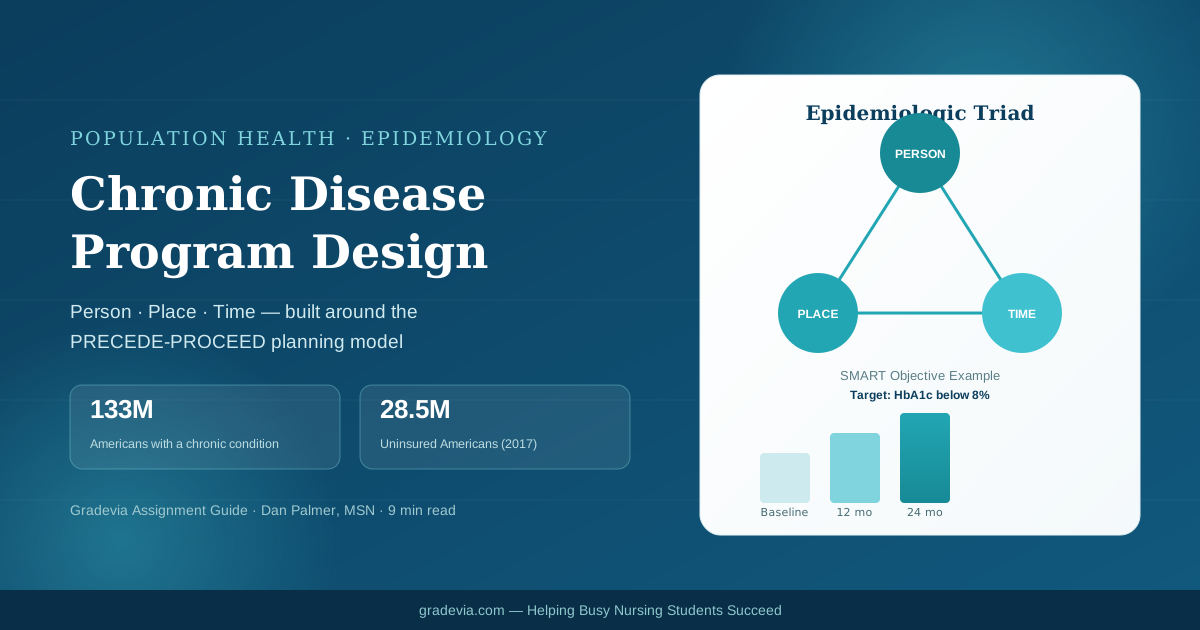
Roughly 28.5 million Americans were still uninsured as of 2017, and 133 million Americans […] suffer from at least one chronic condition.
—Nash et al. (2021, p. 5)
As you know, promoting positive social change is a part of the Walden mission. To be an effective agent for social change, nurses must be able to logically and critically analyze population health issues using epidemiologic concepts, and then translate this knowledge into evidence-based practice to improve healthcare outcomes. This exercise will afford you such an experience at the population level. This is an exciting time to be working in the field of population health with all the new, dynamic, and innovative technologies and strategies to help patients and populations become more knowledgeable about their health.
This week’s Learning Resources present numerous health problems that result in a need for ongoing care. Your Assignment is to select a chronic disease of professional importance to you, and then design an intervention program to improve the health of populations affected by it.
To Prepare:
- Review the Chronic Disease Prevention and Health Promotion (NCCDPHP) website from the Centers for Disease Control and Prevention (CDC).
- Select one of the identified chronic diseases of national significance that impacts a population of interest to you.
- Consider a health outcome you would like to improve in this population related to the selected chronic disease.
- Develop a program proposal to improve this health outcome for this population using the assignment guidelines below. Select one of the program models in Curley, Chapter 8, to guide your planning.
- Review the SMART objective resources for a review of how to write objectives for your program.
- Use the Walden APA paper template, including appropriate APA 7 headings, to develop this Assignment.
The Assignment
In a 7- to 10-page proposal (not including title page and references), address the following:
- Briefly identify your selected chronic health issue and population.
- Describe the geographic region and important characteristics of this population.
- Describe the patterns of the disease in your selected population using the epidemiologic characteristics of person, place, and time.
- Identify one health outcome you would like to improve for the population.
- Briefly summarize current evidence that supports the importance of improving this health outcome.
- Briefly describe the evidence-based program you are developing, and why this approach will best fit the needs of your population.
- Explain what data you would need to collect, and how you would obtain and analyze it. You may choose to collect primary data or use secondary data. Justify your choice.
- Using the “SMART” method, write short- and long-term objectives for the program.
- Identify the stakeholders who should be involved in program planning.
- Identify which program planning model (see Curley, Chapter 7) you selected for your program. Justify your selection of model. Based on the model, explain how you would plan, implement, and evaluate the program.
- Explain any relevant cultural or ethical considerations related to your program design.
- Explain how you would fund the program.
- Describe strategies that would be appropriate for marketing the program.

Step-by-Step Guide: Chronic Disease Program Proposal
PHASE 1: Pre-Writing & Topic Selection (Before You Write Anything)
Step 1 — Choose Your Disease and Population Strategically
Visit the CDC’s NCCDPHP website (cdc.gov/chronicdisease) and browse the listed chronic diseases. Choose one that meets these criteria:
- You have genuine interest or professional exposure to it (nursing context helps here)
- It has a clear, disparity-affected population (e.g., Type 2 diabetes in Black adults, COPD in Appalachian rural communities, hypertension in Latino men)
- Sufficient peer-reviewed literature exists from 2021–2026
- The health outcome you want to improve is measurable
Strong example combinations:
- Type 2 diabetes → Black adults in the rural South → Improve HbA1c control rates
- Hypertension → Hispanic/Latino adults in urban areas → Reduce uncontrolled BP rates
- Obesity → Native American/Alaska Native youth → Improve BMI and physical activity levels
- COPD → Appalachian rural white adults → Reduce hospitalizations
Step 2 — Select Your Program Planning Model (Curley, Chapter 7)
Do this before writing — the model shapes your entire planning section. Common models include:
| Model | Best Fit When… |
|---|---|
| PRECEDE-PROCEED | You need a comprehensive ecological model covering predisposing/enabling/reinforcing factors |
| Logic Model | You want a clear input → activity → output → outcome chain |
| MATCH (Multilevel Approach to Community Health) | Targeting multiple levels (individual, community, policy) |
| MAPP (Mobilizing for Action through Planning & Partnerships) | Community-driven, stakeholder-heavy programs |
Recommendation: PRECEDE-PROCEED is the most commonly expected in public health graduate programs and maps well to every section of this paper.
Step 3 — Gather Your Sources First
Find 10–14 peer-reviewed sources (2021–2026) before writing. You need sources for:
- Disease burden/epidemiology (2–3 sources)
- Population-specific disparities (2–3 sources)
- Evidence-based intervention/program (2–3 sources)
- Health outcome evidence (1–2 sources)
- Your program model (1 source — Curley textbook)
- SMART objectives and program evaluation (1–2 sources)
Use PubMed, CINAHL, Google Scholar. Search terms like: [disease] + [population] + intervention + disparity + outcomes.
PHASE 2: Structure Your Paper (7–10 pages, APA 7)
Use the Walden APA template with these Level 1 and Level 2 headings:
Title Page (not counted in page total) Use Walden’s provided template format.
Section 1: Introduction (~0.5 page)
- Briefly introduce the chronic disease and population in 1–2 paragraphs
- End with a purpose statement: “The purpose of this proposal is to develop a program to improve [health outcome] among [population] in [region].”
- No heading needed for intro per APA 7 (it follows the title)
Section 2: Population and Geographic Description (~0.75–1 page)
APA Heading: Population and Geographic Description
Cover:
- Geographic region (state, county, urban/rural)
- Demographic characteristics (age, race/ethnicity, income, education, insurance status)
- Health system access issues (provider shortages, transportation, language barriers)
- Why this population is particularly affected
Section 3: Epidemiologic Profile (~1–1.5 pages)
APA Heading: Epidemiologic Profile of [Disease] in [Population]
Use the epidemiologic triad of person, place, and time — structure your writing around these three explicitly:
- Person: Who gets this disease? Age, sex, race/ethnicity, SES, risk factors
- Place: Geographic distribution, urban/rural patterns, regional disparities, environmental contributors
- Time: Trends over time — is prevalence rising, falling, stable? COVID-era changes? Seasonal patterns?
Cite CDC surveillance data, state health department reports, and peer-reviewed epidemiology studies.
Section 4: Health Outcome and Evidence (~1 page)
APA Heading: Targeted Health Outcome and Supporting Evidence
Two sub-sections work well here:
Identified Health Outcome State one specific, measurable health outcome. Examples:
- Reduce uncontrolled HbA1c (>9%) rates by 20% over 24 months
- Increase blood pressure control rates from 45% to 65% within 18 months
Evidence Supporting This Outcome Summarize 2–3 studies demonstrating why improving this outcome matters — what happens when it’s not addressed (hospitalizations, mortality, costs, quality of life).
Section 5: Program Description (~1–1.5 pages)
APA Heading: Evidence-Based Program Description
Two sub-sections:
Program Overview Describe the specific evidence-based program you’re proposing (e.g., CDC-recognized Diabetes Prevention Program, community health worker model, telehealth self-management program). Be specific about:
- Modality (in-person, virtual, hybrid)
- Frequency/duration of sessions
- Core components (education, behavior change, clinical monitoring)
Rationale for This Approach Explain why this program fits this specific population. Connect to the barriers you identified in Section 2 (e.g., “Given transportation barriers in rural Appalachia, a telehealth delivery model addresses accessibility while maintaining evidence-based content”).
Section 6: Data Collection and Analysis (~0.75–1 page)
APA Heading: Data Collection and Analysis Plan
Address three parts:
- What data — enrollment rates, clinical measures (HbA1c, BP), attendance, survey responses, hospitalizations
- Primary vs. secondary data — make a clear choice and justify it:
- Primary: surveys, clinical measurements, interviews (more control, more burden)
- Secondary: EHR data, insurance claims, CDC BRFSS data (less burden, may have limitations)
- Analysis approach — descriptive statistics for demographics, pre/post comparisons for outcomes, chi-square or t-tests as appropriate. Mention any software (SPSS, REDCap).

Section 7: SMART Objectives (~0.75 page)
APA Heading: Program Objectives
Write 2 short-term and 2 long-term SMART objectives. Use this formula:
By [date/timeframe], [who] will [do/achieve what] as measured by [measure], from [baseline] to [target].
Short-term examples (3–6 months):
- By Month 3, at least 80% of enrolled participants will complete all six core education sessions, as measured by attendance records.
- By Month 6, participants will demonstrate a statistically significant reduction in mean fasting blood glucose levels compared to baseline, as measured by laboratory results.
Long-term examples (12–24 months):
- By Month 18, 60% of participants will achieve HbA1c levels below 8%, compared to a baseline of 35%, as measured by quarterly lab draws.
- By Month 24, emergency department visits for diabetes-related complications among enrolled participants will decrease by 25% compared to the prior 24-month period, as measured by hospital claims data.
Section 8: Stakeholders (~0.5 page)
APA Heading: Stakeholder Identification
Identify stakeholders at multiple levels and explain each one’s role:
- Clinical: Primary care physicians, NPs, diabetes educators, pharmacists
- Community: Community health workers, faith leaders, local YMCA/community centers
- Organizational: Hospital systems, FQHCs, public health departments
- Policy/Funding: State health department, local government, insurance payers
- Population: Patient advisory council or community members with lived experience
Section 9: Program Planning Model (~1.5 pages)
APA Heading: Program Planning Model
Three sub-sections:
Selected Model and Justification Name the model (e.g., PRECEDE-PROCEED) and explain in 1 paragraph why it fits your population and program type. Cite Curley here.
Planning Phase Walk through the model’s planning phases as applied to your program. For PRECEDE-PROCEED:
- Phase 1 (Social Assessment): QOL concerns of the population
- Phase 2 (Epidemiologic Assessment): Disease burden, risk factors
- Phase 3 (Behavioral/Environmental): Target behaviors and environmental barriers
- Phase 4 (Educational/Ecological): Predisposing, enabling, reinforcing factors
- Phase 5 (Administrative/Policy): Resources, policies, barriers to implementation
Implementation and Evaluation
- How will the program be rolled out (pilot site, phased expansion)?
- Process evaluation (are activities happening as planned?)
- Impact evaluation (are short-term objectives being met?)
- Outcome evaluation (are long-term health outcomes improving?)
Section 10: Cultural and Ethical Considerations (~0.5–0.75 page)
APA Heading: Cultural and Ethical Considerations
- Cultural humility, culturally tailored materials, language access
- Community-based participatory principles
- Informed consent, data privacy (HIPAA)
- Equity considerations — not inadvertently excluding the most vulnerable
- Health literacy accommodations
Section 11: Funding Plan (~0.5 page)
APA Heading: Program Funding
Identify realistic funding sources:
- Federal grants: CDC’s Racial and Ethnic Approaches to Community Health (REACH), HRSA grants, NIH
- State health department grants
- Private foundations: Robert Wood Johnson Foundation, W.K. Kellogg Foundation
- Hospital community benefit funds (501(c)(3) requirement)
- Insurance payer partnerships (value-based care agreements)
Briefly describe a grant-seeking strategy or budget categories (personnel, supplies, education materials, evaluation).
Section 12: Marketing Strategies (~0.5 page)
APA Heading: Marketing Strategies
- Community outreach: Faith-based organizations, community events, barbershops/beauty salons (especially effective in Black communities)
- Healthcare settings: Provider referrals, waiting room flyers, EHR-based patient outreach
- Digital: Social media (Facebook/Instagram for adults 35+), text message reminders, community radio
- Partnerships: Local health department, YMCA, community health centers
- Tailor messaging to the population’s values, language, and trusted messengers
References Page (not counted in page total) APA 7 format, hanging indent, alphabetical order, only sources cited in the paper.
PHASE 3: Writing Tips for Quality
Do these:
- Write in third person throughout (avoid “I will…” — use “The program will…”)
- Use APA Level 1 and Level 2 headings exactly as shown in the Walden template
- Integrate citations naturally — every factual claim about disease rates, effectiveness, or population characteristics needs a citation
- Use transition sentences at the end of each section to connect to the next
- Be specific and concrete — avoid vague language like “improve health outcomes” without defining what that means
Avoid these:
- Using sources older than 2021 (unless a landmark study with no recent equivalent)
- Writing objectives without all five SMART elements
- Confusing the program planning model section with the program description — the model section is about how you plan and evaluate, not what the program does
- Skipping the “justify your choice” language — the rubric likely awards points for rationale, not just description
PHASE 4: Final Checklist Before Submitting
- Title page uses Walden APA template
- Paper is 7–10 pages (body only, not title/references)
- All 13 assignment components are addressed
- APA 7 headings used throughout
- All sources are peer-reviewed and dated 2021–2026
- SMART objectives have all five elements (Specific, Measurable, Achievable, Relevant, Time-bound)
- Program planning model section includes planning, implementation, AND evaluation
- References page is APA 7 formatted with hanging indents
- Spell-check and grammar check completed
- Page count verified (not including title/references)