
Blog
NONPF Nine Core NP Competencies Assignment Guide with Example

NONPF Nine Core NP Competencies Assignment Guide with Example
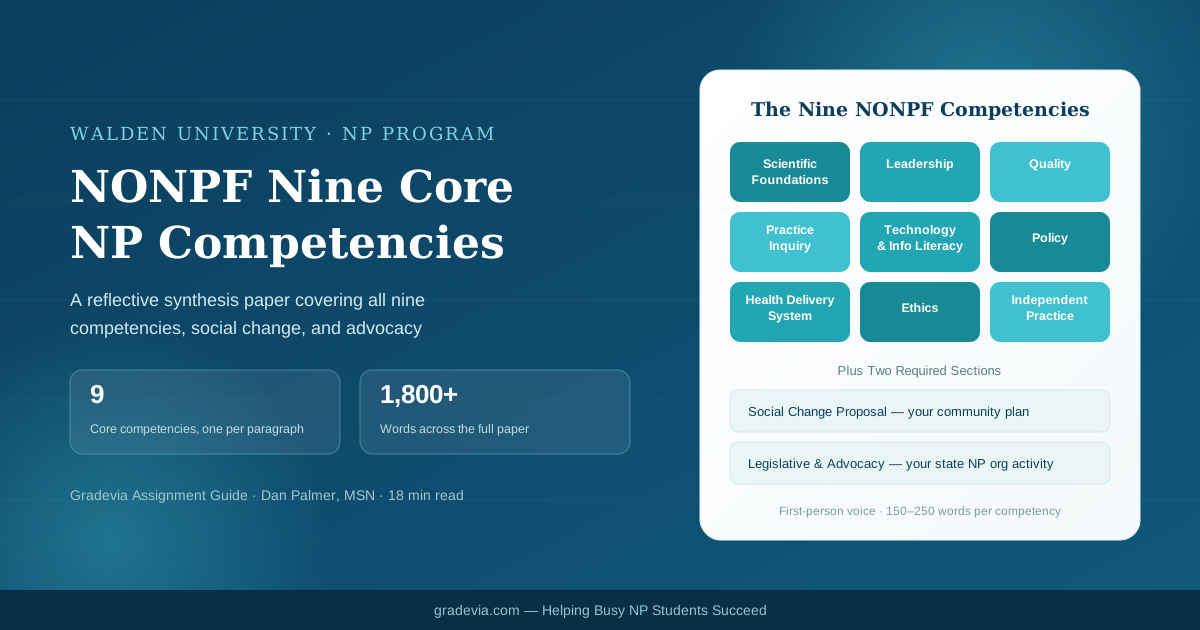
The National Organization of Nurse Practitioner Faculties (NONPF) has determined nine broad areas of core competence that apply to all nurse practitioners, regardless of specialty or patient population focus. NONPF created the first set of Nurse Practitioner Competencies in 1990; the most recent updates were incorporated in 2017. This course was designed to prepare you to synthesize knowledge gained throughout the program and to apply each of the nine core competencies within your selected areas of practice and your representative communities.
The nine areas of competency are:
- Scientific Foundations
- Leadership
- Quality
- Practice Inquiry
- Technology and Information Literacy
- Policy
- Health Delivery System
- Ethics
- Independent Practice
NONPF Nine Core NP Competencies Step-by-Step Writing Guide
Assignment Overview
This assignment has three distinct parts that must all appear in your final submission:
- Nine body paragraphs — one per NONPF competency — explaining how your graduate program prepared you to meet each competency.
- A social change proposal — describing specifically how you plan to engage in social change as an NP in your community.
- Legislative and advocacy activities — identifying 1–2 current activities your state NP organization is involved in, with specific examples.
NOTE: This is a reflective, first-person academic paper — NOT a clinical paper. Write as ‘I’ throughout. Every paragraph must be grounded in YOUR specific program experiences, courses, and clinical hours. Vague, generic statements will not score well.
Quick Reference: What Each Section Requires
| Section | Content Required | Key to Scoring Well |
| C1 — Scientific Foundations | How the program prepared you to use scientific evidence | Name courses; cite a specific research activity or PICOT project |
| C2 — Leadership | How the program developed NP leadership skills | Reference a leadership framework; describe a real leadership moment |
| C3 — Quality | How the program built quality improvement competency | Name a QI model (PDSA); describe a QI project or population outcome focus |
| C4 — Practice Inquiry | How the program built inquiry and knowledge-generation skills | Describe a scholarly project, presentation, or clinical inquiry activity |
| C5 — Technology & Info Literacy | How the program prepared you for health informatics/EHR use | Name specific tools; discuss CDSS, telehealth, or data use |
| C6 — Policy | How the program gave you policy literacy and advocacy skills | Reference scope of practice, ACA, or a specific policy activity |
| C7 — Health Delivery System | How the program exposed you to healthcare systems | Describe care settings, transitions of care, or systems thinking |
| C8 — Ethics | How the program built ethical reasoning capacity | Describe an ethical case or dilemma from course or practicum |
| C9 — Independent Practice | How the program readied you for autonomous NP practice | Reference clinical hours, certification plan, professional identity |
| Social Change | Your specific community social change plan as an NP | Name your community, population, and concrete planned activities |
| Legislative Advocacy | 1–2 state NP org activities (current, specific) | Name the bill or issue; name the organization; be specific |
How To Approach This Paper: General Strategy
Before you write a single paragraph, complete these preparation steps:
- Pull up your program transcript and list every course you completed — especially advanced pathophysiology, pharmacology, research, leadership, health policy, ethics, and your practicum seminars.
- Review your clinical practicum hours log. Know how many hours you completed, in what settings, and with which patient populations. You will reference these across multiple competencies.
- Identify your certification exam target (AANP FNP-C, ANCC PMHNP-BC, etc.) — you will reference this in Competency 9.
- Look up your state’s NP practice authority status (full, reduced, or restricted) and your state NP association — you will need this for the Policy section and the legislative advocacy section.
- Search your state NP organization’s website for 1–2 current legislative or advocacy priorities. Write down the bill number or issue name and year.
Length: Each competency paragraph should be 150–250 words — thorough but focused. The social change section should be 200–300 words. The legislative section should be 150–250 words. Total paper: approximately 1,800–2,800 words.
Tone: First-person academic voice throughout. Do not write in third person. Avoid overly clinical language; this is a reflective synthesis paper. Be specific and personal — generic platitudes will not demonstrate competency.
Step-By-Step Guide: The Nine NONPF Competencies
Each section below includes: (1) what the competency means, (2) what program experiences to draw on, (3) how to structure your paragraph, and (4) a sample opening sentence.
Competency 1: Scientific Foundations
Critically appraise and apply scientific evidence to NP practice
What This Competency Means
This competency requires you to demonstrate that you can evaluate and integrate current, high-quality evidence into your clinical decision-making and patient care. It is about being a consumer and interpreter of science, not just a follower of protocols.
Program Experiences to Draw From
- Pathophysiology and pharmacology coursework that required applying mechanisms of disease to clinical reasoning
- Evidence-based practice (EBP) courses where you critiqued quantitative and qualitative research studies
- Completing PICOT questions and systematic literature searches using PubMed, CINAHL, and Cochrane
- Applying clinical guidelines (AHA, JNC, CDC) to case studies and clinical practicums
- Translating research into patient care plans during supervised clinical hours
How to Structure Your Paragraph
Open by acknowledging that NP practice is rooted in science. Describe specific graduate-level courses (pathophysiology, pharmacology, research methods) that built your ability to evaluate evidence. Give one concrete example — such as completing a PICOT-formatted literature review or applying Level I evidence from a systematic review to a patient care plan during your practicum. Close by stating how this prepares you to maintain currency in your specialty through lifelong engagement with evolving science.
Sample Opening Sentence
“The graduate program’s rigorous emphasis on advanced pathophysiology, evidence-based pharmacology, and research methodology has built the scientific foundation necessary to deliver competent, evidence-driven NP care.”
Suggested Citations
- Melnyk & Fineout-Overholt (2019) — Evidence-Based Practice in Nursing & Healthcare
- NONPF (2017) — NP Core Competencies
Competency 2: Leadership
Lead interprofessional teams and drive organizational and system-level change
What This Competency Means
Leadership for NPs extends beyond clinical supervision. It includes mentoring colleagues, advocating within healthcare systems, shaping practice environments, and guiding teams toward improved patient outcomes.
Program Experiences to Draw From
- Leadership and management coursework in healthcare administration or organizational theory
- Leading interprofessional case conferences or team-based learning simulations
- Completing a DNP or capstone project requiring stakeholder engagement and change management
- Preceptorship experiences where you modeled clinical reasoning for junior students or staff
- Course content on transformational leadership, servant leadership, and Kouzes & Posner’s model
How to Structure Your Paragraph
Begin by defining what NP leadership looks like — it is clinical, professional, and systems-oriented. Identify specific leadership frameworks or models explored in coursework (e.g., transformational, servant leadership). Describe a practicum experience where you took initiative — presenting a quality improvement suggestion, leading a care conference, or mentoring a patient through self-management. Close by connecting leadership competency to your future role.
Sample Opening Sentence
“Throughout the program, coursework in healthcare leadership and collaborative practice has equipped me to lead interprofessional teams, advocate for evidence-based system changes, and model ethical clinical decision-making.”
Suggested Citations
- Kouzes & Posner (2017) — The Leadership Challenge
- AACN (2021) — Essentials for Advanced Practice Nursing Education
Competency 3: Quality
Use data-driven strategies to continuously improve patient care and safety
What This Competency Means
This competency encompasses quality improvement (QI) methodology, patient safety science, reducing disparities, and measuring outcomes. NPs must be able to identify gaps in care, implement QI interventions, and evaluate results.
Program Experiences to Draw From
- Quality improvement courses covering PDSA cycles, Six Sigma, Lean, and IHI frameworks
- Population health coursework addressing health disparities and social determinants
- Using EMR data or clinical databases to identify outcome trends
- Practicum experiences in quality-focused settings (ACO, PCMH, or FQHC environments)
- Capstone/DNP projects centered on measurable clinical quality outcomes
How to Structure Your Paragraph
Open with a statement about QI as integral to NP accountability. Reference a specific QI model or framework learned (PDSA, IHI Model for Improvement). Describe how you applied it — such as identifying a care gap (e.g., suboptimal HbA1c management in a diabetic population) and proposing an evidence-based intervention. Mention measurement of outcomes and what you learned about iterative improvement.
Sample Opening Sentence
“The program’s focus on quality improvement science and patient safety has prepared me to identify practice gaps, implement evidence-based interventions, and evaluate outcomes using established frameworks such as the IHI Model for Improvement.”
Suggested Citations
- Institute for Healthcare Improvement (IHI) — IHI Open School
- Agency for Healthcare Research and Quality (AHRQ) — Patient Safety Primers
Competency 4: Practice Inquiry
Generate, translate, and disseminate knowledge to advance NP practice
What This Competency Means
Practice inquiry goes beyond applying existing evidence — it involves identifying clinical problems, generating new knowledge through inquiry, and sharing findings with the broader healthcare community. NPs contribute to the evidence base, not just consume it.
Program Experiences to Draw From
- Advanced research design and statistical analysis courses
- Identifying a clinical problem and designing a practice improvement project
- Submitting presentations, posters, or papers through the program or at professional conferences
- Conducting chart reviews or quality audits as part of practicum
- Critiquing and comparing clinical guidelines to identify discrepancies or gaps
How to Structure Your Paragraph
Distinguish practice inquiry from basic EBP — it is about generating and disseminating knowledge, not just applying it. Describe a specific inquiry project: Did you design a QI study? Present findings at a clinical conference? Write a clinical policy draft? Connect this to your ongoing responsibility as an NP to contribute to the evidence base in your specialty.
Sample Opening Sentence
“The program cultivated a spirit of scholarly inquiry by requiring students to move beyond knowledge consumption toward knowledge generation, critically appraising and translating clinical evidence into actionable practice recommendations.”
Suggested Citations
- Melnyk et al. (2014) — ARCC Model for EBP
- NONPF (2017) — Practice Inquiry Competencies

Competency 5: Technology and Information Literacy
Leverage health information technology to optimize patient outcomes and care delivery
What This Competency Means
This competency addresses electronic health record (EHR) proficiency, clinical decision support tools, telehealth, health informatics, and the ethical use of patient data. NPs must navigate technology to improve — not impede — care.
Program Experiences to Draw From
- Health informatics or healthcare technology courses
- EHR navigation and documentation training within clinical practicums
- Using clinical decision support systems (UpToDate, Epocrates, CDC guidelines) at point of care
- Exposure to telehealth platforms during COVID-era or virtual practicum rotations
- HIPAA, data privacy, and ethical use of patient data content in program curriculum
How to Structure Your Paragraph
Open with the reality that modern NP practice is inseparable from technology. Reference specific platforms or systems encountered (EHR, telehealth, CDSS). Discuss how you were taught to use technology to support — not replace — clinical judgment. Address informatics literacy: understanding data, interpreting population-level dashboards, or using registries to identify at-risk patients. Close by connecting to your future practice setting.
Sample Opening Sentence
“The program’s integration of health informatics, EHR navigation, and clinical decision support tools has prepared me to leverage technology effectively and ethically to enhance clinical decision-making and patient safety.”
Suggested Citations
- American Nursing Informatics Association (ANIA)
- gov — EHR and Patient Safety Resources
Competency 6: Policy
Influence healthcare policy to promote equitable, high-quality care for all populations
What This Competency Means
NPs must understand how policy shapes practice — including scope of practice laws, reimbursement policy, and public health legislation. This competency requires advocacy at local, state, and federal levels.
Program Experiences to Draw From
- Health policy coursework covering the legislative process, healthcare reform, and NP scope of practice
- Analysis of the Affordable Care Act, Medicare/Medicaid, and value-based care models
- Reviewing state-level NP practice authority (full, reduced, or restricted) and its clinical implications
- Engaging with professional organizations like AANP, ANA, or state NP associations
- Advocacy simulation activities — writing policy briefs or contacting legislators
How to Structure Your Paragraph
Begin by acknowledging that policy is what makes NP full practice authority possible — or limits it. Reference specific policy content from your coursework (ACA, state scope of practice battles, CMS reimbursement). Describe an activity that gave you policy literacy — analyzing a bill, writing a policy brief, or attending a virtual advocacy day. Transition to your commitment to ongoing policy engagement as a practicing NP.
Sample Opening Sentence
“Health policy coursework has transformed my understanding of how legislation shapes NP practice authority, reimbursement structures, and patient access, positioning me to be an active advocate for policies that expand equitable, high-quality care.”
Suggested Citations
- Institute of Medicine (2021) — The Future of Nursing 2020–2030
- AANP — NP Scope of Practice by State (2024)
Competency 7: Health Delivery System
Navigate and improve complex healthcare delivery systems to optimize population health
What This Competency Means
This competency requires understanding how healthcare organizations are structured, financed, and operated — and how to work within and improve those systems. It includes understanding care coordination, interprofessional collaboration, and transitions of care.
Program Experiences to Draw From
- Healthcare systems and organizational behavior coursework
- Care coordination, case management, and transitions-of-care training
- Practicum exposure to different care settings (primary care, specialty, hospital, FQHC, telehealth)
- Understanding value-based care, ACOs, PCMHs, and bundled payment models
- Interprofessional education (IPE) activities and simulation with other health profession students
How to Structure Your Paragraph
Discuss how the program exposed you to the full continuum of care, not just a single clinical setting. Highlight systems thinking — your ability to see how decisions in one part of the system ripple through others. Give an example from practicum: navigating a complex discharge, coordinating with a specialist, or managing a patient across multiple care settings. Close by connecting to your planned practice environment.
Sample Opening Sentence
“By engaging with diverse clinical settings and healthcare delivery models throughout the program, I have developed the systems-thinking capacity necessary to navigate complex organizations, coordinate care across disciplines, and optimize patient outcomes at both the individual and population level.”
Suggested Citations
- Berwick et al. (2008) — The Triple Aim
- CMS — Value-Based Care Program Overview
Competency 8: Ethics
Apply ethical principles to complex clinical and professional dilemmas in NP practice
What This Competency Means
Ethics competency requires NPs to navigate autonomy, beneficence, nonmaleficence, and justice in patient care — and to handle professional ethical conflicts, cultural competency, and advocacy for vulnerable populations with integrity.
Program Experiences to Draw From
- Healthcare ethics course covering major ethical frameworks (deontology, consequentialism, virtue ethics)
- Case studies involving end-of-life decisions, informed consent, treatment refusal, and resource allocation
- Cultural humility and health equity training woven throughout the curriculum
- HIPAA, confidentiality, and mandatory reporting requirements
- Practicum experiences involving ethical dilemmas — conflicting patient/family wishes, resource limitations
How to Structure Your Paragraph
Begin with the ethical weight of independent NP practice — you will regularly face situations where the right answer is not obvious. Reference specific ethical frameworks explored in coursework. Describe a real or simulated ethical challenge: a patient refusing evidence-based treatment, a conflict between patient autonomy and family wishes, or an end-of-life scenario. Explain your ethical reasoning process. Close by affirming your commitment to ethically centered, culturally humble practice.
Sample Opening Sentence
“The program’s robust ethics curriculum, grounded in the four principles of biomedical ethics and reinforced through clinical case analysis, has prepared me to navigate the complex moral terrain of advanced practice with clarity, compassion, and professional integrity.”
Suggested Citations
- Beauchamp & Childress (2019) — Principles of Biomedical Ethics
- ANA Code of Ethics for Nurses (2015)
Competency 9: Independent Practice
Practice autonomously as a licensed, accountable, patient-centered NP
What This Competency Means
This final competency synthesizes all others — it is the demonstration that you are ready to function as an autonomous, accountable advanced practice provider. It includes clinical competency, professional accountability, scope-of-practice adherence, and continuous professional development.
Program Experiences to Draw From
- 500+ supervised clinical hours in your specialty population across multiple practicum sites
- Preparing for and sitting for national board certification (ANCC or AANP)
- Developing a professional portfolio, CV, and personal philosophy of practice
- State licensure requirements, DEA registration, prescriptive authority training
- Ongoing CE planning, professional organization membership, and peer networks
How to Structure Your Paragraph
This paragraph should be the most personal and forward-looking. Describe the clinical hours you have completed, the patient populations you have served, and how these experiences have built your clinical confidence and judgment. Reference your certification pathway. Describe your plan for maintaining competency: CE, specialty certification renewal, professional association involvement, peer consultation. Close with a statement about your professional identity as an NP.
Sample Opening Sentence
“Having completed the requisite clinical hours across diverse practice settings and patient populations, and preparing for national board certification, I am confident in my readiness to assume the full scope of independent NP practice with accountability, compassion, and ongoing commitment to professional excellence.”
Suggested Citations
- AANP — Certification and Recertification
- ANCC — NP Certification Pathways

Part 2: Social Change Proposal
After the nine competency paragraphs, write a dedicated section titled something like: ‘Proposed Engagement in Social Change as a Nurse Practitioner.’
What ‘Social Change’ Means in This Context
Social change refers to deliberate actions you take — as a nurse practitioner — to improve health outcomes, reduce disparities, and address systemic inequities in your community. It goes beyond individual patient care to include community-level impact.
How to Write This Section
- Name your community — be specific. City, county, rural region, or a specific underserved population (e.g., uninsured adults in rural Appalachia, LGBTQ+ youth in your urban area, elderly diabetic patients in a federally qualified health center).
- Identify 1–2 specific health disparities or unmet needs in that community. Use data if possible — local health department statistics, Healthy People 2030 indicators, or state health profiles.
- Describe the concrete activities you plan to engage in: community health screenings, school health programs, faith-based health education, advocacy at town halls, pro bono clinical days, participation in mobile health units, etc.
- Connect your NP competencies to these activities — show that your education has equipped you for this role.
- Include a forward-looking commitment statement — this is your professional pledge, not just an assignment answer.
Make It Real: Do not write about vague social change. ‘I plan to help my community be healthier’ will not score well. ‘I plan to offer monthly blood pressure and diabetes screening at my local YMCA targeting uninsured adults, partnering with the county health department to connect patients with sliding-scale primary care’ is the level of specificity needed.
Sample Social Change Opening
“As a family nurse practitioner serving [your city/region], I am acutely aware of the persistent gap in chronic disease management among uninsured and underinsured adults. I propose to engage in social change by partnering with [specific organization] to deliver quarterly community health fairs offering free HbA1c and blood pressure screenings, with direct referrals to [FQHC or sliding-scale clinic] for follow-up care. Additionally, I will advocate within my professional organization for state-level policies that expand Medicaid eligibility and remove barriers to NP full practice authority, thereby improving access to care at a systems level.”
Part 3: Legislative and Advocacy Activities
The final section asks you to identify 1–2 legislative or advocacy activities your state NP organization is currently involved in. This requires actual research — you must look up your state organization.
Step 1: Find Your State NP Organization
Every U.S. state has at least one NP association. Common examples:
- Georgia: Georgia Nurses Association (GNA) / Georgia Advanced Practice Nurses (GAPN)
- Texas: Texas Nurse Practitioners (TNP)
- Florida: Florida Association of Nurse Practitioners (FLANP)
- California: California Association for Nurse Practitioners (CANP)
- New York: Nurse Practitioner Association of New York State (NYSNA NP)
- National: American Association of Nurse Practitioners (AANP) — also tracks state-level issues
How to Find Current Issues: Go to your state NP organization’s website. Look for a ‘Legislative,’ ‘Advocacy,’ or ‘Policy’ tab. Look for bill numbers, current session priorities, or advocacy alerts. You can also search ‘[State] nurse practitioner full practice authority 2024/2025’ or ‘[State] NP legislation 2025’.
Common Legislative Issues to Research
- Full Practice Authority (FPA) — Many states are still fighting to remove physician supervision requirements for NPs. If your state does not yet have FPA, this is almost certainly a legislative priority.
- Opioid prescribing and DEA registration — State-level efforts to streamline NP DEA registration or expand prescribing authority.
- Medicaid reimbursement parity — Advocacy for NPs to be reimbursed at the same rate as physicians for equivalent services.
- Title protection — Bills to protect the ‘Nurse Practitioner’ title from misuse by unlicensed providers.
- Telehealth expansion — Post-COVID efforts to permanently extend telehealth coverage and prescribing across state lines.
- Mental health workforce bills — Expanding PMHNP scope, mental health integration in primary care, loan forgiveness programs.
How to Write This Section
For each activity, include:
- The name of the organization involved
- The specific issue, bill name, or bill number (e.g., SB 112 — NP Full Practice Authority Act)
- What the bill or activity proposes to do
- Why it matters for NPs and patients in your state
- The current status (passed, in committee, pending governor’s signature, etc.)
Sample Legislative Paragraph
“The [State] Association of Nurse Practitioners is currently advocating for [Bill Name/Number], which would grant full practice authority to licensed NPs, eliminating the requirement for a collaborative practice agreement with a supervising physician. This legislation is critical in [state], where an estimated [X] counties are designated as Health Professional Shortage Areas (HPSAs). Passage of this bill would enable NPs to establish independent practices in underserved rural communities, directly addressing primary care access gaps. As an emerging NP, I plan to participate in the association’s annual legislative day and contact my state representatives in support of this bill.”
Final Submission Checklist
Before submitting, verify every item:
| Done | Requirement |
| ☐ | Nine competency paragraphs written — one per NONPF competency, in order |
| ☐ | Each paragraph references specific courses, experiences, or clinical hours from YOUR program |
| ☐ | Each paragraph is at least 150 words and uses first-person voice |
| ☐ | Social change section names a specific community, population, and planned activities |
| ☐ | Legislative section names a real, current state NP organization and a specific bill or advocacy issue |
| ☐ | In-text citations included for any facts, frameworks, or laws referenced |
| ☐ | APA 7 reference list included at the end of the paper |
| ☐ | Paper formatted in APA 7: 12pt Times New Roman or Arial, double-spaced, 1-inch margins |
| ☐ | Grammarly review completed — all correctness errors resolved |
| ☐ | Paper saved as .docx and submitted per program requirements |