
Blog
KCM1 Task 2 — Root Cause Analysis: Step-by-Step Guide

KCM1 Task 2 — Root Cause Analysis
Introduction
The Joint Commission requires a root cause analysis for all sentinel events. These analyses can be of enormous value. They capture both the big-picture perspective and the details. They facilitate system evaluation, analysis of need for corrective action, and tracking and trending. Managers will be able to determine how often a particular error occurs or how often a particular floor or unit of the hospital is involved. This information may provide clues to the problem. A root cause analysis is very useful and important especially in near-miss scenarios. The technique is applicable not only to laboratory medicine but also to other healthcare-associated disciplines.
Requirements
Your submission must represent your original work and understanding of the course material. Most performance assessment submissions are automatically scanned through the WGU similarity checker. Students are strongly encouraged to wait for the similarity report to generate after uploading their work and then review it to ensure Academic Authenticity guidelines are met before submitting the file for evaluation. See Understanding Similarity Reports for more information.
Grammarly Note:
Professional Communication will be automatically assessed through Grammarly for Education in most performance assessments before a student submits work for evaluation. Students are strongly encouraged to review the Grammarly for Education feedback prior to submitting work for evaluation, as the overall submission will not pass without this aspect passing. See Use Grammarly for Education Effectively for more information.
Microsoft Files Note:
Write your paper in Microsoft Word (.doc or .docx) unless another Microsoft product, or pdf, is specified in the task directions. Tasks may notbe submitted as cloud links, such as links to Google Docs, Google Slides, OneDrive, etc. All supporting documentation, such as screenshots and proof of experience, should be collected in a pdf file and submitted separately from the main file. For more information, please see Computer System and Technology Requirements.
You must use the rubric to direct the creation of your submission because it provides detailed criteria that will be used to evaluate your work. Each requirement below may be evaluated by more than one rubric aspect. The rubric aspect titles may contain hyperlinks to relevant portions of the course.
Note: The case study is found in the AFT2 task 2 transcript file within the Accreditation Audit Case Study Artifacts zip file in the supporting documents section. The other files are for informational purposes only and do not need to be submitted as work to be evaluated in this task.
A. Provide a summary of the following aspects of a root cause analysis related to the sentinel event found in the attached Accreditation Audit Case Study Artifacts by doing the following:
-
-
Describe the sentinel
-
Explain the roles (i.e. responsibilities, ) of the personnel present during the sentinel event.
-
Discuss the barriers that may impede effective interaction among the personnel present during the sentinel
-
a. Propose ways to improve interactions among the personnel
4. Discuss a quality improvement tool to be used to conduct the root cause
B. Outline a corrective action plan to ensure that the sentinel event does not recur by doing the following:
-
-
Recommend a risk management program or process change to ensure that the sentinel event does not recur
-
a. Discuss resources available to support these changes
C. Acknowledge sources, using in-text citations and references, for content that is quoted, paraphrased, or summarized
D. Demonstrate professional communication in the content and presentation of your submission
KCM1 Task 2 — Root Cause Analysis: Step-by-Step Guide
Before You Begin
The task requires the AFT2 Task 2 transcript (the case study), found inside the Accreditation Audit Case Study Artifacts.zip in WGU’s supporting documents. That transcript describes the sentinel event you’ll analyze. Everything below assumes you’ve read it carefully first.
Step 1: Understand the Full Structure
Your paper must cover these sections:
| Section | Requirement |
|---|---|
| A1 | Describe the sentinel event |
| A2 | Explain roles of personnel present |
| A3 | Discuss barriers to effective interaction |
| A3a | Propose ways to improve interactions |
| A4 | Discuss a quality improvement (QI) tool for the RCA |
| B1 | Recommend a risk management program/process change |
| B1a | Discuss resources to support the changes |
| C | APA in-text citations and reference list |
| D | Professional communication throughout |
Step 2: Read and Annotate the Case Study Transcript
As you read, take notes organized around these questions:
- What happened? (the event itself — patient harm or near-miss)
- Who was there? (nurse, physician, charge nurse, pharmacist, etc.)
- What did each person do or fail to do?
- Where did communication break down?
- What system/process failures contributed?
Flag specific quotes or details from the transcript — you’ll reference them in A1 and A2.
Step 3: Write Section A1 — Describe the Sentinel Event
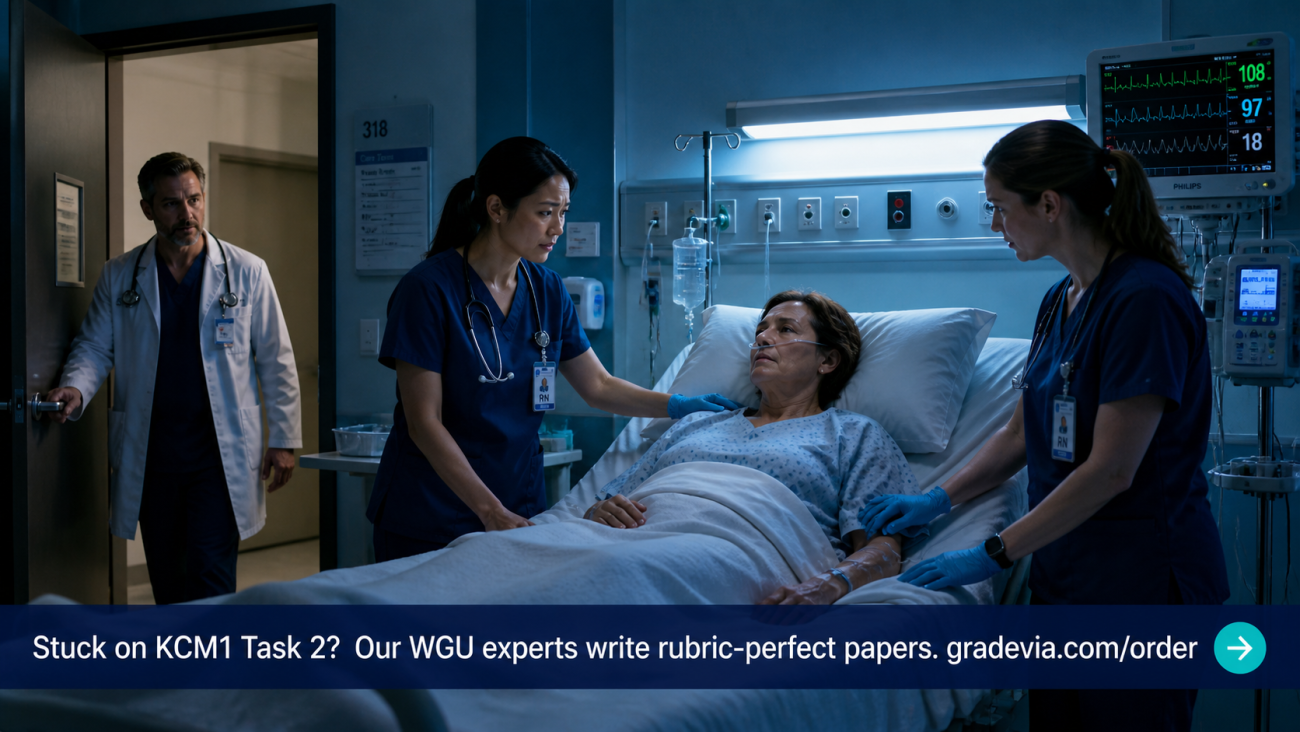
What the rubric wants: A logical description with sufficient detail.
How to write it:
- State what type of sentinel event occurred (wrong medication, patient fall, wrong-site surgery, etc.)
- Include the who, what, when, where, and how of the event
- Clarify whether it resulted in patient harm or was a near-miss
- Reference The Joint Commission’s definition of a sentinel event to frame your response
Sample framing:
“According to The Joint Commission (2023), a sentinel event is an unexpected occurrence involving death or serious physical or psychological injury… The sentinel event in this case involved [specific event from transcript]…”
Length target: 1–2 solid paragraphs.
Step 4: Write Section A2 — Roles of Personnel Present
What the rubric wants: A logical explanation with sufficient detail of each person’s role/responsibilities.
How to write it:
- Identify each staff member present (from the transcript)
- For each person, explain their professional role AND their specific responsibility at the time of the event
- Don’t just list job titles — connect their role to the event (e.g., “The charge nurse was responsible for overseeing the unit and ensuring proper handoff communication…”)
Tip: Address at least 3–4 personnel. Common figures in WGU case studies include the bedside nurse, physician/attending, charge nurse, and sometimes a pharmacist or aide.
Length target: 1 paragraph per key staff member, or a well-developed multi-paragraph section.
Step 5: Write Section A3 — Barriers to Effective Interaction
What the rubric wants: A logical discussion with sufficient detail of barriers that impeded communication/interaction.
Common barriers to discuss (select those supported by your case study):
- Hierarchical barriers — intimidation between nurses and physicians; reluctance to speak up
- Communication breakdowns — failure to use structured tools like SBAR (Situation, Background, Assessment, Recommendation)
- Workload/fatigue — high patient ratios reducing attention to communication
- Role ambiguity — unclear who is responsible for a specific task
- Documentation gaps — incomplete or inaccessible records
- Cultural or interpersonal barriers — tension between departments or shifts
Support each barrier with a peer-reviewed citation.
Length target: 2–3 paragraphs.
Step 6: Write Section A3a — Propose Ways to Improve Interactions
What the rubric wants: An appropriate proposal with sufficient detail.
Strong improvement strategies to propose:
- Implement SBAR communication protocol — standardizes how staff communicate critical patient information
- TeamSTEPPS training — evidence-based teamwork and communication curriculum from AHRQ
- Regular interdisciplinary huddles/briefings — structured daily team check-ins
- Psychological safety training — empowering all staff to speak up regardless of hierarchy
- Crew Resource Management (CRM) — borrowed from aviation, applied to healthcare team dynamics
For each strategy, explain how it addresses a specific barrier you identified in A3.
Length target: 2 paragraphs minimum.
Step 7: Write Section A4 — Quality Improvement Tool for the RCA
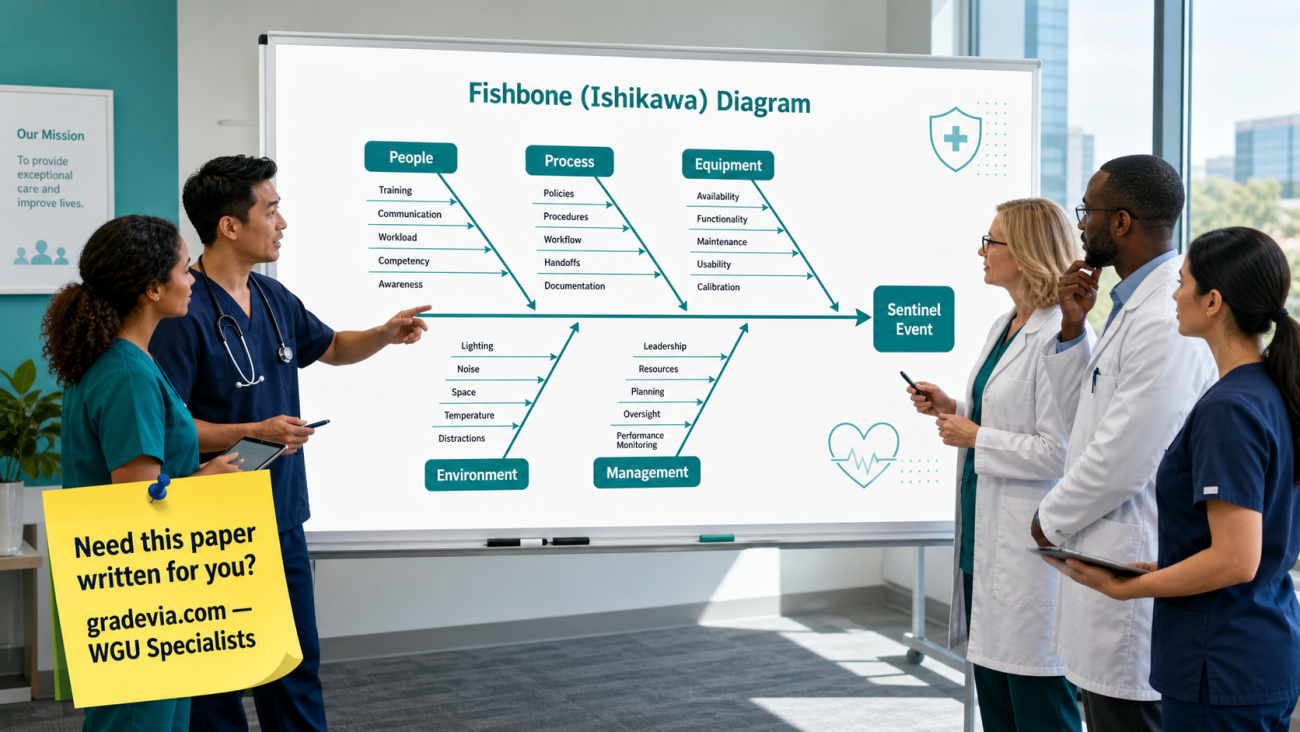
What the rubric wants: A logical discussion with sufficient detail of a QI tool used to conduct the root cause analysis.
Choose one (or two complementary) tools:
| Tool | Best For |
|---|---|
| Fishbone Diagram (Ishikawa) | Visually mapping all contributing causes across categories (people, process, equipment, environment, management) |
| 5 Whys | Drilling down to root cause by repeatedly asking “why” |
| Flow Chart/Process Map | Mapping the sequence of events to find where the process failed |
| Failure Mode and Effects Analysis (FMEA) | Proactively identifying where future failures could occur |
Recommended approach: Choose the Fishbone Diagram paired with the 5 Whys — this combination is widely cited in healthcare RCA literature and gives you plenty to discuss.
What to cover:
- Define the tool
- Explain how it works in the context of an RCA
- Explain why it is appropriate for this specific sentinel event
- Cite peer-reviewed support
Length target: 1–2 paragraphs.
Step 8: Write Section B1 — Risk Management Program/Process Change
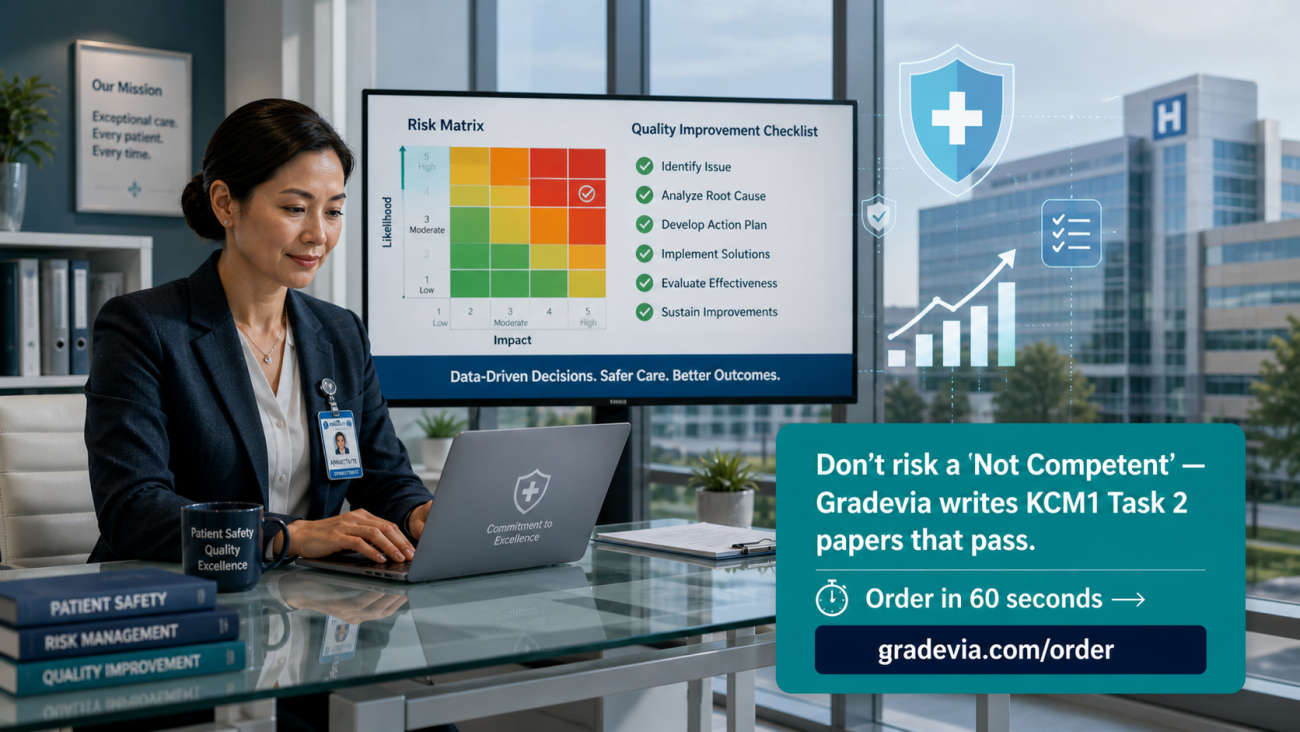
What the rubric wants: An appropriate recommendation with sufficient detail to prevent recurrence.
How to write it:
- Recommend a specific, named program or policy change (not a vague suggestion)
- Tie it directly to the root cause(s) identified in your analysis
Strong options depending on your event type:
- Medication errors → Barcode Medication Administration (BCMA) + pharmacist reconciliation protocol
- Communication failures → Mandatory SBAR + read-back policy; TeamSTEPPS implementation
- Falls → Hourly rounding protocol + bed alarm policy
- Handoff failures → Standardized handoff tool (I-PASS or SBAR-based)
Describe the program: what it is, how it works, who implements it, and how it prevents the specific failure that occurred.
Length target: 2 paragraphs.
Step 9: Write Section B1a — Resources to Support the Changes
What the rubric wants: A logical discussion with sufficient detail of available resources.
Categories of resources to address:
- Internal resources:
- Quality improvement/patient safety department
- Risk management team
- Staff education and training department
- Nurse managers and clinical educators
- EHR system (for documentation/alert changes)
- External resources:
- The Joint Commission’s Sentinel Event resources and RCA² framework
- Agency for Healthcare Research and Quality (AHRQ) — TeamSTEPPS toolkit (free)
- Institute for Healthcare Improvement (IHI) — open school and tools
- State health department guidance
- Professional associations (ANA, AONE)
For each resource, briefly explain how it supports the recommended change.
Length target: 1–2 paragraphs.
Step 10: Citations, References, and Formatting
APA 7 requirements:
- Times New Roman 12pt, double-spaced, 1-inch margins
- In-text citations for every claim that is not common knowledge
- Reference list at the end, alphabetical, with hanging indents
- Minimum 4–6 peer-reviewed sources (2019–2025 preferred)
Recommended sources to find:
- The Joint Commission (sentinel event/RCA definitions)
- AHRQ on TeamSTEPPS or patient safety
- IHI resources on quality improvement
- Peer-reviewed articles from journals like Journal of Patient Safety, Journal of Nursing Care Quality, or Health Affairs
Step 11: Final Checklist Before Submitting
- Sentinel event described with sufficient detail (A1)
- Each staff member’s role explained, not just listed (A2)
- At least 2–3 specific barriers discussed with citations (A3)
- Improvement strategies are concrete and linked to barriers (A3a)
- QI tool is named, defined, and applied to the case (A4)
- A specific risk management program is recommended (B1)
- Both internal and external resources are discussed (B1a)
- Every paragraph has at least one in-text citation
- Reference list is complete and APA 7 formatted
- Run through Grammarly before submitting — WGU checks this automatically
- File saved as .docx
Pro tip: The rubric’s threshold between Approaching Competence and Competent is always “sufficient detail.” If you feel a section is thin, add one more specific example, cite one more source, or connect it more explicitly back to the case study transcript. That depth is what separates a pass from a revise.