
Blog
WGU KCM1 Task 3 — Accreditation Audit (Tracer Methodology): Step-by-Step Guide


WGU KCM1 Task 3 — Accreditation Audit (Tracer Methodology): Step-by-Step Guide
OVERVIEW OF WHAT THIS TASK REQUIRES
This task has two core deliverables wrapped in one paper:
- A1 — Identify and discuss one outstanding patient care issue revealed by the tracer patient data
- A2 — Develop a corrective action plan using the Joint Commission (TJC) electronic manual
STEP 1: ACCESS AND READ THE CASE STUDY ARTIFACTS
Before writing anything, you must thoroughly review the attached “Accreditation Audit Case Study – Task 3 Artifacts” (the zip file linked in the task). It typically contains:
- Patient medical record/chart excerpts
- Medication administration records (MAR)
- Lab results or vital sign logs
- Nursing assessments or care plans
- Incident or transfer documentation
What to look for as you read:
| Red Flag Category | Examples to Watch For |
|---|---|
| Medication errors | Wrong dose, missing reconciliation, allergy not flagged |
| Documentation gaps | Unsigned orders, missing assessments, incomplete handoffs |
| Infection control | Missing isolation precautions, hand hygiene lapses |
| Communication failures | SBAR not used, no provider notification of critical values |
| Care planning | No individualized plan, outdated goals |
| Patient rights | Consent not documented, no discharge education recorded |
Tip: Most WGU KCM1 Task 3 case studies surface issues around medication management, care coordination, or incomplete documentation. Focus there first.
STEP 2: SELECT YOUR OUTSTANDING PATIENT CARE ISSUE (A1)
Pick one clear, well-supported issue — the rubric rewards depth over breadth. A strong issue meets these criteria:
- It appears directly in the tracer data (not assumed)
- It connects to a specific Joint Commission standard
- It has patient safety implications
Common winning issues from this case study type:
- Incomplete medication reconciliation on admission or discharge
- Failure to reassess pain after intervention
- Missing or late nursing assessments
- Absence of documented fall risk reassessment
- Gaps in hand-off communication
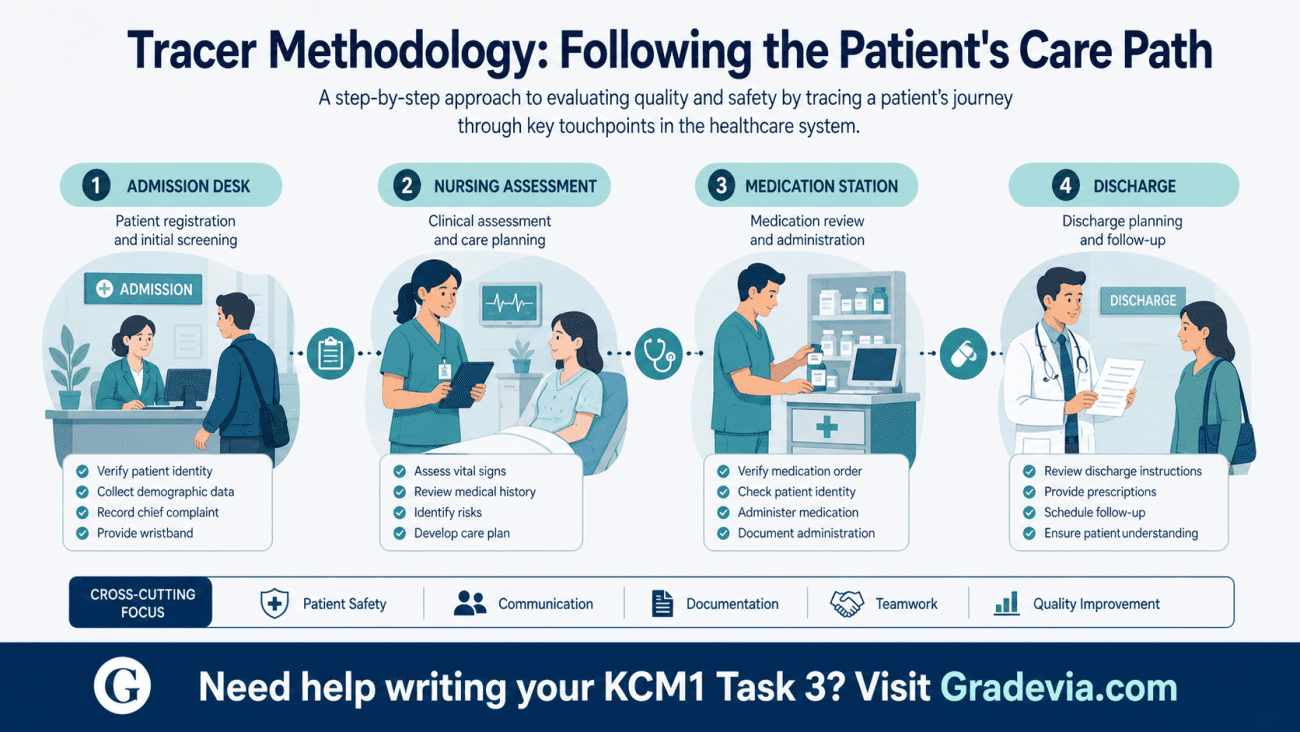
STEP 3: WRITE SECTION A1 — DISCUSSION OF THE PATIENT CARE ISSUE
Length target: 3–5 solid paragraphs
Structure your discussion as follows:
Paragraph 1 — Introduce the issue State the specific patient care issue clearly. Name it, describe what it is, and reference where it appears in the patient’s tracer data.
Example opening: “A review of the tracer patient’s medical record reveals a critical gap in medication reconciliation processes. Specifically, the patient’s home medication list was not formally reconciled upon admission, creating a risk for omission errors and adverse drug events.”
Paragraph 2 — Explain why it matters clinically Describe the patient safety risk. What could go wrong? Use evidence from nursing/healthcare literature (peer-reviewed, 2020–present).
Paragraph 3 — Connect to the organization’s systems Show this isn’t just a one-time error — it reflects a systemic issue (staffing, process, culture, technology). This elevates your response from “Approaching” to “Competent.”
Paragraph 4 — Tie to Joint Commission Standards Reference the specific TJC standard being violated. Use the JC electronic manual (see Step 4 below for how to find it).
Key TJC standard areas to search: NPSG (National Patient Safety Goals), MM (Medication Management), PC (Provision of Care), RC (Record of Care), CAMH
STEP 4: USE THE JOINT COMMISSION ELECTRONIC MANUAL (Required for A2)

The task explicitly states you must do a keyword search in the TJC E-dition manual. Here is exactly how to do it:
- Go to https://e-dition.jcrinc.com
- Log in (WGU provides access — check your course resources or student portal)
- Use the keyword search bar at the top
- Search terms aligned to common issues:
| Issue Identified | Keyword to Search |
|---|---|
| Medication reconciliation | “medication reconciliation” |
| Fall prevention | “fall risk reduction” |
| Hand-off communication | “hand-off communication” |
| Pain reassessment | “pain management” |
| Nursing assessment | “assessment” under PC standards |
| Infection control | “infection prevention” |
- Record the standard number (e.g., NPSG.03.06.01), the element of performance (EP) numbers, and the rationale
- You will cite these directly in your paper
Critical: The rubric requires you to demonstrate you used this tool. Mention the specific standard name and number in your paper.
STEP 5: WRITE SECTION A2 — CORRECTIVE ACTION PLAN (CAP)
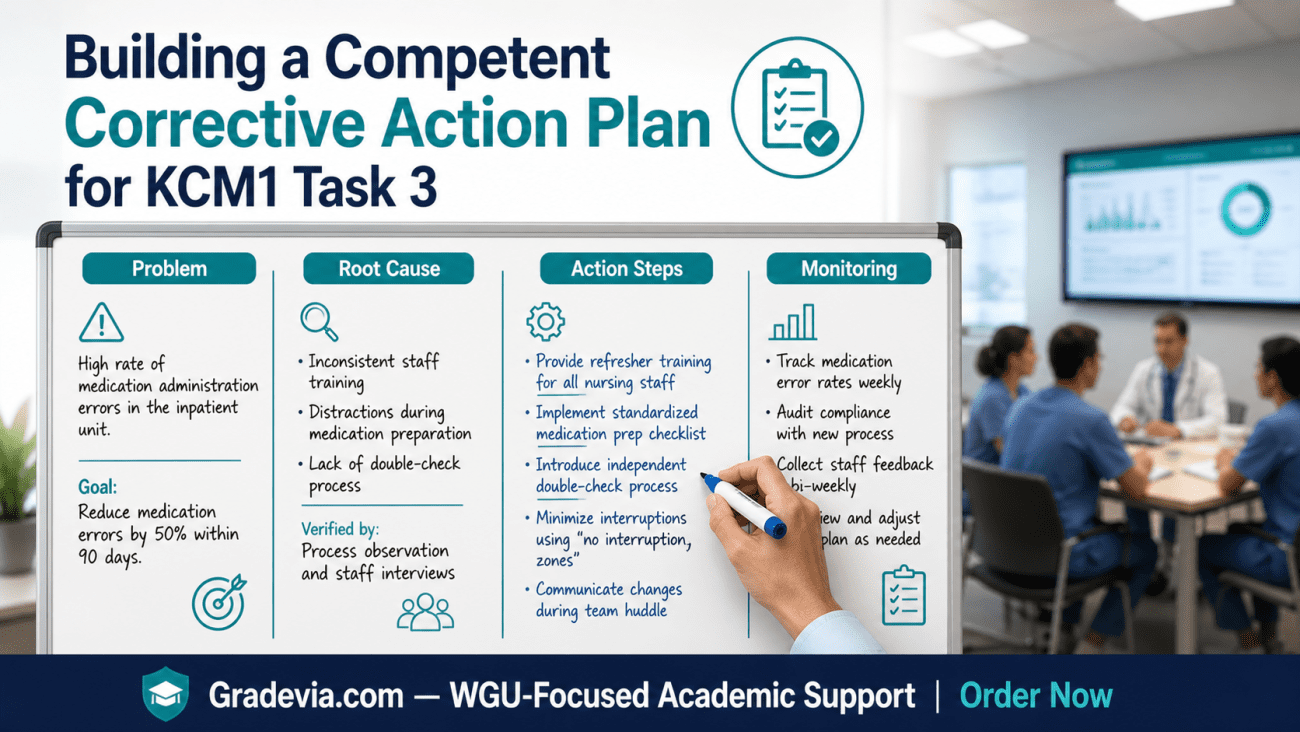
Length target: 4–6 paragraphs or a structured plan with narrative
A strong CAP addresses four dimensions: What went wrong → What standard applies → What will change → How it will be monitored.
Use this framework:
1. Problem Statement Restate the issue briefly (1–2 sentences). Reference the TJC standard violated.
“The failure to complete medication reconciliation upon admission violates TJC Standard NPSG.03.06.01, which requires organizations to maintain and communicate accurate patient medication information.”
2. Root Cause Analysis Identify why this happened. Use a recognized model:
- Fishbone/Ishikawa diagram (mention it conceptually)
- 5 Whys method
- Common root causes: lack of training, no standardized process, EHR workflow gaps, staffing pressure
3. Corrective Actions — be specific, use action verbs:
| Action | Responsible Party | Timeline |
|---|---|---|
| Implement standardized medication reconciliation form in EHR | Pharmacy + IT | 30 days |
| Mandatory staff training on reconciliation protocol | Nurse Manager | 60 days |
| Daily audits of admission records for reconciliation completion | Charge Nurse | Ongoing |
| Add reconciliation step to admission checklist | CNO | 14 days |
4. Alignment with TJC Standards Explicitly state how each action addresses the specific EP (Element of Performance) from the standard you found in the e-dition manual.
5. Monitoring and Evaluation Describe how the organization will know the plan worked:
- What metric will be tracked? (e.g., % of admissions with completed reconciliation)
- What is the target? (e.g., 95% compliance within 90 days)
- Who reviews it? (e.g., Quality Improvement Committee monthly)
- What happens if the target isn’t met? (e.g., escalation to CNO, additional training)
STEP 6: CITATIONS AND REFERENCES (Section B)
The rubric requires APA 7th edition with both in-text citations and a reference list. You need a minimum of 3–5 sources:
Required source types:
| Source | Why Needed |
|---|---|
| Joint Commission E-dition manual | For the specific standard cited in A2 |
| Peer-reviewed nursing/health journal (2020–present) | To support the clinical significance of the issue |
| Textbook or evidence-based guideline | To ground the corrective action plan |
| IHI or AHRQ resource | Optional but strengthens the CAP methodology |
APA reference format examples:
Journal article:
Smith, J. A., & Lee, R. B. (2022). Medication reconciliation failures and patient outcomes in acute care. Journal of Patient Safety, 18(3), 45–52. https://doi.org/xxxxx
Joint Commission:
The Joint Commission. (2024). Comprehensive accreditation manual for hospitals. Joint Commission Resources. https://e-dition.jcrinc.com
STEP 7: FORMAT YOUR PAPER (Section C — Professional Communication)
WGU/Grammarly will assess your writing quality. Follow these rules:
- Format: Microsoft Word (.docx)
- Font: Times New Roman or Arial, 12pt
- Spacing: Double-spaced
- Margins: 1 inch all sides
- APA title page: Include course code (KCM1), task number, your name, date
- Headers: Use APA Level 1 headers to organize sections:
- Outstanding Patient Care Issue
- Corrective Action Plan
- References
Before submitting — Grammarly checklist:
- No run-on sentences
- No comma splices
- Subject-verb agreement throughout
- No passive voice overuse
- Contextual spelling checked (e.g., “affect” vs. “effect”)
- All acronyms spelled out on first use (e.g., TJC, NPSG, EHR)
STEP 8: FINAL SUBMISSION CHECKLIST
| Item | Done? |
|---|---|
| Reviewed all Task 3 Artifacts thoroughly | ☐ |
| Identified one specific, data-supported patient care issue | ☐ |
| A1 written with sufficient detail (3–5 paragraphs) | ☐ |
| TJC E-dition manual searched, standard number recorded | ☐ |
| A2 corrective action plan written with specific steps, timelines, owners | ☐ |
| Monitoring/evaluation metrics included in A2 | ☐ |
| APA in-text citations throughout | ☐ |
| Reference list with 3+ sources, APA 7 formatted | ☐ |
| Paper runs through Grammarly with no red errors | ☐ |
| Saved as .docx, file name has no special characters | ☐ |
| Similarity report reviewed before final submission | ☐ |
QUICK REFERENCE: RUBRIC MAPPING
| Rubric Aspect | What “Competent” Requires |
|---|---|
| A1 Evaluation | Logical discussion with sufficient detail — not just naming the issue, but explaining it with clinical context and TJC connection |
| A2 Plan | Corrective action plan with sufficient detail — specific actions, responsible parties, timelines, and a monitoring mechanism, grounded in TJC standards found via keyword search |
| B Sources | Complete APA citations both in-text AND in reference list; author, date, title, location all accurate |
| C Professional Communication | Grammarly Correctness category must pass; clear, professional academic prose |
KCM1 Task 3 — Accreditation Audit
Introduction
In this task, you will use a tracer methodology to track a patient’s care in order to evaluate the healthcare organization’s systems of providing care and services for a readiness audit. This methodology also makes it possible to assess the healthcare organization’s compliance with Joint Commission standards. This is part of the organization’s compliance with delivering safe, quality healthcare.
You will examine data for a patient that is found in the attached “Accreditation Audit Case Study – Task 3 Artifacts” and find any trends, patterns, and problems. Once these have been identified, you can remediate the concerns.
Requirements
Your submission must represent your original work and understanding of the course material. Most performance assessment submissions are automatically scanned through the WGU similarity checker. Students are strongly encouraged to wait for the similarity report to generate after uploading their work and then review it to ensure Academic Authenticity guidelines are met before submitting the file for evaluation. See Understanding Similarity Reports for more information.
Grammarly Note:
Professional Communication will be automatically assessed through Grammarly for Education in most performance assessments before a student submits work for evaluation. Students are strongly encouraged to review the Grammarly for Education feedback prior to submitting work for evaluation, as the overall submission will not pass without this aspect passing. See Use Grammarly for Education Effectively for more information.
Microsoft Files Note:
Write your paper in Microsoft Word (.doc or .docx) unless another Microsoft product, or pdf, is specified in the task directions. Tasks may notbe submitted as cloud links, such as links to Google Docs, Google Slides, OneDrive, etc. All supporting documentation, such as screenshots and proof of experience, should be collected in a pdf file and submitted separately from the main file. For more information, please see Computer System and Technology Requirements.
You must use the rubric to direct the creation of your submission because it provides detailed criteria that will be used to evaluate your work. Each requirement below may be evaluated by more than one rubric aspect. The rubric aspect titles may contain hyperlinks to relevant portions of the course.
A. Review the tracer patient information from the attached Accreditation Audit Case Study – Task 3 Artifacts and do the following:
-
- Discuss an outstanding patient care issue for the organization made evident by the tracer
- Develop a corrective action plan to address the patient care improvement needs for the organization using a keyword search in the Joint Commission electronic
B. Acknowledge sources, using in-text citations and references, for content that is quoted, paraphrased, or summarized.
C. Demonstrate professional communication in the content and presentation of your submission.