
Blog
How to Identify the Type of Ethical Dilemma in WGU C717 Task 2

Updated on: Oct 8, 2026
By Dan Palmer, MBA · Academic strategy consultant for working adult learners · LinkedIn
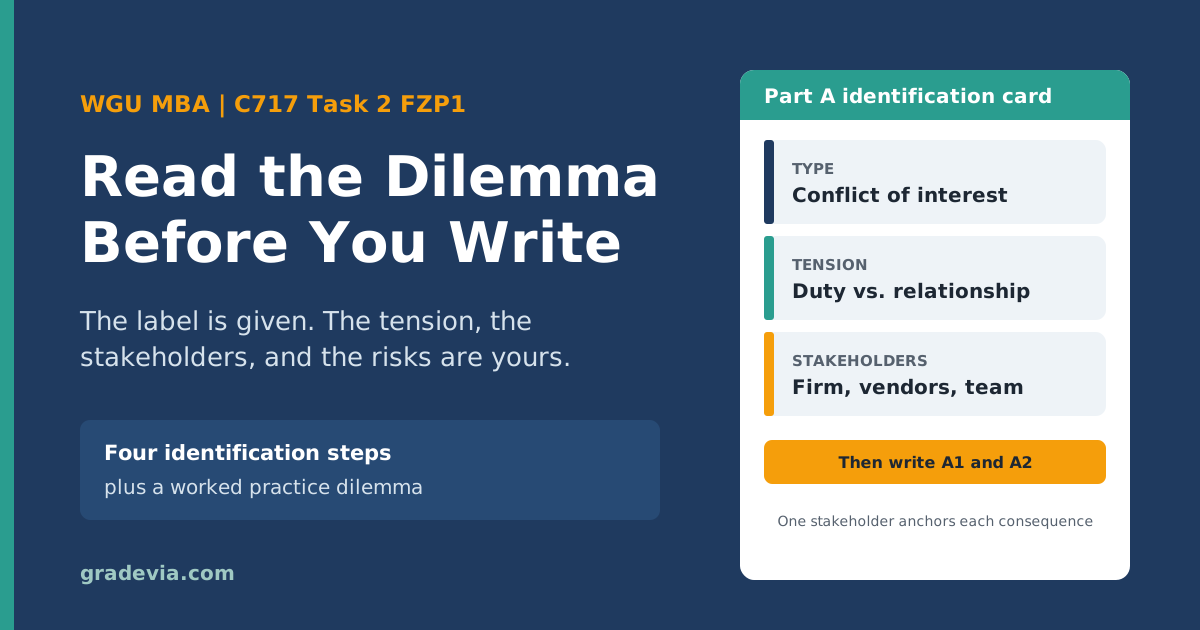
In the current version of the task, FZP1 Task 2: Ethical Dilemmas in Business, WGU has already put a label on each dilemma: Conflict of Interest, Whistleblowing, and an International Ethical Dilemma about accepting gifts or favors. So if the label is given, what is there to identify?
The part the label doesn’t give you: what is actually in tension, who is affected, and what each choice puts at risk. Those three things decide whether your consequences are specific and whether your theory section applies the theory or just defines it. For a working MBA student with one or two evenings to spare, ten minutes of identification work saves the rewrite that comes from vague consequences.
This guide shows how to read each WGU C717 Task 2 FZP1 dilemma before you write, with a worked example on a practice dilemma.
Step 1: Know What Each Label Means
The three labels are distinct types of dilemma, and each has a defining feature you should be able to point to in the scenario:
| WGU’s label | What makes it this type | What to find in the scenario |
|---|---|---|
| Conflict of interest | A decision maker has a personal stake (a relationship, money, a favor) that competes with their duty to decide impartially for the organization | The personal stake, the duty it competes with, and the fact that the problem exists even if the decision would be legitimate |
| Whistleblowing | An employee knows about wrongdoing and must choose between reporting it and staying silent, usually at personal risk | The evidence, the person responsible, the reporting channel, and the risk to the employee |
| International gift or favor | A company rule conflicts with a business custom in another country, so following one means departing from the other | The rule, the custom, the relationship at stake, and why the gift is offered |
A common slip in the conflict of interest dilemma is treating the outcome as the problem. If the decision maker’s friend or relative is involved, the dilemma exists whether or not that person would be the best choice. It comes from the relationship, and that matters for how you write both consequences.
Step 2: Name the Competing Values
A real ethical dilemma is usually a choice between two things that are both right, not between right and wrong. Rushworth Kidder described four common patterns of these “right versus right” dilemmas (Kidder, 2009):
| Pattern | The two sides |
|---|---|
| Truth versus loyalty | Honesty and transparency against loyalty to a person or group |
| Individual versus community | One person’s interests against the interests of the wider group |
| Short term versus long term | An immediate benefit or harm against a later one |
| Justice versus mercy | Applying a rule consistently against making an exception for compassion or a relationship |
Write one sentence naming the two values for each dilemma before you write anything else. A dilemma can show more than one pattern; pick the one that drives the decision. For example, whistleblowing cases often look like truth versus loyalty on the surface, while the employee’s fear of losing their job adds a short term versus long term dimension.
Step 3: List Who Is Affected
Each dilemma involves more people than the one making the choice. Before you write consequences, list the stakeholders: the decision maker, the other person in the dilemma, coworkers, the company, and anyone outside it, such as other vendors, customers, investors, or the overseas supplier.
This list does double duty. Your six consequences come from it, because a workplace consequence is something that happens to one of these groups. And in Part A, utilitarian ethics weighs the outcomes for exactly these stakeholders.
Step 4: Check That It’s More Than a Legal or Policy Question
The Markkula Center’s framework for ethical decision making starts by asking whether a decision could harm someone or benefit people unevenly, and whether the issue is “about more than solely what is legal or what is most efficient” (Markkula Center for Applied Ethics, 2021). This test is especially useful in Part C. “The company has a rule against gifts” is a policy fact. The ethical dilemma is that following the rule may feel disrespectful to a partner whose culture treats gifts as a sign of respect.
How Identification Feeds Each Requirement
| Requirement | What your identification work gives you |
|---|---|
| A1, A2, B1, B2, C1, C2 (consequences) | A stakeholder to anchor each consequence, and a different one for each choice |
| A3b (utilitarian) | The stakeholder list, so you can weigh benefits and harms across everyone affected |
| B3b (virtue) | The competing values, which point to the virtues involved, such as honesty, courage, and practical wisdom |
| C3b (principle based) | The rule and the duty it expresses, so you can explain which principle governs |
For how to write each of those sections, see our WGU C717 Task 2 guide.
Worked Example: Identifying a Practice Dilemma
This practice dilemma is fictitious and is not one of the FZP1 dilemmas.
Rachel, a regional sales director at a fictitious medical supply company, learns that a hospital customer is returning a $220,000 order. Her vice president asks her to log the return on the first day of the next quarter, so the team still hits its quarterly target and earns its bonus.
| Question | Rachel’s answer |
|---|---|
| What type is it? | An accounting integrity dilemma: a request to record a transaction in the wrong period. If she reported it to compliance, it would become a whistleblowing dilemma |
| What are the competing values? | Truth versus loyalty: accurate financial records against loyalty to her vice president and her team. Also short term versus long term: this quarter’s bonus against the company’s credibility with auditors |
| Who is affected? | Rachel, her vice president, her sales team, the finance department, auditors, and investors who rely on the quarterly numbers |
| Is it more than a policy question? | Yes. Delaying the entry misstates the quarter’s results and benefits the team at the expense of everyone who relies on accurate numbers |
With that table done, Rachel’s consequences almost write themselves: one about the finance team’s exposure if the timing is discovered, one about the team’s trust in her if she refuses. And whichever theory she was assigned, she already knows what it would need to weigh.
Common Identification Mistakes
- Restating the label as the analysis. “This is a conflict of interest” isn’t analysis; WGU already said so. Explain what the competing interest is.
- Naming feelings instead of values. “The accountant is scared” describes an emotion. “Honesty against job security” names the tension.
- Listing only the decision maker as a stakeholder. This produces consequences that are personal, not workplace consequences.
- Treating the gift dilemma as a bribery question. Part C is about a company rule and a cultural custom, not bribery law.
- Skipping the tension and going straight to the theory. A theory section without a named tension tends to define the theory and stop.
If You Have Another Version: C717 Task 2 FZP2 or EKP1
If your directions show a different code, such as C717 Task 2 FZP2, your dilemmas may be different, and some versions ask you to name the dilemma yourself rather than labeling it for you. The four steps above work for any scenario. To check which version you have, see FZP1 vs. EKP1 vs. FZP2: which WGU C717 version do you have?
The same skill applies to C717 Task 1. Whether you’re writing up FZP1 Task 1 ethical considerations and principles or another version’s Task 1 analysis, your points are stronger when you name the competing values and the stakeholders rather than just the issue. Our C717 Task 1 guide and C717 Task 1 example show that analysis in a full paper.
Related C717 Guides
- Our WGU C717 Task 2 guide and example covers consequences and the three theories in full.
- Learn how to cite sources for WGU C717 Task 2, including theory definitions.
- See every C717 guide in one place.
Frequently Asked Questions
Do I have to name the type of dilemma in C717 Task 2 FZP1?
The FZP1 directions already label each dilemma. You don’t need a separate section naming the type, but you should identify the competing values and stakeholders, because your consequences and theory sections depend on them.
What are the three types of dilemma in FZP1 Task 2: Ethical Dilemmas in Business?
A conflict of interest, a whistleblowing dilemma, and an international dilemma about accepting gifts or favors.
What is the difference between a conflict of interest and favoritism?
A conflict of interest exists when a personal stake competes with a duty to decide impartially, even before any decision is made. Favoritism describes an outcome where someone receives an advantage because of a relationship rather than merit.
Is the gift dilemma in C717 Task 2 about bribery?
No. It’s about a conflict between a company’s policy against gifts and a business custom in another country, so focus on the rule, the custom, and the relationship.
What if my C717 Task 2 has different dilemmas?
You may have a different version, such as FZP2. Check the code in your directions and apply the same four steps to your own dilemmas.
Want a Second Look Before You Write?
If you’re working full time and want structured assignment support mapping the tension and stakeholders in each dilemma before you write your consequences and theory sections, message Gradevia on WhatsApp at +1 564 544 6924.
Sources
Kidder, R. M. (2009). How good people make tough choices: Resolving the dilemmas of ethical living (Rev. ed.). Harper Perennial.
Markkula Center for Applied Ethics. (2021, November 5). A framework for ethical decision making. Santa Clara University. https://www.scu.edu/ethics/ethics-resources/a-framework-for-ethical-decision-making/