
Blog
WGU D267 Task 3 Guide and Example: Racial Separation Policies and Their Impact

By Dan Palmer, MBA · Academic strategy consultant for working adult learners · LinkedIn
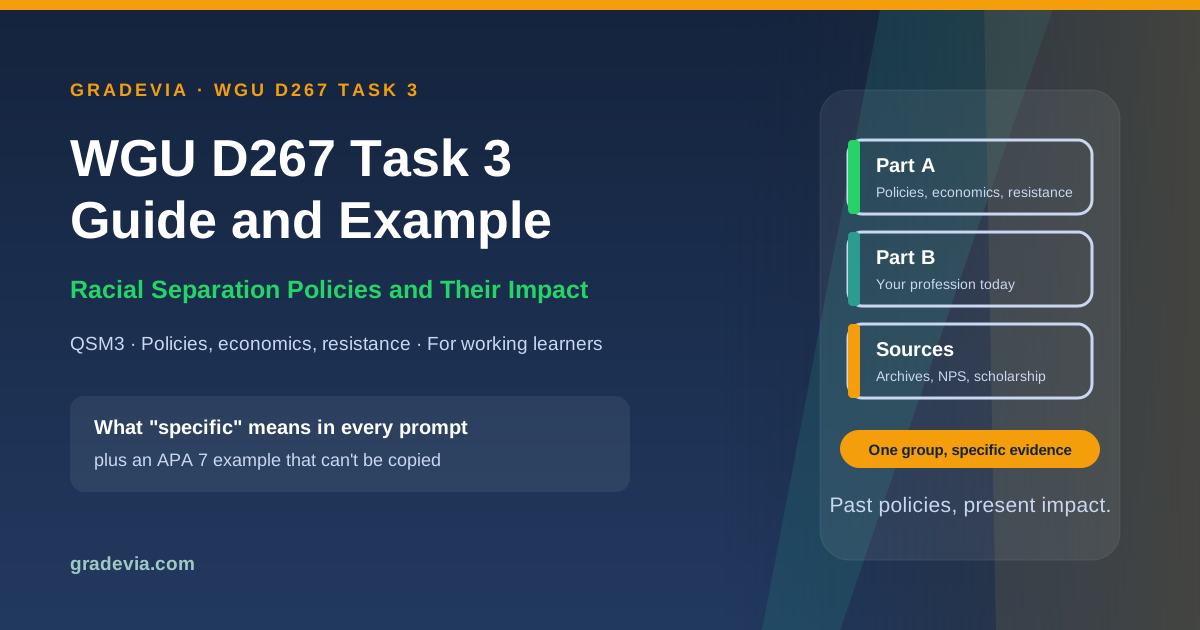
D267 Task 3 asks you to examine racial separation in U.S. history through one community. You choose Native Americans (1820 to present), Japanese Americans (1877 to present), or African Americans (1877 to present), then show how separation policies affected that group politically, economically, and socially, and how its members resisted. The last part is personal: you connect that history to the communities you serve, or will serve, in your own profession.
Working learners usually know the history in broad strokes. What sends this task back is the word specific, which appears in every prompt: two specific policies, two specific economic examples, two specific examples of resistance, and specific social impacts in your profession. This guide shows how to choose a group you can document, what “specific” looks like for each prompt, and how to write a Part B reflection that isn’t generic. It ends with an example built on a group the task doesn’t allow, so it shows the method without answering the task.
D267 Task 3 (QSM3)
Introduction
In the 19th and 20th centuries, American laws and social life segregated Native Americans, Japanese Americans, and African Americans. Now racial separation is widely regarded as a major injustice in American history that has had lasting effects in the present. Racial separation is the act of isolating or segregating—often through oppressive means—communities based on factors such as race. It has taken different forms in U.S. history, including reservations, internment camps, and Jim Crow laws.
In this assessment, you will choose from among three groups and analyze the economic, political, and social impacts of racial separation on different communities.
You will choose from among these three groups and respective periods to complete the task:
- Native Americans (1820 to present)
- Japanese Americans (1877 to present)
- African Americans (1877 to present)
A. Choose one group from the list above and describe U.S. policies that affected the group by doing the following:
- Identify two specific political policies of racial separation that affected your selected group, such as state or federal laws, court cases, etc.
- Explain how U.S. policies focusing on racial separation affected the economic conditions of your selected group, including two specific examples of how this group was affected.
- Explain how members of your selected group demonstrated resistance to U.S. policies on racial separation. Include two specific examples.
B. Reflect on historical racial separation policies. Explain how these policies have contributed to specific social impacts affecting the communities you will work with in your chosen profession.
C. Acknowledge sources, using in-text citations and references, for content that is quoted, paraphrased, or summarized.
D. Demonstrate professional communication in the content and presentation of your submission.

What D267 Task 3 Asks You to Do
The directions label this assessment D267 Task 3 (QSM3).
| Prompt | What you deliver |
|---|---|
| A | Choose one group: Native Americans (1820 to present), Japanese Americans (1877 to present), or African Americans (1877 to present) |
| A1 | Two specific political policies of racial separation that affected the group, such as state or federal laws or court cases |
| A2 | How separation policies affected the group’s economic conditions, with two specific examples |
| A3 | How members of the group resisted separation policies, with two specific examples |
| B | How historical separation policies contributed to specific social impacts on the communities you’ll work with in your profession |
| C | In-text citations and references |
| D | Professional communication |
Choosing Your Group
Each group comes with its own date range, and every example you use must fall inside it. The task’s introduction names the forms separation took: reservations, internment camps, and Jim Crow laws. Choose the group whose history you can connect most directly to your profession, because Part B depends on that connection.
Before you commit, run a quick check: can you find, in credible sources such as the National Archives, the National Park Service, or the Library of Congress, two named policies with dates, two economic effects with evidence, and two acts of resistance with names and outcomes? If one of those is thin, try another group before you start writing.
Starting points for research, by group:
| Group | Policies and events often studied |
|---|---|
| Native Americans (1820 to present) | The Indian Removal Act of 1830, the reservation system, federal boarding schools, and the Dawes Act of 1887 |
| Japanese Americans (1877 to present) | Alien land laws, Executive Order 9066 (1942) and incarceration, Korematsu v. United States (1944), and the Civil Liberties Act of 1988 |
| African Americans (1877 to present) | Jim Crow laws, Plessy v. Ferguson (1896), discriminatory housing and lending practices, and Brown v. Board of Education (1954) |
These are starting points, not answers. The evaluator is looking for what you do with a policy: its date, who it applied to, and how it separated people.
A1: Two Specific Policies
Name each policy precisely: its title or case name, its date, and whether it was federal, state, local, or a court decision. Then explain in a sentence or two how it separated the group from others.
Vague: “Laws kept the group separate.”
Specific: Name the law or case, its year, the level of government, and the mechanism: what it required, banned, or allowed.
A2: Economic Conditions
A2 asks how separation affected economic conditions, so stay with money, land, work, and property. Strong examples include loss of land or property, exclusion from jobs or businesses, limits on where people could live or buy homes, and the lasting effect of those losses on wealth. Give two separate examples, each with evidence such as a date, a place, a figure, or a named person or business.
A3: Resistance
Resistance can take many forms: lawsuits, protests, organizing, journalism, refusing to comply, or building community institutions. Give two specific examples, each with who acted, when, what they did, and what happened as a result. Court cases make strong A3 examples because they have names, dates, and outcomes, but they aren’t the only option.

Part B: Reflecting on Your Profession
Part B is where most generic writing happens. The prompt asks how historical separation policies contributed to specific social impacts on the communities you will work with in your chosen profession. A strong reflection:
- Names your profession and the community you serve, such as a nurse in a rural clinic, a teacher in a particular district, or a manager whose team serves a specific customer base.
- Names one or two specific social impacts that connect to the history in Part A, such as gaps in access to health care, education, housing, or trust in institutions.
- Explains the connection between the historical policy and the present impact, with a citation where you make a factual claim.
- Says what it means for your work: what you’ll do or notice differently because you understand the history.
Write it in the first person. It’s a reflection, so your own voice is expected.
Sources and Citations
Use credible sources for every date, figure, and case: the National Archives, the National Park Service, the Library of Congress, and scholarly histories are reliable starting points. Cite each fact in APA format, and include court case names in italics with the year.
WGU D267 Task 3 Example
Our D267 Task 3 example is a complete APA 7 paper by a fictitious student, a second grade teacher. To avoid answering the task, it analyzes Chinese Americans, a group that isn’t one of the three the task allows. Every fact comes from the National Archives and the National Park Service. The example shows:
- Two dated policies in A1: the Chinese Exclusion Act of 1882 and the exclusion of Chinese American children from San Francisco’s public schools
- Two economic examples in A2, each with evidence
- Two acts of resistance in A3, both Supreme Court cases with names, dates, and outcomes
- A Part B reflection that names the profession, the community, two specific social impacts, and what the teacher will do differently
- Comments explaining what your own paper must use in each part
Here’s part of its A3 section:
Wong Kim Ark, born in San Francisco to Chinese immigrant parents, was “detained and denied reentry” after a visit to China in 1895. He sued, and in United States v. Wong Kim Ark (1898) the Supreme Court held that he was a citizen by birth.
The example can’t be adapted for your D267 Task 3 WGU submission, because its group isn’t one of the three the task allows.
Download the D267 Task 3 example (.docx)
Why Posted D267 Task 3 Answers Backfire
Searches for D267 Task 3 answers turn up papers in which many students chose the same group and the same most familiar policies, written in similar words. That’s exactly the overlap WGU’s similarity checker is built to find. Part B also has to be about your own profession, so another student’s reflection can’t fit your paper. Your own research and your own workplace are what make this task clearly yours.
Plan It Around Your Work Week
- Evening one (about 1.5 hours): Choose your group, find two policies, and write A1.
- Evening two (about 2 hours): Research and write A2 and A3, two examples each.
- Evening three (about 1.5 hours): Write Part B, check every date and citation, run Grammarly, and review the similarity report.
Common Reasons D267 Task 3 Comes Back
- A1 names general conditions (“segregation”) instead of specific laws or cases
- An example falls outside the group’s date range
- A2 describes social or political effects instead of economic ones
- A3 gives one example of resistance, or two without names, dates, or outcomes
- Part B doesn’t name a profession or a specific community
- Part B describes the past without connecting it to present social impacts
- Dates, case names, or figures are uncited
Pre-Submission Checklist
- One group from the list, with every example inside its date range
- A1 names two specific policies with dates and levels of government
- A2 gives two economic examples with evidence
- A3 gives two acts of resistance with names, dates, and outcomes
- Part B names your profession, your community, and specific social impacts
- Every fact, date, and case is cited in APA format
The Rest of D267
If you’re still working on earlier tasks, our D267 Task 1 guide covers analyzing primary and secondary sources about slavery, and our D267 Task 2 guide covers voting rights, the 15th and 19th Amendments, and the Voting Rights Act.
Related WGU Guides
- Our WGU D268 course guide and D268 Task 3 guide cover communicating across differences and presenting evidence.
- Our D253 Task 2 guide covers unconscious bias in workplace decisions, which connects to Part B.
- Our WGU C717 Task 2 guide covers ethical reasoning.
- For tasks built on evaluating evidence, see our D472 Task 1 guide, D473 Task 1 guide, and D428 design thinking guide.
Frequently Asked Questions
What is WGU D267 Task 3?
It’s the QSM3 Task 3 performance assessment for WGU D267. You choose Native Americans, Japanese Americans, or African Americans, analyze two separation policies, their economic effects, and the group’s resistance, and reflect on social impacts in your profession.
Can I use examples from outside the group’s date range?
No. Each group has a date range in the directions: 1820 to present for Native Americans, and 1877 to present for Japanese Americans and African Americans. Keep every example inside it.
What counts as a political policy in A1?
The directions give state or federal laws and court cases as examples. Executive orders and local ordinances can also work if you name them and date them.
What if I’m not working in my chosen profession yet?
Write about the profession your degree prepares you for and the communities you expect to serve. Be specific about the setting.
Can I submit the D267 Task 3 example on this page?
No. It analyzes a group the task doesn’t allow and uses a fictitious student. It’s for illustration only.
Want a Second Look Before You Submit?
If you’re working full time and want structured assignment support choosing a group you can document, finding specific economic and resistance examples, or making your Part B reflection fit your profession, message Gradevia on WhatsApp at +1 564 544 6924 or email Support@gradevia.com.
Sources
Kratz, J. (2024, May 22). AAPI exclusion and the case of Wong Kim Ark. Pieces of History. National Archives. https://prologue.blogs.archives.gov/2024/05/22/aapi-exclusion-and-the-case-of-wong-kim-ark/
National Archives. (2023, January 17). Chinese Exclusion Act (1882). https://www.archives.gov/milestone-documents/chinese-exclusion-act
National Park Service. (2024, September 4). Chinese Americans use the legal system to fight back. https://home.nps.gov/articles/000/chinese-americans-use-the-legal-system-to-fight-back.htm