
Blog
WGU D473 Task 1 Guide and Example: Endothon Supply Chain Analysis and Presentation

Updated on: Oct 14, 2026
By Dan Palmer, MBA · Academic strategy consultant for working adult learners · LinkedIn
D473, the Solutions Design and Visualization Capstone, asks you to act as Endothon’s operations manager and fix a supply chain network that hasn’t changed in 30 years. Task 1 has two halves. In Part A, you dig through the Endothon Data File to find what’s behind a service problem and a cost problem, and you record your analysis in three tabs of the Endothon Data Analysis File. In Part B, you turn that analysis into a presentation for senior leadership, with presenter notes on every slide.
Most working learners don’t lose time on the presentation. They lose it in the spreadsheet: scrolling through the data file without a plan, picking a variable that sounds right but can’t be justified with numbers, or writing a cause-effect table that repeats the problem instead of explaining it. This guide gives you a method for Part A first, then shows how each Part A answer becomes a slide. It ends with a downloadable example built on a fictitious company, BondCraft Sealants, with its own made-up data.
WGU D473 Task 1 Assignment
FAN1 Solutions Design & Visualization Capstone
Endothon Supply Chain Network Redesign
Endothon is a prominent manufacturer of silicone caulk products and supplies various options to “big-box” retailers (i.e., large establishments that offer a wide array of products). These silicone caulk products are in high demand due to their widespread usage by end-users involved in construction projects. However, the existing supply chain network has remained unchanged for the past 30 years, leading to inefficiencies and increased operational costs.
Endothon needs to improve its overall operational efficiency, reduce lead times, and eliminate unnecessary costs. To address these challenges, senior leadership has decided to initiate a full review of the current processes. Leadership and has chosen you, the operations manager, to lead the project—from the analysis of the data collection to the implementation of key performance indicators.
Your leadership team has collaborated with cross-functional teams, continual improvement experts, and outside consultants to identify potential opportunities and challenges in the execution of this project. A comprehensive data file, titled “Endothon Data File,” has been developed for you as a foundation from which you will begin your analysis.
You will gain background information about the case using the “Endothon Case Study” supporting document. You will analyze the collected data in the “Endothon Data File” supporting document and provide your responses to part A of this task using the “Endothon Data Analysis File” supporting document. You will then create a presentation in part B of this task to synthesize and justify your findings.
A. Use the data in the “Endothon Data File” and relevant details in the “Endothon Case Study” to complete the following:
Identify one key variable that directly contributes to the current supply chain network service problem.
a. Justify your response using quantitative data from the “Endothon Data File.”
Note: Place your responses in tab A1 of the “Endothon Data Analysis File.”
- Identify two key variables that directly contribute to the current supply chain network cost problem.
b. Justify your response using quantitative data from the “Endothon Data File.”
Note: Place your responses in tab A2 of the “Endothon Data Analysis File.”
- Create a cause-effect table to describe the root causes of each of the three variables identified in parts A1 and A2.
Note: Place your responses in tab A3 of the “Endothon Data Analysis File.”
B. Create a multimedia presentation for the senior leadership team in which you provide and support data-informed recommendations. Include presenter notes for each slide using relevant details from both the “Endothon Case Study” and the “Endothon Data File.” Within your presentation, you must complete the following:
Develop a project charter by doing the following:
a. Provide a concise and logical problem statement.
b. Summarize your findings from allcomponents of part A.
2. Propose solutions for the variables identified in part A by doing the following:
a. Describe one solution for eachof the threevariables identified in part A.
b. Justify each solution by describing the expected outcome.
c. Identify two tasks that need to be performed to effectively execute each solution.
3. Create a control plan by doing the following:
a. Describe a key performance indicator (KPI) for each of the three solutions from part B2.
b. Explain how each KPI should be monitored.
C. Acknowledge sources, using in-text citations and references, for content that is quoted, paraphrased, or summarized.
D. Demonstrate professional communication in the content and presentation of your submission.
What D473 Task 1 Asks You to Do
| Requirement | What you deliver | Where it goes |
|---|---|---|
| A1, A1a | One variable that directly contributes to the network’s service problem, justified with quantitative data | Tab A1 of the Endothon Data Analysis File |
| A2, A2a | Two variables that directly contribute to the network’s cost problem, each justified with quantitative data | Tab A2 |
| A3 | A cause-effect table describing the root causes of all three variables | Tab A3 |
| B1a, B1b | A project charter: a concise problem statement and a summary of your Part A findings | Presentation |
| B2a to B2c | One solution for each of the three variables, the expected outcome of each, and two execution tasks per solution | Presentation |
| B3a, B3b | A control plan: one KPI per solution and how each KPI should be monitored | Presentation |
| C | In-text citations and references for anything quoted, paraphrased, or summarized | Slides and references slide |
| D | Professional communication | Whole submission |
Two details in the directions are easy to miss. The presentation needs presenter notes on each slide, and those notes must use relevant details from both the Endothon Case Study and the Endothon Data File. And every Part A justification must be quantitative, drawn from the data file, not from the case narrative alone.
Your task page may show the assessment code FAN1 next to the course code. Check the code on your own directions before using any outside material, so you know it was written for your version.
The Three Endothon Files and What Each Is For
| File | Use it for |
|---|---|
| Endothon Case Study | Background: the company, its customers, how the network works, and details that explain why a number looks the way it does |
| Endothon Data File | The numbers. Every A1a and A2a justification comes from here |
| Endothon Data Analysis File | Your answers, in tabs A1, A2, and A3 |
Read the case study once before you open the data file. You’re looking for clues about where the service and cost problems show up, such as a site, a customer group, a transportation mode, or a process that hasn’t changed. Those clues tell you which columns of the data file to compare first.
Part A: Finding the Variables in the Data File
Separate service from cost before you start
The directions ask for one service variable and two cost variables, and they’re different kinds of measure:
- Service variables describe what the customer experiences: fill rate, on time delivery, lead time, stockouts, days on hand, order accuracy.
- Cost variables describe what the network spends: warehousing cost, freight cost, inventory holding cost, handling cost, often per unit or per case.
A variable that could go in either list, such as inventory level, needs a clear explanation of which problem you’re using it for.
Compare every site or lane against the network
Raw totals mislead. A large warehouse will always have the biggest freight bill. The useful comparison is a rate: cost per case, days of inventory, fill rate. A working approach in Excel:
- Add a column that turns each total into a rate, such as freight cost divided by cases shipped.
- Calculate the network average for that rate.
- Add a column for each site’s difference from the average, as a percentage.
- Sort by that difference. The outlier is your candidate variable.
Keep the formula cells in your own working copy. When you write A1a or A2a, you’ll need the exact figures.
Write a justification the evaluator can check
A strong justification names the variable, gives the site’s number, gives the comparison number, and states the gap:
Weak: “Freight costs are too high, which hurts the cost problem.”
Specific: “Outbound freight cost per case at [site] is $X, compared with a network average of $Y, which is Z% higher, even though [site] ships fewer cases than [comparison site].”
If you can’t fill in X, Y, and Z from the data file, choose a different variable.
A3: Building the Cause-Effect Table
A3 asks for the root causes of each of your three variables. The most common mistake is listing a symptom, such as “high freight cost is caused by expensive freight.” A root cause explains why the number is out of line.
Set up the table with the same columns for every variable:
| Column | What goes in it |
|---|---|
| Variable (effect) | The variable from A1 or A2, worded the same way |
| Root cause | The underlying reason, such as a schedule, a contract, a location, or a missing control |
| Category | A grouping such as process, method, people, equipment, transportation, or network design |
| Evidence | The figure from the data file or the detail from the case study that supports it |
Give each variable at least one root cause, and two if the evidence supports them. Every root cause should point toward a solution you can propose in B2. If it doesn’t, it will be hard to write Part B.
Part B: Turning Part A Into the Presentation
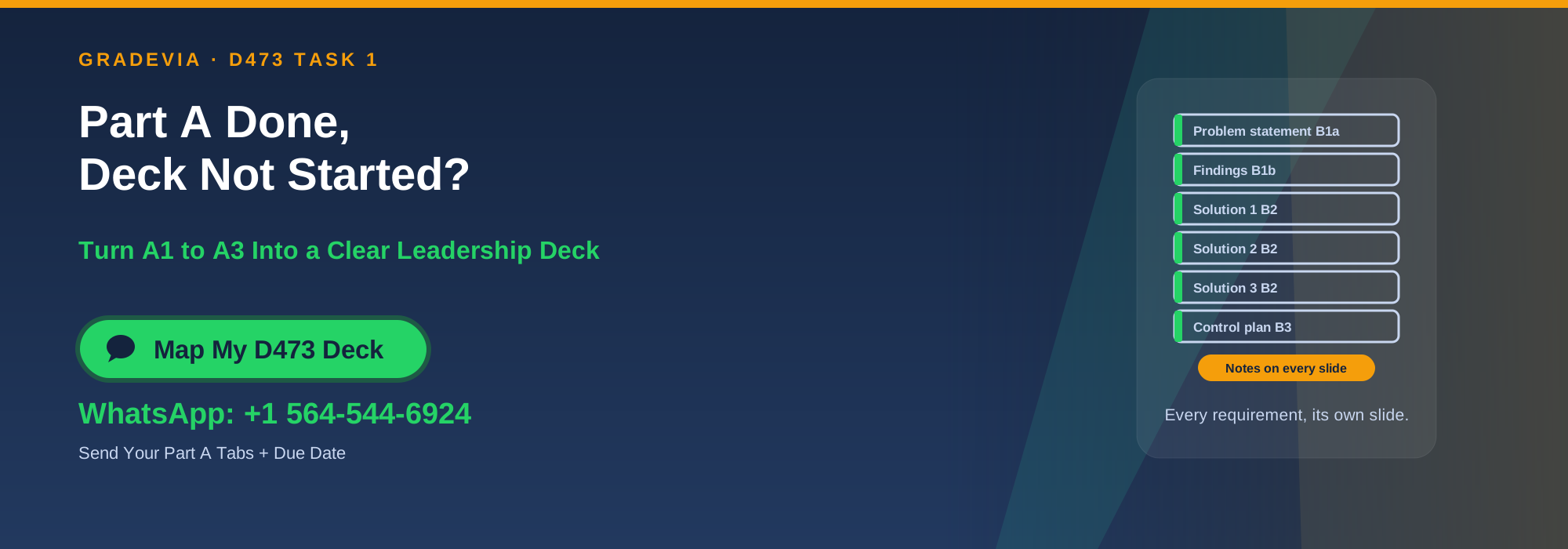
The directions don’t set a slide count. A deck of 8 to 10 slides covers every requirement without padding:
| Slide | Covers |
|---|---|
| Title | Your project, audience, and role |
| Problem statement | B1a |
| Findings | B1b: all three variables, the key numbers, and the root causes |
| Solution 1 | B2a to B2c for the service variable |
| Solution 2 | B2a to B2c for the first cost variable |
| Solution 3 | B2a to B2c for the second cost variable |
| Control plan | B3a and B3b for all three KPIs |
| References | C |
B1: The project charter
The problem statement (B1a) should be one or two sentences that name the service problem and the cost problem with numbers. The findings (B1b) must summarize all components of Part A: the service variable, both cost variables, and the root causes. A single chart of your key variable compared with the network average is the quickest way to make the finding visible.
B2: Solutions, outcomes, and tasks
For each of the three variables:
- B2a, the solution: one specific change that addresses the root cause you named in A3.
- B2b, the expected outcome: what moves, in which direction, and roughly how far, tied to the number from Part A.
- B2c, two tasks: concrete steps that would put the solution in place, such as a data analysis, a contract action, a pilot, or a schedule change.
B3: The control plan
Choose one KPI per solution that measures the variable you’re fixing. Then explain monitoring with four details: how often it’s checked, who owns it, where the data comes from, and what happens if it misses the target. Combining operational and financial measures gives a fuller picture of supply chain performance (Israel et al., 2023), which suits a task with both a service problem and a cost problem.
Presenter notes on every slide
Write the notes as what you’d actually say to senior leadership, and bring in at least one detail from the case study and one figure from the data file wherever they fit. The title and references slides still need notes, even if they’re brief.
Section C: Citing Your Sources
Cite the Endothon Case Study and Endothon Data File as your course directs, and cite any outside research you use to support a solution or KPI, in text and on a references slide. Check that every source you cite exists and opens to the page you used.
WGU D473 Task 1 Example: BondCraft Sealants
Our D473 Task 1 example uses BondCraft Sealants, a fictitious company with its own invented network data, not Endothon. It shows the method from this guide applied to a four warehouse network:
- Part A workbook: a small practice data set with formulas visible, a service variable (days on hand at Denver, 7.0 days compared with a network average of 21.3), two cost variables (Phoenix warehouse cost per case 25% above average and Portland freight cost per case 41% above average), and a cause-effect table with categories and evidence
- Part B deck: an 8 slide presentation with a project charter, one slide per solution, a KPI control plan, a references slide, and presenter notes on every slide
Here’s part of the presenter notes for its control plan slide:
Denver days on hand will be tracked weekly by the planning team with a target of 14 days. Phoenix warehouse cost per case will be tracked monthly by finance against $1.15. Any KPI outside its threshold for two periods in a row triggers a root cause review.
Both files carry a “fictitious example” notice on every sheet and slide. Your submission must analyze the Endothon Data File and present your own findings.
Download the D473 Task 1 Part A example workbook (.xlsx)
Download the D473 Task 1 Part B example deck (.pptx)
Plan It Around Your Work Week
- Evening one (about 2 hours): Read the case study, list the clues, and build rate and difference columns in a copy of the data file.
- Evening two (about 2 hours): Choose your three variables, write A1a and A2a with exact figures, and complete the A3 table.
- Evening three (about 2 hours): Build the slides from your Part A answers, one requirement per slide.
- Evening four (about 1.5 hours): Write presenter notes for every slide, add citations and references, and check each requirement against the directions.
Common Reasons D473 Task 1 Comes Back
- A variable is named without numbers from the data file
- A1 or A2 gives the wrong count: the task asks for one service variable and two cost variables
- A3 lists symptoms instead of root causes, or leaves out one of the three variables
- The findings slide summarizes only part of Part A
- A solution doesn’t connect to the root cause in A3, or has fewer than two tasks
- A KPI is named without saying how it’s monitored
- Some slides have no presenter notes, or the notes use only the case study
Pre-Submission Checklist
- Tab A1 names one service variable with figures from the data file
- Tab A2 names two cost variables, each with figures from the data file
- Tab A3 gives root causes for all three variables, with evidence
- The problem statement is short and includes numbers
- The findings slide covers all three variables and their root causes
- Each variable has one solution, an expected outcome, and two tasks
- Each solution has one KPI and a monitoring plan
- Every slide has presenter notes using the case study and the data file
- Sources are cited in text and on a references slide
Related WGU Guides
- See every D473 guide in one place.
- Our root cause analysis walkthrough shows how to move from symptom to cause.
- The control plan in B3 uses the same thinking as the Control phase in our D469 DMAIC model guide.
- For working with data in Excel, see our C207 Task 1 guide.
- Our C209 strategic management guide covers presenting recommendations to leadership.
- Browse all WGU assignment guides and samples.

Frequently Asked Questions
How many variables do I need in D473 Task 1?
Three: one variable for the service problem in A1 and two variables for the cost problem in A2. A3 then gives the root causes of all three.
Does every justification need numbers?
Yes. A1a and A2a ask for quantitative data from the Endothon Data File. Compare the variable with a network average or another site and state the gap.
How many slides should the D473 Task 1 presentation have?
The directions don’t set a number. Eight to ten slides covers the project charter, three solutions, the control plan, and references.
Do I need presenter notes on every slide?
Yes. The directions ask for presenter notes on each slide, using relevant details from both the Endothon Case Study and the Endothon Data File.
Can I use the same root cause for more than one variable?
Yes, if the data supports it. Make sure each variable still has its own row, and that the solution for each variable addresses its cause.
Can I submit the BondCraft example?
No. It uses a fictitious company with invented data and is for illustration only. Your submission must analyze the Endothon files in your own words.
Want a Second Look Before You Submit?
If you’re working full time and want structured assignment support picking defensible variables from the Endothon Data File, building your cause-effect table, or checking your slides and presenter notes before you submit, message Gradevia on WhatsApp at +1 564 544 6924.
Sources
Israel, B., Mahuwi, L., & Mwenda, B. (2023). A review on financial and non-financial measures of supply chain performance. International Journal of Production Management and Engineering, 11(1), 17–29. https://doi.org/10.4995/ijpme.2023.18797
This guide is written for academic coaching and assignment support purposes. It is not affiliated with or endorsed by Western Governors University. Course codes, task letters, and rubric language referenced above are drawn from WGU’s publicly issued task overview for D473 Task 1 as of September 2026 and may change between terms.