
Blog
Step-by-Step Guide: KLM2 Task 1 — Global Strategic Marketing Plan (C212)


Step-by-Step Guide: KLM2 Task 1 — Global Strategic Marketing Plan (C212)
Introduction
Marketing managers for global organizations are often asked to evaluate the feasibility of new products and services and predict the profitability of those new products for the organization. For this task, you will use the attached “Marketing Scenario” to introduce a new product line of eyewear to attain a competitive advantage in the global market. You will identify the global target market for the new product line, create a strategic marketing plan for the product line, and consider how you would reach that market using traditional mass media and social media for the launch and beyond.
Scenario
See the “Marketing Scenario” in the Supporting Documents section.
Requirements
Your submission must represent your original work and understanding of the course material. Most performance assessment submissions are automatically scanned through the WGU similarity checker.
Students are strongly encouraged to wait for the similarity report to generate after uploading their work and then review it to ensure Academic Authenticity guidelines are met before submitting the file for evaluation. See Understanding Similarity Reports for more information.
Grammarly Note:
Professional Communication will be automatically assessed through Grammarly for Education in most performance assessments before a student submits work for evaluation. Students are strongly encouraged to review the Grammarly for Education feedback prior to submitting work for evaluation, as the overall submission will not pass without this aspect passing. See Use Grammarly for Education Effectively for more information.
Microsoft Files Note:
Write your paper in Microsoft Word (.doc or .docx) unless another Microsoft product, or pdf, is specified in the task directions. Tasks may not be submitted as cloud links, such as links to Google Docs, Google Slides, OneDrive, etc. All supporting documentation, such as screenshots and proof of experience, should be collected in a pdf file and submitted separately from the main file. For more information, please see Computer System and Technology Requirements.
A. Using the attached “Marketing Plan Template,” develop a global strategic marketing plan for the product in the scenario by doing the following:
- Identify one of the two global markets from the attached “Marketing “
a. Identify one segmentation variable of the product line’s target
b. Explain the specific data collection method you would use to determine that there is both a need and an existing global market for this product
c. Explain one competitive advantage the company will gain by offering this new product line to the global
d. Discuss two inherent risks associated with launching the new product line in the global market and discuss a strategy to minimize each risk.
2. Explain three types of information that will be collected by customer relationship management (CRM) to support the new product line, based on the
3. Identify one distribution channel for the new product line and discuss how that channel may be affected by the global supply
4. Describe two development costs associated with the new product
5. Identify a pricing strategy for the new product line (i.e., cost-plus pricing, competition-based pricing, break-even–based pricing, penetration-based pricing, price skimming, premium pricing) for the global marketplace and explain three factors that would influence your pricing strategy
Note: You may use the attached “Competitor Data” documents to guide identification and explanation of a pricing strategy.
6. Identify two mass media and two social media channels you would use to promote the new product line in the new global market.
Note: You may use the attached “Media Data” and “Competitor Data” documents to guide your identification and justification of the channels.
a. Justify why you chose each of the channels in part A6 based on market segmentation (e.g., demographics, psychographics, behavioral characteristics, culture) and the alignment of the channels to the target audience and the new global
b. Discuss two sales promotion activities aligned to the target audience and the new global market that you would use to support the new product introduction (e.g., coupons, games, contests, sweepstakes).
B. Acknowledge sources, using in-text citations and references, for content that is quoted, paraphrased, or summarized
C. Demonstrate professional communication in the content and presentation of your submission
Step-by-Step Guide: KLM2 Task 1
Overview
This assignment requires you to complete WGU’s Marketing Plan Template for a new eyewear product line entering a global market. Everything must go inside the provided template (not a free-form paper). Below is a section-by-section breakdown of exactly what to write and how to earn “Competent” on every rubric criterion.
Before You Write Anything
- Download all four supporting documents from the task page:
- Marketing Scenario.docx ← defines the company, product, and two global markets
- Marketing Plan Template.docx ← your actual submission file
- Competitor Data.docx ← use for A5 (pricing) and A6 (media)
- Media Data.docx ← use for A6 (channel selection)
- Read the Marketing Scenario carefully and note:
- The company name and existing product lines
- The two global markets offered (you will choose ONE)
- Any demographic details about the target consumer
- Open the Marketing Plan Template — all your writing goes directly into its designated sections.
Section A1 — Global Market (Rubric: Identify 1 market from the scenario)

What to do: Pick one of the two global markets named in the Marketing Scenario. Name it explicitly.
Example approach:
“The selected global market for the new eyewear product line is [Country/Region X], as identified in the Marketing Scenario.”
Competency tip: Don’t invent a market. It must be one of the two listed in the scenario document.
Section A1a — Segmentation Variable (Rubric: Identify 1 segmentation variable)
What to do: Choose ONE segmentation variable from these four types and tie it to your chosen market:
| Type | Examples |
|---|---|
| Demographic | Age, income, gender, occupation |
| Psychographic | Lifestyle, values, social status |
| Behavioral | Purchase frequency, brand loyalty |
| Geographic | Region, urban vs. rural, climate |
Example approach:
“The primary segmentation variable is demographic — specifically, age and income level. The target audience consists of adults aged 25–45 with disposable income sufficient for premium eyewear purchases.”
Competency tip: One variable is enough. Don’t list all four — the rubric only requires one, and unfocused answers score lower.
Section A1b — Data Collection Method (Rubric: Explain a specific, relevant method)
What to do: Name ONE specific research method and explain how it would confirm both (a) customer need and (b) an existing global market.
Strong choices:
- Online surveys distributed to the target demographic in the chosen market
- Focus groups conducted in the target country
- Secondary market research using industry reports (e.g., Euromonitor, Statista)
Example approach:
“An online survey targeting adults aged 25–45 in [Market X] would be deployed through social media platforms popular in that region. Survey questions would assess current eyewear purchasing habits, willingness to pay for premium eyewear, and unmet needs in style or function. This data would confirm both consumer demand and the size of the existing market.”
Competency tip: Vague answers like “do research” will score Approaching. Be specific — name the method, name the tool or platform, and link it directly back to identifying need AND market size.
Section A1c — Competitive Advantage (Rubric: 1 logical, relevant advantage)
What to do: Explain ONE advantage this company gains by entering the global market with this product line. Base it on something in the scenario (unique technology, brand reputation, pricing, design, etc.).
Example approach:
“By entering [Market X] with a technologically advanced, fashion-forward eyewear line, the company gains first-mover advantage in a market currently dominated by generic, lower-quality alternatives. This positioning establishes brand recognition before competitors can respond, creating sustained customer loyalty.”
Competency tip: The advantage must be logical (makes business sense) and relevant (tied to the scenario’s product and market). Don’t make generic claims — connect it to specifics.
Section A1d — Inherent Risks + Mitigation Strategies (Rubric: 2 risks, 1 strategy each)
What to do: Identify TWO risks and provide a specific minimization strategy for EACH.
Common global market risks for eyewear:
| Risk | Mitigation Strategy |
|---|---|
| Currency fluctuation | Use hedging contracts or price in USD/stable currency |
| Regulatory/compliance differences | Hire local legal counsel; conduct pre-launch compliance audit |
| Cultural misalignment in marketing | Partner with local marketing agency; conduct cultural sensitivity review |
| Supply chain disruption | Diversify suppliers across multiple regions |
| Counterfeit/IP theft | Register trademarks in the target country before launch |
Example structure:
“Risk 1: Regulatory barriers — Different countries have varying import regulations and product safety standards for eyewear. To minimize this risk, the company should conduct a pre-entry regulatory audit and retain a compliance consultant familiar with [Market X] laws.
Risk 2: Currency exchange rate volatility — Fluctuating exchange rates could erode profit margins. To minimize this risk, the company should implement forward contracts to lock in exchange rates and price products in the local currency where feasible.”
Section A2 — CRM Information (Rubric: 3 types of information)

What to do: Name and explain THREE types of data the CRM system will collect to support the eyewear product line.
Strong CRM data types:
- Purchase history data — tracks what customers buy, when, and how often; enables targeted reorder reminders and upsell recommendations for lens upgrades or accessories
- Customer demographic data — age, location, gender, income bracket; allows segmentation for targeted promotions in the new global market
- Customer feedback/satisfaction data — post-purchase surveys, product reviews, return reasons; identifies product improvement opportunities and supports loyalty retention
Example approach for each:
“First, the CRM will collect purchase history data, including product type, price point, and purchase frequency. This information allows the marketing team to identify high-value customers and tailor promotions for repeat purchases of the new eyewear line…”
Section A3 — Distribution Channel + Global Supply Chain Impact (Rubric: 1 channel + supply chain discussion)
What to do: Name ONE channel and then discuss specifically how the global supply chain could affect it (positively or negatively).
Channel options:
- E-commerce/direct-to-consumer online store
- Retail partnerships (optical stores, department stores)
- Wholesale distributors in the target country
Example approach:
“The selected distribution channel is an e-commerce platform operated directly by the company, with fulfillment handled through a regional warehouse in [Market X]. This channel allows direct consumer access without relying on retail intermediaries.
However, this channel is significantly affected by the global supply chain. Delays in raw material sourcing — such as acetate frames from Italian suppliers or lenses from Asian manufacturers — can extend lead times and create inventory shortages. To mitigate this, the company should establish safety stock inventory and develop relationships with backup suppliers in different geographic regions.”
Section A4 — Development Costs (Rubric: Describe 2 costs)
What to do: Describe TWO specific costs the company will incur to develop and launch the new eyewear product line.
Strong examples:
- Product design and prototyping costs — fees for industrial designers, 3D modeling, and physical prototype creation before mass production begins
- Market entry and regulatory compliance costs — expenses for product testing, certifications, trademark registration, and legal filings required to sell in the target global market
Example approach:
“The first development cost is product design and prototyping, which includes hiring specialized eyewear designers and manufacturing sample units for consumer testing. This phase typically requires significant investment before any revenue is generated.
The second development cost is regulatory compliance and certification, including hiring legal experts to navigate import regulations and obtaining any safety or quality certifications required in [Market X].”
Section A5 — Pricing Strategy + 3 Influencing Factors (Rubric: 1 strategy + 3 factors)

What to do: Select ONE pricing strategy from the list provided and explain THREE factors that influenced that choice. Use the Competitor Data document to inform this section.
Pricing strategy options:
- Cost-plus | Competition-based | Break-even-based | Penetration-based | Price skimming | Premium pricing
Recommended choice for a new eyewear line entering a global market: Premium Pricing (if the scenario positions the brand as upscale) or Penetration Pricing (if entering a price-sensitive market).
Three factors to explain:
- Competitor pricing — reference the Competitor Data document to show where your price sits relative to rivals
- Target audience income level — your demographic segmentation from A1a should justify the price point
- Brand positioning/perceived value — premium materials or technology justify a higher price; new/unknown brands may need lower entry pricing
Example:
*”A premium pricing strategy is recommended for the new eyewear line. Three factors influence this decision: First, competitor analysis (per the Competitor Data) shows that existing premium eyewear brands in [Market X] price between X–X– Y, leaving room for a well-differentiated product at a comparable price point. Second, the target demographic of adults aged 25–45 with above-average disposable income is willing to pay a premium for quality and brand prestige. Third, the company’s use of high-quality materials and advanced lens technology supports a perception of superior value, justifying the premium price.”*
Section A6 — Mass Media & Social Media Channels (Rubric: 2 mass + 2 social media)
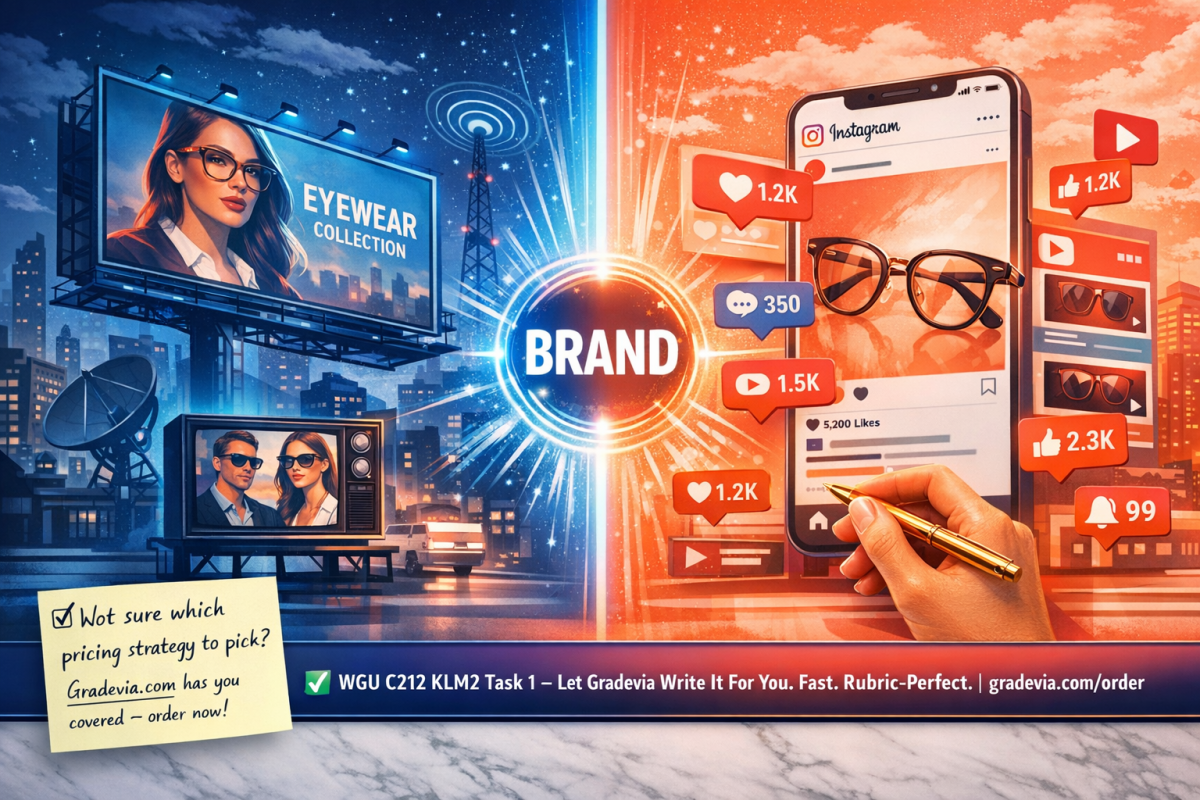
What to do: Identify exactly 2 mass media channels and 2 social media channels. Use the Media Data document to guide selection.
Examples:
| Type | Channel | Why It Works |
|---|---|---|
| Mass Media | Television advertising | Broad reach in the target country; effective for brand awareness |
| Mass Media | Print/magazine advertising | Fashion and lifestyle magazines align with eyewear’s aesthetic appeal |
| Social Media | Highly visual platform; ideal for eyewear lifestyle imagery | |
| Social Media | YouTube | Video tutorials, influencer reviews; strong engagement with 25–45 demographic |
Section A6a — Justification for Each Channel (Rubric: Justify all 4 channels by target audience alignment)
What to do: For EACH of the 4 channels, write a specific justification connecting it to:
- The segmentation variable from A1a (demographics, psychographics, etc.)
- The specific global market from A1
Example (Instagram):
“Instagram is justified for this campaign because the target demographic of adults aged 25–45 in [Market X] shows high Instagram engagement rates according to the Media Data. Psychographically, this audience values aesthetics and lifestyle branding — both of which align with Instagram’s image-driven format. The platform also allows geotargeted advertising, enabling the company to reach specifically consumers in [Market X].”
Repeat this level of detail for all four channels.
Section A6b — Sales Promotion Activities (Rubric: 2 activities, aligned to market + audience)
What to do: Describe TWO promotional activities and explain how each works to promote the product in the global market.
Options: Coupons, contests, sweepstakes, games, free samples, loyalty rewards, influencer partnerships
Example:
“Activity 1: A social media photo contest where consumers in [Market X] post photos wearing the new eyewear line using a branded hashtag. Winners receive free products or discounts. This drives user-generated content, increases brand visibility organically, and aligns with the target audience’s engagement habits on visual platforms.
Activity 2: An introductory discount coupon (20% off first purchase) distributed through partnering optical retailers and the company’s e-commerce site during the launch month. This incentivizes trial purchases among price-conscious first-time buyers and accelerates market entry.”
Section B — Sources (Rubric: In-text citations + reference list)
What to do:
- Cite any external sources you use (industry reports, textbook, market data) in APA 7 format
- Include at least 2–3 credible sources (your course textbook, Statista, IBISWorld, or similar)
- Add a References page at the end of the template
APA in-text example:
(Johnson & Smith, 2022)
APA reference example:
Johnson, A., & Smith, B. (2022). Global marketing strategies. Pearson.
Section C — Professional Communication
Checklist before submitting:
- Run the document through Grammarly for Education (required by WGU — submission won’t pass without it)
- No sentence fragments or run-on sentences
- Formal academic tone throughout (no slang or casual phrasing)
- All sections of the Marketing Plan Template are filled in (no blank sections)
- File saved as .docx format
- File name contains only allowed characters
Final Submission Checklist
| Item | Done? |
|---|---|
| Marketing Plan Template completed (all sections) | ☐ |
| One global market selected from the scenario | ☐ |
| All rubric counts met (1 segmentation variable, 2 risks, 3 CRM types, etc.) | ☐ |
| Competitor Data and Media Data used for A5 and A6 | ☐ |
| In-text citations and reference list included | ☐ |
| Grammarly review completed | ☐ |
| File saved as .docx | ☐ |