
Blog
NURS 6630 Week 2: Psychopharmacology Scavenger Hunt Concept Map Guide + Example

Updated on: Sep 26, 2026
The Week 2 Psychopharmacology Scavenger Hunt Concept Map in Walden’s NURS 6630 asks you to map how psychotropic medications act on receptors. You explain the four positions on the agonist spectrum, describe how the CYP450 enzyme system affects what happens to a drug in the body, research eight assigned medications, and place each one on the spectrum. The catch: you submit it as a visual concept map, not a paper.
This guide is written for PMHNP students at Walden who are working full-time, often on 12-hour shifts, and need to finish by Day 7 without losing a day off. It explains each requirement, the pharmacology you need to get right, how to research the medications efficiently, how to build a map that is clear and APA compliant, and it includes a downloadable illustrative example in Word.
How the example works: the example concept map uses eight different medications from the eight assigned in your course. It shows the structure, depth, and citation style evaluators look for, while your own map has to be built from your own research on the assigned medications.
Assignment: Psychopharmacology Scavenger Hunt Concept Map
As you continue to learn about psychopharmacology, you will find that medications used to treat mental health conditions are agonists across the spectrum. It will be important for you to recognize some of those medications and how they act on a variety of neurochemicals in different ways to treat the symptoms.
In this Assignment, you will “scavenger” the literature as you research the agonist spectrum and key neurotransmitters and pathways targeted in psychopharmacology. You will have the opportunity to apply your knowledge as you create a Concept Map exploring each of the agonist spectrum listed below. Support your answers with evidence-based, peer-reviewed scholarly literature. APA style format title page, citations, and references will apply.
Note: You will not set up your Assignment as a paragraph-formatted paper but, instead, as a creative, visually appealing Concept Map.
Resources
Be sure to review the Learning Resources before completing this activity.
Click the weekly resources link to access the resources.To prepare for this Assignment:
- Review the Learning Resources assigned this week.
- Review the Concept Map resources.
- Explore the listed agonist spectrum and consider the action and receptor of each:
- Agonist
- Partial agonist
- Antagonist
- Inverse agonist
The Assignment
You will submit a concept map exploring the four agonists on the agonist spectrum (agonist, partial agonist, antagonist, and inverse agonist) in which you:
- Describe the different characteristics of the four agonists and how each mediates distinct biological activities. Include proposed mechanisms and the receptor it is targeting.
- Identify how the P450 enzyme system plays a role in the body’s absorption, distribution, and clearance of medication.
- Scavenge the literature after describing each agonist on the spectrum for research that is based on the medications in the table below.
- Apply the medications to the appropriate agonist on the agonist spectrum in your Concept Map.
|
|
|
|
|
|
|
|
|
Illustrative Concept Map Example (Different Medications)
ILLUSTRATIVE EXAMPLE ONLY. This concept map is an example created by Gradevia for illustration purposes only. It is not to be submitted for grading. It deliberately uses eight different medications from the eight assigned in NURS 6630 Week 2, so you must complete your own research and concept map.
Need help or assistance with your Psychopharmacology Scavenger Hunt Concept Map? Contact us on WhatsApp: +1 564-544-6924.
NURS6630_Week 2_Concept_Map_Example (Click to Download)
The attached example above includes:
| Element | What it shows |
|---|---|
| APA title page | Student, program, course, instructor, and date in APA 7 student format |
| Figure 1: the concept map | A landscape map with a central spectrum node, four color-coded branches, and a connected CYP450 node, with citations inside the nodes |
| Table 1 | Characteristics, mechanisms, and receptor targets for each position on the spectrum |
| Table 2 | Each illustrative medication placed on the spectrum with its receptor action |
| Table 3 | The CYP450 system across absorption, distribution, and clearance, including non-CYP pathways |
| References | APA 7 references to peer-reviewed and course-level sources |
What the Example Does Well
- Shows intrinsic activity visually with a color bar from inverse to full.
- Pairs every medication with a receptor, such as buprenorphine as a high-affinity mu-opioid partial agonist and diphenhydramine as an H1 inverse agonist.
- Treats CYP450 as its own node with a separate example for absorption, distribution, and clearance.
- Flags drugs that do not depend on CYP450, such as morphine (glucuronidation) and pramipexole (renal elimination), which is a detail evaluators notice.
What the Assignment Asks For
| Requirement | What you need to show |
|---|---|
| The four agonist types | Agonist, partial agonist, antagonist, and inverse agonist: their characteristics and how each mediates distinct biological activity |
| Mechanism and receptor | The proposed mechanism of each and the receptor it targets |
| CYP450 enzyme system | How it affects absorption, distribution, and clearance of medication |
| Literature scavenger hunt | Research on each of the eight assigned medications, from evidence-based, peer-reviewed sources |
| Medication placement | Each assigned medication applied to the correct position on the spectrum |
| Format | A creative, visually appealing concept map, not a paragraph-formatted paper |
| APA | APA title page, citations, and references |
The eight assigned medications are oxycodone, brexpiprazole, haloperidol, naloxone, aripiprazole, amphetamine, risperidone, and pimavanserin. Submit by Day 7 of Week 2.
The Agonist Spectrum in Plain Language
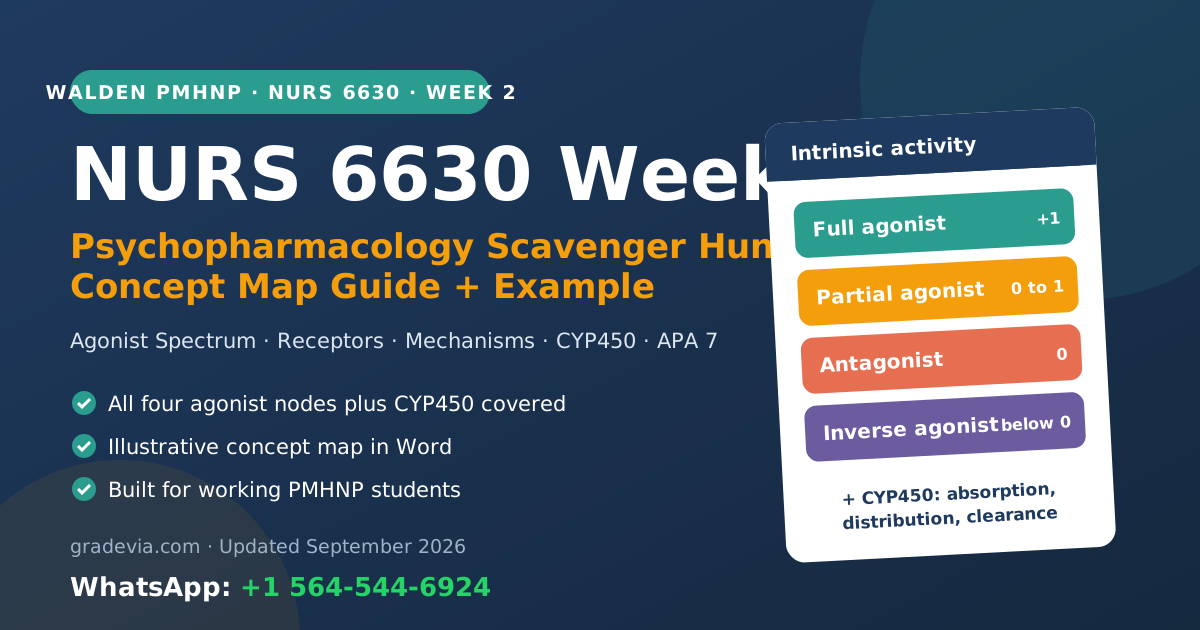
The agonist spectrum describes a drug’s intrinsic activity: once it binds to a receptor, how much does it change that receptor’s signaling? Stahl’s framework, used throughout PMHNP psychopharmacology, arranges drugs along a line from full activation to below-baseline activity (Stahl, 2021).
| Position | Intrinsic activity | What happens at the receptor | Clinical picture |
|---|---|---|---|
| Full agonist | 1 (maximal) | Fully activates the receptor and its downstream signaling | Maximum effect, including maximum side effects |
| Partial agonist | Between 0 and 1 | Activates the receptor only partly, even at full occupancy | Boosts signaling when natural tone is low, dampens it when a full agonist is present |
| Antagonist | 0 (neutral) | Binds and blocks, producing no signal of its own | Prevents agonists (and inverse agonists) from acting |
| Inverse agonist | Below 0 | Reduces a receptor’s constitutive (baseline) activity | Produces effects opposite to an agonist |
The inverse agonist is the concept students confuse most often. It only makes sense for receptors that have constitutive activity, meaning they signal even without a ligand. An antagonist leaves that baseline alone; an inverse agonist lowers it (Berg & Clarke, 2018). Your map should show that difference clearly.

How the CYP450 System Fits In
The cytochrome P450 enzymes, found mainly in the liver and intestinal wall, perform phase I oxidative metabolism for a large share of psychotropics. CYP families 1 to 3 account for about 80% of oxidative drug metabolism and roughly half of overall drug elimination (Zhao et al., 2021). Organize your CYP450 node around the three phases the assignment names:
- Absorption: gut-wall and hepatic CYP3A4 metabolize some drugs before they reach circulation (the first-pass effect), which lowers oral bioavailability and explains why some drugs are given by other routes.
- Distribution: CYP activity determines how much parent drug and active metabolite are available to reach tissues, including the brain. CYPs can also act at local sites (Zhao et al., 2021).
- Clearance: CYP metabolism is a main route of elimination. Inhibitors raise drug levels, inducers lower them, and genetic polymorphisms (notably CYP2D6 and CYP2C19) create poor and ultrarapid metabolizers.
Strong maps connect this node to the medications. For each assigned drug, note the main CYP pathway, any clinically important inhibitor or inducer, and whether it relies on a non-CYP route instead.
Scavenging the Literature Efficiently
The assignment asks you to “scavenge” research on each medication. With eight drugs, a plan saves hours:
- Search the Walden Library (CINAHL, MEDLINE, PsycINFO) or PubMed, using the drug name plus “receptor,” “mechanism of action,” or “pharmacokinetics.”
- Filter for peer-reviewed sources and check your course’s recency expectation.
- Save one source per medication that confirms its receptor action, plus one or two sources for the agonist spectrum and CYP450.
- Record as you go: drug, receptor, position on the spectrum, CYP pathway, and citation. That table becomes your map.
A Classification Checklist for Each Assigned Medication
Ask these questions for every drug on the list:
- Which receptor does it act on, and is it one receptor or several?
- What is its intrinsic activity at that receptor: full, partial, none, or below baseline?
- Does it act directly on a receptor at all? Some medications work mainly through transporters or by changing neurotransmitter release, which you should explain rather than force into a box.
- Does the literature describe more than one action? Some antipsychotics are described as antagonists at one receptor and partial agonists or inverse agonists at another. Name the receptor you are classifying.
- What is its main CYP pathway, and does anything clinically important interact with it?
Designing a Concept Map That Passes
- Use landscape orientation and one central node, “Agonist Spectrum,” with four branches and a connected CYP450 node.
- Color-code the four positions and use the same color for each medication placed there.
- Keep nodes short. Use phrases, not paragraphs, and put citations inside the nodes they support.
- Label every medication with its receptor, not just its category.
- Add an APA title page before the map and a reference list after it.
- Build it in a tool you can export cleanly, such as Word or PowerPoint, and check your course’s submission format before uploading.
Common Mistakes on the Scavenger Hunt Concept Map
- Writing a paper instead of a map. The instructions say the assignment should not be paragraph formatted.
- Confusing antagonists and inverse agonists. Explain constitutive activity, or the difference is lost.
- Placing a drug without naming the receptor. A classification only makes sense at a specific receptor.
- Skipping one of the three CYP450 phases. Absorption, distribution, and clearance all need coverage.
- Missing medications. All eight must appear on the map.
- Citations only in the reference list. Cite inside the nodes that use a source.
- Non-peer-reviewed sources, such as drug websites, used as the main evidence.
- Missing APA title page or references.
A Week 2 Plan for Working PMHNP Students
| When | What to do | Time |
|---|---|---|
| Day 1 or first day off | Review the Learning Resources and concept map resources; sketch the map layout | 1 hr |
| Next two short sessions | Research the eight medications, one source each; fill in your tracking table | 2 hrs |
| Next session | Draft the four agonist nodes and the CYP450 node with citations | 1.5 hrs |
| Next session | Place the eight medications and link them to the CYP450 node | 1 hr |
| Before Day 7 | Add the APA title page and references, check colors and readability, submit | 45 min |
Submission Checklist
- All four positions on the agonist spectrum described
- Characteristics, proposed mechanism, and receptor for each
- CYP450 role in absorption, distribution, and clearance
- All eight assigned medications researched with peer-reviewed sources
- Each medication placed on the spectrum with its receptor
- Visual concept map format, not paragraphs
- In-node citations, APA title page, and APA reference list
Get Support With NURS 6630
If you are balancing clinical shifts with the PMHNP program, Gradevia offers assignment support for NURS 6630. We can talk through any medication’s receptor action and CYP450 profile, review your concept map layout against the requirements, and check your sources and APA formatting before Day 7. The research and the map stay yours.
NURS 6630 Week 2 concept map support on WhatsApp for working PMHNP students

Frequently Asked Questions
What is the NURS 6630 Week 2 Psychopharmacology Scavenger Hunt?
It is a Week 2 assignment in Walden’s NURS 6630 in which you create a concept map of the agonist spectrum (agonist, partial agonist, antagonist, and inverse agonist), explain how the CYP450 enzyme system affects absorption, distribution, and clearance, and place eight assigned medications on the spectrum using peer-reviewed research.
What is the difference between an antagonist and an inverse agonist?
An antagonist binds a receptor and blocks it without changing its activity. An inverse agonist binds a receptor that has baseline (constitutive) activity and lowers that activity below baseline, producing effects opposite to an agonist.
Does the concept map need APA format?
Yes. The instructions require an APA title page, citations, and references, even though the map itself is not written in paragraphs.
Can I use the example concept map for my submission?
No. The example uses different medications from the ones assigned and is for illustration purposes only. Your map must be built from your own research on the assigned medications.
What tool should I use to build the concept map?
Any tool that produces a clear, visual map and exports cleanly, such as Word or PowerPoint. Check your course’s submission format before you upload.
How many sources do I need?
The instructions ask for evidence-based, peer-reviewed support. A practical target is one peer-reviewed source per medication plus sources for the agonist spectrum and CYP450. Check your rubric for any minimum.
Related Walden PMHNP Guides
- NRNP 6635 Psychopathology and Diagnostic Reasoning: PMHNP Clinical Guide
- Factors That Influence the Development of Psychopathology (NRNP 6635 Week 1)
- Psychiatric Interview Components and the BDI-II
- Comprehensive Psychiatric Evaluation for Mood Disorders (NRNP 6635 Week 3)
- NURS 6501 Week 6 Midterm Exam Review Guide
- Browse all Walden University Nursing guides
References
Berg, K. A., & Clarke, W. P. (2018). Making sense of pharmacology: Inverse agonism and functional selectivity. International Journal of Neuropsychopharmacology, 21(10), 962–977. https://doi.org/10.1093/ijnp/pyy071
Stahl, S. M. (2021). Stahl’s essential psychopharmacology: Neuroscientific basis and practical applications (5th ed.). Cambridge University Press.
Zhao, M., Ma, J., Li, M., Zhang, Y., Jiang, B., Zhao, X., Huai, C., Shen, L., Zhang, N., He, L., & Qin, S. (2021). Cytochrome P450 enzymes and drug metabolism in humans. International Journal of Molecular Sciences, 22(23), 12808. https://doi.org/10.3390/ijms222312808
Gradevia is an independent study resource and is not affiliated with or endorsed by Walden University. This guide is for educational purposes and is not clinical or prescribing advice. Assignment details reflect the NURS 6630 Week 2 instructions as of September 2026 and may change between terms.