
Blog
WGU C200 Task 1: What a Perfect-Score Personal Leadership Evaluation Looks Like

Updated on: Sep 17, 2026
You just got your CliftonStrengths results back, you’re working full time, and C200 wants a paper connecting five theme names you may not have thought about since the assessment closed to a scholarly leadership theory you have to pick, defend, and turn into real self-improvement goals. If you searched wgu c200 task 1 examples, wgu c200 task 1 examples pdf, or wgu c200 task 1 examples free and landed on paywalled uploads of someone else’s real reflection, this guide is the alternative: a fast rubric breakdown, the mistakes that actually get this task sent back, and a free downloadable example (for illustration) you can study without it doubling as content to copy.
A note on originality. C200 Task 1 is graded on how specifically your analysis connects to your own CliftonStrengths results. A borrowed or generic reflection doesn’t just risk a similarity flag; Section A and B read as disconnected from your actual report the moment an evaluator checks them against it. Use the structure below; build the content from your own five themes.
See also the WGU C200 Task 2 guide for the organization and leadership evaluation.
C200 Task 1 Assignment Prompt
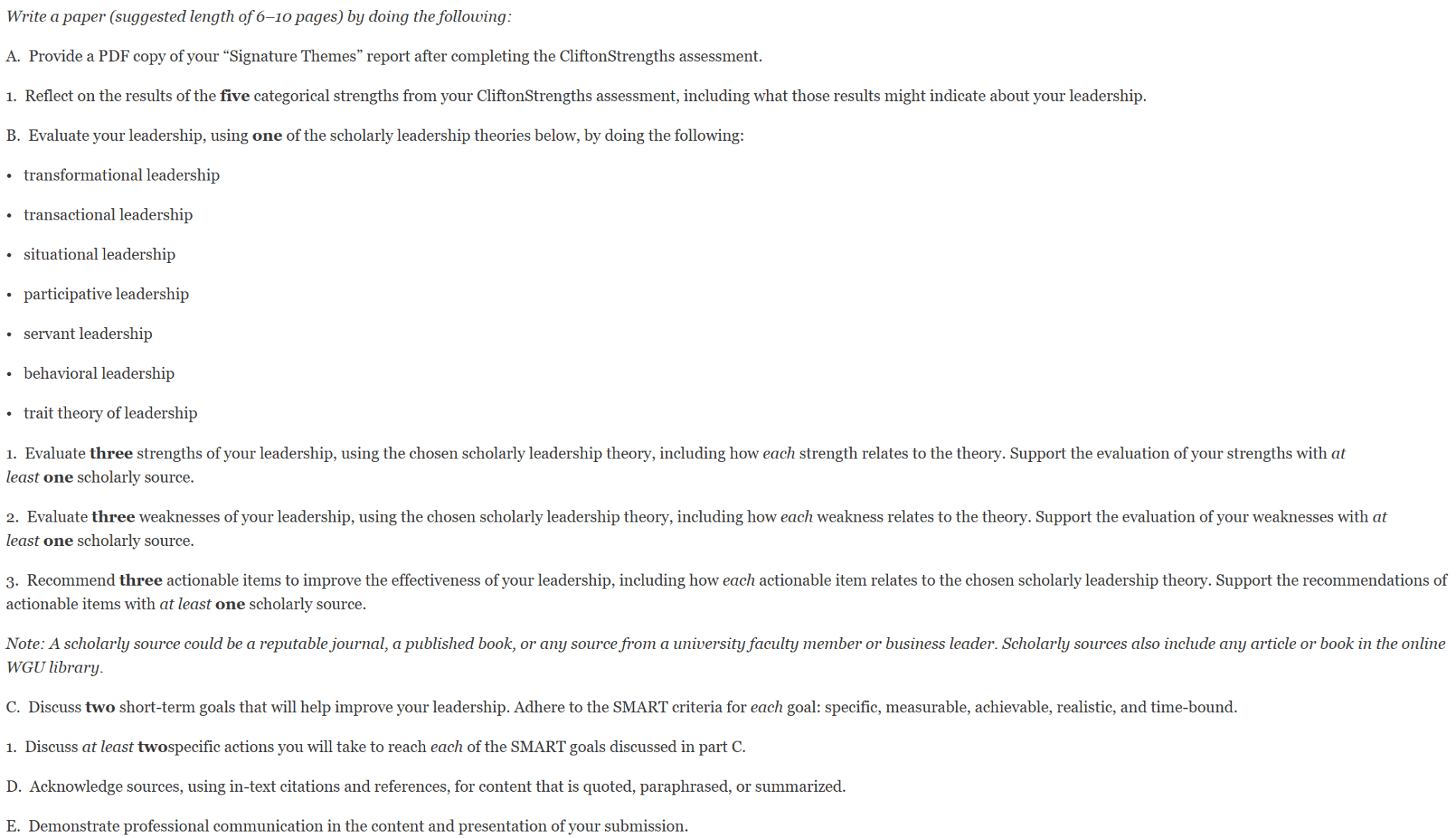
IntroductionFor this task, you will conduct an evaluation of your personal leadership effectiveness. You will write a paper evaluating your own leadership using a scholarly leadership theory. To help you refine your own leadership skills, you will develop at least two SMART (specific, measurable, achievable, realistic, and time-bound) goals as part of your evaluation.
Requirements
Your submission must represent your original work and understanding of the course material. Most performance assessment submissions are automatically scanned through the WGU similarity checker. Students are strongly encouraged to wait for the similarity report to generate after uploading their work and then review it to ensure Academic Authenticity guidelines are met before submitting the file for evaluation. See Understanding Similarity Reports for more information.
C200 Task 1 Example
The example provided below is for illustration purpose only. Not to be submitted for grading. Need custom/unique C200 Task 1? WhatsApp Us: +1 564-544-6924
C200_Task 1_Example Click to Download

What C200 Task 1 actually asks for
C200 (Managing Organizations and Leading People) Task 1, the Personal Leadership Evaluation, is a Performance Assessment, not a timed exam. You complete the Gallup CliftonStrengths assessment, then write a paper that does three things: reflects on your five Signature Themes, evaluates your own leadership through one scholarly leadership theory (three strengths, three weaknesses, all tied to that theory and each backed by a scholarly source), and sets at least two SMART goals for your own development. There’s no official wgu c200 task 1 template beyond the rubric itself, sections A through D are the template, whatever any third-party page shows you.
For the follow-up assignment in the same course, see the WGU C200 Task 2 guide, which shifts from your own leadership to evaluating a leader inside a real organization.
What a perfect-score paper looks like, at a glance
Scan this before you draft anything. It’s the fastest way to see where your own paper still needs work.
| Section | Falls short | Looks competent |
|---|---|---|
| A | A theme summarized in the Gallup report’s own language | Each theme reflected on with a real, specific workplace example |
| B, strengths | Vague (“I’m a good communicator”) | Three strengths explicitly tied to your chosen theory’s actual components, each backed by a scholarly source |
| B, weaknesses | A humblebrag (“I care too much”) | Three genuine weaknesses, tied to the same theory, each backed by a scholarly source |
| B, overall | Theory introduced once, then dropped | The chosen theory threads through every strength and weakness, not just the opening paragraph |
| C | “Improve my communication skills” | A goal with a stated metric and a real deadline, tied back to a weakness named in Section B |
| C, actions | One vague action per goal | At least two specific actions per goal |
| D | Sources listed with no clear connection to a claim | In-text citations tied to specific statements, matched to a complete reference list |
| Overall | Reads as generic leadership advice | Reads as your leadership, grounded in your CliftonStrengths report |
If your draft matches the right column everywhere, it’s close. If Section B is the one still reading generic, that’s normal, it’s where most of this task’s actual difficulty lives.
WGU C200 Task 1 rubric, section by section
Section A, CliftonStrengths reflection. Attach your Signature Themes PDF and reflect on what each of your five themes indicates about your leadership. Specificity is what separates a passing reflection from a thin one: a theme discussed through a concrete moment at work scores higher than one described only in the abstract language from your Gallup report.
Section B, leadership theory application. Choose one theory, transformational, transactional, situational, participative, servant, behavioral, or trait, and use it as the lens for three strengths and three weaknesses drawn from your CliftonStrengths results, each supported by at least one scholarly source. This is where most point loss happens, not from picking the “wrong” theory, but from the discussion drifting into generic leadership language partway through instead of staying anchored to that theory’s actual components.
Section C, SMART goals. At least two goals, specific, measurable, achievable, realistic, and time-bound, tied back to the weaknesses named in Section B, each with at least two concrete actions you’ll take to reach it.
Section D, sources. In-text citations and a matching reference list, APA format, for anything quoted, paraphrased, or summarized, plus professional communication clean enough to clear Grammarly for Education before submission.
If you’re still deciding between theories, transformational vs. servant leadership for C200 walks through how to pick the one that actually fits your CliftonStrengths results, not just the one you’ve heard of. For Section D specifically, how to find scholarly sources for C200 Task 1 covers where to look beyond a general Google search.

Common mistakes that send this task back for revision
- Section B loses the thread of the chosen theory. A strong opening paragraph on transformational leadership, then three paragraphs of generic leadership language that could apply to any theory. The rubric wants the theory applied consistently, not just introduced once.
- Weaknesses written too safely. A “weakness” that’s actually a compliment in disguise (“I care too much about my team”) reads as inauthentic and often triggers a request for a more genuine reflection.
- SMART goals that aren’t actually measurable. The single most common technical miss: a goal with no clear metric or deadline fails the criterion even when the underlying development plan is sound.
- A citation with no clear connection to a claim. A source sitting in the reference list with nothing specific tied to it in the Section B analysis reads as decorative rather than substantive.
- Section A that restates the Gallup report instead of reflecting on it. Summarizing what your theme means, in the report’s own language, isn’t the same as showing how it shows up in your actual work.
- Goals disconnected from Section B. A SMART goal about a weakness you never actually named earlier in the paper breaks the logical thread the rubric is looking for across the whole submission.
Why a real “C200 Task 1 example” you find online is riskier than it looks
Search c200 wgu task 1 examples and most of what comes up is a paywalled upload of someone else’s real reflection, someone else’s CliftonStrengths profile, someone else’s workplace scenario. Beyond the obvious originality-checker risk, there’s a simpler problem: Sections A and B are graded on how specifically your analysis connects to your actual Signature Themes. A generic or borrowed reflection doesn’t just risk a similarity flag; it reads as disconnected from the CliftonStrengths report you’re supposed to be analyzing, and evaluators catch that quickly. What you actually need isn’t someone else’s finished paper, it’s a clear map of the structure, which is what the worked example below is built to show.
Worked example: how a complete response reads
The excerpt below and the full downloadable paper use a fictitious profile, Marcus Bell, a regional operations supervisor, evaluated through situational leadership. None of it is real; it exists only to show structure and depth, not content to copy.
CliftonStrengths reflection (Section A, excerpt): “My Strategic theme shows up most clearly during quarterly planning, when I can usually see which of three possible staffing scenarios will cause the fewest downstream problems before my peers have finished outlining the first one. My Command theme drives a tendency to state my conclusion early in a group discussion, which occasionally shuts down input from team members who process out loud rather than arriving at an answer quickly.”
Leadership theory application (Section B, excerpt): “Applying situational leadership, my Strategic theme supports the theory’s core diagnostic step, accurately reading a follower’s readiness level before choosing a style. My Command theme, however, creates tension with situational leadership’s delegating style: my instinct to direct rather than step back works against the theory’s expectation that a leader shift toward low-involvement support once a follower reaches high readiness” (Al Hinai & Al Habsi, 2022).
SMART goal (Section C, excerpt): “Within 90 days, I will reduce my directive interventions with two high-readiness team members by at least half, tracked through a self-logged leadership-style journal reviewed biweekly with my manager, to practice shifting deliberately toward a delegating style as situational leadership recommends.”
The complete paper, all five CliftonStrengths themes, the full three-strengths and three-weaknesses analysis, both SMART goals with their actions, and a formatted APA reference list, is attached to this guide as a downloadable Word document, formatted the way an actual C200 Task 1 submission should look.
What actually gets Task 1 passed on the first try
- Save your Signature Themes PDF the moment you receive it. Retaking the CliftonStrengths assessment isn’t free, and losing your results is one of the most avoidable delays in this task.
- Start with your most complicated theme, not your strongest one. Five paragraphs that all sound equally flattering read as less genuine than one that grapples honestly with a theme that’s harder to spin positively.
- Draft the weaknesses paragraph in Section B before the strengths paragraphs. It’s easier to build a credible strengths narrative around a real, specific weakness than to retrofit a weakness after you’ve already written glowing strengths content.
- Use a real, or realistically detailed, work situation. Evaluators can tell the difference between a genuinely reflective example and a generic, invented scenario, even when identifying details have been changed.
- Reread the SMART criteria immediately before writing Section C. A goal that feels specific and measurable in your head isn’t always written that way on the page.
Third-party resources worth bookmarking
- Gallup CliftonStrengths, the official source for your Signature Themes report and further reading on each of the 34 themes.
- WGU Library Databases, accessible through your student portal, for the peer-reviewed leadership-theory sources Section D requires beyond the course textbook.
- Your WGU Course Mentor, who can review a CliftonStrengths reflection draft and flag anything likely to trigger a revision before you submit.
FAQ
Is there an official wgu c200 task 1 rubric template I can download? Not beyond the task instructions and rubric WGU provides directly; those are the actual template your evaluator grades against. Any third-party version, including this guide’s structure, is one interpretation of that same rubric.
What’s the difference between C200 Task 1 and wgu c200 task 2? Task 1, covered here, is the individual CliftonStrengths and leadership-theory reflection. C200 Task 2 shifts to evaluating a leader you’ve personally observed inside a real organization. See the C200 Task 2 guide for the full breakdown.
Can I use a wgu c200 paper example I found online as a starting structure? Use it only to understand format and depth, the way this guide’s worked example is intended. Never as content to adapt; Sections A and B are graded specifically on how well your analysis connects to your own CliftonStrengths results.
How do I pick a leadership theory if more than one seems to fit? Pick the one whose core mechanism, diagnosing follower readiness for situational, serving follower needs first for servant, inspiring shared vision for transformational, most naturally explains both a strength and a weakness from your own five themes. If two theories fit equally well, the one with more accessible scholarly literature for Section D is usually the more practical choice.
References
Al Hinai, A. bin M., & Al Habsi, R. (2022). The degree of school principals’ practice of situational leadership according to Hersey and Blanchard’s theory in Al Buraimi Governorate. Alustath Journal for Human and Social Sciences, 61(4), 73–97. https://doi.org/10.36473/ujhss.v61i4.1929
Orea-Rocha, A., & Appiah, G. (2025). Hersey-Blanchard situational leadership model. In Elgar Encyclopedia of Leadership (pp. 98–99). Edward Elgar Publishing. https://doi.org/10.4337/9781035307074.00047
Rachmad, Y. E. (2022). Behavioral goal setting theory. https://doi.org/10.17605/OSF.IO/KP968
Watkins, N. A., Gautreau, C., & Watkins, D. V. (2022). Using CliftonStrengths for professional development: Recommendations for practice. Journal of Organizational Psychology, 22(1), 121–133. https://articlegateway.com/index.php/JOP/article/download/5108/4872
This guide is written for academic coaching and assignment support purposes. It is not affiliated with or endorsed by Western Governors University or Gallup, Inc. CliftonStrengths® and StrengthsFinder® are registered trademarks of Gallup, Inc. Course codes, task letters, and rubric language referenced above are drawn from WGU’s publicly issued task overview for C200 Task 1 as of September 2026 and may change between terms.