
Blog
APN Infographic Assignment Example: What, Why, When & How to Create Yours

An APN infographic assignment asks you to take everything you know about Advanced Practice Nursing and compress it into something a stranger with no clinical background could understand in under a minute. That’s a harder skill than it sounds. Nursing students are trained to write in detail, cite thoroughly, and use precise clinical language; an infographic asks you to do the opposite, cut the detail down to what actually matters and say it visually.
The assignment usually centers on four questions: what APN is, why it matters, when patients interact with or benefit from it, and how APNs actually contribute to care. Getting all four onto one visual, in language a general audience can follow, is the real challenge. This article walks through what the assignment is really asking for, a hypothetical example organized around What, Why, When, and How, the tools students typically use to build it, a step-by-step creation process, common mistakes, and a checklist to run before you submit. For the full assignment breakdown, see our APN infographic assignment guide.
What Is an APN Infographic Assignment?
Understanding Advanced Practice Nursing
Advanced Practice Nursing describes registered nurses who’ve completed graduate-level education and clinical training beyond a standard nursing degree, qualifying them to take on expanded roles in patient care. This umbrella covers nurse practitioners, clinical nurse specialists, certified nurse-midwives, and certified registered nurse anesthetists, each with a different focus but a shared foundation of advanced clinical preparation. According to the American Association of Nurse Practitioners, nurse practitioners specifically assess patients, order and interpret diagnostic tests, diagnose conditions, and initiate and manage treatment plans, including prescribing medications, a scope that’s kept them a growing part of how Americans access primary, acute, and specialty care.
What Your APN Infographic Must Communicate
Most versions of this assignment expect your infographic to answer four questions clearly:
- WHAT is APN? A plain-language definition of advanced practice roles and what sets them apart from general nursing.
- WHY is APN important? The value APNs add to healthcare access, quality, and patient outcomes.
- WHEN do patients interact with or benefit from APNs? The real situations where someone might see an APN.
- HOW do APNs contribute to healthcare? The actual process of care an APN provides.
Why the Lay Public Is the Target Audience
Assignments like this typically specify that the infographic should be understandable to the general public, not other nursing students or clinicians. That’s a deliberate constraint, not a formality. Writing for a lay audience forces you to translate clinical concepts into language that actually communicates, which is a real skill for future practitioners who’ll spend their careers explaining diagnoses and treatment plans to patients who don’t have a medical background. If your draft is full of terms like “scope of practice,” “collaborative agreement,” or “differential diagnosis” without translation, it’s written for classmates, not the audience the assignment actually specifies.
APN Infographic Assignment Prompt Explained
Assignments in this category generally ask you to build a visual representation of information, not a written report reformatted with a few icons. That distinction matters: infographics can take on different rhetorical purposes, informative, instructive, descriptive, or persuasive, and a strong one usually leans into one primary mode rather than trying to do all four at once. The whole point of the format is conveying a lot of information quickly, which is why cramming in every fact you know about APNs usually backfires; the assignment rewards concise, well-organized content over comprehensive coverage.
You’ll typically be asked to pick a platform to build the infographic yourself. Easelly, Piktochart, and Visme are commonly suggested options, and most offer usable free tiers, so you generally aren’t required to pay for a subscription just to complete the assignment. Submission is usually expected as a PDF; if your chosen platform won’t let you export a PDF without paying, screenshotting your finished design is typically an acceptable alternative; check your specific course instructions to confirm.
Assignment Prompt
Infographics are visual representations of information. They can include numbers, text, images, or any combination of the three. Just as in traditional writing assignments, infographics can take on any of the various rhetorical modes — informative, instructive, descriptive, persuasive, etc. Infographics provide a quick way to convey a lot of information. For example, this infographic from the American Association of Nurse Practitioners conveys data related to NPs much more concisely than another paragraph inserted here could have (https://www.aanp.org/all-about-nps/what-is-an-np-2):
Students will create an Infographic on the topic of Advanced Practice Nursing. You will create an infographic that is easily understood by the lay public or general population. The infographic should provide information useful to communicating the “What, Why, When and How” of APN.
- Student will select a platform (tool) for building their infographics. There are plenty of great infographic platforms out there. Most are free, but may require that you do set up an account. Check out am, Easelly, Piktochart, and Visme.
- Create the Infographic using one of the above platforms.
- Post completed infographic in PDF format
- Students are not required to purchase a membership to any third party sites. If you cannot download a PDF without purchase, please submit a screenshot(s) of your final product for grading.
APN Infographic Example Based on the Assignment Prompt
The following is a hypothetical, illustrative example built to demonstrate structure and reasoning. It is not an official assignment answer and should not be copied as a submission.
Advanced Practice Nursing: What, Why, When & How
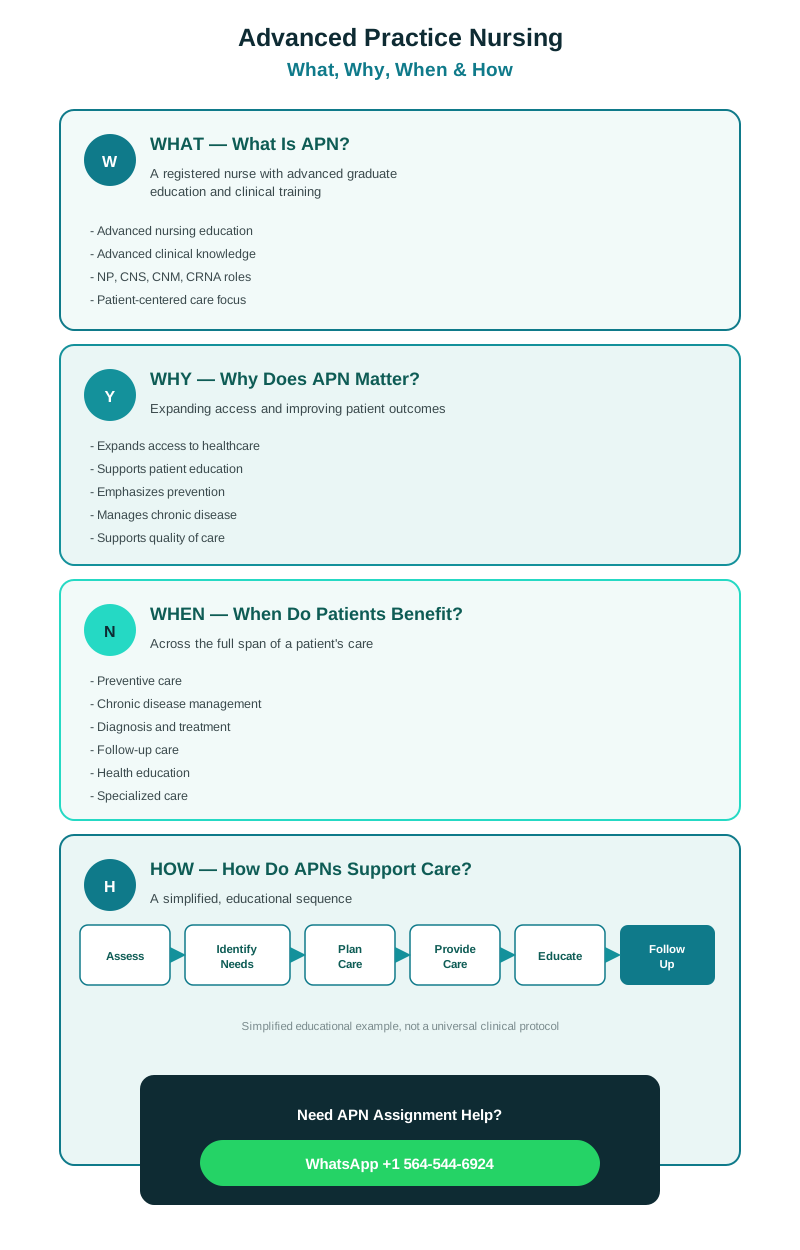
WHAT: What Is Advanced Practice Nursing?
An APN is a registered nurse who has completed advanced graduate education and clinical training, equipping them to diagnose conditions, order and interpret tests, and manage treatment, working within roles like nurse practitioner, clinical nurse specialist, certified nurse-midwife, or certified registered nurse anesthetist. The plain-language version for a lay audience: APNs are highly trained nurses who can provide many of the same services as a physician, often serving as a patient’s primary point of contact for care.
WHY: Why Is Advanced Practice Nursing Important?
APNs expand access to healthcare, particularly in areas with physician shortages, while emphasizing patient education, prevention, and long-term relationship-based care. For patients managing chronic conditions, that combination often means more consistent follow-up and a provider who has time to explain a treatment plan in detail, both of which support better outcomes over time.
WHEN: When Do Patients Benefit From APN Services?
Illustrative patient touchpoints include:
- Preventive care, annual checkups and screenings.
- Chronic disease management, ongoing care for conditions like diabetes or hypertension.
- Diagnosis and treatment, addressing acute symptoms or new health concerns.
- Follow-up care, monitoring recovery or medication effectiveness.
- Health education, guidance on lifestyle, prevention, and self-management.
- Specialized care, depending on the APN’s specific role and focus area.
HOW: How Do APNs Support Patient Care?
A simplified process view:
Assess → Identify Needs → Plan Care → Provide Care → Educate → Follow Up
This is a simplified educational representation meant to show the general shape of an APN’s involvement in a patient’s care, not a universal clinical protocol; actual care pathways vary by patient, condition, and setting.
Can You Give Me Some Examples of Infographics That Present Information?
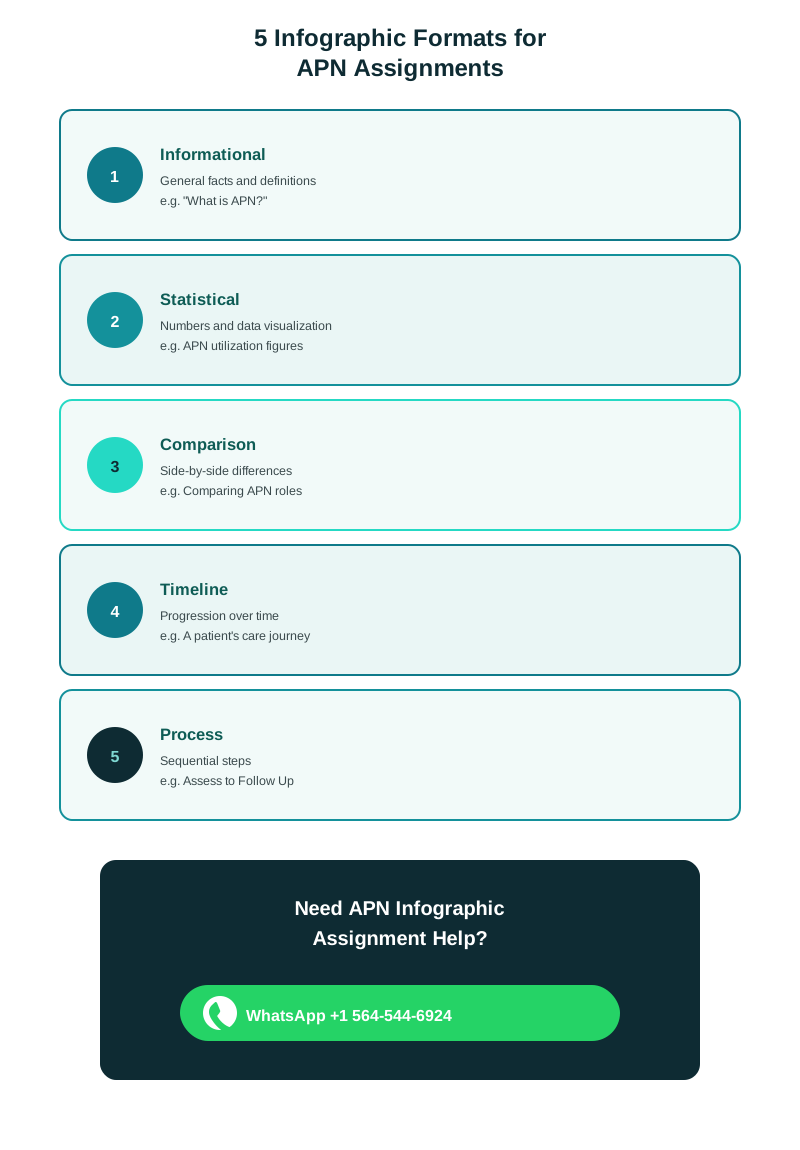
Infographic formats generally fall into a handful of categories: informational, statistical, comparison, timeline, and process, each suited to a different kind of content. Choosing the right one for your APN topic makes the difference between a design that clarifies and one that just decorates.
- Informational infographics present general facts and definitions, a natural fit for the “What is APN” component.
- Statistical infographics use numbers and data visualizations, useful for showing APN utilization or access-related figures.
- Comparison infographics show differences side by side, which could work for comparing APN roles or comparing APN care to other care models.
- Timeline infographics show progression over time, less common for this assignment but useful if you’re covering APN history or a patient’s care journey.
- Process infographics show sequential steps, the natural format for the “How” section of this assignment.
Most strong APN infographics for this assignment end up blending an informational layout with a process section for “How,” since a single format rarely covers all four required questions cleanly on its own.
What Should a Good Infographic Look Like?
A strong academic infographic is easy to understand at a glance, visually organized, concise, evidence-based, and appropriate for its stated audience, with credible sources and balanced visual weight across sections. Attractive design alone doesn’t make an infographic effective; a beautifully designed graphic that buries its point in too much text, or that a general reader can’t follow, misses the actual assignment.
Characteristics worth checking for:
- Easy to understand without additional explanation
- Visually organized, with a clear reading path
- Concise, prioritizing key points over exhaustive detail
- Evidence-based, with real sources behind any claims
- Professional in tone and design
- Audience-appropriate language throughout
- Properly sourced, with visible references
- Visually balanced, without one section overwhelming the others
Which Infographics Can Be Used to Demonstrate a Step-by-Step Procedure?
Process infographics, flowchart infographics, timeline infographics, and numbered-step infographics are all suited to showing a step-by-step procedure, using directional flow to guide the reader through a sequence. For the “How” component of an APN infographic, this is usually the strongest format, since it visually mirrors the actual sequence of care.
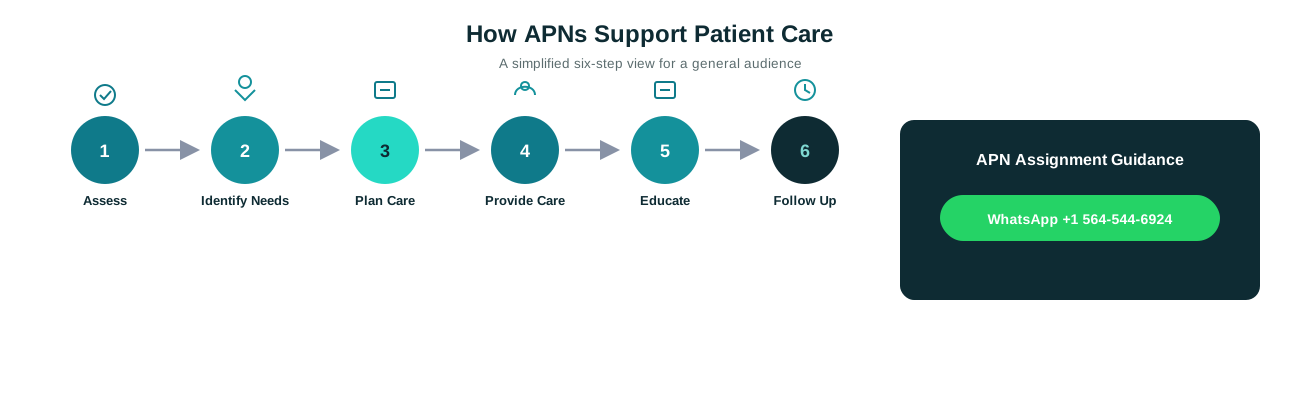
Applied to APN care, a simplified sequence like Assess → Identify Needs → Develop Plan → Provide Care → Educate → Follow Up gives a lay reader a clear mental model of what happens during a typical care interaction, without requiring them to understand clinical decision-making in depth.
Best Tools for Creating an APN Infographic
Three platforms come up most often for assignments like this:
- Easelly tends to be the simplest to pick up quickly, with a straightforward drag-and-drop interface, a reasonable fit if this is your first time building an infographic.
- Piktochart offers more structured templates and a wider range of chart and icon options, useful if your infographic leans on statistics or comparisons.
- Visme provides more advanced design flexibility, including more control over layout and typography, which suits students who want a more polished, custom look.
All three typically offer usable free tiers. You generally shouldn’t need to pay for a membership to complete this kind of assignment; if a specific export feature is locked behind a paywall on your chosen platform, a screenshot of your finished design is usually an acceptable submission format, but confirm this against your own course’s specific instructions.
How to Create an APN Infographic Step by Step
Step 1: Read the Assignment Prompt and Rubric
Before opening any design tool, know exactly what’s required: the specific questions to address, the audience, the format, and the submission method. Building first and checking requirements later almost always means rework.
Step 2: Define the Audience
Confirm you’re writing for a general, non-clinical audience. This shapes every word choice you make from here forward.
Step 3: Organize Information Around What, Why, When and How
Draft your content in plain text first, one to two sentences per question, before touching any visual design. This keeps your message focused before layout decisions start competing for attention.
Step 4: Choose the Infographic Format
Based on your content, decide whether an informational layout, a process flow, or a blend fits best. For most APN assignments, a hybrid, informational sections for What/Why/When and a process flow for How, works well.
Step 5: Add Visual Elements
Choose icons and imagery that reinforce your content rather than decorate it. A stethoscope icon next to “What is APN” does real work; a random unrelated graphic doesn’t.
Step 6: Add Credible References
Cite the sources behind any factual claims, particularly anything statistical. Organizations like AANP, the American Nurses Association, and the National Council of State Boards of Nursing are reasonable starting points depending on your specific claims.
Step 7: Proofread and Check Readability
Read your infographic as if you’re the intended lay audience. If a sentence needs a nursing background to parse, revise it.
Step 8: Export and Submit the Final Product
Export as a PDF if your platform allows it; if not, take clean screenshots of the finished design. Confirm your specific course’s file-format requirements before submitting.
APN Infographic Assignment Example: Suggested Content Layout
| Section | Information | Suggested Visual |
|---|---|---|
| What | APN definition and roles | Healthcare/nurse icon |
| Why | Importance and benefits | Statistics/icons |
| When | Patient-care situations | Patient illustrations |
| How | APN contribution to care | Process arrows |
| Key Takeaway | Main message | Highlight box |
| Sources | References | Reference section |
Common Mistakes Students Make on APN Infographic Assignments
Writing Too Much Text
An infographic that reads like a condensed essay defeats the purpose of the format. Cut every sentence down to its essential point.
Using Too Much Nursing Jargon
Terms that are second nature to you (scope of practice, collaborative agreement, differential diagnosis) need translation or removal for a lay audience.
Ignoring the General-Public Audience
If you’re writing for classmates instead of the specified audience, the whole design misses the assignment’s actual purpose.
Focusing Only on the Definition of APN
A strong infographic addresses all four required questions, not just “what APN is” at the expense of why, when, and how.
Forgetting One of the Four Required Questions
Double-check that What, Why, When, and How each have a clear, visually distinct section.
Using Weak or Unreliable Sources
Pull facts from credible healthcare organizations, not general web content with no clinical authority behind it.
Creating a Crowded Design
More icons and more colors don’t make an infographic stronger; visual clutter usually makes it harder to read, not easier.
Ignoring Submission Requirements
Confirm your file format and any specific naming or formatting requirements before you submit, not after.
Copying Existing Infographic Content
Existing NP or APN infographics from organizations like AANP are useful for understanding tone and structure, but your content and design need to be your own original work.
APN Infographic Assignment Checklist
- Addresses What
- Addresses Why
- Addresses When
- Addresses How
- Written for a general audience
- Uses concise language
- Includes relevant visuals
- Uses credible sources
- Proofread
- Meets file-format requirements
- Original work
Frequently Asked Questions About APN Infographic Assignments
What is an APN infographic assignment?
An assignment where nursing students create a visual representation explaining Advanced Practice Nursing to a general, non-clinical audience, typically addressing what APN is, why it matters, when patients encounter it, and how it works.
What should I include in an APN infographic?
At minimum, clear coverage of the What, Why, When, and How of APN, written in accessible language, supported by credible sources, and organized with a clear visual hierarchy.
How many words should an APN infographic have?
There’s no universal word count, but the format rewards brevity; most effective infographics use short phrases and concise statements rather than full paragraphs, letting the visual layout carry meaning alongside the text.
What is the best infographic format for APN?
A hybrid works well for most versions of this assignment: an informational layout for the What/Why/When content, paired with a process flow for the How section.
Can I use a free infographic platform?
Generally yes. Easelly, Piktochart, and Visme all offer usable free tiers, and most versions of this assignment don’t require a paid subscription to complete.
Do I need references on an APN infographic?
Yes, if you’re citing factual or statistical claims, credible sources should be visible on the infographic, even if briefly noted.
Can I submit screenshots instead of a PDF?
Often yes, if your platform requires payment to export a PDF, though you should confirm this against your specific course’s submission instructions.
How do I make an APN infographic easy for patients to understand?
Replace clinical terminology with plain language, use short sentences, and lean on visuals to communicate what text alone would take longer to explain.
Need Help With Your APN Infographic Assignment?
If you understand Advanced Practice Nursing but aren’t sure how to organize it into a clear, concise infographic, or you want a second opinion before you submit, focused academic support can help with:
- Interpreting the assignment requirements
- Planning your infographic’s structure and flow
- Organizing content around What, Why, When, and How
- Reviewing visual structure and readability
- Academic review of your draft
- Clarity and plain-language checks
- Citation and reference review
- Preparing your final submission
This is guidance and review support, not a service that completes graded work for you. You bring the nursing knowledge; this kind of support helps you translate it into a stronger final product.
Need APN Infographic Assignment Help? WhatsApp +1 564-544-6924.
Sources & References
- American Association of Nurse Practitioners, “All About NPs”. Used for background on the nurse practitioner role, scope, and utilization referenced in the What and Why sections of the example.
- American Nurses Association. Referenced generally as a credible professional nursing organization for sourcing broader APN and nursing practice content.
- National Council of State Boards of Nursing. Referenced generally as a credible authority on nursing licensure and scope-of-practice information.
Advanced Practice Nursing scope of practice and specific role definitions can vary by state and jurisdiction. Confirm any jurisdiction-specific claims against current state licensing board guidance rather than treating national-level information as universal.