
Blog
C207 Task 2 Example – Decision Tree Analysis (MPC)

C207 Task 2 Example
Task 2: Decision Tree Analysis Scenario
Decision tree analysis is used to determine a recommended decision alternative or an optimal decision strategy when a decision-maker is faced with an uncertain and risk-filled pattern of future events. The goal of decision tree analysis is to identify the best decision alternative, or the optimal decision strategy, given information about the uncertain events and the possible payoffs of selections.
You are the chief operating officer (COO) at Major Pharmaceutical Company (MPC). The chief executive officer (CEO) of MPC has asked you to review the company business plan for drug line development. You have been given a market research report that includes the state of the drug marketplace with probabilities and payoffs (see below and on the “Data Analysis Template” tab).
You are charged with presenting an analysis report of the plan, including recommending a course of action. The CEO wants to know the best immediate action, along with a backup action, and wants clarity based on your recommendations.
You will consider the following possible active alternative actions: 1) develop a new drug (exploration) or 2) focus on modifications to an existing drug (exploitation of new applications). Within these two alternatives are two possible states for market conditions. You must consider the probability of success and the payoffs to determine the course of action based on the calculated expected values.
You have been provided with the market research report data.
You are to use the data from the market research to complete the task, including payoff boxes on a decision tree diagram. Then, you may use the lower table on the template to show how you determined expected values for each state of nature node.
Market Research Report
MPC contracted with Drug Markets Analysts Inc. (DMA). Based on competitive research, DMA has found that there are new competing drugs recently granted FDA approval. MPC will need to be aware of the competition in the market as they consider whether to develop a new drug line, exploit the existing drug line for potential new applications, or simply continue with the current drug line at this time. The new formula is a clear advancement developed under strict guidelines and is scheduled for FDA approval in the first quarter of the year. Currently, there are only two other widely available products on the market that meet the same needs.
In a highly favorable market that is supported by MPC’s drug offering being considered the better solution, a new drug line with have 70% likelihood of success with a demand of 4133 units per month, the existing drug will have a 62% likelihood with a demand of 5577 units per month, and making no changes will be 78% likely to succeed with a demand of 657 units per month.
In an unfavorable market, a new drug line will have a demand of 1355 units per month, the existing drug will have a demand of 1911 units per month, and making no changes will have a demand of 258 units per month. Profits are estimated to be 0.64 per unit for the new drug line, 0.76 per unit for the existing drug line with new FDA-approved uses, while the current profit is 0.86 per unit.
C207 Task 2 Example
Section A: Description of a business question that could be answered by applying decision tree analysis and is derived from the scenario
In this scenario, the decision is whether to develop a new drug line, exploit the existing one for potential new applications, or continue with the existing one. Therefore, the question is: Should MPC develop a new drug line, exploit the existing one for potential new applications, or continue with the existing line to achieve the highest expected financial return under uncertain market conditions?
B. Identification of relevant data values required for the decision tree analysis, including the following:
- probabilities
- profits
- demand

Section C
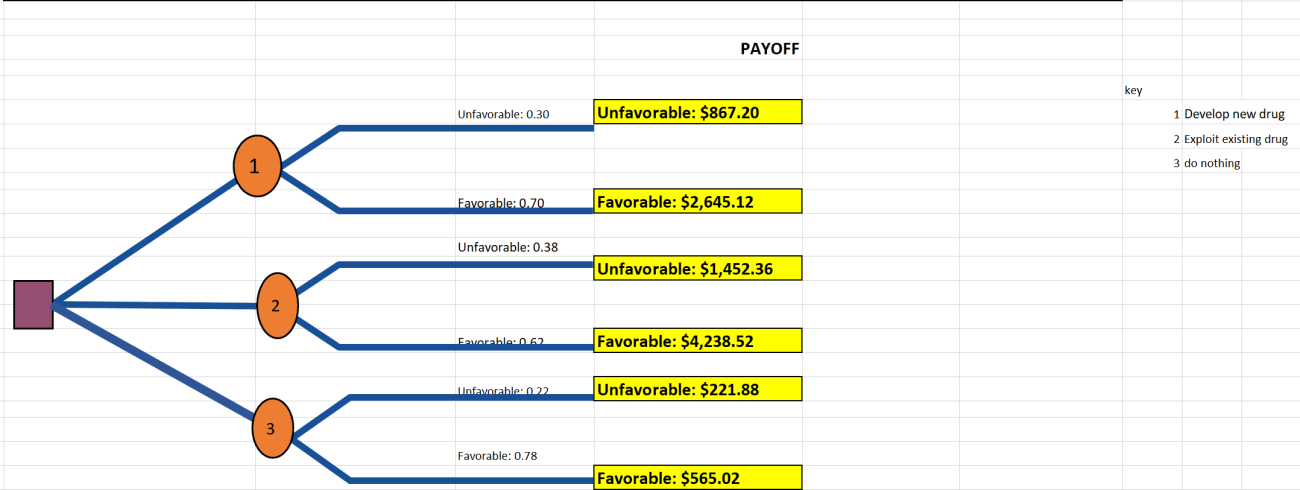
C. Complete a decision tree diagram, including each of the following:
- state-of-nature nodes
- calculated payoffs, each expressed out to two decimal places
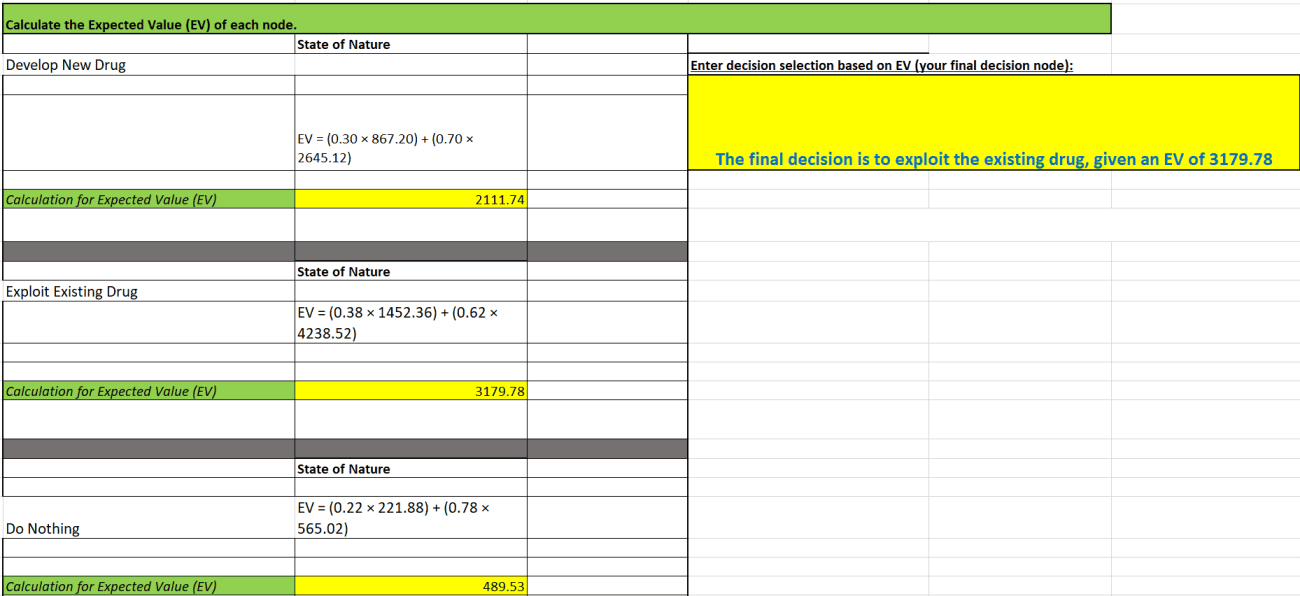
- expected values, each expressed out to two
Section D. Implications of the Decision Tree Analysis
D1. Explanation of Expected Value Calculation
To calculate the expected value (EV) for each decision option, multiply each market scenario’s payoff by its probability and sum the results. For instance, the development of a new drug alternative contains an unfavorable payoff of $867.20 and a probability of 0.30, and a favorable payoff of $2,645.12 and a probability of 0.70. The EV of this option equals the sum of the product of each payoff and probability. The same procedure was followed for the other two options. By comparing the EVs of the three options, we determine which is most likely to yield the greatest financial outcome in a risky market environment.
D2. Limitations
A potential limitation of the data is that demand estimates may not be accurate. These estimates are derived from research and assumptions that could be influenced by competitors’ actions, regulatory changes, and other market factors. If the market demand is significantly different from the estimates, then the payoffs, and by extension the EVs, would also vary. Another potential issue with decision trees is that they assume probabilities are static and known precisely, which is unlikely in real markets. Decision trees also reduce the environment to a set of distinct outcomes, which may not account for other factors such as long-term effects on brand positioning, resource constraints, or changing market preferences.
Section E. Recommended Course of Action
The decision tree analysis suggests MPC should leverage the existing drug for new FDA applications because this strategy has the highest expected value of $3,179.78. This course of action answers the business question by recommending the decision with the highest expected value, given uncertain market conditions. The much higher EV relative to the development of a new drug and doing nothing suggests that building on the existing drug line is the most attractive combination of profitability and likelihood of success. This strategy will allow MPC to make the most profits with the least risk.
Related Resources
WGU C206 Task 2 (Paradigm Toys): Guide + Full Example
WGU C717 Task 2 (FZP1 or EKP1): Which Scenario You Have + Pass Guide
WGU C200 Task 1 Guide and Example: Personal Leadership Evaluation
WGU C207 Task 2 Guide: Decision Tree Analysis + Example (2026 Edition)