Blog
WGU C206 Task 2 Guide and Example: Developing Organizational Ethics and Socially Responsible Behavior (EHM2)

Updated on: Oct 15, 2026
By Dan Palmer, MBA · Academic strategy consultant for working adult learners · LinkedIn
WGU C206 Task 2 moves from you to an organization. In Task 1, you reflected on your own ethics. In Task 2, you’re a business manager at Paradigm Toys, a publicly held company that makes and sells children’s toys, and the board has asked you to run an ethics audit and report whether the company needs ethics training. The deliverable is a report with a suggested length of 6 to 8 pages, and it’s assessed under the code EHM2.
The report has four content sections, and each asks for a different kind of thinking: explaining a concept, applying it to Paradigm Toys, analyzing a dilemma of your own, and designing a training program. Working adults usually know enough about workplace ethics to write all four. Task 2 comes back when a section stays general, such as a CSR discussion that never mentions Paradigm Toys or a training topic with no reason behind it. This guide walks through every rubric aspect in order, shows what “specific” looks like, and ends with a complete example report written for a fictitious pet supply company.
C206 Task 2 Assignment: Developing Organizational Ethics And Socially Responsible Behavior
IntroductionAs an organizational leader, one of your primary roles is establishing programs and policies that ensure the organization operates under ethical considerations and legal mandates. This responsibility includes informing employees of the organization’s code of ethics, communicating the code of ethics, providing training, and ensuring that operational aspects are administered in a legal and ethical manner.
You will assume the role of a leader and decide what strategies you will use to develop a strong organizational ethical climate. In your position as a leader, you will need to identify primary and secondary stakeholders and satisfy their concerns, understand the organization’s ethical standing, and develop an ethics training program.
ScenarioYou are a business manager of Paradigm Toys, a fictional publicly held company that is a retailer and manufacturer of children’s toys. The board of directors has asked you to conduct an ethics audit of the company and report to the board if you find the need for ethics training.
RequirementsYour submission must represent your original work and understanding of the course material. Most performance assessment submissions are automatically scanned through the WGU similarity checker. Students are strongly encouraged to wait for the similarity report to generate after uploading their work and then review it to ensure Academic Authenticity guidelines are met before submitting the file for evaluation. See Understanding Similarity Reports for more information.
Grammarly Note:Professional Communication will be automatically assessed through Grammarly for Education in most performance assessments before a student submits work for evaluation. Students are strongly encouraged to review the Grammarly for Education feedback prior to submitting work for evaluation, as the overall submission will not pass without this aspect passing. See Use Grammarly for Education Effectively for more information.
Microsoft Files Note:Write your paper in Microsoft Word (.doc or .docx) unless another Microsoft product, or pdf, is specified in the task directions. Tasks may notbe submitted as cloud links, such as links to Google Docs, Google Slides, OneDrive, etc. All supporting documentation, such as screenshots and proof of experience, should be collected in a pdf file and submitted separately from the main file. For more information, please see Computer System and Technology Requirements.
You must use the rubric to direct the creation of your submission because it provides detailed criteria that will be used to evaluate your work. Each requirement below may be evaluated by more than one rubric aspect. The rubric aspect titles may contain hyperlinks to relevant portions of the course.
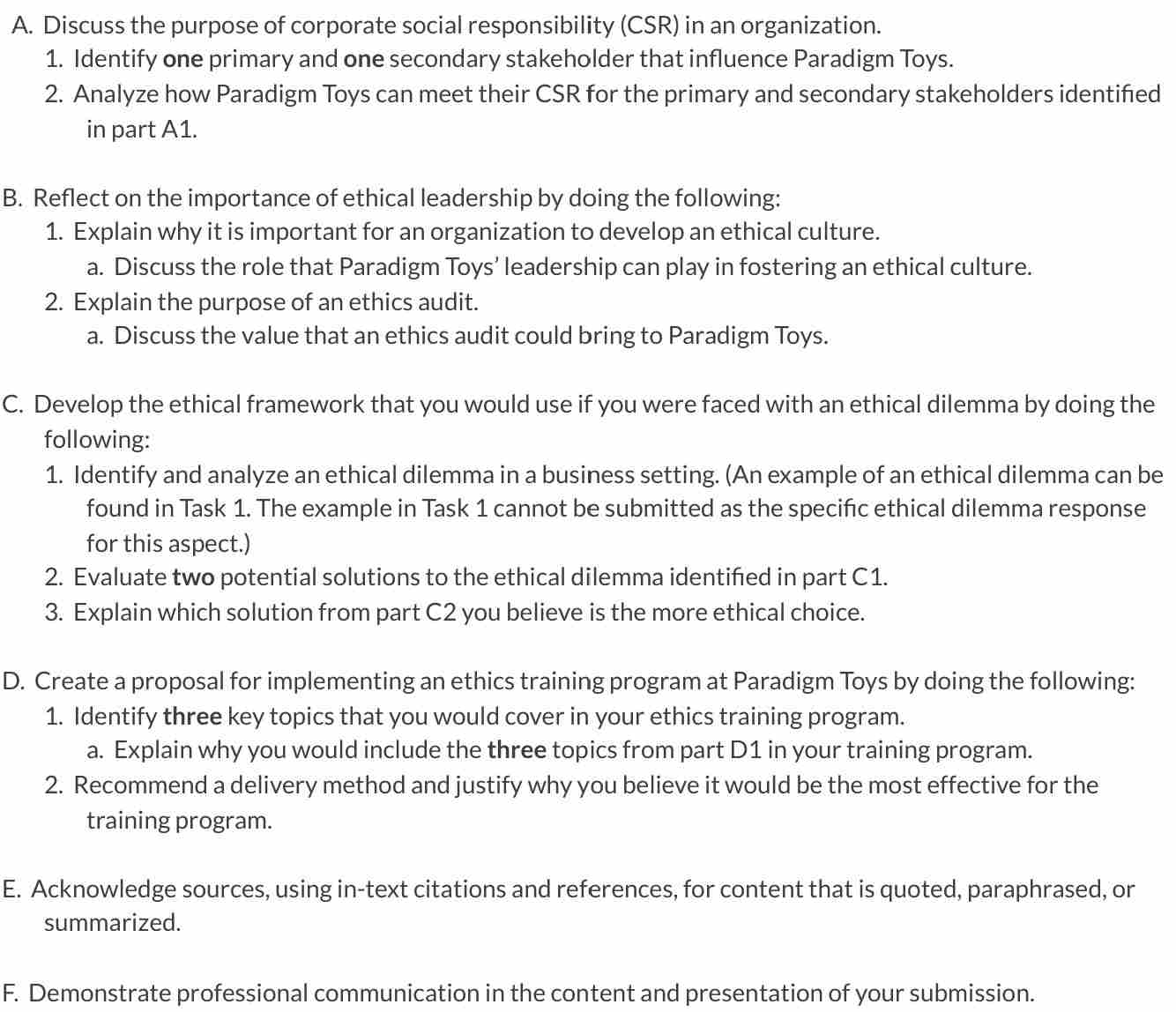
Prepare a report (suggested length of 6–8 pages) for Paradigm Toys in which you do the following:

WGU C206 Task 2 Summary
| Item | Detail |
|---|---|
| Course | C206 Ethical Leadership |
| Assessment | EHM2 Task 2: Developing Organizational Ethics and Socially Responsible Behavior |
| Your role | Business manager at Paradigm Toys, a publicly held toy retailer and manufacturer |
| The request | The board wants an ethics audit and a report on whether ethics training is needed |
| Deliverable | A report, suggested length 6 to 8 pages, in Microsoft Word |
| Sections | A: CSR and stakeholders. B: ethical culture and the ethics audit. C: an ethical dilemma and two solutions. D: an ethics training proposal. E: sources. F: professional communication |
| Typical time for a working adult | Four or five evenings |
What WGU EHM2 Task 2 Asks You to Do
| Prompt | What you deliver |
|---|---|
| A | The purpose of corporate social responsibility (CSR) in an organization |
| A1 | One primary and one secondary stakeholder that influence Paradigm Toys |
| A2 | How Paradigm Toys can meet its CSR to each of those stakeholders |
| B1 | Why it’s important for an organization to develop an ethical culture |
| B1a | The role Paradigm Toys’ leadership can play in fostering that culture |
| B2 | The purpose of an ethics audit |
| B2a | The value an ethics audit could bring to Paradigm Toys |
| C1 | An ethical dilemma in a business setting, identified and analyzed. The Task 1 example dilemma can’t be used |
| C2 | An evaluation of two potential solutions |
| C3 | Which solution is the more ethical choice, and why |
| D1 | Three key topics for an ethics training program |
| D1a | Why each of the three topics belongs |
| D2 | A recommended delivery method, with a justification of why it’s the most effective |
| E | In-text citations and references |
| F | Professional communication, checked by Grammarly for Education |
Notice the pattern: A, B1, and B2 explain a concept, and A2, B1a, and B2a apply it to Paradigm Toys. Many returned reports explain every concept well and never apply them.
Part A: CSR and Stakeholders
A: The purpose of CSR
The rubric asks for a discussion that’s “accurate” and “complete.” A widely cited framework describes CSR as four kinds of responsibility: economic, legal, ethical, and philanthropic (Carroll, 2021). A complete answer explains what CSR is, why organizations practice it, and whom it serves. Two or three paragraphs are enough.
A1: One primary and one secondary stakeholder
A primary stakeholder is one the company depends on directly to operate. A secondary stakeholder influences or is affected by the company without that direct dependency. For a publicly held toy company, logical choices include:
| Primary stakeholder options | Secondary stakeholder options |
|---|---|
| Customers, such as the parents and caregivers who buy the toys | Child safety and consumer advocacy groups |
| Employees in stores and factories | The media |
| Shareholders, since Paradigm Toys is publicly held | Communities near its factories and stores |
| Suppliers of materials and components | Industry associations |
Choose the pair you can say the most about in A2. The rubric’s test is whether each choice is “logical,” so add a sentence explaining how each one influences Paradigm Toys.
A2: Meeting CSR for each stakeholder
A2 needs an analysis for each stakeholder, with specific actions. Ask what each stakeholder expects from Paradigm Toys and what the company could actually do to meet it.
Vague: “Paradigm Toys should act responsibly toward its customers.”
Specific: Name the stakeholder’s concern, two or three concrete actions the company could take, and why those actions meet the concern. For a children’s product company, product safety, honest labeling, and how recalls are handled are natural places to start.
Part B: Ethical Culture and the Ethics Audit
B1: Why an ethical culture matters
Support this with evidence, not opinion. The Ethics & Compliance Initiative’s 2023 Global Business Ethics Survey, drawn from employees in 42 countries, found that 65% had observed misconduct, 46% of those who reported it experienced retaliation, and 87% said their workplace didn’t have a strong ethical culture (Ethics & Compliance Initiative [ECI], 2023). Figures like these show why culture, not just written policy, decides what employees do.
B1a: Leadership’s role at Paradigm Toys
This is about Paradigm Toys’ leaders specifically. The U.S. Department of Justice’s guidance on compliance programs says an effective program needs commitment “from the middle and the top” (U.S. Department of Justice, 2024). Turn that into actions: what executives communicate, how middle managers respond to concerns, and how ethics shows up in performance reviews and promotions.
B2 and B2a: The ethics audit
B2 asks for the purpose of an ethics audit in general. B2a asks what it would bring to Paradigm Toys.
- B2: An ethics audit is a systematic review of whether an organization’s stated values, policies, and actual practices match. A review of the business ethics literature concludes that its central goal should be improving the organization’s ethical performance and creating meaningful accountability (Schöppl et al., 2022). Mention what an audit typically examines, such as the code of ethics, reporting channels, training records, incident data, and employee surveys.
- B2a: The rubric wants “key details.” Name what the audit would look at in a toy company, such as product safety and testing processes, supplier and factory practices, marketing to parents, and how concerns are reported, and what the board would gain: evidence for its training decision.
Part C: Your Own Ethical Dilemma
The directions are explicit that the dilemma from Task 1, the knee joint scenario, can’t be used here. C1 asks for a dilemma “in a business setting,” which gives you a choice:
- A dilemma at Paradigm Toys, such as one involving product safety, supplier practices, or marketing to families
- A dilemma from your own workplace or industry, which you can describe with confidence
Either works if it’s a genuine dilemma: two options that each have ethical weight, not a choice between right and obviously wrong.
| Prompt | What a Competent answer includes |
|---|---|
| C1 | The situation, the people affected, and the values in conflict, analyzed completely |
| C2 | Both solutions, each with its strengths and weaknesses |
| C3 | The more ethical choice, with reasons tied to principles, stakeholders, or consequences |
A common weak spot is a C2 where one solution is clearly a straw man. Two solutions that a reasonable manager might choose make C3 far stronger.
Part D: The Ethics Training Proposal
D1 and D1a: Three topics, three reasons
The rubric asks that all three topics be “logical and feasible,” and that the reason for each be well supported. Strong topics connect back to the rest of your report: a risk your audit would examine in B2a, the dilemma in Part C, or a stakeholder concern from A2.
Vague: “Topic 1: Ethics. Employees need to know about ethics.”
Specific: Name a focused topic, such as conflicts of interest, speaking up without retaliation, or product safety escalation, and explain what risk at Paradigm Toys it addresses.
D2: Delivery method
Recommend one method and justify why it’s the most effective for Paradigm Toys’ workforce, which includes store, factory, and office employees. The Department of Justice (2024) asks whether training is tailored to risk and whether its effectiveness is measured, which gives you two strong justification points: who needs what kind of training, and how the company will know it worked.
Sources and Professional Communication (E and F)
Cite every fact, figure, and definition in APA format, including the scenario as your course directs. Then run Grammarly for Education; the directions note the submission won’t pass unless professional communication passes.
WGU C206 Task 2 Example: Lumen Pet Supply
Our WGU C206 Task 2 example is a complete, seven page APA 7 report for Lumen Pet Supply, a fictitious publicly held pet products company, not Paradigm Toys. It includes:
- A CSR discussion, with customers as the primary stakeholder and animal welfare groups as the secondary stakeholder
- B sections on ethical culture, leadership’s role, and the ethics audit, supported with 2023 and 2024 sources
- A Part C dilemma about a supplier offering a purchasing manager a paid “consulting role,” with two evaluated solutions
- Three training topics with a reason for each, and a blended delivery method with a plan to measure effectiveness
- Comments explaining which rubric aspect each section meets
Here’s part of its C3:
The second solution is the more ethical choice. A conflict of interest damages trust because of how it looks, not only because of what it causes, and only disclosure allows others to judge the decision fairly.
The example can’t be submitted for WGU C206 Task 2, because it’s written for a different company. It shows the structure and depth each section needs.
Download the WGU C206 Task 2 example (.docx)
How Task 2 Connects to WGU C206 Task 1 and Task 3
| What it focuses on | Our guide | |
|---|---|---|
| WGU C206 Task 1 | You: an ethical leader, ethical theories, moral development, and your Ethical Lens Inventory | C206 Task 1 guide and example |
| WGU C206 Task 2 | An organization: CSR, ethical culture, an audit, a dilemma, and training | This page |
| WGU C206 Task 3 | An organization’s code of ethics and legal responsibilities | C206 Task 3 guide and example |
Skills carry forward. The four lens questions from Task 1 are a practical way to evaluate the two solutions in Part C; our how to do an ethical lens guide explains the method.
Plan It Around Your Work Week
- Evening one (about 1.5 hours): Write Part A, choosing stakeholders you can analyze in depth.
- Evening two (about 1.5 hours): Write B1, B1a, B2, and B2a, applying each to Paradigm Toys.
- Evening three (about 2 hours): Choose your dilemma, then write C1, C2, and C3.
- Evening four (about 1.5 hours): Write D1, D1a, and D2, connecting the topics to earlier sections.
- Evening five (about 1 hour): Add references, run Grammarly, and review the similarity report.
Common Reasons C206 Task 2 Comes Back
- A discusses CSR in general but never applies it to Paradigm Toys in A2
- A2 analyzes only one of the two stakeholders
- B1a or B2a describes leaders or audits in general rather than at Paradigm Toys
- The Part C dilemma is the Task 1 knee joint scenario
- C2 evaluates one solution well and the other in a sentence
- D1a gives one reason for all three topics, or none for one
- D2 names a method without saying why it’s the most effective
- Statistics or definitions are uncited

Pre-Submission Checklist
- A: CSR’s purpose explained accurately and completely
- A1: one primary and one secondary stakeholder, each with a reason
- A2: specific CSR actions for each stakeholder
- B1 and B1a: why culture matters, and what Paradigm Toys’ leaders can do
- B2 and B2a: an audit’s purpose, and its value to Paradigm Toys with key details
- C1 to C3: your own business dilemma, two evaluated solutions, and a reasoned choice
- D1 and D1a: three feasible topics, each with its own reason
- D2: one delivery method, justified as the most effective
- E and F: APA citations, Grammarly reviewed, and the similarity report checked
Related C206 Resources
- Our C206 Task 1 guide and example covers the first task in full.
- Our Ethical Lens Inventory guide covers the ELI from Task 1.
- Our C206 Task 3 guide and example covers the code of ethics task.
- Browse all of our C206 Ethical Leadership guides.
Frequently Asked Questions
What is WGU C206 Task 2?
It’s the second performance assessment in C206 Ethical Leadership, coded EHM2. As a business manager at Paradigm Toys, you write a report on CSR and stakeholders, ethical culture, an ethics audit, an ethical dilemma, and an ethics training proposal.
How long is WGU C206 Task 2?
The directions suggest 6 to 8 pages. Covering every rubric aspect fully matters more than length.
Can I use the Task 1 dilemma in Part C?
No. The directions say the example dilemma from Task 1 can’t be submitted for Part C. Choose a different business dilemma, at Paradigm Toys or in your own field.
Does my Part C dilemma have to be about Paradigm Toys?
The directions ask for “an ethical dilemma in a business setting,” so it doesn’t have to be. A dilemma at Paradigm Toys or from your own industry can both work if you analyze it completely.
Who counts as a primary versus a secondary stakeholder?
Primary stakeholders are those the company depends on directly, such as customers, employees, shareholders, and suppliers. Secondary stakeholders influence or are affected by the company without that direct dependency, such as advocacy groups, the media, and local communities.
Can I submit the C206 Task 2 example on this page?
No. It’s written for a fictitious company, Lumen Pet Supply, not Paradigm Toys. It’s for illustration only.
Want a Second Look Before You Submit?
If you’re working full time and want structured assignment support choosing stakeholders you can analyze, finding a Part C dilemma of your own, or tying your training topics back to the audit, message Gradevia on WhatsApp at +1 564 544 6924 or email Support@gradevia.com.
Sources
Carroll, A. B. (2021). Corporate social responsibility: Perspectives on the CSR construct’s development and future. Business & Society, 60(6), 1258–1278. https://doi.org/10.1177/00076503211001765
Ethics & Compliance Initiative. (2023). Global business ethics survey: 2023 data. https://ethics.org/gbes-2023
Schöppl, N., Taddeo, M., & Floridi, L. (2022). Ethics auditing: Lessons from business ethics for ethics auditing of AI. In J. Mökander & M. Ziosi (Eds.), The 2021 yearbook of the Digital Ethics Lab (pp. 209–227). Springer. https://doi.org/10.1007/978-3-031-09846-8_13
U.S. Department of Justice, Criminal Division. (2024). Evaluation of corporate compliance programs (Updated September 2024). https://www.justice.gov/criminal/criminal-fraud/page/file/937501/dl