
Blog
APN Infographic Assignment: Complete Guide, Instructions, and Sample

Updated on: Aug 22, 2026
Nursing students in MSN, BSN-to-MSN, and NP transition courses are frequently asked to complete an APN infographic assignment. Instead of writing a traditional paper, you are asked to design a single visual that explains Advanced Practice Nursing (APN) to people outside the profession. This guide breaks down what the assignment expects, walks through infographic assignment instructions step by step, and closes with a full infographic assignment sample you can adapt for your own submission.
APN Infographic Assignment Prompt
Infographics are visual representations of information. They can include numbers, text, images, or any combination of the three. Just as in traditional writing assignments, infographics can take on any of the various rhetorical modes — informative, instructive, descriptive, persuasive, etc. Infographics provide a quick way to convey a lot of information. For example, this infographic from the American Association of Nurse Practitioners conveys data related to NPs much more concisely than another paragraph inserted here could have (https://www.aanp.org/all-about-nps/what-is-an-np-2):
Students will create an Infographic on the topic of Advanced Practice Nursing. You will create an infographic that is easily understood by the lay public or general population. The infographic should provide information useful to communicating the “What, Why, When and How” of APN.
- Student will select a platform (tool) for building their infographics. There are plenty of great infographic platforms out there. Most are free, but may require that you do set up an account. Check out am, Easelly, Piktochart, and Visme.
- Create the Infographic using one of the above platforms.
- Post completed infographic in PDF format
- Students are not required to purchase a membership to any third party sites. If you cannot download a PDF without purchase, please submit a screenshot(s) of your final product for grading.
What Is the APN Infographic Assignment?
The APN infographic assignment asks students to build a visual, not a written essay, that communicates the “What, Why, When, and How” of Advanced Practice Nursing to the lay public. Infographics are useful here because they combine numbers, short text, and images to convey a lot of information quickly, the way a single chart from the American Association of Nurse Practitioners can say more at a glance than a full paragraph.
Most versions of the assignment sheet ask you to:
- Select a free infographic platform, such as Piktochart, Easelly, Visme, or Infogr.am
- Build the infographic on that platform
- Post the completed infographic in PDF format
- Submit a screenshot instead, if the platform will not let you export a PDF for free
That last point matters. The infographic assignment sheet is usually explicit that you are not required to buy a membership on any third-party site. If a paid plan is the only way to download a PDF, a clear screenshot of your finished design is an accepted substitute.

The Four Content Pillars: What, Why, When, How
Every strong apn infographic organizes its content around four questions, and grading rubrics tend to map directly onto them:
- What APN is: the definition and the recognized roles
- Why APN matters: the impact on access, quality, and cost of care
- When APNs are called into practice: the settings and scenarios where they work
- How someone becomes an APN: the education and certification pathway
What Is Advanced Practice Nursing?
Advanced Practice Nursing is a graduate-level tier of nursing in which registered nurses take on expanded authority to diagnose conditions, order tests, and manage treatment, either independently or in collaboration with a physician. There are four recognized APN roles:
- Nurse Practitioner (NP), the most common APN role, delivering primary and specialty care
- Certified Registered Nurse Anesthetist (CRNA), administering anesthesia for surgical and procedural care
- Certified Nurse Midwife (CNM), managing prenatal, labor, delivery, and postpartum care
- Clinical Nurse Specialist (CNS), focused on specialty patient care, staff education, and quality improvement
All four require at least a Master of Science in Nursing, and a growing share of APNs now hold a Doctor of Nursing Practice.
Why Does APN Matter?
APNs are one of the main responses to a shrinking supply of primary care providers in the United States, particularly in rural and underserved areas. For the “Why” panel of your infographic, three themes tend to work well: access, quality, and cost. You can support each with a short, sourced statistic, for example the current count of licensed nurse practitioners nationwide, the number of states granting NPs full practice authority, or research comparing patient outcomes and costs between NP-led and physician-led primary care.
When Are APNs Called Into Practice?
APNs work across the full range of care, from routine wellness visits to acute illness and long-term chronic disease management. Common scenarios to illustrate include:
- Primary and preventive care, including chronic disease management for conditions like diabetes and hypertension
- Urgent and acute care in clinics or emergency settings
- Mental and behavioral health care, including medication management
- Women’s health, prenatal care, and family planning
- Pediatric and geriatric specialty care
- Surgical and procedural support delivered by CRNAs
A settings-based visual, showing a clinic, a hospital, a telehealth call, and a community health center, illustrates this section well without needing much text.
How Do You Become an Advanced Practice Nurse?
The path to becoming an APN generally follows six steps:
- Earn a Bachelor of Science in Nursing (BSN)
- Pass the NCLEX-RN exam and obtain RN licensure
- Gain clinical experience as a working RN, typically one to two years
- Complete graduate education, an MSN or DNP, including several hundred supervised clinical hours
- Pass a national certification exam through a body such as ANCC, AANPCB, AANA, or ACNM, depending on the APN role
- Apply for state licensure, which may include a collaborative practice agreement depending on the state
Altogether, this path takes roughly six to eight years starting from high school, or two to three years for an RN who already holds a BSN.

Infographic Assignment Instructions: How to Build Yours Step by Step
Once your content is drafted, building the actual visual does not need to take long. Here is a practical way to work through the infographic assignment instructions.
Step 1: Pick a Platform
Piktochart, Visme, Easelly, and Infogr.am are all free at the base tier and commonly listed on assignment sheets. Piktochart’s healthcare-themed templates make it a popular first choice, while Visme offers more design flexibility if you want a more custom layout.
Step 2: Plan the Layout
A vertical single-column layout, or a 2×2 grid with one quadrant per section, both work well for organizing What, Why, When, and How into a single readable page.
Step 3: Write Section Content
Keep the language at roughly a sixth to eighth grade reading level throughout, since this is meant for a general audience, not other clinicians. Avoid acronyms and clinical jargon unless you define them.
Step 4: Add Supporting Visuals
Pair each section with a simple icon or image: a stethoscope or graduation cap for “What,” a bar chart or map for “Why,” a hospital or telehealth icon for “When,” and a numbered pathway or timeline for “How.”
Step 5: Export and Submit
Export as a PDF when the platform allows it for free. If the apn infographic assignment pdf export is locked behind a paid plan, take a full screen screenshot instead and save the file using a clear filename such as Lastname_APNInfographic.
Common Mistakes to Avoid
A few issues show up again and again in submitted infographics:
- Writing for clinicians instead of the general public, using acronyms or terms a non-nurse would not recognize
- Overloading each section with text, when 20 to 40 words per section is usually plenty
- Leaving out the “How” section, since many students focus on What and Why and forget the pathway
- Skipping source citations for statistics
- Low contrast text that is hard to read
- Submitting a Word document or slide deck instead of an actual infographic image or PDF
APN Infographic Assignment Example
Below is a complete, ready-to-use content block you can drop into your chosen platform as an infographic assignment sample.
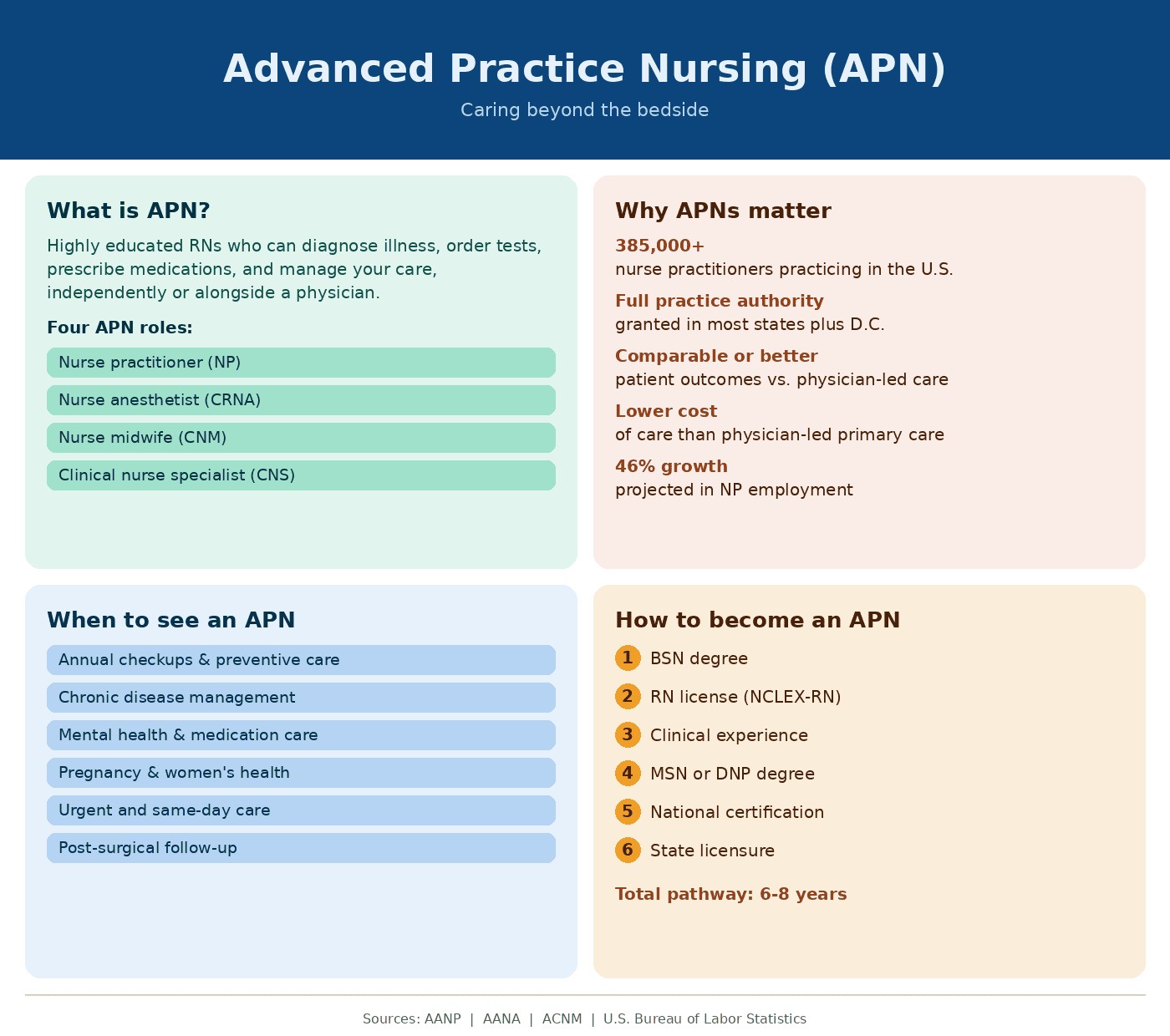
Header: Advanced Practice Nursing (APN), Caring Beyond the Bedside
Section 1, What Is APN? Advanced Practice Nurses are highly educated RNs who can diagnose illness, order tests, prescribe medications, and manage your care, independently or alongside a physician.
Four APN roles: Nurse Practitioner (NP), Certified Registered Nurse Anesthetist (CRNA), Certified Nurse Midwife (CNM), Clinical Nurse Specialist (CNS)
Section 2, Why APNs Matter List three to five sourced statistics on access, quality, and cost, such as the number of practicing NPs, the number of states with full practice authority, and research on patient outcomes or cost savings compared to physician-led care.
Section 3, When to See an APN Annual checkups and preventive care, chronic condition management, mental health and medication management, pregnancy and women’s health, urgent and same-day care, post-surgical follow-up
Section 4, How to Become an APN BSN degree, RN license through NCLEX-RN, clinical experience, MSN or DNP degree, national certification, state licensure. Total pathway: roughly six to eight years.
Footer: Cite your sources, such as AANP, AANA, ACNM, or the Bureau of Labor Statistics, along with the publication year for each statistic.
This structure works whether your course refers to it as the 2024 version of the assignment, an updated 2025 iteration, or an older apn infographic assignment 2021 version some syllabi still reference. The four core sections and the underlying content rarely change from year to year, even when the assignment sheet’s formatting or point values are updated.
Related Guides and Examples
APN Infographic Assignment Example: What, Why, When & How to Create Yours
MSN 572 HEENT and Neurological SOAP Note: Complete Guide + Example Notes
MSN 572 Head-to-Toe Exam: Pass the 84% Threshold on Attempt One
MSN560 Week 4: Access, Cost, and Quality for APNs Help – Guide, Tips, & Sample Paper
MSN560 Transitions in Practice: The Role of the Advanced Practice Nurse | Complete Expert Guide
How to Choose an Epidemiologic Study Design (NURS 8310 Week 4 Framework)
Frequently Asked Questions
What should an APN infographic include? It should include four labeled sections: What APN is, Why APN matters, When APNs are needed, and How to become an APN, written for a general audience and supported by a few cited statistics.
Do I have to pay for Piktochart or Visme to finish the assignment? No. Most assignment sheets state clearly that no paid membership is required. If a PDF export is locked behind a paid plan, a screenshot of the finished infographic is an accepted alternative.
What is the difference between APN and NP? APN is the umbrella term covering four roles: NP, CRNA, CNM, and CNS. NP is simply the most common of the four.
Which platform is easiest for a nursing infographic assignment? Piktochart is often the easiest starting point because of its healthcare templates and drag-and-drop editor. Visme is a good second option if you want more design control.
How long does the assignment usually take? Most students finish in one to three hours: about 30 minutes for research and writing, 30 to 60 minutes for design, and 15 to 20 minutes for review and export.