
Blog
Step-by-Step Guide: Global Healthcare Comparison Matrix & Narrative Statement (NURS 6050)


Global Healthcare Comparison Matrix and Narrative Statement
If you talk about a possible poor health outcome, do you believe that outcome will occur? Do you believe eye contact and personal contact should be avoided?
You would have a difficult time practicing as a nurse if you believed these to be true. But they are very real beliefs in some cultures.
Differences in cultural beliefs, subcultures, religion, ethnic customs, dietary customs, language, and a host of other factors contribute to the complex environment that surrounds global healthcare issues. Failure to understand and account for these differences can create a gulf between practitioners and the public they serve.
In this Assignment, you will examine a global health issue and consider the approach to this issue by the United States and by one other country.
To Prepare:
- Review the World Health Organization’s (WHO) global health agenda and select one global health issue to focus on for this Assignment.
- Select at least one additional country to compare to the U.S. for this Assignment.
- Reflect on how the global health issue you selected is approached in the U.S. and in the additional country you selected.
- Review and download the Global Health Comparison Matrix provided in the Resources.
The Assignment: (1- to 2-page Global Health Comparison Matrix; 1-page Plan for Social Change)
Part 1: Global Health Comparison Matrix
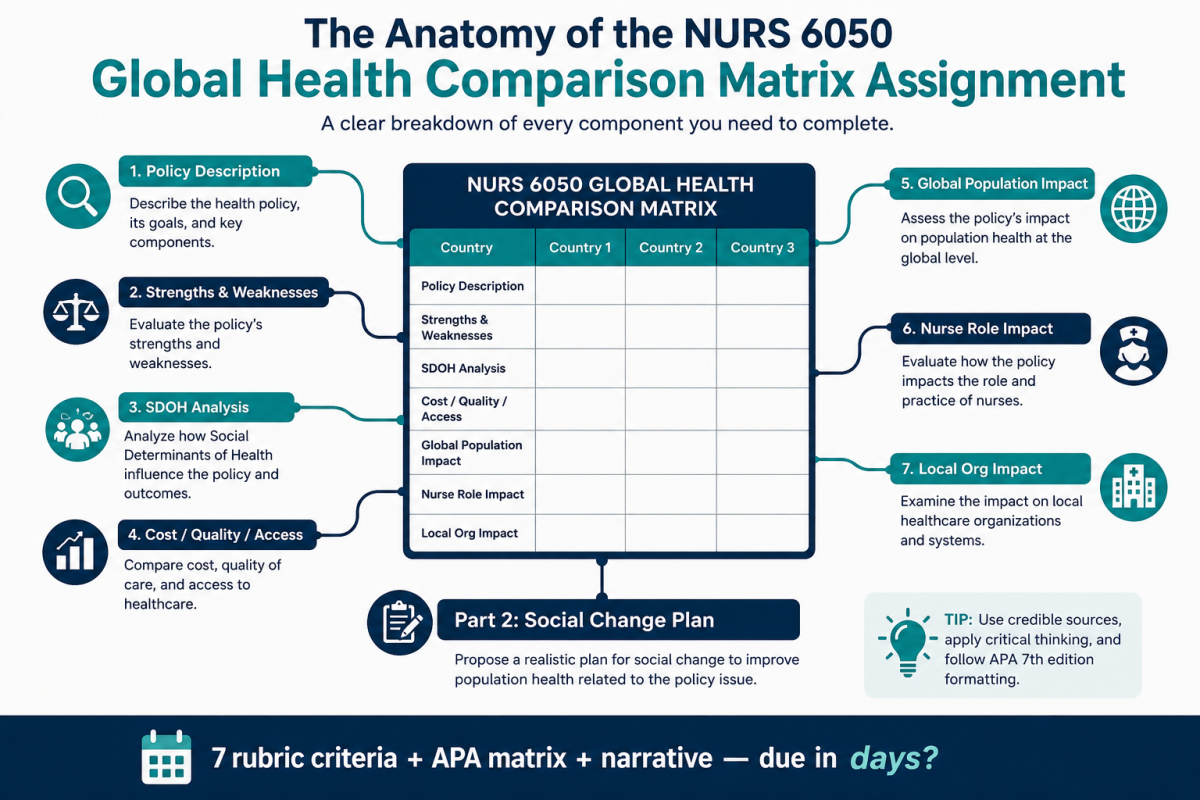
Focusing on the country you selected and the U.S., complete the Global Health Comparison Matrix. Be sure to address the following:
- Consider the U.S. national/federal health policies that have been adapted for the global health issue you selected from the WHO global health agenda. Compare these policies to the additional country you selected for study.
- Explain the strengths and weaknesses of each policy.
- Explain how the social determinants of health may impact the global health issue you selected. Be specific and provide examples.
- Using the WHO’s Organization’s global health agenda as well as the results of your own research, analyze how each country’s government addresses cost, quality, and access to the global health issue selected.
- Explain how the health policy you selected might impact the health of the global population. Be specific and provide examples.
- Explain how the health policy you selected might impact the role of the nurse in each country.
- Explain how global health issues impact local healthcare organizations and policies in both countries. Be specific and provide examples.
Part 2: A Plan for Social Change
Reflect on the global health policy comparison and analysis you conducted in Part 1 of the Assignment and the impact that global health issues may have on the world, the U.S., your community, as well as your practice as a nurse leader.
In a 1-page response, create a plan for social change that incorporates a global perspective or lens into your local practice and role as a nurse leader.
- Explain how you would advocate for the incorporation of a global perspective or lens into your local practice and role as a nurse leader.
- Explain how the incorporation of a global perspective or lens might impact your local practice and role as a nurse leader.
- Explain how the incorporation of a global perspective or lens into your local practice as a nurse leader represents and contributes to social change. Be specific and provide examples
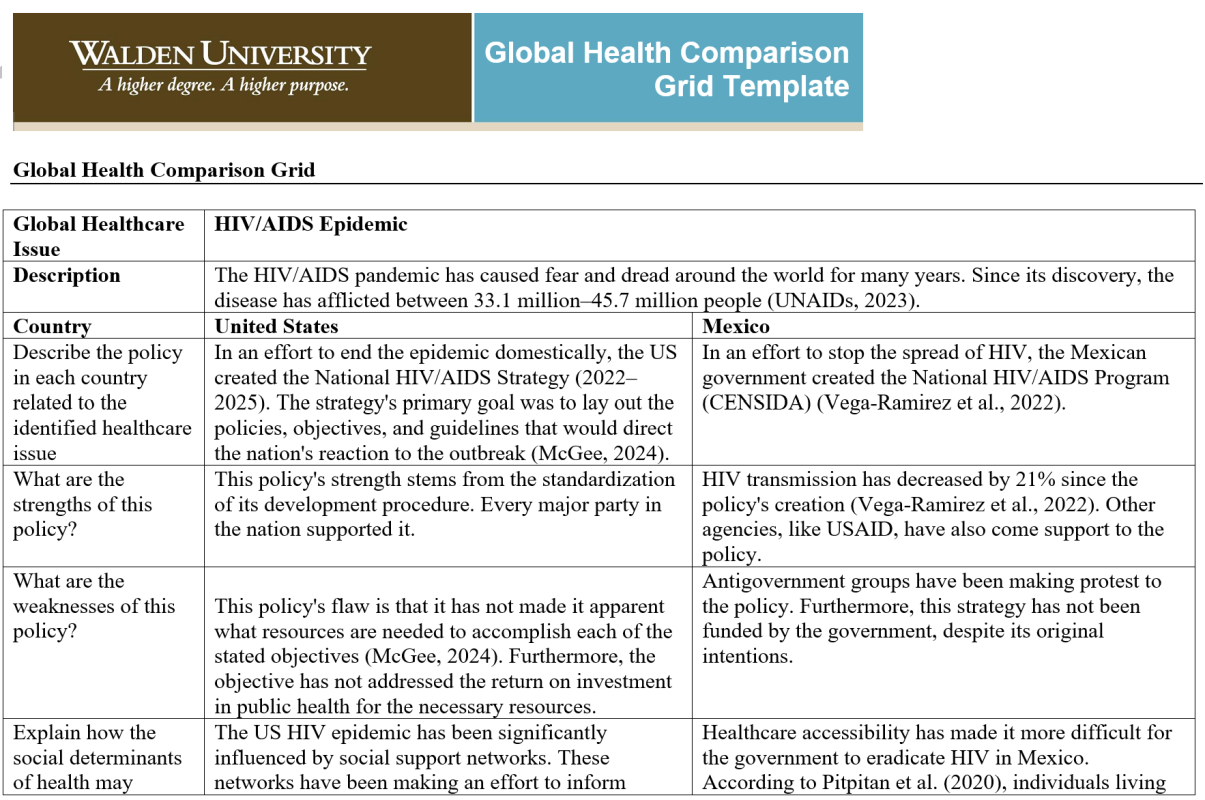
Global Health Comparison Matrix Template
USW1_NURS_6050_Global Health Comparison Grid Template
Step-by-Step Guide: Global Healthcare Comparison Matrix & Narrative Statement (NURS 6050)
STEP 1: Choose Your Global Health Issue Strategically
Best choice for 2025–2026: Non-Communicable Diseases (NCDs) and Mental Health — this is the WHO’s single highest-priority item, culminating in the landmark UN HLM4 Political Declaration adopted September 25, 2025 titled “Equity and integration: transforming lives and livelihoods through leadership and action on NCDs and mental health.”
Best country pairing: United States + Canada (strong policy contrast) or United States + Kenya/Nigeria (stronger SDOH contrast, more dramatic disparities = richer analysis).
Why NCDs/Mental Health wins:
- It is the current headline issue on the WHO global agenda
- Peer-reviewed literature from 2023–2025 is abundant
- The U.S. and comparison country will have meaningfully different policy approaches
- Mental health adds nursing role specificity (PMHNP relevance, telepsychiatry, scope of practice)
STEP 2: Build Your Research Foundation Before Writing a Single Word
Gather sources in these four buckets:
Bucket 1 – WHO/Policy documents (required)
- WHO Global Action Plan for NCDs 2013–2030
- WHO Political Declaration HLM4, September 2025
- WHO NCD Progress Monitor 2022/2025
Bucket 2 – U.S. Policy Sources
- Affordable Care Act (ACA) provisions on prevention
- National Institute of Mental Health (NIMH) Strategic Plan
- CMS Mental Health Parity rules
Bucket 3 – Comparison Country Sources
- Country-specific national health plan documents
- WHO country profiles
Bucket 4 – Peer-reviewed journals (2021–2026)
- BMJ Global Health, Nursing Outlook, Journal of Global Health, Health Affairs
STEP 3: Complete the Comparison Matrix — Row by Row (Part 1)
Organize Part 1 as a 3-column table: Row Label | United States | Comparison Country
ROW 1: Global Healthcare Issue Description
Write 3–5 sentences defining the issue using the latest WHO data. Use the 2025 HLM4 declaration language — NCDs claim 18 million lives prematurely each year, while mental health conditions affect over a billion people globally, and both are increasing in every country. This framing immediately signals currency and sophistication. WHO
ROW 2: Policy Description (U.S. and Comparison Country)
U.S. column must mention:
- The Affordable Care Act (ACA) and its prevention provisions
- Mental Health Parity and Addiction Equity Act (MHPAEA)
- Medicaid/Medicare expansion
- Healthy People 2030 NCD targets
Comparison country column (example: Canada):
- Canada Health Act (universal coverage framework)
- Pan-Canadian Health Data Strategy
- Specific provincial mental health frameworks (e.g., Ontario’s Roadmap to Wellness)
Avoid the common mistake: Don’t describe only one policy — describe the system of policies addressing the issue.
ROW 3: Strengths of Each Policy
Go beyond surface-level. For example:
- U.S. strength: The MHPAEA legally mandates parity between mental health and medical benefits in employer-sponsored insurance — a structural guarantee
- Comparison strength: Canada’s single-payer model eliminates the coverage fragmentation that drives NCD disparities in the U.S.
Cite a peer-reviewed source for each strength claim.
ROW 4: Weaknesses of Each Policy (most commonly under-scored row)
Be equally critical of both countries. The rubric explicitly requires weaknesses for EACH policy.
- U.S. weakness: ACA expansion is not universal — 10 states had not fully expanded Medicaid as of 2024, leaving millions uninsured and without NCD prevention access
- Comparison weakness (Canada): Long wait times for mental health services, significant rural-urban gaps in specialty NCD care
Support each weakness with a specific statistic or citation.
ROW 5: Social Determinants of Health (SDOH) (most commonly superficial row)
This is where most papers lose points. Do NOT just list SDOH categories. Instead, map each SDOH to a specific population in each country with data.
Structure your SDOH section like this:
| SDOH Factor | How it Impacts the Issue in U.S. | How it Impacts the Issue in Comparison Country |
|---|---|---|
| Income/Poverty | 37M Americans below poverty line; lower income = higher NCD risk due to food insecurity | [Country-specific data] |
| Education | Low health literacy → delayed NCD diagnosis; disproportionately affects minority groups | [Country-specific data] |
| Neighborhood/Environment | Food deserts, lack of walkable infrastructure increase obesity and CVD rates | [Country-specific data] |
| Race/Ethnicity | Black Americans have 40% higher cardiovascular mortality than white Americans (CDC, 2023) | [Country-specific data] |
Cite Donkin et al. (2017) — a required reading — which establishes the framework for global SDOH action.
ROW 6: Cost, Quality, and Access Analysis (triple-part row — address all three)
The rubric says: “analyze how each country’s government addresses cost, quality, and access.” Most papers combine these. Treat them as three sub-rows:
- Cost: How does each government manage the financial burden of the issue? (e.g., U.S.: insurance-based with high out-of-pocket costs; comparison: tax-funded universal model)
- Quality: What quality benchmarks or accreditation standards govern care? (e.g., U.S.: HEDIS metrics, Joint Commission standards)
- Access: Who is excluded from care and why? (e.g., rural populations, undocumented immigrants, uninsured)
ROW 7: Impact on Global Population Health
Scale up your argument here. Reference the 2025 WHO Political Declaration’s global targets: the declaration establishes targets including at least 80% of primary health care facilities having access to affordable, WHO-recommended essential medicines for NCDs and mental health, and at least 60% of countries implementing financial protection policies by 2030. WHO
Explain how the U.S. policy approach (or failure) influences global norms through its WHO membership, funding contributions, and research leadership.
ROW 8: Impact on the Role of the Nurse (most generic row in Page 1 papers)
Be specific. For each country:
- U.S.: With MHPAEA and ACA, nurses in federally qualified health centers (FQHCs) now serve as primary NCD screeners and care coordinators; PMHNPs have expanded prescriptive authority in most states; nurses are required to complete cultural competency training under CMS Conditions of Participation
- Comparison country: Describe whether nurses have expanded, limited, or unchanged roles in relation to the policy
Cite Corless et al. (2018) — a required reading — which directly addresses expanding nursing roles in global health.
ROW 9: Impact on Local Healthcare Organizations (most missed row)
Name a specific type of local organization and explain the mechanism of impact:
- “Community health centers serving Medicaid beneficiaries in rural Alabama must now comply with HRSA’s NCD prevention grant requirements, diverting administrative resources from direct patient care.”
- “Hospital systems participating in CMS Shared Savings Programs are incentivized to invest in NCD prevention infrastructure, changing staffing ratios toward community health workers.”
This level of specificity is what separates A-range papers from B-range papers.
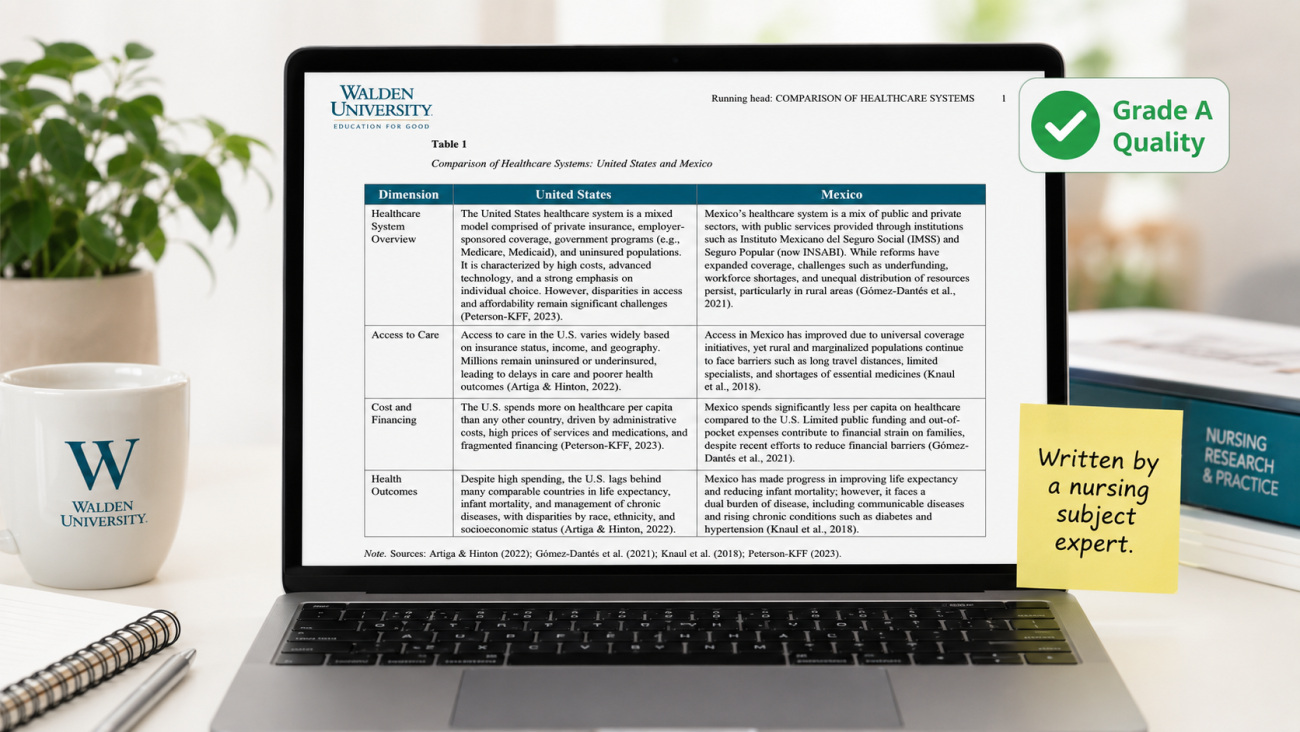
Here’s What Expert-written Looks Like. Request Yours Below
STEP 4: Write Part 2 — Plan for Social Change (1 page, narrative format)
This is NOT a table. Write in paragraphs. Most Page 1 papers are vague here — yours should have a 3-part concrete plan:
Paragraph 1 — Advocacy: Explain HOW you would advocate. Specifics matter. Example: “I would advocate for the adoption of a global health lens within our hospital’s annual competency training by proposing a structured cultural humility module that incorporates WHO SDOH frameworks, formally presenting this proposal to the Nurse Practice Council.”
Paragraph 2 — Local Practice Impact: Explain what changes in your day-to-day nursing practice. Example: “Integrating a global perspective means screening patients using validated tools (PHQ-9, AUDIT) regardless of their immigration status, recognizing that NCD risk factors documented in WHO global data are present in my local patient population.”
Paragraph 3 — Social Change Contribution: Connect your individual action to systemic change. Cite Milstead & Short (2019) on nurses as policy advocates. Argue that nurses who understand global health policy are better positioned to influence local health board decisions, contribute to community health needs assessments, and testify at legislative hearings.
STEP 5: APA Formatting & Rubric Verification Checklist
Before submitting, verify each of these:
- Title page with running head, student name, institution, course, date
- Matrix is formatted as a clear table (not prose paragraphs)
- Each matrix cell has at least one in-text APA citation
- Part 2 is narrative prose, not a table or bullet list
- Reference list includes all required readings (Milstead & Short, 2019; Corless et al., 2018; Donkin et al., 2017)
- All peer-reviewed sources are dated 2021–2026
- Strengths AND weaknesses are addressed for BOTH countries
- SDOH section names specific determinants with data
- Cost, quality, AND access are addressed separately for each country
- Nurse role impact is policy-specific, not generic
- Local healthcare organization is named or described specifically
- Social change plan includes advocacy, practice impact, AND systemic contribution

References
- World Health Organization. (2025, December 16). World leaders adopt a historic global declaration on noncommunicable diseases and mental health. https://www.who.int/news/item/16-12-2025-world-leaders-adopt-a-historic-global-declaration-on-noncommunicable-diseases-and-mental-health
- World Health Organization. (2025, June 4). WHA78: Key decisions advancing the global NCD and mental health agenda ahead of HLM4. https://www.who.int/news/item/04-06-2025-wha78–key-decisions-advancing-the-global-ncd-and-mental-health-agenda-ahead-of-hlm4
- World Health Organization. (2025, May 6). Mental health and NCDs: A shared but differentiated agenda for the 2025 UN High-level meeting. https://www.who.int/news-room/commentaries/detail/mental-health-and-ncds–a-shared-but-differentiated-agenda-for-the-2025-un-high-level-meeting
- Roth, G. A., Mensah, G. A., Johnson, C. O., et al. (2022). Global burden of cardiovascular diseases and risk factors, 1990–2019. Journal of the American College of Cardiology, 76(25), 2982–3021. https://doi.org/10.1016/j.jacc.2020.11.010
- Donkin, A., Goldblatt, P., Allen, J., Nathanson, V., & Marmot, M. (2018). Global action on the social determinants of health. BMJ Global Health, 3(Suppl 1), e000603. https://doi.org/10.1136/bmjgh-2017-000603
- Corless, I. B., Nardi, D., Milstead, J. A., Larson, E., Nokes, K. M., Orsega, S., Kurth, A. E., & Woith, W. (2018). Expanding nursing’s role in responding to global pandemics. Nursing Outlook, 66(4), 412–415. https://doi.org/10.1016/j.outlook.2018.06.003
- U.S. Department of Health and Human Services. (2023). Healthy People 2030: Mental health and mental disorders. https://health.gov/healthypeople/objectives-and-data/browse-objectives/mental-health-and-mental-disorders
- Winkler, V., Aigner, A., & Leitzmann, M. (2022). Non-communicable diseases across the globe: A systematic analysis of WHO data. BMC Public Health, 22(1), 1–14. https://doi.org/10.1186/s12889-022-14351-7
- Patel, V., Saxena, S., Lund, C., Thornicroft, G., Baingana, F., Bolton, P., … & UnÜtzer, J. (2022). The Lancet Commission on global mental health and sustainable development. The Lancet, 392(10157), 1553–1598. https://doi.org/10.1016/S0140-6736(18)31612-X
- Singh, G. K., & Siahpush, M. (2023). Widening rural-urban disparities in all-cause mortality and mortality from major causes of death in the USA, 2011–2022. Journal of Urban Health, 100(1), 14–29. https://doi.org/10.1007/s11524-022-00698-2
- American Nurses Association. (2023). Nursing’s social policy statement: The essence of the profession. https://www.nursingworld.org/practice-policy/nursing-excellence/official-position-statements/
- Milstead, J. A., & Short, N. M. (2019). Health policy and politics: A nurse’s guide (6th ed.). Jones & Bartlett Learning. (Required text — use throughout for nurse policy advocacy framework)

Rubric
| Criteria | Ratings | Pts | ||||
|---|---|---|---|---|---|---|
|
Global Healthcare Issues and PoliciesPart 1: Global Health Comparison MatrixFocusing on the country you selected and the U.S., complete the Global Health Comparison Matrix. Be sure to address the following:• Consider the U.S. national/federal health p
|
|
50 pts
|
||||
|
The Nurse’s Role in Global HealthcarePart 2: A Plan for Social ChangeReflect on the global health policy comparison and analysis you conducted in Part 1 of the Assignment. In a 1-page response, create a plan for social change that incorporates a global perspective or lens into your local practice and role as a nurse leader.• Explain how you would advocate for the incorporation of a global perspective or lens into your local practice and role as a nurse leader.• Explain how the incorporation of a global perspective or lens might impact your local practice and role as a nurse leader.• Explain how the incorporation of a global perspective or lens into your local practice as a nurse leader represents and contributes to social change. Be specific and provide examples.
|
|
35 pts
|
||||
|
Written Expression and Formatting – Paragraph Development and Organization: Paragraphs make clear points that support well developed ideas, low logically, and demonstrate continuity of ideas.Sentences are carefully focused– neither long and rambling nor short and lacking substance. A clear and comprehensive purpose statement and introduction is provided which delineates all required criteria.
|
|
5 pts
|
||||
|
Written Expression and Formatting – English Writing Standards: Correct grammar, mechanics, and proper punctuation
|
|
5 pts
|
||||
|
Written Expression and Formatting:The paper follows correct APA format for title page, font, spacing, parenthetical/in-text citations, and reference list).
|
|
5 pts
|
||||
|
Total Points: 100
|
||||||