
Blog
Depression Patient Guide for Special Populations (Pregnancy, Teens, Elderly, Children)

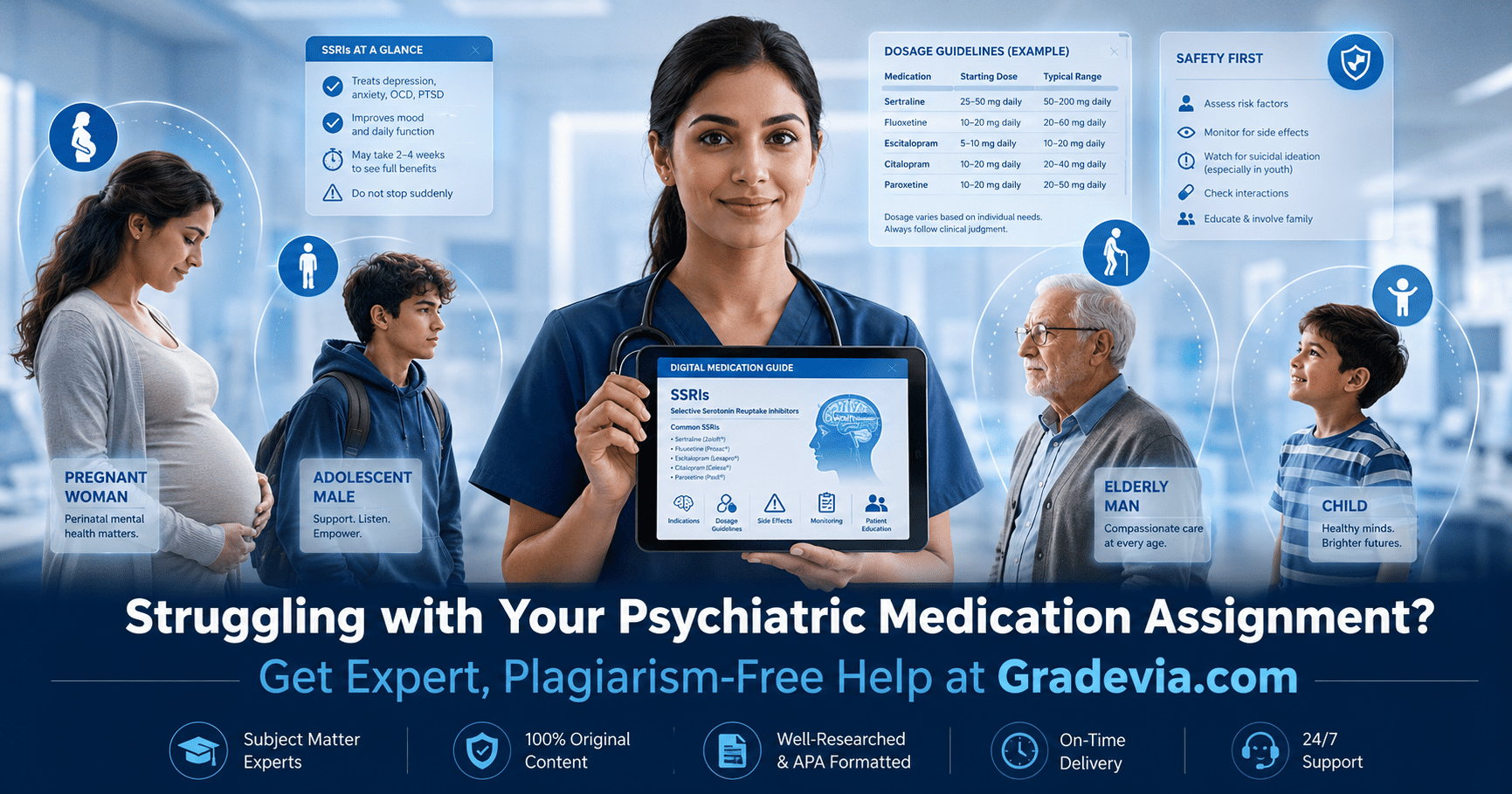
Depression Medication Guide for Special Populations (Pregnancy, Teens, Elderly, Children)
Understanding that prescribing medication is not the same for all individuals is imperative to becoming a safe and effective psychiatric nurse practitioner. In clinical practice, you will see many patients in different stages of their lives and need to consider these in developing your prescribing treatment plan.
For this Assignment, you will choose a vulnerable patient and develop a 2- to 3-page Medication Guide for them and their family. In your guide, you will consider their ages, birth-assigned sex, FDA approvals, and considerations for increased or decreased risk for side effects. You will choose the most appropriate medication for each of these individuals. Support your answers with evidence-based, peer-reviewed scholarly literature. APA style format title page, citations and references will apply.
Note: You will not set up this Medication Guide as a paragraph-formatted paper but, instead, as a creative, visually appealing guide.
Resources
Be sure to review the Learning Resources before completing this activity.
Click the weekly resources link to access the resources.
To prepare for this Assignment:
- Select a vulnerable patient from the list provided.
- Consider age, birth-assigned sex, FDA approvals, and risk and side-effect consideration.
- Select the most appropriate medication for your selected patient based upon the information provided.
- Review the textbook for commonly prescribed antidepressants, Fast Facts for Psychopharmacology for Nurse Practitioners.
- Review the textbook Stahl’s essential psychopharmacology: Neuroscientific basis and practical applications (5th ed.). Chapters assigned
- Conduct research through the FDA website Links to an external site..
- Review prescriber information for professionals of the medications.
Note: These can be located free online with web search. - Review national guidelines for prescribing for these vulnerable individuals:
The Assignment
Step 1: Choose one of the following vulnerable patients to create a Medication Guide for the patient:
- Patient 1: 26-year-old female with a diagnosis of major depressive disorder and social anxiety disorder who is increasing in isolation and poor self-care. She is in her third trimester of pregnancy.
- Patient 2: 16-year-old male with a diagnosis of major depressive disorder, severe. He has seen a therapist weekly for the past 6 months and has had minimal change in symptoms. He has expressed thoughts of wanting to die.
- Patient 3: 72-year-old male with diagnosis of major depressive disorder and panic disorder. He has cardiac history and takes antihypertensive medications.
- Patient 4: 8-year-old Asian female with a diagnosis of severe depressive disorder presents to the office with a report of worsening symptoms. She has never taken psychotropic medication before.
Step 2: Create a Medication Guide for a patient. In your guide, you should provide the following specific instructions for the patient:
- Describe the chosen classification of medications, from the classification category, for your chosen vulnerable patient. Explain your rationale for your choice.
- Explain what dose you would start the chosen medication with and the frequency.
- Discuss how the medication works to treat their symptoms.
- Explain how long they should take the medication.
- Discuss the typical or common side effects of the medication.
- Explain the urgent or emergent considerations for the patient taking the medication.
The Medication Guide should also include:
- Directions you would provide the patient on how to take the prescribed medication
- Instructions on what the patient should do if a medication dose is missed
- List of any other medications, over-the-counter medications, and/or supplements/herbals the patient should avoid while taking the prescribed medication
- List of foods the patient should avoid when taking this medication
- Date when the patient should return for follow-up visit with you
- Discussion about the legal and ethical considerations for the medication being prescribed
- Answers in consideration of Social Determinants of Health on how you would:
- Assist the patient who cannot not afford to pay financially for the medication you are recommending/prescribing; and/or
- Has difficulty with transportation that impacts their ability to present for regular appointments with you
- Discuss how financial hardship and lack of transportation could relate to Social Determinants of Health, as well as why they are important considerations for you as a prescriber.
Depression Medication Guide for Special Populations (Pregnancy, Teens, Elderly, Children)
Introduction
Treating major depressive disorder (MDD) in vulnerable populations requires careful clinical judgment. Factors such as age, pregnancy status, comorbidities, and FDA approvals significantly influence medication selection, dosing, and monitoring.
This guide provides evidence-based medication recommendations for four high-risk patient groups:
- Pregnant adult
- Suicidal adolescent
- Elderly patient with cardiac disease
- Pediatric patient (child)
👩🍼 Patient 1: Pregnant Female (26 Years Old, 3rd Trimester)

💊 Recommended Medication
Sertraline (SSRI)
✅ Rationale
- First-line antidepressant in pregnancy
- Favorable safety profile (low teratogenic risk)
- Minimal infant exposure during breastfeeding
- Supported by ACOG & APA guidelines
💉 Dosing
- Start: 25–50 mg daily
- Target: 50–200 mg/day
⚙️ Mechanism
Increases serotonin availability → improves mood, sleep, and anxiety symptoms.
⚠️ Side Effects
- Nausea
- Fatigue
- Sexual dysfunction
- Headache
🚨 Pregnancy Considerations
- Risk of neonatal adaptation syndrome (usually mild)
- Untreated depression → higher risk (preterm birth, poor self-care)
📅 Follow-Up
- Every 2–4 weeks
- Coordinate with OB-GYN
⚖️ Ethical Considerations
- Balance maternal vs fetal risk
- Shared decision-making required
👦 Patient 2: Adolescent Male (16 Years, Severe Depression, Suicidal Ideation)
💊 Recommended Medication
Fluoxetine
✅ Rationale
- FDA-approved for ≥8 years
- Strongest evidence for adolescents
- First-line in clinical guidelines
💉 Dosing
- Start: 10 mg/day
- Increase: 20 mg/day after 1 week
🚨 BLACK BOX WARNING
- Increased risk of suicidal thoughts
Monitor for:
- Agitation
- Mood worsening
- Behavioral changes
⚠️ Side Effects
- Insomnia
- Anxiety (early)
- GI upset
📅 Follow-Up
- 1–2 weeks initially (critical)
- Frequent monitoring required
⚖️ Legal Considerations
- Requires parental consent + patient assent
- Mandatory safety planning
👴 Patient 3: Elderly Male (72 Years, Cardiac History)
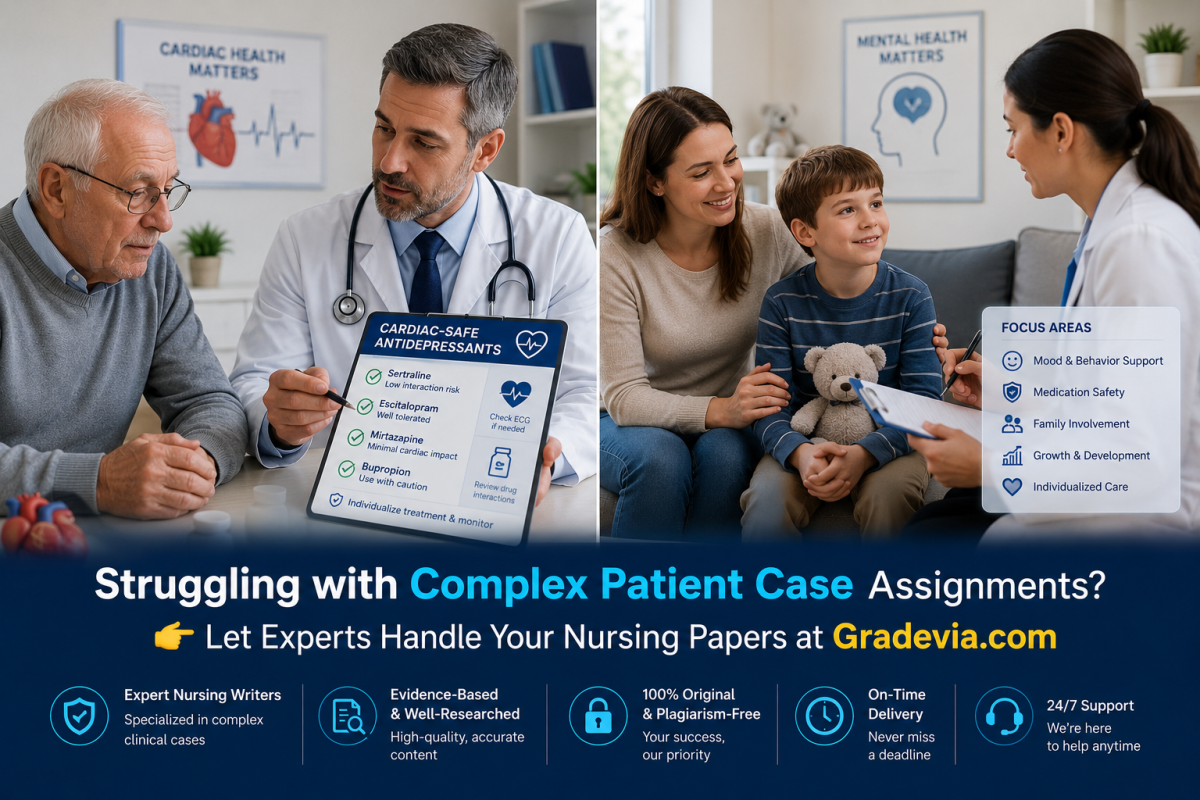
💊 Recommended Medication
Sertraline
✅ Rationale
- Low cardiac risk compared to TCAs
- Minimal QT prolongation
- Safe with antihypertensives
💉 Dosing
- Start: 25 mg/day
- Titrate slowly
⚙️ Special Considerations
- Increased sensitivity to side effects
- Risk of:
- Hyponatremia
- Falls
⚠️ Side Effects
- Dizziness
- Fatigue
- Electrolyte imbalance
🚨 Drug Interactions
- Monitor with:
- Beta-blockers
- Antihypertensives
📅 Follow-Up
- Every 2–4 weeks
- Monitor sodium levels
⚖️ Ethical Considerations
- Assess decision-making capacity
- Avoid polypharmacy
👧 Patient 4: Child (8-Year-Old Female, Severe Depression)
💊 Recommended Medication
Fluoxetine
✅ Rationale
- Only FDA-approved SSRI for young children
- Strong evidence for pediatric depression
💉 Dosing
- Start: 10 mg/day
- Increase cautiously
⚠️ Side Effects
- Behavioral activation
- Sleep changes
- Appetite changes
🚨 Critical Monitoring
- Watch for:
- Irritability
- Hyperactivity
- Suicidal thoughts
📅 Follow-Up
- Weekly initially
⚖️ Legal Considerations
- Requires parental consent
- Child assent encouraged
📋 General Medication Instructions (All Patients)
✔️ How to Take Medication
- Take daily at the same time
- Do not stop abruptly
❗ Missed Dose
- Take ASAP
- Skip if close to next dose
- Never double dose
🚫 Avoid These Substances
- MAOIs
- St. John’s Wort
- Alcohol (especially elderly & adolescents)
🍽️ Food Considerations
- No strict restrictions
- Limit caffeine
🌍 Social Determinants of Health (SDOH)
💰 Financial Barriers
- Use generic SSRIs (low cost)
- Assistance options:
- Medicaid
- Discount programs
🚗 Transportation Issues
- Telehealth visits
- Community mental health clinics
- School-based services
📊 Why SDOH Matters
- Poor access → treatment failure
- Missed appointments → relapse risk
- Financial stress worsens depression
🧠 Key Clinical Takeaways
- SSRIs are first-line across all populations, but selection varies
- Fluoxetine → best for children & adolescents
- Sertraline → safest for pregnancy & elderly
- Monitoring is critical for suicide risk and side effects
- Always integrate psychotherapy + medication
📚 References
American Psychiatric Association. (2023). Practice guideline for the treatment of patients with major depressive disorder. https://www.apa.org/depression-guideline
American College of Obstetricians and Gynecologists (ACOG). (2022). Treatment of depression during pregnancy.
U.S. Food and Drug Administration. (2024). Antidepressant prescribing information.
Stahl, S. M. (2021). Stahl’s essential psychopharmacology (5th ed.).
Stahl, S. M. (2022). Prescriber’s guide (7th ed.).
Centers for Disease Control and Prevention (CDC). (2023). Mental health surveillance among children and adults.
Substance Abuse and Mental Health Services Administration (SAMHSA). (2024). 988 Suicide & Crisis Lifeline. https://www.samhsa.gov/mental-health/988
NURS_6630_Week3_Assignment_Rubric
| Criteria | Ratings | Pts |
|---|---|---|
|
Selected patient guide describes how the medication works, length of use, side effects, and other considerations. The student patient guide addresses all of the specific information for the patient as outlined in the Assignment directions. |
||
|
The medication guide is accurate in information and written for the appropriate patient audience. The medication guide is creative and visually appealing. |
||
|
Ethical and Legal considerations are discussed. |
||
|
Social determinants of health considerations are applied regarding financial responsibility and ability to attend appointments. |
||
|
Written Expression and Formatting—English writing standards: Correct grammar, mechanics, and proper punctuation |
||
|
Written Expression and Formatting: The submission contains an APA format for title page, citations, and Reference List. |