
Blog
NRNP 6635 Psychopathology and Diagnostic Reasoning: PMHNP Clinical Guide for Walden University Students


NRNP 6635 Psychopathology and Diagnostic Reasoning
Introduction: What NRNP 6635 Really Prepares You For
Psychiatric misdiagnosis is not a theoretical problem. It walks into your clinic wearing the face of someone who has been labeled treatment-resistant for a decade — when, in fact, no one has ever taken a thorough history. NRNP 6635: Psychopathology and Diagnostic Reasoning is Walden University’s foundational PMHNP practicum course designed specifically to prevent that clinical failure. It does not teach you to memorize the DSM-5-TR. It teaches you to reason.
Most students entering NRNP 6635 arrive with strong pharmacology knowledge from NURS 6630 and a general understanding of advanced health assessment from NURS 6512. What they often lack — and what this course builds methodically — is the clinical reasoning infrastructure to move from a patient’s chief complaint to a defensible, evidence-based differential diagnosis. That is a different cognitive skill, and it requires deliberate cultivation.
This guide is written for PMHNP students currently enrolled in or preparing for NRNP 6635 at Walden University. It is not a shortcut or an exam cheat sheet. It is the kind of expert clinical context that textbooks summarize and professors gesture toward but rarely spell out clearly: what this course demands, why it matters, how to excel in every assignment, and how the skills you build here form the clinical backbone of every subsequent PMHNP course — and every patient encounter you will have for the rest of your career.
Course Overview: Structure, Grading, and Where NRNP 6635 Fits
Course Description and Position in the PMHNP Sequence
NRNP 6635 is a 3-credit, 11-week course offered through Walden University’s College of Nursing. Per the Summer 2026 syllabus, the course prepares PMHNPs to use knowledge of psychopathology and diagnostic reasoning for health promotion, psychiatric assessment, and developing differential diagnoses for patients with psychiatric and substance use disorders across the lifespan.
It is a prerequisite bridge course — you cannot proceed to NRNP 6645 (Psychotherapy with Multiple Modalities) or NRNP 6665 (PMHNP Care Across the Lifespan I) without passing it. Its prerequisites include NURS 6501, NURS 6521, NURS 6512, NURS 6052, and NURS 6630, meaning students arrive with graduate-level pathophysiology, pharmacology, and advanced health assessment already under their belts. NRNP 6635 demands you synthesize all of it through a psychiatric lens.
Grading Breakdown: What Actually Matters
| Component | Total Points | Weighted % |
|---|---|---|
| Discussions (x2) | 200 | 10% |
| Assignments (x5) | 500 | 40% |
| Exams (x2 — Midterm + Final) | 200 | 50% |
| Total | 900 | 100% |
Clinical insight: Exams carry 50% of your grade — the single largest weighted component. Many students over-invest in assignments and under-prepare for the tests. Build exam study habits from Week 1, not Week 10.
Required Course Texts
- Carlat, D. J. (2024). The psychiatric interview (5th ed.). Wolters Kluwer. — This is your clinical Bible for the course. Every structured encounter, every MSE, every interview technique traces back here.
- Boland, R., Verduin, M. L., & Ruiz, P. (2022). Kaplan & Sadock’s synopsis of psychiatry (12th ed.). Wolters Kluwer. — The reference you will annotate, dog-ear, and return to throughout your entire PMHNP career.
Assignment Due Dates (Summer 2026)
- Week 1 Discussion — May 27, 2026
- Week 2 Discussion — June 3, 2026
- Week 3 Assignment — June 14, 2026
- Week 4 Assignment — June 21, 2026
- Week 6 Midterm Exam — July 4, 2026
- Week 7 Assignment — July 12, 2026
- Week 8 Assignment — July 19, 2026
- Week 10 Assignment — August 2, 2026
- Week 11 Final Exam — August 8, 2026
Psychopathology as a Clinical Discipline: Beyond the DSM Checklist
Graduate nursing students are often told to ‘apply the DSM-5-TR.’ What this instruction usually produces is a student who reads the diagnostic criteria, matches symptoms to bullet points, and arrives at a diagnosis that is technically defensible but clinically shallow. NRNP 6635 demands more than that.
Psychopathology, properly understood, is the study of how biological vulnerabilities, psychological stressors, developmental disruptions, and social determinants combine to produce suffering that we then classify into diagnostic categories. The categories are useful tools — not truth. A PMHNP who forgets that distinction will misdiagnose patients regularly and confidently.
The Biopsychosocial Model in Practice
Every comprehensive psychiatric evaluation you write in this course, and every patient encounter you document as a PMHNP, requires integration across three axes:
- Biological: Genetic predisposition, neurochemistry, medical comorbidities, substance exposure, prescribed medications, metabolic factors (thyroid function, B12, inflammatory markers), sleep architecture disruption.
- Psychological: Developmental history, attachment patterns, cognitive schemas, prior trauma, history of psychiatric treatment and response, current coping mechanisms, insight and judgment.
- Social: Family dynamics, housing stability, occupational function, cultural identity, religious/spiritual frameworks, socioeconomic stressors, social support, access to care, legal history.
A patient presenting with depressed mood, anhedonia, and fatigue is not automatically a MDD case. Before you anchor on that diagnosis, you must rule out hypothyroidism, anemia, vitamin D deficiency, sleep apnea, early bipolar II, adjustment disorder, grief, and substance use — among other possibilities. That is the biopsychosocial model applied clinically, not just described theoretically.
DSM-5-TR vs. ICD-10-CM: Why PMHNPs Must Know Both
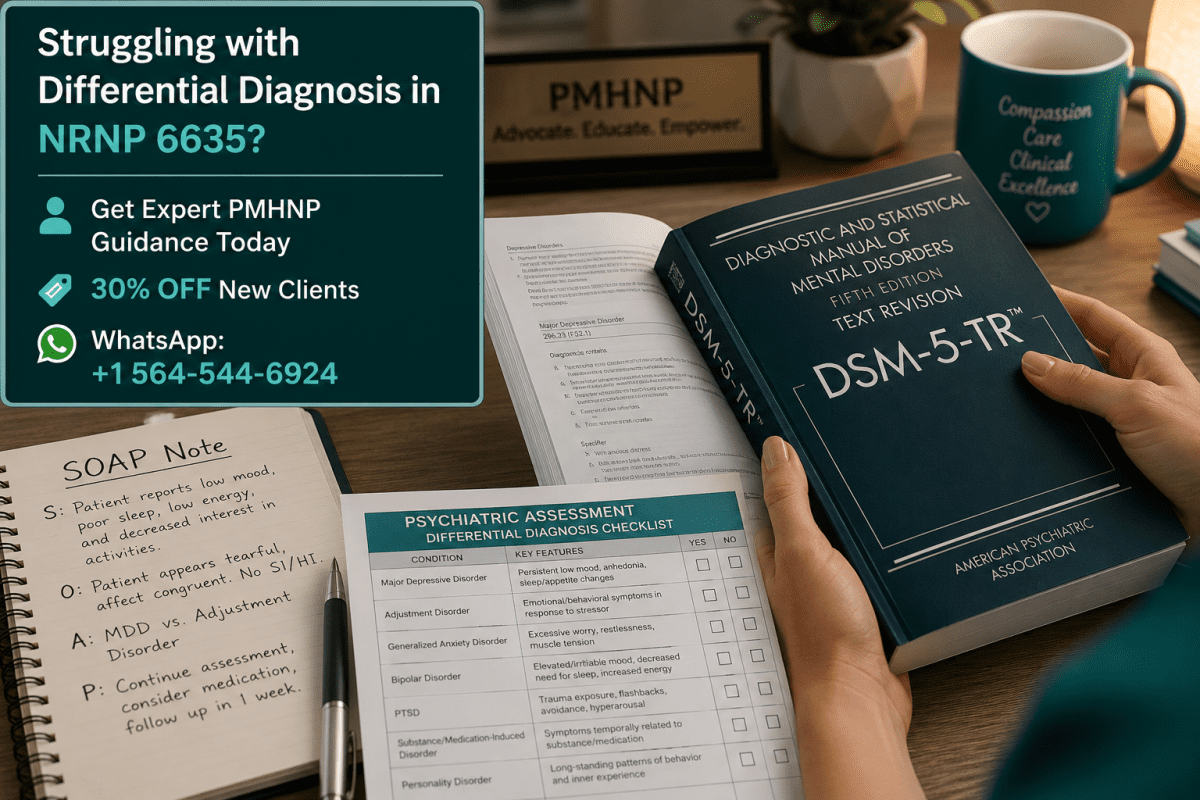
The DSM-5-TR (APA, 2022) is the diagnostic framework used for clinical decision-making and research. The ICD-10-CM is the coding system required for billing. As a PMHNP, you will document your assessment using DSM-5-TR language, then translate to ICD-10-CM codes for insurance reimbursement. NRNP 6635 trains you on DSM-5-TR application; your billing literacy must develop in parallel.
Key example: A patient meets criteria for Major Depressive Disorder, single episode, moderate severity. DSM-5-TR diagnosis. ICD-10-CM code: F32.1. Both appear in a properly documented clinical note.
Cognitive Bias in Psychiatric Diagnosis
One of the most clinically important, and least discussed, concepts in NRNP 6635 is cognitive bias in diagnostic reasoning. Premature closure (anchoring on an initial diagnosis and failing to revise it with new information) is one of the most common causes of psychiatric misdiagnosis. Other relevant biases include:
- Confirmation bias: Seeking information that confirms an initial hypothesis while discounting contradictory evidence.
- Availability heuristic: Diagnosing a patient with a condition you recently saw in another patient, regardless of fit.
- Attribution error: Assuming a patient’s symptoms are ‘personality-based’ without systematic ruling out of Axis I conditions.
- Framing effects: Allowing the referral source’s diagnosis to anchor your own assessment before you’ve interviewed the patient independently.
Carlat (2024) addresses these cognitive traps explicitly in The Psychiatric Interview. Learning to recognize and counteract them is not just academic — it is the difference between a PMHNP who helps patients and one who perpetuates years of misdiagnosis.
The Psychiatric Interview and Mental Status Exam: Your Core Clinical Instrument

In medicine, the stethoscope is an assessment tool. In psychiatry, you are the assessment tool. The way you ask a question, pace a silence, reflect an emotion, and structure your inquiry determines the quality of the diagnostic information you receive. No algorithm replaces clinical skill in the psychiatric interview — and NRNP 6635 begins building that skill from the first week.
The 10 Domains of the Mental Status Exam (MSE)
The MSE is the objective portion of your psychiatric assessment and must be documented in every comprehensive psychiatric evaluation note. Here is how each domain functions clinically; not as a definition, but as a clinical reasoning tool:
- Appearance: Grooming, hygiene, clothing appropriateness for context, apparent vs. stated age, body habitus, visible signs of self-neglect or self-harm. Disheveled appearance in a previously well-groomed patient signals decompensation.
- Behavior/Psychomotor Activity: Agitation, retardation, tics, stereotypies, tremor. Psychomotor retardation in a patient reporting ‘just stress’ should raise your suspicion for MDD with melancholic features.
- Attitude Toward Examiner: Cooperative, guarded, hostile, seductive, dramatic, dismissive. Guardedness in a first interview may reflect paranoia, trauma history, or appropriate wariness — context matters.
- Mood vs. Affect: Mood is the patient’s self-reported subjective state. Affect is your objective observation of their emotional expression. The critical clinical skill is documenting discordance — a patient who reports ‘fine’ while describing suicidal planning demonstrates affect incongruent with content.
- Speech: Rate (rapid, slowed, pressured), volume, tone, latency, spontaneity, coherence. Pressured speech with decreased sleep strongly suggests a manic or hypomanic episode.
- Thought Process: The how of thinking — whether it is logical and goal-directed, circumstantial, tangential, loosely associated, or frankly disorganized. Distinguish thought process from thought content.
- Thought Content: The what of thinking — suicidal ideation, homicidal ideation, obsessions, compulsions, phobias, delusions, ideas of reference, magical thinking, overvalued ideas.
- Perceptual Disturbances: Hallucinations (auditory, visual, tactile, olfactory, gustatory), illusions, depersonalization, derealization. Always ask about hallucinations — patients rarely volunteer them.
- Cognition: Orientation x4 (person, place, time, situation), attention, concentration, immediate/short-term/long-term memory, fund of knowledge, abstract reasoning, calculation ability. This domain connects to formal cognitive assessment tools (MoCA, MMSE).
- Insight and Judgment: Insight — does the patient recognize they have a psychiatric condition? Judgment — can they make reasonable decisions about their safety and care? Poor insight directly impacts treatment engagement and capacity to consent.
Validated Assessment Tools Used in NRNP 6635
| Tool | Condition Assessed | Population | Format |
|---|---|---|---|
| PHQ-9 | Depression | Adults/Adolescents | Self-report (9 items) |
| GAD-7 | Generalized Anxiety | Adults/Adolescents | Self-report (7 items) |
| C-SSRS | Suicide risk severity | All ages | Clinician-administered |
| MoCA | Cognitive screening | Adults | Clinician-administered |
| Conners 3rd Ed. | ADHD | Children 6-18 | Multi-informant |
| Hamilton Anxiety | Anxiety severity | Adults | Clinician-administered |
| Hamilton Depression | Depression severity | Adults | Clinician-administered |
| AUDIT/CAGE | Alcohol use | Adults | Self-report/interview |
The Conners 3rd Edition is specifically featured in Week 8 of NRNP 6635 assignments. Know its psychometric properties: sensitivity, specificity, normative data, T-scores, and appropriate use window (ages 6-18). Expect questions about it on the midterm.
Culturally Responsive Psychiatric Interviewing
The Summer 2026 NRNP 6635 curriculum includes case studies featuring patients from diverse ethnic, cultural, and socioeconomic backgrounds — including presentations involving Native American patients with substance use histories. Culturally responsive interviewing is not an add-on; it is a clinical competency.
Racial and ethnic disparities in psychiatric diagnosis are well-documented. Black patients are disproportionately diagnosed with schizophrenia and underdiagnosed with bipolar disorder. Immigrant patients may present with culturally specific idioms of distress that do not map directly to DSM-5-TR criteria. Women, particularly women of color, are more likely to have ADHD, ASD, and PTSD go unrecognized or misattributed. A PMHNP who does not actively account for these patterns will replicate the very inequities that worsen mental health outcomes in underserved populations (Metzl & Hansen, 2014; Alegria et al., 2021).
Week-by-Week Clinical Focus: What NRNP 6635 Actually Covers
Rather than a generic summary of each week, what follows is a clinician’s interpretation of the content arc — organized around the diagnostic reasoning skills each module is building, and the clinical traps it is training you to avoid.
Weeks 1-2: Assessment Foundations and Practicum Orientation
The first two weeks establish your assessment infrastructure. You are introduced to the course framework and begin developing your clinical practicum planning guide — a structured document that defines your learning objectives for the semester in partnership with your preceptor. This is not busywork. PMHNPs who enter practicum without clear learning goals leave with unfocused clinical experience.
The foundational question these weeks are answering: What does a complete psychiatric assessment require, and how do you structure it systematically? The answer, drawn from Carlat (2024) and Boland et al. (2022), involves learning to gather a comprehensive history that includes HPI, psychiatric history, medical history, family psychiatric history, developmental history, social history, substance use history, and trauma history — in a way that feels like a conversation, not an interrogation.
Weeks 3-4: Neurodevelopmental and Mood Disorders
ADHD Across the Lifespan (Week 3)
ADHD is among the most frequently misdiagnosed and underdiagnosed conditions in PMHNP practice. The diagnostic picture changes substantially by age and by sex. Hyperactive-impulsive presentations in young boys are easily recognized; inattentive presentations in adult women are routinely missed and misattributed to anxiety or depression.
Key diagnostic considerations the course emphasizes: Symptoms must be present before age 12, present in at least two settings, not better explained by another condition, and cause clinically significant impairment. The Conners 3rd Edition rating scale gathers multi-informant data (parent, teacher, self) to capture cross-setting presence of symptoms — a critical DSM-5-TR requirement.
Clinical pearl: Always rule out anxiety before anchoring on ADHD. Anxiety produces inattention, restlessness, and poor concentration — the same surface presentation as ADHD. The differential hinges on whether the core dysfunction is emotional dysregulation/worry (anxiety) or executive function/working memory deficits (ADHD). Many patients have both.
Mood Disorders: MDD, Bipolar I and II, PDD (Week 4)
The mood disorder differential is clinically treacherous, and NRNP 6635 treats it with appropriate seriousness. The most consequential diagnostic error in this category is prescribing an SSRI to a patient in the depressed phase of Bipolar II without a mood stabilizer — which risks precipitating a mixed or manic episode. The clinical interview must always screen for lifetime hypomanic episodes before diagnosing MDD, even when the patient presents in depression.
Other critical differentials in this module: Persistent Depressive Disorder (dysthymia) vs. MDD with partial remission; MDD with psychotic features vs. schizoaffective disorder, depressive type; premenstrual dysphoric disorder vs. MDD with perimenstrual exacerbation. Each requires not just criterion-matching but clinical history-taking that surfaces the diagnostic distinctions.
Weeks 5-6: Anxiety, Trauma, Psychotic Disorders, and Midterm
Anxiety Spectrum and PTSD (Week 5)
Generalized Anxiety Disorder, Panic Disorder, Social Anxiety Disorder, OCD, and PTSD are clinically distinct but symptomatically overlapping. The key axis of differentiation is the nature of the feared stimulus and the response pattern it generates. Panic disorder involves recurrent, unexpected panic attacks with anticipatory worry about future attacks. PTSD involves intrusive re-experiencing, hyperarousal, and avoidance tied to a specific traumatic event or events.
Complex PTSD — characterized by affect dysregulation, dissociation, identity disturbance, and relational disruption beyond the core PTSD symptom cluster — is not currently a formal DSM-5-TR diagnosis (it is recognized in ICD-11). Many of your patients will present with this picture, and recognizing it clinically even without a formal code requires understanding its phenomenology (Herman, 2023; Cloitre et al., 2022).
Psychotic Disorders (Week 6) — and the Midterm
The schizophrenia spectrum is the most biologically severe category in DSM-5-TR and the one with the most clinical nuance at the diagnostic boundary. Distinguishing first-episode psychosis from substance-induced psychotic disorder, from a manic episode with psychotic features, from brief psychotic disorder, requires a timeline of symptom onset that you can only construct with thorough history-taking.
The midterm (due July 4, 2026) covers Weeks 1-5 content. High-yield topics: DSM-5-TR criteria for core disorders by category, neurotransmitter-to-disorder associations, validated rating scales and their appropriate use, and clinical reasoning about common differentials.
Weeks 7-8: Personality Disorders and Substance Use
Personality Disorders (Week 7)
Personality disorders are the most stigmatized diagnostic category in all of psychiatry — and one of the most clinically important. The most common source of missed diagnosis is clinician discomfort with the diagnosis of Borderline Personality Disorder (BPD), leading to repeated bipolar II diagnoses in patients whose core presentation involves unstable identity, frantic abandonment fears, and chronic emptiness — not episodic hypomanic periods.
The BPD vs. Bipolar II differential is one of the highest-yield clinical questions in NRNP 6635 and on PMHNP board examinations. The key distinction: In BPD, mood dysregulation is triggered by interpersonal events and lasts hours to days. In Bipolar II, hypomanic episodes are sustained (at least 4 days), not solely reactive to triggers, and represent a clear change from baseline with increased energy and decreased sleep need (Zimmermann et al., 2021).
Substance-Related and Addictive Disorders (Week 8)
This module addresses one of the highest-prevalence and most complex areas of PMHNP practice: co-occurring psychiatric and substance use disorders. The clinical principle that no psychiatric diagnosis should be finalized until the patient has had adequate sober time is foundational — but the timeframe varies by substance. Alcohol psychosis can resolve within days; methamphetamine-induced symptoms may take weeks to months.
NRNP 6635 Week 8 assignments require a comprehensive psychiatric evaluation of a patient with substance use, and often involve presentations like the one embedded in course case studies — a 43-year-old patient with polysubstance use (methamphetamines and alcohol) presenting for sobriety. Accurate differential diagnosis requires applying DSM-5-TR Substance Use Disorder criteria (severity: mild 2-3, moderate 4-5, severe 6+ criteria), assessing for medical complications, and formulating a treatment plan that integrates both the SUD and any comorbid psychiatric diagnosis.
Weeks 9-10: Neurocognitive Disorders
The cognitive neuroscience module addresses the clinical triad that every PMHNP working with elderly or medically complex patients must master: differentiating delirium, dementia, and depression — the Three Ds.
| Feature | Delirium | Dementia | Depression |
|---|---|---|---|
| Onset | Acute (hours-days) | Gradual (months-years) | Weeks to months |
| Course | Fluctuating, worse at night | Slowly progressive | Persistent, may fluctuate |
| Attention | Severely impaired | Relatively preserved early | Variably impaired |
| Consciousness | Altered | Clear until late stages | Clear |
| Memory | Impaired (acute) | Impaired early (short-term) | Subjective > objective deficit |
| Key Clinical Flag | Identify/treat cause URGENTLY | MoCA score, ADL decline | Cognitive complaints without objective loss |
Week 11: Final Exam
The final exam (due August 8, 2026) is comprehensive, covering all 11 weeks of content. Review every disorder category systematically: DSM-5-TR criteria, first-line treatments, key differentials, and validated rating scales. The exam is administered in Canvas and auto-submits when time elapses. Use Chrome or Firefox, disable all other browser windows, and do not use portable devices.
Mastering the Comprehensive Psychiatric Evaluation Note
The comprehensive psychiatric evaluation (CPE) note is the primary deliverable in NRNP 6635 assignments. Most students write technically adequate notes. Fewer write clinically excellent ones. The difference matters; not just for your grade, but because the clinical thinking your note reflects is the thinking you will bring to actual patient care.
The Anatomy of an Outstanding CPE SOAP Note
S — Subjective
The subjective section captures everything the patient reports. It is not a transcript; it is a clinically organized synthesis. Structure it as: Chief Complaint (CC) in the patient’s own words, History of Present Illness (HPI) using OLD CART or OPQRST frameworks, past psychiatric history (prior diagnoses, hospitalizations, suicide attempts, prior medication trials and responses), medical history, family psychiatric history, social history (housing, employment, relationships, legal history), substance use history, medications and allergies, and review of systems.
The HPI is your diagnostic argument in narrative form. It should trace the trajectory of the current episode clearly enough that a clinician who has never met the patient can understand why you arrived at your differential diagnoses.
O — Objective
Document vital signs, the complete mental status exam (all 10 domains, see Section IV), results from validated rating scale administrations (with numeric scores, not just descriptors), any physical examination findings, and relevant laboratory results.
A — Assessment
This is the highest-stakes section. It must include: your primary diagnosis with the specific DSM-5-TR criteria met (documented explicitly, not assumed); a differential diagnosis list ranked by likelihood with clinical reasoning for each (why you are including it, what evidence supports it, why it ranks below your primary); a risk assessment covering suicidality (ideation, plan, intent, means access, protective factors), homicidality, self-harm, and substance use safety; and any relevant medical contributors to the psychiatric presentation.
P — Plan
Document pharmacologic interventions (specific agent, dose, frequency, rationale, monitoring parameters), psychotherapeutic recommendations (specific modality and rationale), psychoeducation provided, labs or diagnostics ordered, referrals made, safety planning completed, and follow-up timing and criteria for return to care before next scheduled appointment.
The Most Common CPE Errors in NRNP 6635 (And How to Avoid Them)
- Underdocumented MSE: Writing ‘mood: depressed, affect: congruent’ without describing what specifically was observed. Document the quality, range, intensity, and contextual appropriateness of affect.
- Floating differential diagnoses: Listing three differential diagnoses without explaining why each was considered or why the primary was preferred. Every differential item needs at least one supporting statement and one differentiating statement.
- Missing risk stratification: Omitting the safety assessment entirely, or documenting ‘denies SI/HI’ as sufficient. A proper risk assessment documents protective factors, access to means, prior attempts, current stressors, and your clinical reasoning about level of risk.
- Plan disconnected from assessment: Writing a treatment plan that does not tie interventions to the specific diagnoses and risk factors identified in the Assessment section.
- Over-reliance on direct quotes: Per Walden’s academic integrity policy, the CPE note must demonstrate your clinical reasoning in your own synthesis — not a transcript of patient statements with a diagnosis attached.
Differential Diagnosis Reasoning: The Clinical Thinking NRNP 6635 Builds
Differential diagnosis is not a list. It is a cognitive process — a structured argument about probability, evidence, and clinical reasoning. NRNP 6635 trains you to move through this process systematically rather than jumping to a label.
The Clinical Reasoning Ladder
- Step 1 — Chief complaint: What brought the patient in today, in their words?
- Step 2 — Symptom cluster identification: What is the pattern of symptoms across biological, psychological, and social domains?
- Step 3 — Hypothesis generation: What diagnostic categories are consistent with this cluster?
- Step 4 — Systematic rule-out: What history, MSE findings, lab results, or rating scale data would confirm or disconfirm each hypothesis?
- Step 5 — Provisional diagnosis: Rank your hypotheses by probability, select the primary, document your reasoning.
- Step 6 — Treatment-informed refinement: Does the patient’s response to treatment confirm or challenge your diagnosis? Revisit regularly.
The Highest-Yield NRNP 6635 Differentials
MDD vs. Bipolar II (Depressed Phase)
Appears on both the midterm and final. The differentiating factor: lifetime hypomanic episodes. Screen every depressed patient with the Mood Disorder Questionnaire (MDQ) or structured interview questions about past periods of unusual energy, decreased sleep need without fatigue, increased productivity, and expansive mood. SSRI monotherapy in unrecognized Bipolar II risks cycling.
ADHD vs. Anxiety vs. PTSD
All three produce inattention, restlessness, and impaired concentration. ADHD: executive dysfunction is pervasive, not context-dependent, with childhood onset. Anxiety: symptoms wax and wane with worry-triggers; catastrophic thinking is primary. PTSD: symptoms tie to trauma reminders; hypervigilance and avoidance dominate.
BPD vs. Bipolar II (see Week 7 section above)
Schizophrenia vs. Schizoaffective vs. Bipolar I with Psychotic Features
The timeline is the diagnostic key. Schizoaffective disorder requires psychotic symptoms that persist for at least 2 weeks in the absence of a mood episode, plus episodes meeting criteria for a major mood episode. Schizophrenia has psychotic symptoms without the prominent, qualifying mood episodes. Bipolar I with psychotic features has psychosis occurring only during mood episodes.
Dementia vs. Delirium vs. Depression — see Section V, Week 9-10 table
When Labs and Diagnostics Change Your Differential
- TSH: Order for every new presentation of depression or anxiety. Hypothyroidism mimics MDD; hyperthyroidism mimics anxiety and mania.
- CBC, CMP, B12/folate: Rule out metabolic and nutritional contributors to cognitive and mood symptoms.
- Urine drug screen: Mandatory for new-onset psychosis before attributing it to a primary psychiatric etiology.
- LFTs: Check before initiating mood stabilizers (valproate is hepatotoxic; carbamazepine induces CYP450 enzymes).
- Lipid panel, fasting glucose, HbA1c: Baseline metabolic monitoring before starting atypical antipsychotics (metabolic syndrome risk).
NRNP 6635 Exam Prep: High-Yield Strategy and Content
Exams constitute 50% of your NRNP 6635 grade — the largest single weighted component. Yet most students underestimate this section until they receive their midterm score. Prepare differently.

High-Yield Content Areas
- Neurotransmitter-to-disorder associations: Dopamine dysregulation in schizophrenia (mesolimbic excess) and negative symptoms (mesocortical deficit); serotonin in MDD and OCD; GABA in anxiety disorders; norepinephrine in PTSD and ADHD; glutamate in schizophrenia and mood disorders.
- DSM-5-TR criteria by category: Know the minimum symptom counts, duration requirements, and specifier options for MDD, Bipolar I and II, GAD, PTSD, schizophrenia spectrum disorders, SUD, and ADHD.
- First-line pharmacologic treatments: SSRIs for MDD and anxiety; lithium and valproate for Bipolar I; lamotrigine for Bipolar II depression; stimulants for ADHD; atypical antipsychotics for schizophrenia; naltrexone/acamprosate for AUD.
- Validated rating scales: Know the purpose, population, format, and scoring interpretation for PHQ-9, GAD-7, C-SSRS, MoCA, Hamilton scales, and Conners 3rd Edition.
- Substance use: Hepatic metabolism of alcohol (alcohol dehydrogenase, then aldehyde dehydrogenase); dual diagnosis prevalence (~50% of persons with SUD have a co-occurring psychiatric disorder per classic epidemiological data); drug-induced psychiatric syndromes vs. primary disorders.
- Pediatric-specific presentations: Childhood ADHD criteria, childhood-onset schizophrenia characteristics (greater social withdrawal vs. adult onset), and normal developmental milestones relevant to differential diagnosis.
Exam-Taking Mechanics (Per the Walden Syllabus)
- Take the exam in one sitting — Canvas does not allow pausing and resuming.
- Use Chrome or Firefox only; do not use tablets, phones, or iPads.
- One browser window only — leaving the window is logged as a policy violation.
- Do not use the back/return button; it will lock you out.
- Answer each question as presented; you cannot return to change answers.
- Questions are presented one at a time. Read carefully; identify qualifier words (always, never, most likely, least likely, first-line).
Legal and Ethical Dimensions of PMHNP Practice
Legal and ethical competency is threaded throughout NRNP 6635, not confined to a single week. The scenarios you encounter in case studies will require you to identify when these principles apply — often when a patient’s clinical presentation intersects with safety, autonomy, or legal obligation.
- Informed consent and capacity: Capacity is decision-specific and present-tense — a patient with dementia may retain capacity for some decisions and not others. Competency is a legal determination made by a court; capacity is your clinical assessment. PMHNPs must document capacity evaluations clearly when treatment consent is in question.
- Duty to warn (Tarasoff principle): When a patient makes a credible threat against an identifiable third party, you have a legal and ethical duty to warn — which may require notifying both the intended victim and law enforcement. This duty varies by state; know your jurisdiction.
- Mandatory reporting: Child abuse, elder abuse, and dependent adult abuse are mandatory reporting requirements in all U.S. states. Clinical suspicion — not certainty — triggers the reporting obligation.
- Involuntary psychiatric holds: The criteria for a psychiatric hold (5150/Baker Act equivalents) are imminent danger to self or others, or grave disability. PMHNPs must document the specific clinical reasoning — not just check a box.
- Confidentiality in mental health: Psychiatric records have additional legal protections beyond standard HIPAA provisions. Psychotherapy notes have heightened protection. Medication records are less protected. Know the distinction.
- AI use policy in NRNP 6635: Per the Summer 2026 syllabus, AI tools (ChatGPT, CoPilot, and others) cannot be used for assignments unless explicitly permitted. This is a professional integrity expectation consistent with PMHNP practice — you would not have an AI write your patient notes, either.
NRNP 6635 and PMHNP Board Certification
Every comprehensive psychiatric evaluation you write in NRNP 6635, every differential you argue, every rating scale you apply — these are board exam prep. The ANCC PMHNP-BC and AANPCB PMHNP certification exams test exactly this: DSM-5-TR application, psychiatric assessment, risk stratification, diagnostic reasoning, and evidence-based treatment selection.
The course required texts are not arbitrary — Carlat (2024) directly parallels the clinical interview skills tested on boards; Kaplan & Sadock (2022) is the standard reference text for PMHNP exam preparation materials. Students who treat NRNP 6635 assignments as genuine clinical reasoning practice — rather than papers to complete — consistently report stronger performance on their board exams.
Build your exam blueprint from Day 1. As you complete each week’s content, create a one-page reference card: disorder name, DSM-5-TR criteria summary, key differential, first-line treatment, clinical pearl. By Week 11, you have a personalized board prep document.
FAQs: What NRNP 6635 Students Ask Most
What is the difference between NRNP 6635 and PRAC 6635?
NRNP 6635 is the didactic course (discussions, assignments, exams). PRAC 6635 is the co-enrolled practicum course where you accumulate supervised clinical hours with your preceptor. They run simultaneously and are graded separately. Both must be passed to progress.
How many clinical hours are required?
Hour requirements are detailed in PRAC 6635 documentation. Per Walden policy, group therapy encounters count — each patient in the group counts as an individual patient encounter. Log all hours in the approved tracking system (Meditrek or equivalent).
What is the NRNP 6635 final exam like?
Multiple choice, scenario-based. Questions test application of DSM-5-TR criteria, clinical reasoning about differentials, pharmacotherapy selection, and rating scale knowledge. Review by disorder category, not by week. Prioritize breadth over depth.
Does NRNP 6635 prepare you for PMHNP boards?
Substantially. The course maps directly onto ANCC and AANPCB board content domains. Students who engage deeply with the CPE assignments and exam preparation in this course are building the clinical reasoning foundation that board exams assess.
What is the late policy for NRNP 6635?
Assignments: 4% deduction per day late, up to 5 days; zero after 5 days. Discussions, midterm, and final exam: a missed deadline results in zero. Contact your instructor before the deadline in extenuating circumstances.
References
- Alegria, M., NeMoyer, A., Falgàs Bagué, I., Wang, Y., & Alvarez, K. (2021). Social determinants of mental health: Where we are and where we need to go. Current Psychiatry Reports, 22(1), 1–13. https://doi.org/10.1007/s11920-020-01140-z
- American Psychiatric Association. (2022). Diagnostic and statistical manual of mental disorders (5th ed., text rev.). https://doi.org/10.1176/appi.books.9780890425787
- Boland, R., Verduin, M. L., & Ruiz, P. (2022). Kaplan & Sadock’s synopsis of psychiatry (12th ed.). Wolters Kluwer.
- Carlat, D. J. (2024). The psychiatric interview (5th ed.). Wolters Kluwer.
- Cloitre, M., Hyland, P., Bisson, J. I., Brewin, C. R., Roberts, N. P., Karatzias, T., & Shevlin, M. (2022). ICD-11 PTSD and complex PTSD: Clinical utility and co-occurrence of trait-based presentations. Psychological Medicine, 52(2), 222–232. https://doi.org/10.1017/S0033291719002417
- Herman, J. L. (2023). Trauma and recovery: The aftermath of violence — from domestic abuse to political terror (Revised ed.). Basic Books.
- Metzl, J. M., & Hansen, H. (2014). Structural competency: Theorizing a new medical engagement with stigma and inequality. Social Science & Medicine, 103, 126–133. https://doi.org/10.1016/j.socscimed.2013.06.032
- National Institute of Mental Health. (2023). Mental health statistics. U.S. Department of Health and Human Services. https://www.nimh.nih.gov/health/statistics
- Solmi, M., Radua, J., Olivola, M., Croce, E., Soardo, L., Salazar de Pablo, G., Il Shin, J., Kirkbride, J. B., Jones, P., Kim, J. H., Kim, J. Y., Carvalho, A. F., Seeman, M. V., Correll, C. U., & Fusar-Poli, P. (2022). Age at onset of mental disorders worldwide: Large-scale meta-analysis of 192 epidemiological studies. Molecular Psychiatry, 27(1), 281–295. https://doi.org/10.1038/s41380-021-01161-7
- Walden University. (2026). Syllabus: Psychopathology and Diagnostic Reasoning (NRNP 6635), Summer 2026. Walden University Canvas.
- Zimmermann, P., Brückl, T., Nocon, A., Pfister, H., Binder, E. B., Uhr, M., Lieb, R., & Wittchen, H. U. (2021). Interrelationship of DSM-IV borderline personality disorder and affective disorders in a large clinical sample. Journal of Affective Disorders, 286, 10–18. https://doi.org/10.1016/j.jad.2021.02.059
About the Author
Dan Palmer is a psychiatric-mental health nursing professional with clinical and academic expertise in psychopathology, diagnostic reasoning, and PMHNP education. He writes to bridge the gap between textbook knowledge and the clinical reasoning skills that actually distinguish competent advanced practice nurses. Dan is committed to producing evidence-based, practitioner-driven content that helps PMHNP students not just pass their courses but become the kind of clinicians their patients deserve.
Connect with Dan on LinkedIn: linkedin.com/in/dan-palmer-a49378108