
Blog
NURS 6501N Week 11 Final Exam: 2026 Review Guide for Working Walden MSN Nurses


By Jane Penry, MSN, PMHNP · Published May 12, 2026 · Updated on September 26, 2026
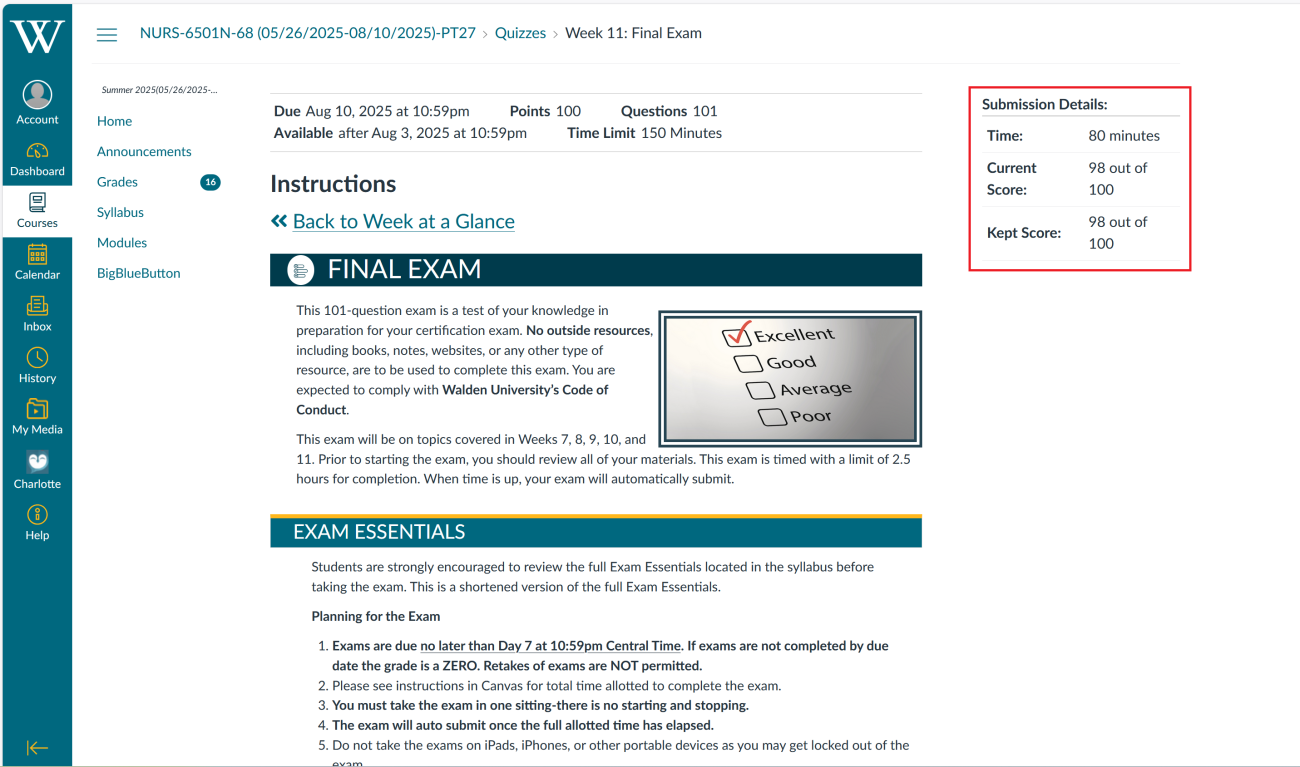
Quick answer: The NURS-6501N Week 11 Final Exam is the last major exam in Walden University’s Advanced Pathophysiology course. In recent course versions, the second half of the course covers neurological and musculoskeletal disorders (Weeks 7 to 8), psychological disorders (Week 9), and women’s and men’s health, infections, and hematologic disorders (Week 10). Expect scenario-based multiple-choice questions that ask why a disorder produces its signs, symptoms, and lab findings, completed in one timed sitting. Check your Week 11 instructions to see whether your final is cumulative; either way, Weeks 7 to 10 deserve most of your study time.
By Week 11 you have been juggling Advanced Pathophysiology with a full-time nursing job for more than two months, and the final lands when energy is lowest. This guide is built for that reality: a clear map of what the NURS 6501 final exam covers, a four-week plan you can follow around 12-hour shifts, 12 original practice questions with rationales, and exam-day steps that protect your score. For more Walden course help, browse our Walden University nursing guides.
Need Help Completing Your NURS 6501N Week 11 Final Exam? WhatsApp Us: +1 564-544-6924
What is the NURS 6501 final exam at Walden University?
The NURS 6501 final exam at Walden University closes out Advanced Pathophysiology, one of the “3 Ps” (with advanced pharmacology and advanced health assessment) required in Walden’s MSN nurse practitioner specializations. It follows the same format as the NURS 6501 Week 6 midterm exam: mechanism-focused, scenario-based multiple-choice questions.
What to confirm in your own Week 11 exam instructions (details can change by term, so the classroom is always the authority):
| Item | What to check |
|---|---|
| Scope | Weeks 7 to 10 only, or cumulative across the course |
| Number of questions | Students commonly report about 100 multiple-choice items |
| Time limit and deadline | Exact minutes, due day, and time zone |
| Attempts | Usually one attempt; confirm in the syllabus |
| Rules | Allowed materials (typically none), proctoring, and browser requirements |
| Grade weight | The final’s share of your grade and the minimum grade your program requires |
How the final differs from the midterm: the midterm tests cellular processes, immunity, and the cardiovascular, respiratory, GI, and endocrine systems. The final shifts to the nervous system, bones and joints, mental health, reproductive health, infections, and blood disorders, where many conditions look alike on paper. Comparing pairs becomes the core skill.
NURS 6501 final exam topic map: Weeks 7 to 10
Recent versions of NURS 6501 organize the second half of the course as shown below. Match this to your Module overviews, since titles and weeks can shift between terms.
| Week | Module focus | High-yield concepts to master |
|---|---|---|
| 7 | Neurological and musculoskeletal disorders | Stroke (ischemic vs. hemorrhagic), increased intracranial pressure, seizures, Parkinson disease, multiple sclerosis, myasthenia gravis, Alzheimer disease, headache types, spinal cord injury |
| 8 | Neurological and musculoskeletal application | Osteoarthritis vs. rheumatoid arthritis, gout, osteoporosis, fractures and healing, low back pain, case-based reasoning across neuro and musculoskeletal findings |
| 9 | Psychological disorders | Neurobiology of depression, bipolar disorder, anxiety disorders, schizophrenia, PTSD, ADHD; neurotransmitter pathways and the HPA axis |
| 10 | Women’s and men’s health, infections, and hematologic disorders | Menstrual disorders, PCOS, BPH, prostate and breast cancer basics, STIs and PID, infertility; sepsis and infection responses; anemias, clotting disorders (DIC, thrombocytopenia), leukemia and lymphoma |
If your final is cumulative, add a light review of Weeks 1 to 6 using the NURS 6501 Week 6 midterm exam guide. Cellular injury, inflammation, and immune mechanisms reappear inside neuro, psych, and hematologic questions.

Study the look-alikes side by side
Most missed final exam items come from confusing similar conditions. Build a one-page comparison for each pair:
| Pair | The key difference |
|---|---|
| Ischemic vs. hemorrhagic stroke | Blocked blood flow vs. bleeding into brain tissue; hemorrhagic often presents with sudden severe headache |
| Multiple sclerosis vs. myasthenia gravis | CNS demyelination vs. antibodies against acetylcholine receptors at the neuromuscular junction |
| Osteoarthritis vs. rheumatoid arthritis | Wear-related cartilage loss, stiffness under 30 minutes vs. autoimmune synovitis, symmetric small joints, morning stiffness over an hour |
| Iron deficiency vs. B12 deficiency anemia | Microcytic, low ferritin vs. macrocytic with neurological symptoms |
| DIC vs. immune thrombocytopenia | Widespread clotting that consumes platelets and clotting factors vs. antibody-mediated platelet destruction with normal clotting factors |
| Depression vs. bipolar disorder | Persistent low mood vs. episodes that include mania or hypomania |
A 4-week final exam plan built around 12-hour shifts
| Week | Work days (20 to 30 minutes) | Days off (about 2 hours) |
|---|---|---|
| 7 | Flashcards: stroke, ICP, seizures, Parkinson disease | Read assigned chapters; draw cause-to-finding chains for 5 neuro disorders |
| 8 | 10 practice questions on neuro and musculoskeletal | OA vs. RA, gout, and osteoporosis comparison sheet; review Week 7 misses |
| 9 | Flashcards: neurotransmitters and psych disorders | Map depression, bipolar, anxiety, and schizophrenia to neurotransmitter pathways |
| 10 to 11 | Mixed flashcards and 10 daily questions on reproductive, infection, and hematologic topics | Two timed 50-question mixed sets; final pass on your two weakest pairs |
Protect exam day: schedule the final after a full night of sleep, not after a night shift. A tired brain misreads stems, and stems are where final exam points are lost.
NURS 6501N final exam study guide support for working Walden MSN nurses on WhatsApp
NURS 6501N Week 11 final exam questions: 12 original practice items
These NURS 6501N Week 11 final exam questions are original practice items written by Gradevia in the style of mechanism-focused pathophysiology questions. They are not items from the Walden exam. Cover the answer, choose, then read the rationale.
1. Parkinson disease. A patient has a resting tremor, rigidity, and slowed movement. Which mechanism underlies these findings?
A. Demyelination of CNS neurons
B. Loss of dopamine-producing neurons in the substantia nigra
C. Antibodies against acetylcholine receptors
D. Amyloid plaque formation in the cortex
Answer: B. Loss of dopaminergic neurons disrupts the balance of dopamine and acetylcholine in the basal ganglia, producing tremor, rigidity, and bradykinesia.
2. Multiple sclerosis. A 29-year-old woman has episodes of blurred vision and leg weakness that resolve and later return. What is the primary mechanism?
A. Autoimmune demyelination of CNS axons
B. Degeneration of upper and lower motor neurons
C. Peripheral nerve compression
D. Cerebral vasospasm
Answer: A. In MS, immune-mediated inflammation destroys CNS myelin, slowing or blocking conduction. Relapses and remissions reflect new lesions and partial recovery.
3. Myasthenia gravis. A patient reports drooping eyelids and muscle weakness that worsens by evening and improves with rest. Which mechanism explains this?
A. Excess acetylcholine release
B. Antibodies that block and destroy acetylcholine receptors at the neuromuscular junction
C. Demyelination in the spinal cord
D. Loss of dopamine
Answer: B. Fewer functioning acetylcholine receptors mean weaker muscle contraction with repeated use, so weakness is fatigable and improves after rest.
4. Increased intracranial pressure. Which set of findings represents Cushing’s triad, a late sign of rising ICP?
A. Hypotension, tachycardia, rapid respirations
B. Hypertension with widening pulse pressure, bradycardia, irregular respirations
C. Fever, stiff neck, photophobia
D. Tachycardia, hypertension, and diaphoresis
Answer: B. As ICP rises, systolic pressure increases to maintain cerebral perfusion, a reflex slows the heart, and brainstem compression disrupts breathing. It signals impending herniation.
5. Rheumatoid arthritis. Which finding best distinguishes rheumatoid arthritis from osteoarthritis?
A. Pain that worsens with activity
B. Symmetric small-joint swelling with morning stiffness lasting over an hour
C. Bony enlargement of the distal finger joints
D. Onset in a single weight-bearing joint
Answer: B. RA is an autoimmune inflammation of the synovium that is typically symmetric and causes prolonged morning stiffness. OA is degenerative and usually causes short-lived stiffness and activity-related pain.
6. Gout. A patient wakes with a hot, red, extremely painful big toe after a night of heavy drinking. What causes the inflammation?
A. Calcium pyrophosphate crystals
B. Monosodium urate crystals that trigger a neutrophil-driven inflammatory response
C. Bacterial infection of the joint
D. Autoantibodies against cartilage
Answer: B. High uric acid levels lead to urate crystal deposits. Alcohol raises uric acid, and the crystals activate an intense acute inflammatory response.
7. Osteoporosis. Why does postmenopausal osteoporosis develop?
A. Increased osteoblast activity
B. Loss of estrogen increases osteoclast activity, so bone resorption exceeds formation
C. Vitamin D excess
D. Increased calcitonin secretion
Answer: B. Estrogen normally restrains bone resorption. After menopause, osteoclast activity rises and bone mass falls, increasing fracture risk.
8. Schizophrenia. Positive symptoms such as hallucinations and delusions are most closely linked to which neurobiological change?
A. Decreased serotonin in the raphe nuclei
B. Excess dopamine activity in the mesolimbic pathway
C. Reduced GABA in the cerebellum
D. Increased acetylcholine in the hippocampus
Answer: B. Positive symptoms are associated with increased dopaminergic activity in the mesolimbic pathway, which is why dopamine-blocking antipsychotics reduce them. Negative symptoms relate more to reduced mesocortical activity.
9. Iron deficiency anemia. Which laboratory pattern is most consistent with iron deficiency anemia?
A. High MCV, low B12
B. Low MCV, low ferritin, high TIBC
C. Normal MCV, high reticulocytes
D. High MCV, low folate
Answer: B. Iron deficiency produces microcytic, hypochromic red cells. Low ferritin reflects depleted stores, and total iron-binding capacity rises as the body tries to capture more iron.
10. Pernicious anemia. A patient has macrocytic anemia with numbness and tingling in the feet. What is the most likely cause?
A. Folate deficiency
B. Lack of intrinsic factor causing B12 malabsorption
C. Chronic blood loss
D. Hemolysis
Answer: B. Both B12 and folate deficiency cause macrocytic anemia, but neurological symptoms point to B12. In pernicious anemia, autoimmune damage to gastric parietal cells reduces intrinsic factor, which is needed to absorb B12.
11. DIC. A patient with septic shock is oozing from IV sites, with low platelets, prolonged PT and aPTT, and elevated D-dimer. What is happening?
A. Isolated vitamin K deficiency
B. Widespread clotting consumes platelets and clotting factors, leading to bleeding
C. Immune destruction of platelets only
D. Hemophilia A
Answer: B. In disseminated intravascular coagulation, a trigger such as sepsis activates clotting throughout the microcirculation. Platelets and factors are used up, and fibrinolysis raises D-dimer, so the patient clots and bleeds at the same time.
12. Benign prostatic hyperplasia. A 68-year-old man has a weak urinary stream, hesitancy, and nocturia. Which mechanism explains his symptoms?
A. Enlargement of the prostate’s transition zone compressing the urethra
B. Bladder cancer
C. Urethral stricture from infection
D. Kidney stones
Answer: A. BPH involves growth of prostate tissue around the urethra, driven largely by dihydrotestosterone. The enlarged gland narrows the urethra and obstructs outflow.
Looking for NURS 6501N Week 11 final exam answers or a PDF?
Searches for “NURS 6501N Week 11 final exam answers” and “NURS 6501N Week 11 final exam PDF” usually lead to files sold as the “actual final.” Before you download one, consider:
- Many are outdated or wrong. Files are often years old, rebuilt from memory, and reposted without checking. Some place topics in the wrong half of the course entirely.
- They do not match how the exam is built. Scenario stems change, and memorized letters do not transfer to a new question about the same mechanism.
- Using leaked exam content violates Walden’s academic integrity policy. A failed course at the end of the term can delay your MSN and your NP plans by months.
What works better: your Week 7 to 10 Knowledge Check results, the assigned chapters, original practice questions with rationales, and a focused study guide built around your weakest pairs.
Urgent NURS 6501N final exam review guide requests on WhatsApp
Need a NURS 6501N final exam review guide fast? Send your urgent request on WhatsApp and we will build a custom Weeks 7 to 10 guide prioritized around your weakest topics, from MS vs. myasthenia gravis to DIC and the anemias, handled around your shifts.
Common mistakes on the NURS 6501 final exam
| Mistake | Better approach |
|---|---|
| Studying each disorder in isolation | Study look-alike pairs side by side |
| Treating Week 9 as “just psych” | Learn the neurotransmitter pathway behind each disorder; questions ask about mechanisms, not DSM criteria |
| Rushing Week 10 because it is last | Week 10 packs reproductive, infection, and hematologic content into one week; start it early |
| Ignoring Weeks 1 to 6 on a cumulative final | Review cellular injury, inflammation, and immunity, which underpin neuro and hematologic questions |
| Reviewing only correct answers | Re-learn the mechanism behind every missed Knowledge Check item |
| Testing after a night shift | Schedule the exam after sleep, in a quiet space, with a stable connection |
Exam-day checklist
- Re-read the Week 11 exam instructions for scope, time limit, deadline, and allowed materials
- Use the required browser on a computer that meets the technical requirements
- Block the full time with no interruptions
- Identify what each stem asks: mechanism, finding, or next step
- Eliminate options that describe the look-alike condition
- Leave time to review flagged items if the exam allows it
Frequently asked questions
What does the NURS 6501N Week 11 final exam cover? In recent course versions, the second half of NURS 6501 covers neurological and musculoskeletal disorders (Weeks 7 to 8), psychological disorders (Week 9), and women’s and men’s health, infections, and hematologic disorders (Week 10). Check your Week 11 instructions to see whether your final is cumulative or focused on Weeks 7 to 10.
How is the NURS 6501 final exam different from the Week 6 midterm? The Week 6 midterm tests Weeks 1 to 6 (cellular processes, immunity, cardiovascular, respiratory, GI, and endocrine). The Week 11 final centers on Weeks 7 to 10 and may also draw on earlier concepts, so cellular and immune mechanisms still matter.
Can I find NURS 6501N Week 11 final exam answers or a PDF online? Files sold as actual final exam answers are often outdated or wrong, and using them violates Walden’s academic integrity policy. Original practice questions, your Knowledge Check results, and a focused study guide are safer and more effective.
How many questions are on the NURS 6501 final exam at Walden University? Students commonly report around 100 multiple-choice questions in one timed sitting, but counts, time limits, and rules can change by term. Your Week 11 exam instructions are the authority.
How can a full-time working nurse prepare for the NURS 6501 final exam? Keep pace with Weeks 7 to 10 using 20 to 30 minute review blocks on work days and 2-hour blocks on days off, focus on commonly confused pairs, and schedule the exam after rest rather than after a night shift.
Finish NURS 6501 strong
You made it through the midterm while working full time; the final rewards the same habits. Learn mechanisms instead of lists, compare look-alike conditions, and fix weak topics before Week 11, not during it. When you are ready for your next course, find more guides in our Walden University nursing collection.
NURS 6501N Week 11 final exam support with urgent study guides for full-time working nurses
Working full time and the NURS 6501N final is this week? Get NURS 6501N final exam support built for busy nurses: urgent study guides, high-yield summaries, and practice sets delivered on WhatsApp so you can review between shifts. Chat on WhatsApp at +1 564-544-6924.
References
Rogers, J. L. (Ed.). (2023). McCance & Huether’s pathophysiology: The biologic basis for disease in adults and children (9th ed.). Elsevier.
Walden University. (n.d.). NURS 6501: Advanced pathophysiology [Course catalog listing]. https://academics.waldenu.edu/catalog/courses/nurs/6501
Gradevia provides coaching and exam preparation support. Practice questions on this page are original and are not items from any Walden University exam. Follow Walden University’s academic integrity policy.