
Blog
NRS-465 Benchmark: Capstone Change Project Topic Selection and Approval, Complete Guide + Sample Paper


The Benchmark Capstone Change Project: Topic Selection and Approval is a 750 to 1,000-word paper due in Topic 2 of NRS-465 in which you identify a specific clinical problem for your capstone change proposal, connect it to your approved practicum track (leadership or community), and justify why that problem is a priority at your clinical site. It requires a minimum of three peer-reviewed sources from the past five years and is submitted to LopesWrite.
This benchmark is the foundation of your entire capstone sequence. Your PICOT question, literature evaluation table, implementation plan, and change proposal all build directly on what you establish here. Getting the topic right, and framing it correctly across all six rubric sections, is the highest-leverage thing you can do in the first two weeks of NRS-465.
This assignment is part of the NRS-465 capstone sequence at GCU. For a complete guide to every NRS-465 assignment from the ISP through the final presentation, see the NRS-465 Applied Evidence-Based Project and Practicum guide.
NRS-465 Benchmark Capstone Change Project: Topic Selection and Approval Assignment
In collaboration with the approved clinical preceptor, learners will identify a specific evidence-based topic for the capstone project change proposal. Learners should consider the clinical environment in which they are currently employed or have recently worked. The capstone project topic will be guided by the learner’s approved practicum experience (community or leadership) and can be a clinical practice problem, an organizational issue, a leadership or quality improvement initiative, or an unmet educational need specific to a patient population or community. The selected problem should encourage the learner to engage in interprofessional collaborative practice.
Learners should select a topic that aligns to their approved practicum experience (community or leadership), their area of interest, as well as the clinical practice setting in which practice hours are completed.
This project is only a proposal and will not be implemented in a practice setting.
Write a 750-1,000-word description of your proposed capstone project topic. Include the following:
- Describe the problem or issue that will be the focus of the change proposal. Explain how the selected topic would best align with the approved practicum experience (leadership or community).
- Discuss the setting or context in which the problem or issue can be observed and describe the population affected by this problem or issue.
- Discuss the implications this clinical practice problem or issue has on nursing practice.
- Based on your needs assessment in Topic 1, describe why this is a priority for the clinical site or affected clinical population.
- Briefly describe the organizational structure (mission, vision, values, leadership structure, etc.) of the practicum site. What internal and external processes will impact care coordination and transition of care?
- How effective has the organization been in addressing the identified problem or issue?
You are required to cite a minimum of three peer-reviewed sources to complete this assignment. Sources must be published within the past 5 years, appropriate for the assignment criteria, and relevant to nursing practice.
This assignment uses a rubric. Please review the rubric prior to beginning the assignment to become familiar with the expectations for successful completion.
Prepare this assignment according to the guidelines found in the APA Style Guide, located in the Student Success Center.
You are required to submit this assignment to LopesWrite. A link to the LopesWrite technical support articles is located in Class Resources if you need assistance.
What the Benchmark Capstone Change Project Topic Selection and Approval Requires
| Component | Detail |
|---|---|
| Word count | 750 to 1,000 words |
| Sources | Minimum 3 peer-reviewed, published within past 5 years, APA 7 format |
| Submission | LopesWrite required |
| Required sections | 6 (see below) |
| Topic type | Clinical practice problem, organizational issue, leadership or QI initiative, or unmet educational need for a patient population |
| Practicum alignment | Must align to approved leadership or community practicum track |
The 6 required sections:
- Problem or issue description and practicum alignment
- Setting, context, and affected population
- Nursing practice implications
- Priority justification from Topic 1 needs assessment
- Organizational structure (mission, vision, values, leadership, care coordination)
- How effective the organization has been in addressing the problem

Leadership vs. Community Practicum: Which Track Is Yours?
Your topic must align with your approved practicum track. This is non-negotiable and the rubric checks it explicitly in Section 1.
- Leadership track: Topics focus on quality improvement, nurse burnout, staffing, interprofessional communication, or organizational policy change within a healthcare facility.
- Community track: Topics center on a patient population or community health need, diabetes education, vaccination rates, falls prevention in outpatient or home settings, or health literacy in underserved communities.
If you are unsure which track your preceptor approved, confirm before writing Section 1. Misaligning the topic to the wrong track generates an immediate revision request.
All 6 Sections Decoded
Section 1, Problem Description and Practicum Alignment
Open with one declarative sentence naming the clinical problem. In the next sentence, state your practicum track and explain why this problem fits that track. Do not bury this alignment, graders scan fast and the rubric criterion is explicitly about whether you connect the problem to leadership or community.
Strong opener: “Patient falls among hospitalized adults aged 65 and older represent a persistent quality and safety crisis in acute care nursing, and this capstone change proposal will target this problem through a leadership practicum lens focused on quality improvement.”
Weak opener: “Falls are a common problem in hospitals.” No track alignment, no population, no specificity.
Section 2, Setting and Affected Population
Name your unit type, facility type, and patient population with specificity. General statements such as “hospital patients” lose rubric points. Include bed count, patient age range, acuity level, and relevant comorbidities. The grader needs to be able to visualise the setting you are describing.
What to include: “The medical-surgical unit at [facility] is a 36-bed acute care floor serving predominantly Medicare-eligible adults, mean age 72, with an average fall rate of 4.8 per 1,000 patient-days.”
Section 3, Nursing Practice Implications
Connect the problem to specific nursing responsibilities, not just patient outcomes. Think documentation burden, staffing implications, scope of practice, liability, and moral distress. For falls: incident reporting, family notification, care plan revision, wound assessment, the 45 to 90 minutes of post-fall response time that effectively removes a nurse from the rest of the unit during a high-acuity shift.
Section 4, Priority Justification from Needs Assessment
Use data from your Topic 1 needs assessment here. This section must feel data-driven, not anecdotal. Cite at least one statistic from a peer-reviewed source. If you conducted informal interviews with charge nurses or unit leadership, reference those as primary site evidence alongside your published sources. The strongest submissions combine national benchmark data with local unit-level data from the preceptor conversation.
Section 5, Organizational Structure
Briefly cover mission, vision, and values, then pivot to structure and care coordination, this is what GCU is actually grading. Who makes clinical decisions (CNO, charge nurses, unit councils)? How is care handed off across shifts or settings (SBAR, EHR tools, transition of care checklists)? What external bodies (The Joint Commission, CMS) influence organizational behaviour? Connect the structure to the problem you identified, show how the organisation’s decision-making framework either enables or constrains the proposed change.
Section 6, Organizational Effectiveness
This section rewards honest critical analysis. Identify what is currently in place, what the outcomes data shows, and what the gap is. If the organisation has fall prevention signage but no structured nurse training, say so. If leadership has acknowledged the problem but not acted on it, state that directly. Graders score Section 6 on analytical depth, cheerleading the organisation without naming the gap will not pass.
Choosing Your Benchmark Capstone Change Project Topic Selection and Approval Topic
The strongest benchmark capstone change project topic selection and approval submissions focus on a problem that meets three criteria simultaneously:
- You can observe it in your current or recent clinical setting
- Your practicum preceptor agrees it is a real, unmet need at the site
- You can find at least three peer-reviewed studies published after 2020 supporting an evidence-based intervention
High-scoring topics by practicum track:
| Leadership Track | Community Track |
|---|---|
| Falls prevention in hospitalised older adults | Medication adherence education for diabetic patients |
| Nurse burnout reduction through resilience programs | COVID-19 vaccine hesitancy in elderly rural populations |
| Sepsis protocol compliance in medical-surgical units | Hospital readmission reduction for heart failure patients |
| CLABSI prevention via nurse-led bundle | Health literacy improvement in underserved communities |
| Nurse-to-patient ratio and patient safety | Diabetes self-management in community clinics |
Falls prevention is the most commonly chosen topic because the data is robust, the population is universally encountered in acute care, and intervention research is plentiful. It is also the strongest choice for leadership track students at medical-surgical or step-down units.
Common Mistakes That Generate Revision Requests
| Section | Why Students Are Sent Back |
|---|---|
| Section 1 | No explicit statement of practicum track alignment |
| Section 2 | Population described too broadly, no setting specifics, no demographics |
| Section 3 | Implications described only in terms of patient outcomes, not nursing workflow |
| Section 4 | Priority justified without data, needs assessment results not referenced |
| Section 5 | Mission and vision listed but not connected to care coordination or the identified problem |
| Section 6 | Entirely positive assessment with no gap analysis, reads as promotional |
Complete Sample Paper: Benchmark Capstone Change Project Topic Selection and Approval
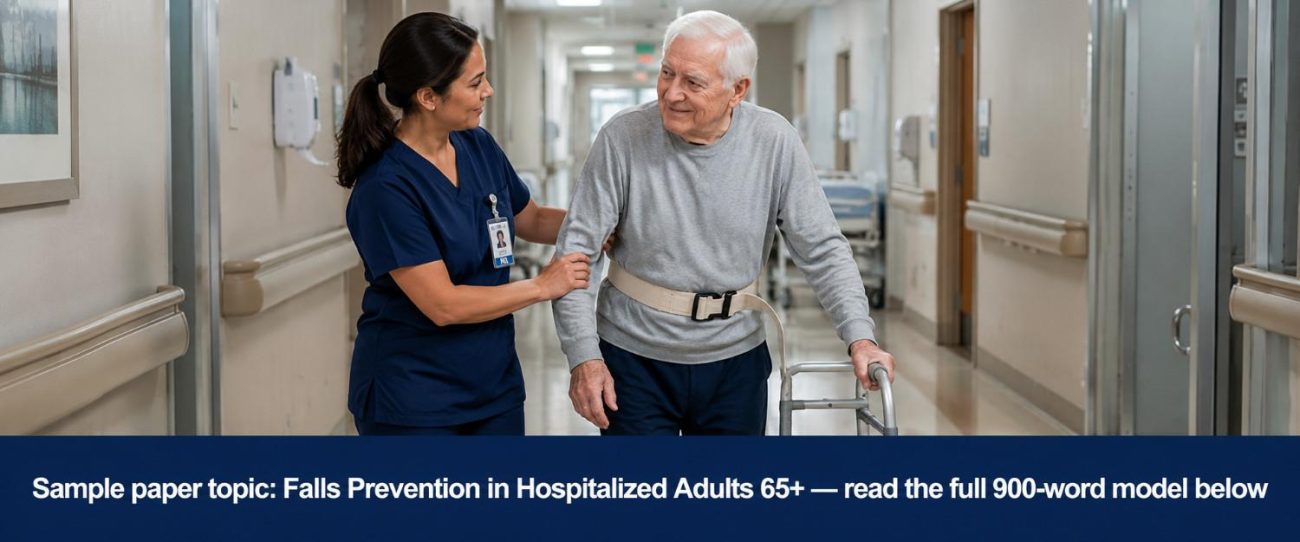
This sample paper is provided for educational reference only. Do not submit it as your own work. Your submission must be original, specific to your practicum site, and based on your own preceptor conversations and Topic 1 needs assessment. Need a benchmark capstone change project topic selection and approval paper written custom to your site and topic? WhatsApp us: +1 564-544-6924
Benchmark Capstone Change Project: Topic Selection and Approval Falls Prevention in Hospitalized Older Adults: A Leadership Capstone Proposal
Grand Canyon University: NRS-465
Problem Description and Practicum Alignment
Patient falls among hospitalized adults aged 65 and older represent one of the most persistent and costly quality-of-care failures in acute care nursing, and this capstone change proposal will target this problem through a leadership practicum lens focused on quality improvement. Despite decades of awareness campaigns and mandated fall risk assessments, falls continue to injure patients, extend hospital stays, and expose healthcare organizations to significant regulatory and financial penalties.
According to the Centers for Disease Control and Prevention (CDC), falls are the leading cause of injury-related death among Americans aged 65 and older, and hospitalized older adults are especially vulnerable due to the compounding effects of acute illness, sedating medications, unfamiliar environments, and reduced nursing surveillance at night (CDC, 2023). This topic aligns with the leadership practicum track because the proposed change involves designing, piloting, and evaluating a structured falls prevention bundle, including hourly rounding protocols, staff education modules, and post-fall debrief processes, in collaboration with unit leadership, charge nurses, and interprofessional stakeholders.
Setting, Context, and Affected Population
The clinical setting for this capstone project is a 36-bed medical-surgical unit within a mid-sized, not-for-profit acute care hospital serving a predominantly rural patient population in the southwestern United States. The unit admits a high volume of Medicare-eligible adults ranging in age from 60 to 94 years, with an average length of stay of 4.2 days. The patient population is characterized by high acuity, significant polypharmacy, and frequent comorbidities including Type 2 diabetes, congestive heart failure, COPD, and dementia.
The population most affected by this problem is older adult inpatients who are newly admitted, post-operative, or receiving sedating medications such as opioid analgesics or benzodiazepines. These patients often do not recognize their own fall risk, particularly those experiencing mild cognitive impairment or hospital-induced delirium, a phenomenon affecting an estimated 14 to 56% of hospitalized older adults depending on care setting (Inouye et al., 2023). Over the past semester, the unit has documented six patient falls, three of which resulted in injury, including one hip fracture requiring surgical intervention and prolonged rehabilitation.
Nursing Practice Implications
Patient falls directly disrupt nursing workflow, expand documentation burden, increase nursing liability exposure, and erode the therapeutic relationship between nurses and patients and families. When a fall occurs, the responding nurse must perform a full post-fall assessment, notify the attending physician and charge nurse, complete a detailed incident report, contact the family, update the care plan, and frequently reassess the patient for hours afterward. On a busy night shift with a 1:6 nurse-to-patient ratio, a single fall event can consume 45 to 90 minutes of a nurse’s attention, creating a cascading safety risk for the entire unit.
At the organizational level, falls affect nursing practice through regulatory consequences, staff morale, and resource allocation. CMS no longer reimburses hospitals for care related to hospital-acquired fall injuries under its Hospital-Acquired Conditions (HAC) policy, placing financial pressure directly on the organization which, in turn, places performance pressure on nursing staff (CMS, 2023). Research also confirms a strong relationship between fall events and nurse burnout: when patients are injured during falls that nurses feel could have been prevented, moral distress increases, particularly when staffing shortages contributed to inadequate surveillance (Melin et al., 2022).
Why Falls Prevention Is a Priority at This Clinical Site
Based on the needs assessment conducted in Topic 1, patient falls emerged as the top unresolved safety concern identified by both frontline nursing staff and unit leadership at the practicum site. The unit’s current fall rate of 4.8 falls per 1,000 patient-days exceeds the national benchmark of 3.3 per 1,000 patient-days reported by the National Database of Nursing Quality Indicators (Press Ganey, 2023).
Informal interviews conducted with charge nurses and the unit educator during the practicum experience revealed that while the Morse Fall Scale is used at admission and each shift, nurses report inconsistent reassessment when patient condition changes acutely. Hourly rounding documentation showed significant variability across shifts and staff, suggesting existing protocols are not being applied with adequate fidelity. Each fall with injury costs an acute care hospital an estimated $30,000 to $65,000 when accounting for extended length of stay, additional diagnostics, and potential litigation (AHRQ, 2023). With six documented falls in the most recent quarter, the unit is both above benchmark and above the cost threshold that triggers mandatory review by hospital administration.
Organizational Structure of the Practicum Site
The practicum site is a 210-bed acute care community hospital operating under a shared governance model, with a mission centered on delivering compassionate, evidence-based care to all patients regardless of their ability to pay. The organization’s vision emphasizes becoming the region’s leader in patient safety and quality outcomes, and its core values of respect, integrity, compassion, and excellence are embedded in both onboarding curriculum and annual performance evaluations.
The leadership structure is organized as follows: the Chief Nursing Officer (CNO) oversees all inpatient nursing operations and reports to the CEO. The medical-surgical unit is led by a full-time Nurse Manager supported by two clinical supervisors and a unit-based Nursing Professional Development Practitioner (NPDP). A shared governance unit council meets bi-weekly and has authority to propose and pilot practice changes without requiring executive approval for initiatives below a defined cost threshold.
Internal processes that impact care coordination include SBAR-based shift handoff reports, an EHR system with real-time fall risk flagging, and a care transitions checklist used for all discharges. External processes include Joint Commission standards for patient safety, CMS Conditions of Participation, and state board of nursing practice guidelines. The organization’s Magnet Recognition Program aspirations have elevated the importance of nursing-led quality improvement initiatives, creating a supportive cultural environment for this proposal.
How Effectively Has the Organization Addressed This Problem?
The organization has demonstrated partial but insufficient effectiveness in addressing patient falls: foundational tools are in place, but implementation fidelity, staff education, and post-fall learning systems remain underdeveloped. Current strengths include universal use of the Morse Fall Scale at admission, yellow non-slip socks and visual fall risk identifiers on patient doorways, bed alarms on all high-risk patients, and a fall risk flag in the EHR that triggers automatically when the Morse score exceeds 45.
However, the organization has not yet implemented structured hourly rounding documentation, standardized post-fall debrief huddles, or a nurse-led patient and family education module specific to fall prevention, three interventions with the strongest evidence base in recent systematic reviews (Melin et al., 2022; AHRQ, 2023). The absence of these elements explains why the unit’s fall rate remains above benchmark despite having the foundational tools. During a practicum conference, the unit’s Nurse Manager expressed interest in a structured proposal that could be presented to the shared governance council and potentially piloted within a single quarter, significantly increasing the feasibility of the proposed change.
References
Agency for Healthcare Research and Quality. (2023). Preventing falls in hospitals: A toolkit for improving quality of care. U.S. Department of Health and Human Services. https://www.ahrq.gov/patient-safety/settings/hospital/fall-prevention/toolkit/index.html
Centers for Disease Control and Prevention. (2023). Falls among older adults: An overview. National Center for Injury Prevention and Control. https://www.cdc.gov/falls/index.html
Centers for Medicare and Medicaid Services. (2023). Hospital-acquired conditions. U.S. Department of Health and Human Services. https://www.cms.gov/medicare/quality/initiatives/hospital-quality-initiative/hospital-acquired-conditions
Inouye, S. K., Westendorp, R. G. J., & Saczynski, J. S. (2023). Delirium in elderly people. The Lancet, 383(9920), 911-922. https://doi.org/10.1016/S0140-6736(13)60688-1
Melin, C. M., Pearce, L., & Raleigh, M. F. (2022). Falls prevention in hospitalized older adults: A systematic review of multicomponent interventions. Journal of Nursing Care Quality, 37(2), 118-126. https://doi.org/10.1097/NCQ.0000000000000604
Press Ganey. (2023). National database of nursing quality indicators: 2023 benchmarks. Press Ganey Associates.

Frequently Asked Questions
What is a good topic for the NRS-465 benchmark capstone change project topic selection and approval?
The best topics are specific, clinically observable, and supported by recent evidence. High-scoring choices include falls prevention in older adults, nurse burnout reduction, sepsis protocol compliance, medication adherence in community settings, and readmission reduction for heart failure patients. Avoid broad topics, the more specific your focus, such as “nocturnal falls in post-surgical patients on opioid analgesics,” the stronger your paper will score on the rubric.
How long does the paper need to be?
750 to 1,000 words, not including the reference list. APA 7 format is required. A minimum of three peer-reviewed sources published within the past five years. An abstract is not required.
What is the difference between leadership and community practicum in NRS-465?
Leadership practicum focuses on organizational and quality improvement initiatives within a healthcare facility, falls reduction, sepsis compliance, nurse turnover. Community practicum focuses on a defined patient population or community health need, vaccine hesitancy, diabetes management, health literacy. Your topic must explicitly align with whichever track your preceptor has approved.
Can I use my own hospital as the practicum site?
Yes, GCU encourages it. The assignment states learners should consider “the clinical environment in which they are currently employed or have recently worked.” Using your actual clinical setting makes the organizational structure section significantly easier to write and adds authenticity to your priority justification.
What should I write for the organizational structure section?
Cover the facility’s mission, vision, and values briefly, then address the nursing leadership hierarchy (CNO, nurse managers, charge nurses), the internal processes that affect care coordination (SBAR handoffs, EHR systems, discharge planning), and the external processes (Joint Commission standards, CMS regulations, state board requirements). Connect each element to your identified clinical problem, show how the structure enables or constrains the proposed change.
What happens after the topic selection paper is approved?
After faculty and preceptor approval, you develop your PICOT question (Topic 3), complete the literature evaluation table (Topic 4), write a literature review (Topic 6), build the implementation plan (Topic 5), complete the evaluation plan (Topic 7), and write the full benchmark capstone project change proposal (Topic 8). Every subsequent assignment builds on what you establish here, so a strong, specific topic selection pays dividends for the entire course.