
Blog
NRS-465 Topic 3: Capstone Change Project PICOT Question Development — Expert Guide + Free Sample Answer


NRS-465 Topic 3: Capstone Change Project PICOT Question Development
| Quick Overview
The NRS-465 Topic 3 PICOT Question Development assignment requires GCU nursing students to complete a structured template that identifies a clinical patient population (P), nursing intervention (I), comparison practice (C), measurable outcome (O), and timeframe (T) — all tied directly to the clinical problem approved in Topic 2. You must also submit a 150-word problem statement and two APA-cited peer-reviewed articles published within the last 5 years. This guide explains every component, shows a fully worked sample answer, and tells you exactly what GCU’s rubric rewards. |
Assignment – Capstone Change Project: PICOT Question Development
The purpose of this assignment is to develop a PICOT question. A PICOT (Patient, Intervention, Comparison, Outcome and Time) question starts with a designated patient population in a particular clinical area and identifies clinical problems or issues that arise from clinical care. The intervention used to address the problem must be a nursing practice intervention. Include a comparison of the proposed or new nursing intervention to another nursing intervention or standard practice, and specify the timeframe needed to implement the change process.
Using the “Capstone Change Project; PICOT Question Development” template, formulate a PICOT question applying the PICOT format that addresses the approved clinical nursing problem from Topic 2 assignment: Capstone Change Project – Topic Selection and Approval.
The PICOT question will provide a framework for your capstone project change proposal.
Include at least two peer-reviewed research articles published within the last 5 years and relevant to nursing practice to support your problem statement and discussion.
While APA style is not required for the body of this assignment, solid academic writing is expected, and documentation of sources should be presented using APA formatting guidelines, which can be found in the APA Style Guide, located in the Student Success Center.
This assignment uses a rubric. Please review the rubric prior to beginning the assignment to become familiar with the expectations for successful completion.
You are required to submit this assignment to LopesWrite. A link to the LopesWrite technical support articles is located in Class Resources if you need assistance.
What Is the NRS-465 Topic 3 PICOT Assignment? (And Why It Matters)
The NRS-465 PICOT Question Development assignment is the critical foundation of your entire capstone project at Grand Canyon University. Everything that follows in Topics 4 through 10 — your literature table, literature review, implementation plan, and final change proposal — builds directly on the PICOT question you write here.
PICOT stands for Patient/Population, Intervention, Comparison, Outcome, and Time. According to the American Association of Colleges of Nursing (AACN), the PICOT framework is the gold standard for translating clinical problems into answerable, evidence-based research questions.
Why this assignment trips students up: The most common error is writing a PICOT question that doesn’t match the Topic 2 approved clinical problem — or choosing an intervention that isn’t a nursing practice intervention. The rubric specifically penalizes both.
What Are the PICOT Components? (Definitions + Nursing Examples)
Each letter in PICOT represents a distinct element of your clinical question. Below is a breakdown of what each component means in the context of an NRS-465 nursing capstone.
| Component | Definition | Sample Entry |
|---|---|---|
| P — Population | The specific patient group or clinical setting your problem addresses | Adult inpatients (65+) in acute care hospital settings |
| I — Intervention | The nursing practice intervention being proposed (must be nursing-driven) | Structured hourly rounding by RNs using a standardized protocol |
| C — Comparison | Current standard of care or alternative intervention being compared against | Standard as-needed nurse call response (no structured rounding) |
| O — Outcome | The measurable clinical result your intervention aims to improve | Reduction in inpatient fall rate and fall-related injuries |
| T — Time | The realistic timeframe in which the outcome can be measured | Within a 12-week implementation period |
Important note: The T (time) element is described as optional in some GCU templates, but including it always strengthens your question and improves your rubric score. Always include it.
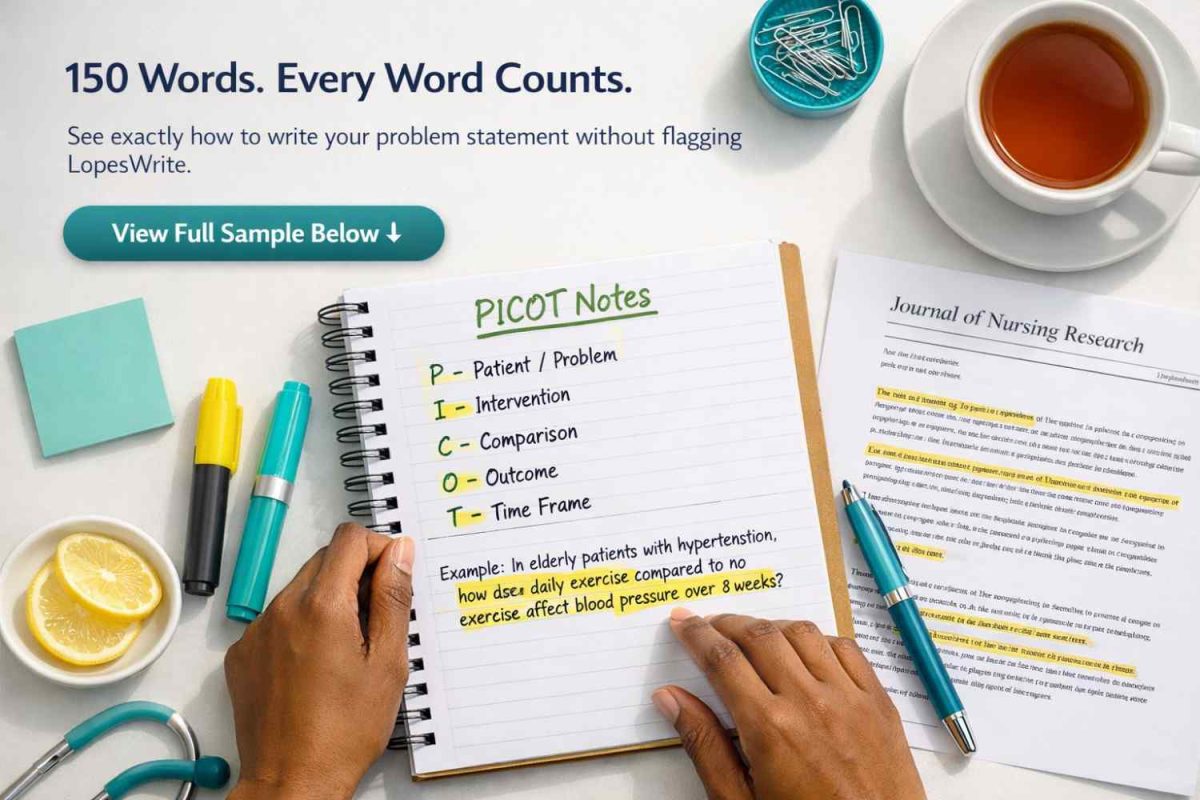
How to Write a Strong Problem Statement for Your PICOT (150 Words or Less)
Your problem statement must justify why the clinical problem matters and set up the logic for your PICOT intervention. Think of it as a brief executive summary of the problem — not the solution.
A strong problem statement includes three elements:
- The scope of the problem: relevant statistics or clinical data (e.g., fall rates, infection rates, readmission rates)
- The consequence of the problem: patient harm, increased cost, poor outcomes
- The gap your intervention addresses: what isn’t being done consistently in current practice
| LopesWrite Tip
GCU runs this assignment through LopesWrite — their plagiarism detection system. Your problem statement is the highest-risk section for similarity flags because students often copy statistics directly from websites. Always paraphrase data in your own words and cite the source with an APA in-text citation. Do not copy sentences from your approved Topic 2 submission verbatim. |
NRS-465 PICOT Question Development — Fully Worked Sample Answer
The following is a complete, rubric-aligned sample answer using inpatient falls prevention as the clinical topic — one of the most common approved topics in NRS-465. Use this as a structural model; your own submission must reflect your specific approved Topic 2 clinical problem.
Sample Problem Statement
| Inpatient falls represent one of the most frequent and preventable adverse events in acute care settings. The Centers for Disease Control and Prevention (CDC, 2024) estimates that falls account for more than 800,000 hospitalizations annually in the United States, with older adults at the highest risk due to polypharmacy, cognitive impairment, and reduced mobility. Falls result in significant patient harm, including hip fractures, traumatic brain injuries, and extended hospital stays — increasing care costs by an average of $30,000 per incident (CDC, 2024). Despite existing fall prevention protocols, inconsistent implementation of structured nurse rounding remains a critical gap in acute care practice. A standardized, evidence-based hourly rounding protocol has the potential to reduce fall incidence and improve patient safety outcomes when implemented consistently by nursing staff. |
Sample PICOT Components (Template Fill-In)
| Component | Definition | Sample Entry |
|---|---|---|
| P — Patient/Population | Specify the patient population and clinical setting | Adult inpatients aged 65 and older admitted to acute care medical-surgical units |
| I — Intervention | Describe the nursing practice intervention (must be nursing-driven) | Implementation of a structured hourly nursing rounding protocol using a standardized checklist addressing the 4 Ps (Pain, Position, Personal needs, Placement) |
| C — Comparison | Describe the current standard or alternative practice | Standard as-needed patient care response based on call-light activation without structured rounding intervals |
| O — Outcome | State the measurable clinical outcome | Reduction in inpatient fall rate and fall-related injury incidence among elderly acute care patients |
| T — Time | Specify the implementation and measurement timeframe | Within a 12-week implementation period following staff education and protocol rollout |
Sample Formatted PICOT Question
| Complete PICOT Question:
“In adult inpatients aged 65 and older on acute care medical-surgical units (P), how does the implementation of a structured hourly nursing rounding protocol using the 4 Ps checklist (I), compared to standard as-needed call-light response care (C), affect the rate of inpatient falls and fall-related injuries (O) within a 12-week implementation period (T)?” |

Sample APA References
Reference 1 (Quantitative — supports intervention):
Gliner, M., Dorris, J., Aiyelawo, K., Morris, E., Hurdle-Rabb, D., & Frazier, C. (2022). Patient falls, nurse communication, and nurse hourly rounding in acute care: Linking patient experience and outcomes. Journal of Public Health Management and Practice, 28(2), E467–E470. https://doi.org/10.1097/PHH.0000000000001387
Reference 2 (Supports problem statement — epidemiology):
Khawaja, I., Awan, S. A., Babar, M., Khan, T., & Khalil, M. O. (2023). Fall prevalence and associated risk factors in the hospitalized adult population: A crucial step towards improved hospital care. Cureus, 15(8). https://doi.org/10.7759/cureus.46976
What Clinical Topics Work Best for the NRS-465 PICOT Assignment?
Any clinical problem approved in Topic 2 can become a strong PICOT — but some topics yield more available peer-reviewed evidence than others. Here are the most common and research-rich topics GCU students use:
| Clinical Topic | Common PICOT Intervention |
|---|---|
| Inpatient Falls Prevention | Structured hourly rounding / Bedside fall-risk signage |
| Hospital-Acquired Pressure Injuries | Regular repositioning protocols / Skin assessment bundles |
| Diabetes Medication Adherence | Telehealth follow-up / Patient education programs |
| Ventilator-Associated Pneumonia (VAP) | Evidence-based VAP bundle / Oral care protocols |
| Sepsis Early Recognition | Nurse-driven sepsis screening tools / SBAR communication |
| 30-Day Readmission Reduction | Discharge education / Transition-of-care nurse calls |
| Medication Errors | Barcode medication administration (BCMA) / Double-check protocols |
If your Topic 2 problem isn’t in this list, don’t worry — the PICOT framework applies universally. The key is ensuring your Intervention is something a nurse can initiate, not a physician order or administrative policy.
What Are the Most Common Mistakes on this Assignment?
Understanding where GCU nursing students lose points on this assignment is as important as knowing what to include.
- Intervention is not a nursing practice intervention. The rubric requires the I to be something nurses can independently implement — not a physician-ordered treatment or a hospital-wide administrative change.
- PICOT doesn’t match the approved Topic 2 problem. Changing your clinical focus between Topic 2 and Topic 3 is a common error that leads to point deductions and faculty feedback requesting revision.
- Problem statement exceeds 150 words. GCU’s template has a strict word limit here. Use the word count tool in Word before submitting.
- Articles are older than 5 years. The assignment explicitly requires peer-reviewed research published within the last 5 years. A 2018 article is not acceptable in 2025.
- Articles are not peer-reviewed. Websites, textbooks, CDC fact pages, and government reports are not peer-reviewed research articles. Use CINAHL, PubMed, or the GCU library to verify.
- PICOT question is missing the T component. Even though Time is listed as optional in the template instructions, omitting it consistently leads to lower rubric scores.
- LopesWrite similarity score is too high. Problem statements copied from Topic 2 or paraphrased too closely from sources will flag. Rewrite all statistics in your own voice with proper citations.
How to Search for Peer-Reviewed Articles for NRS-465 PICOT
Finding strong peer-reviewed evidence is one of the most time-consuming parts of this assignment for busy working nursing students. Here’s the most efficient search approach:
Best Databases to Use
- CINAHL (Cumulative Index to Nursing and Allied Health Literature) — the gold standard for nursing-specific research. Always filter to ‘Peer Reviewed’ and set the date range to 2020–present.
- PubMed — excellent for clinical and evidence-based nursing research. Use the ‘Clinical Queries’ filter to narrow to intervention studies.
- GCU Library OneSearch — combines multiple databases and allows you to filter by peer-reviewed, date, and full text availability simultaneously.
Sample Search String (Falls Prevention)
| Search: “nurse hourly rounding” AND “fall prevention” AND “acute care”
Filters: Peer-Reviewed | Published 2020–2025 | Full Text Available Tip: Aim for one quantitative study (measures outcomes numerically) and one qualitative or mixed-methods study (examines nurse or patient experiences). This prepares you for the Topic 4 Literature Evaluation Table. |
How Does the NRS-465 Topic 3 Assignment Connect to the Rest of the Capstone?
The PICOT question you develop in Topic 3 is the single most referenced document in your entire NRS-465 course. Understanding how it flows forward prevents rework.
| Topic / Assignment | How It Uses Your PICOT |
|---|---|
| Topic 4 — Literature Evaluation Table | You search for 6–8 articles that directly answer your PICOT question |
| Topic 5 — Implementation Plan | Your I (Intervention) becomes the implementation strategy; your T (Time) becomes the project timeline |
| Topic 6 — Literature Review | You synthesize the evidence you found using your PICOT as the organizing framework |
| Topic 7 — Evaluation Plan | Your O (Outcome) becomes the measurable metric for your evaluation design |
| Topic 8 — Final Change Proposal | Your full PICOT question is reproduced verbatim in the introduction section |
This is why a weak or misaligned PICOT in Topic 3 causes cascading problems throughout the course. Getting it right here — and getting specific — saves hours of revision work later.
Why Busy Working Nursing Students Struggle With this Assignment
Most GCU RN-to-BSN and MSN students enrolled in NRS-465 are working full-time as nurses while completing their degree. The challenge isn’t understanding the PICOT concept — it’s finding the time to navigate the GCU library, locate qualifying peer-reviewed articles, and write academic content after a 12-hour shift.
Common pain points include:
- Not knowing which databases qualify as ‘peer-reviewed’ at GCU
- Confusion about what makes an intervention a ‘nursing practice’ intervention vs. a medical intervention
- Uncertainty about whether their Topic 2 approved problem translates cleanly into PICOT format
- Fear of LopesWrite flags — especially students who are non-native English writers
- NRS-465 moves fast: Topic 4 (Literature Evaluation Table) is due the following week

Frequently Asked Questions: NRS-465 PICOT Question Development
What is a PICOT question in nursing?
A PICOT question is a structured clinical research question format used in evidence-based nursing practice. It breaks a clinical problem into five components — Patient/Population, Intervention, Comparison, Outcome, and Time — to generate a specific, searchable question that guides literature review and evidence-based decision-making.
What does the NRS-465 Topic 3 assignment require?
The NRS-465 Topic 3 assignment requires students to complete a GCU-provided PICOT template, write a 150-word-or-less problem statement, formulate a formally structured PICOT question, and cite at least two peer-reviewed research articles published within the last five years in APA format.
What kind of intervention counts as a ‘nursing practice intervention’ for PICOT?
A nursing practice intervention is an action that a registered nurse can independently initiate as part of their scope of practice. Examples include structured rounding protocols, patient education programs, fall-risk assessments, medication reconciliation checks, and early mobility programs. Physician-ordered treatments, surgical procedures, and hospital-wide policy changes do not qualify.
How long should the NRS-465 PICOT problem statement be?
The GCU PICOT Question Development template specifies a maximum of 150 words for the problem statement. This section should identify the clinical problem, its patient impact, relevant statistics, and the gap in current practice that your proposed intervention addresses.
What peer-reviewed databases should I use for NRS-465?
GCU recommends CINAHL, PubMed, and the GCU Library OneSearch platform for finding peer-reviewed nursing research. Always apply the ‘Peer Reviewed’ filter and limit results to articles published in the last five years (2020–2025). Avoid websites, government fact sheets, and textbooks, which do not count as peer-reviewed research articles.
Does the NRS-465 PICOT assignment need to be submitted to LopesWrite?
Yes. GCU requires submission of the NRS-465 PICOT Question Development assignment to LopesWrite for originality verification. Avoid copying directly from your Topic 2 submission or paraphrasing too closely from online sources. All data and statistics should be rewritten in your own words with proper APA in-text citations.
Can I change my clinical problem between Topic 2 and Topic 3?
No. The Topic 3 PICOT question must be built around the clinical problem approved by your faculty in Topic 2. Changing your clinical focus without faculty approval is one of the most common reasons students receive revision requests on this assignment.
| This article was written by the Gradevia nursing content team, comprising registered nurses and MSN-credentialed academic writers with direct experience in GCU nursing programs. Our writers have supported over 500 nursing students across RN-to-BSN, MSN, and DNP capstone coursework. All sample content is written from scratch, rubric-aligned, and reviewed for LopesWrite compliance before publication.
Need Help? WhatsApp us directly for custom NRS-465 assignment assistance. |
Article Update
| Date | Update Summary |
|---|---|
| June 9, 2025 | Initial publication — full NRS-465 Topic 3 PICOT guide with complete falls prevention sample answer, rubric breakdown, LopesWrite tips, and FAQ |
Also read: NRS-465: Applied Evidence-Based Project & Practicum