Blog
WGU D267 Course Guide: US History, Stories of an American Democracy

By Dan Palmer, MBA · Academic strategy consultant for working adult learners · LinkedIn
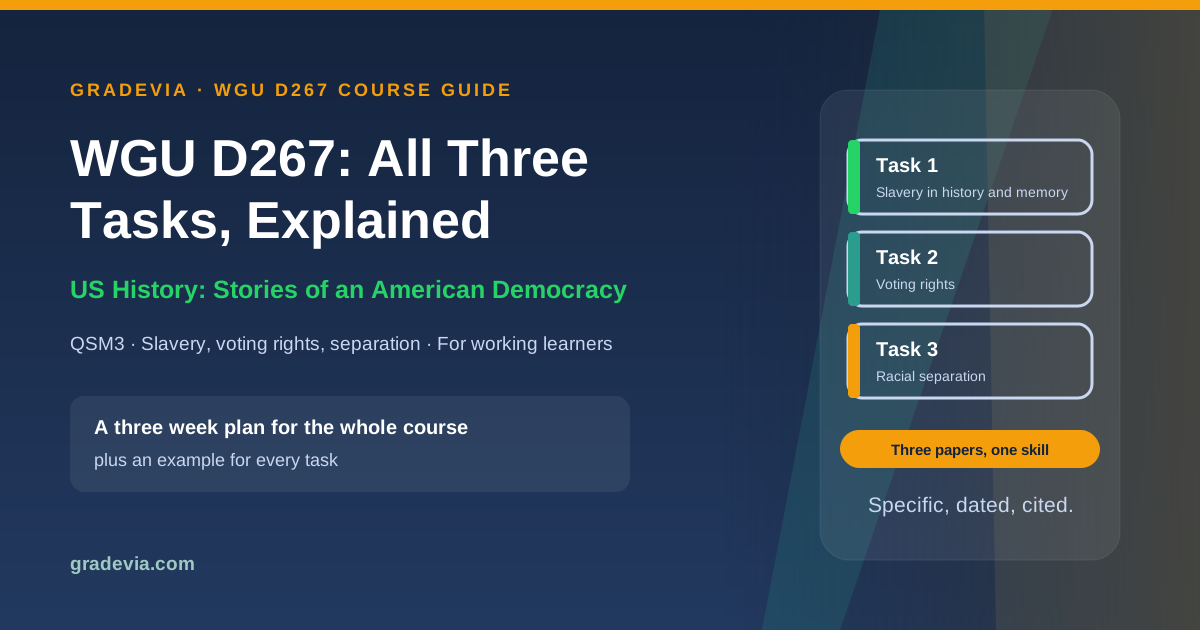
WGU D267, the US history course listed as US History: Stories of an American Democracy, is assessed through three written performance tasks under the code QSM3. Each task takes one long struggle in American history and asks you to work with evidence: slavery and how it’s remembered, the expansion of the right to vote, and racial separation and its lasting effects. There are no slides or recordings to make. Every task is a paper, and every one is graded on how specific your evidence is.
That word is the thread through the whole course. The prompts ask for two specific factors, two specific examples, one specific policy, and a specific change before a specific year. Working learners rarely struggle with the history itself. They lose time when a paper comes back because an example had no date, a policy wasn’t named, or a reflection stayed general. This page shows what each task asks, what the three have in common, and how to fit WGU US history around a full time job, with a link to the detailed guide and example for each task.
D267 at a Glance
| Task 1 | Task 2 | Task 3 | |
|---|---|---|---|
| Topic | Slavery in history and memory | Voting rights | Racial separation |
| What you choose | One primary and one secondary source from the course list | One individual from the course list, and the 15th or 19th Amendment | One group: Native Americans, Japanese Americans, or African Americans |
| What you write | The primary author’s perspective, a comparison of both sources, and a reflection | The individual’s role, the amendment’s purpose and how it was undermined, and the Voting Rights Act of 1965 | Two policies, their economic effects, the group’s resistance, and a reflection on your profession |
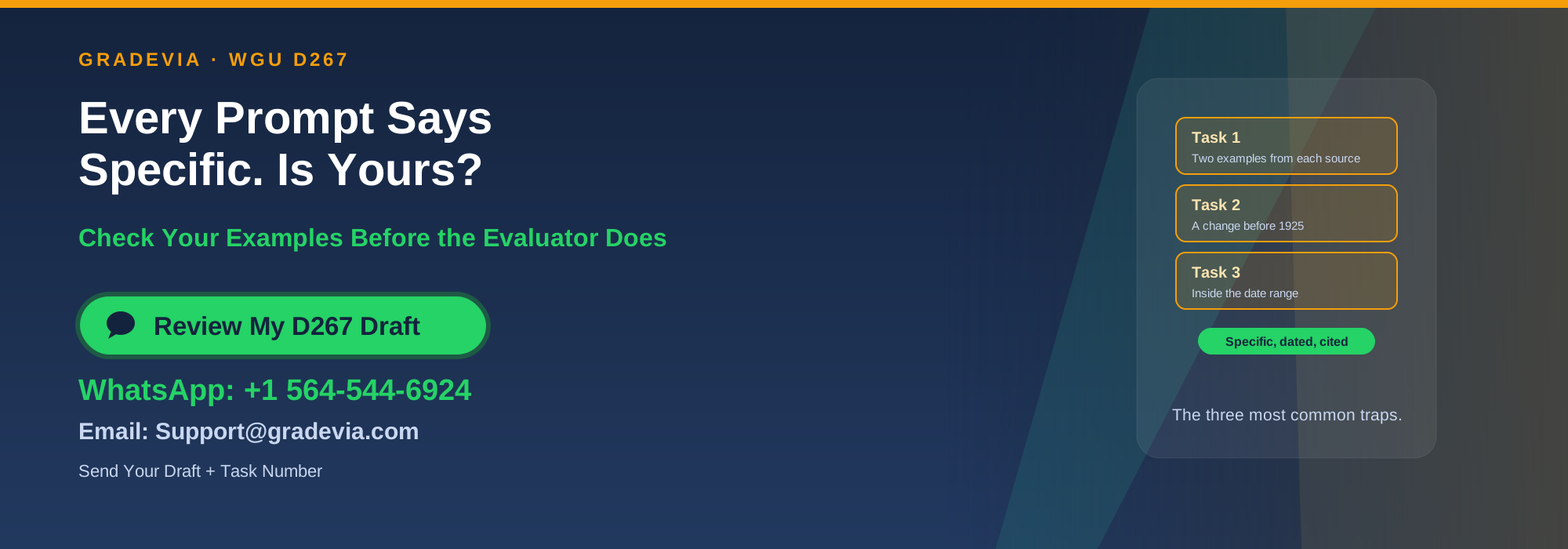
| The trap | B2 needs two examples from each source | A2 needs a change before 1925; C2 covers both amendments | Every example must stay inside the group’s date range |
| Typical time for a working adult | 4 evenings | 3 evenings | 3 evenings |
| Detailed guide | D267 Task 1 guide | D267 Task 2 guide | D267 Task 3 guide |

What Connects the Three Tasks
Each task asks the same three questions about a different part of American history:
| Question | Task 1 | Task 2 | Task 3 |
|---|---|---|---|
| What happened, and who made it happen? | A primary source author and the forces that shaped them | An individual who fought for the vote | Two policies of separation |
| How did people push back? | The primary source itself, as testimony | The individual’s actions and the amendments | The group’s resistance |
| What does it mean now? | How primary sources shaped your understanding | How the Voting Rights Act addressed earlier failures | Social impacts in your profession |
Working through Task 1 carefully pays off later. Learning to pull a specific, dated example from a source and cite it properly is exactly what Tasks 2 and 3 ask for, only with different topics.
WGU D267 Task 1: Slavery in History and Memory
What it asks: You choose one primary source and one secondary source from the course’s “Primary and Secondary Sources List.” In Part A, you discuss two social, political, or cultural factors that affected the primary source’s author and two main ideas of the source. In Part B, you give two main ideas of the secondary source and compare how both depict slavery, with two examples from each. In Part C, you reflect on one aspect of slavery the primary sources helped you understand, and on why primary sources matter.
Where students lose time:
- Choosing a source pair with little overlap, which makes the B2 comparison hard to write
- Naming general factors in A1, such as “slavery was legal,” instead of dated laws or court cases
- Giving fewer than two examples from one of the sources in B2
Our WGU D267 Task 1 guide lists every source on the course list, explains how to choose a pair that compares well, and includes an example paper built on two real sources that aren’t on the list.
WGU D267 Task 2: Voting Rights
What it asks: In Part A, you choose one individual from the “Individuals Active in Voting Rights” list and explain one specific example of their position and one specific change in voting rights before 1925 that they contributed to. In Part B, you choose the 15th or 19th Amendment and explain its intended outcome and one policy or practice used to undermine it. In Part C, you analyze the Voting Rights Act of 1965: its intended outcomes and how it addressed the failures of both amendments.
Where students lose time:
- Choosing an individual without a documented change before 1925
- Listing several undermining practices in B2 instead of explaining one in depth
- Covering only the amendment from Part B in C2
Our WGU D267 Task 2 guide explains each prompt and includes an example that substitutes a different person, amendment, and law, so it shows the method without answering the task.
WGU D267 Task 3: Racial Separation and Its Impact
What it asks: You choose Native Americans (1820 to present), Japanese Americans (1877 to present), or African Americans (1877 to present). In Part A, you identify two specific policies of racial separation, explain their economic effects with two examples, and describe two examples of the group’s resistance. In Part B, you reflect on how these policies contributed to specific social impacts on the communities you’ll serve in your profession.
Where students lose time:
- Using an example from outside the group’s date range
- Describing social or political effects in A2, which asks only about economic conditions
- Writing a Part B reflection that doesn’t name a profession or a specific community
Our WGU D267 Task 3 guide covers each prompt, a research checklist for choosing a group, and an example built on a group outside the task’s three options.
Rules That Apply to Every D267 Task
- Choose from the course lists. Tasks 1 and 2 give you lists to choose from, and Task 3 gives you three groups. Outside research is welcome for context, but your main subjects must come from the task.
- Date everything. Laws, court cases, speeches, and events need years. Several prompts depend on dates, including Task 2’s 1925 cutoff and Task 3’s date ranges.
- Name, don’t summarize. A specific policy has a name. A specific example has a person, a place, and an outcome.
- Use credible sources. The National Archives, the National Park Service, the Library of Congress, and scholarly histories are reliable starting points. Cite every fact in APA format, with in-text citations and a reference list.
- Check professional communication. Run Grammarly for Education and review the similarity report before each submission.
How to Fit D267 Around a Full Time Job
Ten evenings over three weeks is realistic for most working learners:
| Week | Evenings | Work |
|---|---|---|
| Week 1 | 4 | Task 1: read several short primary sources, choose your pair, then write Parts A, B, and C |
| Week 2 | 3 | Task 2: research two or three individuals, choose one, then write Parts A, B, and C |
| Week 3 | 3 | Task 3: choose a group and check your sources, write Part A, then write your Part B reflection |
Submit each task as you finish it, and start the next while it’s being evaluated. If a task comes back, the evaluator’s comments point to the specific prompt to fix.
WGU D267 Examples: What Each One Shows
All three examples use fictitious students and real, verified history, and each is designed so it can’t be submitted:
| Example | How it avoids answering the task | Where to find it |
|---|---|---|
| Task 1 | Analyzes two real sources that aren’t on the course list | D267 Task 1 guide |
| Task 2 | Uses a person not on the list, a different amendment, and a different federal law | D267 Task 2 guide |
| Task 3 | Analyzes a group outside the task’s three options | D267 Task 3 guide |
Frequently Asked Questions
What is WGU D267?
D267 is a WGU US history course, listed as US History: Stories of an American Democracy. It’s assessed through three written performance tasks under the code QSM3, on slavery, voting rights, and racial separation.
How many tasks are in WGU D267?
Three. Task 1 analyzes primary and secondary sources on slavery, Task 2 covers voting rights, and Task 3 covers racial separation policies.
Does D267 have an objective assessment?
The course’s assessments are the three performance tasks. Check your course page for the current assessment list.
What does QSM3 mean?
QSM3 is the assessment code on the current D267 task directions. Some older papers posted online are labeled QSM2, which points to an earlier version, so check the code on your own task page.
Do I need outside sources for D267?
Your main sources and subjects come from the course lists and directions. Outside research is useful for dates, laws, and context, as long as it’s credible and cited.
Can I submit the D267 examples on Gradevia?
No. Each one is designed around a source, person, or group the task doesn’t allow, and uses a fictitious student. They’re for illustration only.
Want Help Planning D267?
If you’re working full time and want structured assignment support choosing your sources, individual, or group, finding specific dated examples, or checking a paper before you submit, message Gradevia on WhatsApp at +1 564 544 6924 or email Support@gradevia.com.
Related WGU Guides
- Our WGU D268 course guide covers another general education course with three written and presented tasks.
- Our D253 Task 2 guide covers unconscious bias, which connects to the reflections in Tasks 1 and 3.
- Our WGU C717 Task 2 guide covers ethical reasoning.