
Blog
NRS-445 Assignment Guide: Nursing Research & Evidence-Based Practice (Every Assignment, Explained)

NRS-445 Assignment Guide
NRS-445 is the course where GCU’s RN-to-BSN program teaches you to use research — to find evidence, judge whether it’s any good, and turn it into a practice recommendation. Almost everything you do in this five-week course is one connected thread: build a PICOT question, find the evidence, appraise it, synthesize it, and propose a change. This guide walks you through that thread, links you to a full breakdown of each assignment, and shows you how NRS-445 sets up your capstone — all in a way that helps you do the work yourself.
How to use this guide: This is a teaching resource. Each section explains how an assignment works and what graders look for, then points you to a deeper walkthrough. The goal is to help you produce your own work with confidence — which is exactly the EBP skill this course is built to give you.
NRS-445 at a glance
| Course | NRS-445 — Nursing Research & Evidence-Based Practice |
| Credits / length | 3 credits · 5 weeks (one course at a time) |
| Prerequisite | HLT-362V (Applied Statistics) |
| Core skills | PICOT, literature searching, critical appraisal, synthesis, EBP recommendations |
| What you’ll produce | A PICOT question, a Literature Evaluation Table, quantitative and qualitative critical appraisals, a literature review, and a final EBP proposal |
| Where it leads | Directly into the NRS-465 capstone |
Where NRS-445 sits: the EBP learning spine
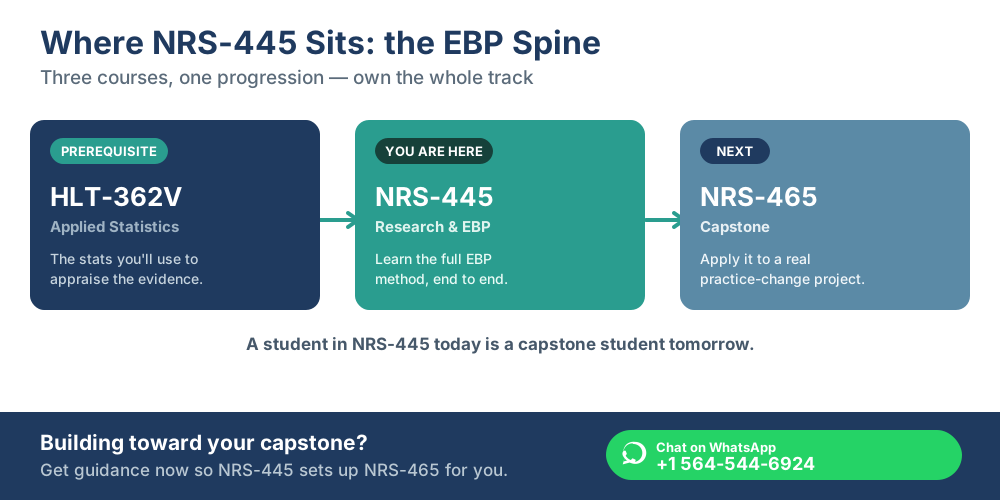
NRS-445 doesn’t stand alone — it’s the middle of a three-course progression, and understanding that makes the whole course easier:
- HLT-362V (Applied Statistics) — your prerequisite. The stats you learned there (p-values, confidence intervals, study designs) are exactly what you’ll use to appraise research in this course. If a concept feels shaky, revisit your HLT-362V material.
- NRS-445 (this course) — where you learn the EBP method end to end.
- NRS-465 (capstone) — where you apply that method to a real practice-change project. The PICOT and Literature Evaluation Table you build here reappear in the capstone.
Treat NRS-445 as the dress rehearsal for your capstone. Choosing a clinical problem you genuinely care about now pays off twice.
Every NRS-445 Assignment — Full Guides
NRS-445 builds in sequence: your PICOT drives your literature search, your literature search feeds the Evaluation Table, the table feeds the Literature Review, and the review supports the EBP Proposal. Use the guides below in order.
Weekly discussion questions (Topics 1–5)
The DQs scaffold your project. Early ones get you identifying a clinical problem and a PICOT question; later ones build toward appraisal and synthesis. Each initial post is 200+ words with two scholarly references; peer responses are 100–150 words with one reference. → Full walkthroughs: Topic 1 DQ 1 · Topic 1 DQ 2 and the rest of the DQ set.
How to Write Your NRS-445 PICOT Question (Step by Step, With Examples)
Your PICOT is the foundation of everything in NRS-445 — and the same framework carries into your NRS-465 capstone. This guide walks through every element (Population, Intervention, Comparison, Outcome, Time) with worked examples and the most common mistakes that get PICOT questions rejected by faculty.
NRS-445 Literature Evaluation Table: How to Complete It (Step by Step)
The Literature Evaluation Table is where NRS-445 stops being conceptual and becomes technical. This guide covers how to select the right articles, complete every column in GCU’s template, classify level of evidence correctly, and write the applicability column the way faculty expect.
NRS-445 Literature Review: How to Synthesize (Not Summarize) Your Evidence
Most students lose points here by summarizing articles one at a time instead of synthesizing them thematically. This guide explains the difference and shows you exactly how to structure a literature review that builds a coherent argument across your sources.
NRS-445 Qualitative Critical Appraisal: How to Use the CASP Checklist (Step by Step)
Qualitative studies are appraised differently from quantitative ones. This guide walks through GCU’s qualitative critical appraisal requirements using the CASP checklist — what each question is testing, how to answer it, and how to write your appraisal response.
NRS-445 Quantitative Critical Appraisal: How to Use the CASP RCT Checklist (Step by Step)
The quantitative appraisal applies the CASP RCT checklist to a randomised controlled trial or similar study design. This guide decodes every section — bias assessment, results interpretation, applicability — so you can complete the appraisal correctly the first time.
NRS-445 EBP Proposal: The Complete Section-by-Section Guide
The Research Critiques and Evidence-Based Practice Change Proposal is the final and highest-stakes deliverable in NRS-445. This guide breaks down every required section, explains what faculty are grading at each point, and shows you how to connect your literature to a specific practice change recommendation.
How the assignments connect
If you see NRS-445 as seven unrelated tasks, it feels overwhelming. See it as one project in stages and it gets simple:
Problem → PICOT → find evidence → appraise evidence → synthesize → propose a change.
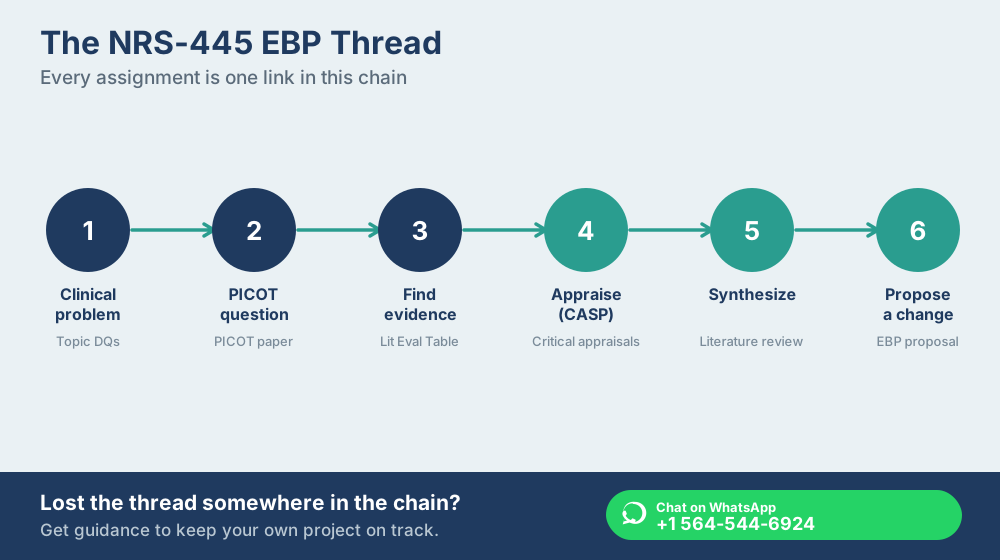
Every assignment is one link in that chain. The clinical problem you pick in your early DQs becomes your PICOT; the PICOT drives your Literature Evaluation Table; those articles get critically appraised; the appraisals feed your literature review; and the review supports your final EBP proposal. Pick a strong, narrow, nurse-influenceable problem at the start and the whole chain holds together.
How NRS-445 sets up your NRS-465 capstone
This is the part savvy students use to their advantage. The capstone (NRS-465) asks for a PICOT, a Literature Evaluation Table, and an evidence-based change project — the same building blocks you create here. If you choose a capstone-worthy clinical problem in NRS-445 and do the work well, you walk into NRS-465 with your foundation already built. → See the NRS-465 capstone guide and the Literature Evaluation Table as it’s used in the capstone.
Study tips and common pitfalls
- Dust off your HLT-362V stats. Critical appraisal is impossible if p-values and study designs are a blur. A quick refresher up front saves hours later.
- Nail “primary” and “peer-reviewed.” The Literature Evaluation Table needs primary research — original studies, not reviews or summaries. Use the GCU Library’s CINAHL and MEDLINE filters.
- Learn the two CASP checklists. Quantitative and qualitative appraisal ask different questions for good reasons; know why.
- Synthesize, don’t summarize. In the literature review, organize by theme, not by article. This is the most common point loss.
- Keep one clinical problem the whole way through. Switching problems mid-course forces you to redo earlier work.
- APA 7 throughout — in-text citations matched to references, DOIs as live links, and recent (within ~5 years) scholarly sources.
Helpful EBP resources
- Grand Canyon University (Ed.). (2022). Nursing research: Understanding methods for best practice (2nd ed.). — your course textbook.
- Melnyk, B. M., & Fineout-Overholt, E. (2023). Evidence-based practice in nursing & healthcare: A guide to best practice (5th ed.). Wolters Kluwer. — the standard EBP reference.
- Melnyk, B. M., Gallagher-Ford, L., Zellefrow, C., Tucker, S., Thomas, B., Sinnott, L. T., & Tan, A. (2018). The first U.S. study on nurses’ evidence-based practice competencies indicates major deficits that threaten healthcare quality, safety, and patient outcomes. Worldviews on Evidence-Based Nursing, 15(1), 16–25. https://doi.org/10.1111/wvn.12269
- CASP (Critical Appraisal Skills Programme) checklists — the appraisal tools your assignments use; access them through your topic Resources.

Frequently asked questions
What is NRS-445 about? NRS-445, Nursing Research & Evidence-Based Practice, teaches you to evaluate quantitative and qualitative research and translate it into practice through a PICOT-driven, evidence-based recommendation. Its prerequisite is HLT-362V.
What assignments are in NRS-445? Weekly discussion questions, a PICOT question, a Literature Evaluation Table (four primary research articles — two quantitative, two qualitative), quantitative and qualitative critical appraisals using CASP checklists, a literature review, and a final Research Critiques and EBP Proposal.
How hard is NRS-445? The workload is manageable if you keep one clinical problem throughout and refresh your HLT-362V statistics for the appraisal assignments. The biggest challenges are finding primary research and synthesizing rather than summarizing.
How does NRS-445 connect to the capstone? The PICOT, Literature Evaluation Table, and EBP recommendation you build in NRS-445 are the same building blocks used in the NRS-465 capstone, so strong work here gives you a head start.
Do I need statistics for NRS-445? Yes. Critical appraisal of quantitative studies relies on the statistics concepts from the HLT-362V prerequisite.
Working through NRS-445 on top of full-time shifts and want a second set of eyes on your PICOT, your appraisal, or your EBP proposal before you submit? Message us on WhatsApp at +1 564-544-6924 and we’ll help you sharpen your own work.