
Blog
WGU C200 Managing Organizations and Leading People: Complete Guide to Task 1 and Task 2

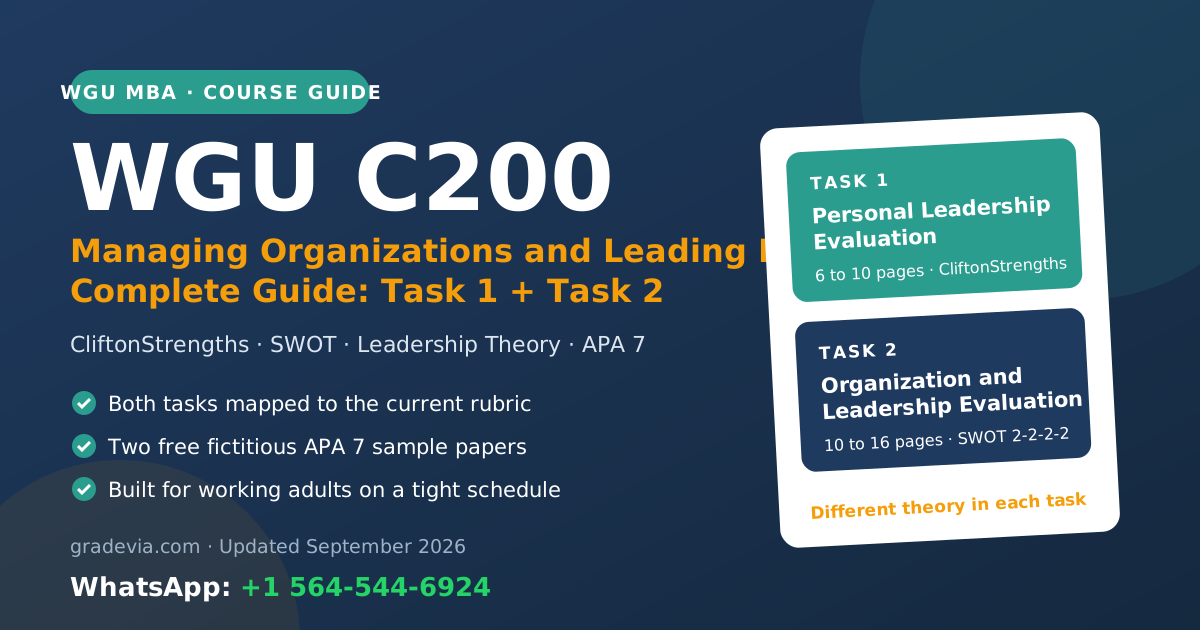
Updated on: Sep 25, 2026
WGU MBA C200, Managing Organizations and Leading People, is often one of the first courses new WGU MBA students take. There is no exam. Instead, you write two papers: WGU C200 Task 1, a Personal Leadership Evaluation built on your CliftonStrengths results, and WGU C200 Task 2, an Organization and Leadership Evaluation of a leader you have worked with.
This guide is written for working adults who want to pass both tasks on the first submission and keep their program moving. It explains what each task actually requires under the current instructions, the rules that trip up new students, the questions people ask most, and where to find two free, fully fictitious sample papers.
WGU C200 at a Glance
| WGU MBA C200 Task 1 | WGU MBA C200 Task 2 | |
|---|---|---|
| Official title | DCM2 Task 1: Personal Leadership Evaluation | DCM2 Task 2: Organization and Leadership Evaluation |
| Who you evaluate | Yourself | The current leader of an organization you know (not you) |
| Starting point | Your CliftonStrengths Signature Themes report | An organization you have personal experience with |
| Core analysis | One leadership theory: 3 strengths, 3 weaknesses, 3 actions | SWOT (2 per category) plus a different theory: 3 strengths, 3 weaknesses, 3 actions |
| Goals or actions | 2 SMART goals, 2 actions each | 3 actions that address the leader’s weaknesses |
| Suggested length | 6 to 10 pages | 10 to 16 pages |
| Files | Word paper + Signature Themes PDF | Word paper (supporting documents in a separate PDF) |
| Detailed guide | Task 1 guide + example | Task 2 guide + example |

Both tasks share the same competencies: the practice of management, theories of leadership, sustaining business performance, and organizational performance methods. Both are also scanned by the WGU similarity checker and assessed for professional communication through Grammarly for Education.
WGU C200 Task 1: Personal Leadership Evaluation
Task 1 asks you to evaluate your own leadership. Here is what the current instructions require:
- Part A: a PDF copy of your CliftonStrengths Signature Themes report, plus a reflection on all five themes and what they suggest about your leadership.
- Part B: one scholarly leadership theory from WGU’s list of seven (transformational, transactional, situational, participative, servant, behavioral, or trait), used to evaluate three strengths, three weaknesses, and three actionable items. Each of those three sections needs at least one scholarly source.
- Part C: two short-term SMART goals, each with at least two specific actions.
- Parts D and E: APA citations and professional communication.
The most common Task 1 problem is restating Gallup’s theme descriptions instead of showing how each theme appears in your actual work. The second most common is a theory that appears in the first paragraph of Part B and then disappears.
Want an example of WGU C200 Task 1? The Task 1 guide includes a free, fictitious WGU C200 Task 1 paper in Word, formatted in APA 7. It follows a warehouse shift manager through servant leadership and covers every rubric item. It is for illustration only and not to be submitted for grading.
WGU C200 Task 2: Organization and Leadership Evaluation
Task 2 turns outward. You write about an organization you have personally experienced and its current leader:
- Part A: describe the organization and its objectives, explain three leadership practices of the current leader (someone other than you), and discuss how that leader has affected the organization’s culture.
- Part B: a SWOT analysis with exactly two current strengths, two current weaknesses, two unmet opportunities, and two unresolved threats. Strengths and weaknesses are internal; opportunities and threats are external.
- Part C: evaluate the leader using a theory different from the one you used in Task 1, with three strengths, three weaknesses, and three actionable items that address those weaknesses, each section supported by at least one scholarly source.
- Parts D and E: APA citations and professional communication.
The task also requires fictional names for every person, supplier, and organization, and it asks you to discuss organization-specific data, including financial information, only in general terms.
Looking for a WGU C200 Task 2 example? The Task 2 guide includes a free, fictitious 13-page APA 7 example of a medical practice’s patient access department, evaluated through transformational leadership. It is for illustration only and not to be submitted for grading.
Choosing Your Theories for Both Tasks
Because Task 2 must use a different theory from Task 1, it helps to plan both at the start:
- Task 1: pick the theory whose core idea explains both a strength and a weakness in your own five themes.
- Task 2: pick the theory that best explains how the leader you plan to evaluate actually behaves, making sure it is not your Task 1 theory.
Many students use servant leadership in one task and transformational leadership in the other, because both are well supported in scholarly literature. Transformational vs. servant leadership for WGU C200 explains how to tell them apart, and how to find scholarly sources for C200 shows where to find support for Parts B and C.
WGU C200 Task 1 PDF and Task 2 PDF: What Goes Where
Searches for a wgu c200 task 1 pdf or wgu c200 task 2 pdf usually mean one of two things: the file WGU wants you to upload, or a finished paper someone else wrote. Here is what WGU actually asks for:
| File | Task 1 | Task 2 |
|---|---|---|
| Your paper | Microsoft Word (.doc or .docx) | Microsoft Word (.doc or .docx) |
| Required PDF | Your CliftonStrengths Signature Themes report | None required |
| Supporting documents | In a separate PDF, if any | In a separate PDF, if any |
| Cloud links | Not accepted | Not accepted |
Finished PDFs of other students’ papers are a different story. They describe someone else’s themes and workplace, they often follow an older version of the course, and copying from them can trigger the similarity checker.
WGU C200 Sample Papers: How to Use Them Safely
A WGU C200 sample paper is useful for one thing: seeing the structure and depth evaluators expect. Both Gradevia examples are fully fictitious, clearly labeled as illustrations, and include an appendix that maps each rubric item to the section that covers it.
- WGU C200 Task 1 examples: the Task 1 guide and its downloadable Word example
- WGU C200 Task 2 example: the Task 2 guide and its downloadable Word example
Use them to check your outline, not as text to adapt. Evaluators compare Task 1 against your own Signature Themes PDF, and Task 2 has to describe an organization you actually know.
Get help fixing a returned C200 task on WhatsApp

How the C200 Rubric Works
Each task is evaluated against a rubric aligned to the lettered parts of the instructions: A through E for both tasks. Every aspect needs to reach a passing level for the task to pass, so one missing item can send the whole paper back. Three habits help across both tasks:
- Mirror the task letters in your headings, so an evaluator can find every requirement quickly.
- Count before you submit. Five themes; three strengths, three weaknesses, and three actions; two SMART goals with two actions each; three practices; two items per SWOT category.
- Tie every claim to evidence. A behavior you observed, a theory component, and a scholarly source are stronger together than any one alone.
Always check the rubric inside your course before you submit. WGU revises tasks between terms.
WGU C200 Questions Students Ask Most
People who search wgu c200 reddit or browse WGU study communities tend to ask the same handful of WGU C200 questions. Here are direct answers based on the current task instructions.
Is WGU C200 hard?
The concepts are not difficult, but the papers are more structured than they look. Students who write a personal essay tend to get revisions; students who follow the lettered parts and hit every count tend to pass on the first attempt.
How long does WGU C200 take?
It depends on your schedule. Many working students plan about one week of evenings for Task 1 and one to two weeks for Task 2, which is longer because of the SWOT and the leadership evaluation.
Can I use the same leadership theory in Task 1 and Task 2?
No. Task 2 Part C requires a theory different from the one you used in Task 1.
Do I need scholarly sources?
Yes. In Task 1, each of the three Part B sections (strengths, weaknesses, and actions) needs at least one scholarly source. In Task 2, each of the three Part C sections needs at least one. WGU accepts reputable journals, published books, faculty or business-leader sources, and anything in the WGU library.
Can I write about my current employer in Task 2?
Yes, and most students do. You must use fictional names for people and the organization, and keep specific financial or proprietary data general.
Can I be the leader in Task 2?
No. Task 2 evaluates the current leader of the organization, someone other than yourself.
What happens if a C200 task gets returned?
The evaluation report identifies which rubric aspects did not pass. Revise those sections, recheck the counts and citations, and resubmit. Check your course or program mentor for any attempt limits that apply to you.
What is the difference between WGU C200 Task 1 and Task 2?
Task 1 evaluates your own leadership using your CliftonStrengths results and ends with SMART goals. Task 2 evaluates another leader and their organization using a SWOT and a different leadership theory, and ends with three actions for that leader.
A Two-Task Plan for Working Adults
| Week | Task | What to do |
|---|---|---|
| Week 1, days 1 to 2 | Task 1 | Take CliftonStrengths, save the PDF, draft one workplace example per theme |
| Week 1, days 3 to 5 | Task 1 | Choose your theory, find sources, draft Part B (weaknesses first) |
| Week 1, days 6 to 7 | Task 1 | Draft SMART goals, check citations, run Grammarly, submit |
| Week 2, days 1 to 3 | Task 2 | Choose the organization and leader, draft Part A and the SWOT |
| Week 2, days 4 to 6 | Task 2 | Choose a different theory, draft Part C with each action tied to a weakness |
| Week 2, day 7 | Task 2 | Anonymize, check APA citations, run Grammarly, submit |
Adjust the pace to your schedule. The order matters more than the speed: finish your analysis before you polish the writing.
Get Support With WGU C200
If you are starting your WGU MBA while working full-time, Gradevia offers assignment support for both C200 tasks. We can help you plan your Task 1 and Task 2 theories together, review your drafts against every rubric line, work through evaluator feedback on a returned task, and check your APA citations before you submit. The reflection, the observations, and the analysis stay yours.

WGU C200 assignment support on WhatsApp for working MBA students
All C200 Guides
- WGU C200 Task 1 Personal Leadership Evaluation: Guide, Rubric, and Example
- WGU C200 Task 2 Organization and Leadership Evaluation: Guide + Example Paper
- Transformational vs. Servant Leadership for WGU C200
- How to Find Scholarly Sources for WGU C200
- Browse all C200 guides
About This Guide
This guide was reviewed against WGU’s current DCM2 Task 1 and Task 2 instructions in September 2026. The sample papers linked above were written for illustration using fictitious people and organizations, and every scholarly source they cite was checked against its DOI or publisher listing. Gradevia is an independent study resource and is not affiliated with or endorsed by Western Governors University or Gallup, Inc. CliftonStrengths® is a registered trademark of Gallup, Inc.