
Blog
XH3002 Clinical Judgment Through Assessment

Introduction: What Is XH3002 Clinical Judgment Through Assessment and Why Does It Matter?
XH3002 Clinical Judgment Through Assessment is a core nursing assignment at Walden University that challenges students to demonstrate professional-level clinical reasoning. Unlike simple knowledge recall tasks, XH3002 asks you to analyse a real patient scenario, connect clinical findings to evidence-based nursing theory, and justify every decision you make – all while satisfying a detailed rubric.
For many Walden nursing students, this is one of the most demanding assignments in the program. The difficulty does not lie in finding information – it lies in demonstrating a structured, articulate reasoning process that mirrors how an experienced registered nurse actually thinks. That is precisely what this guide is designed to teach.
| What you will learn in this guide:
• Exactly what XH3002 evaluates and what Walden’s rubric expects at each criterion • How to apply the CJMM and Tanner’s Clinical Judgment Model to your response • A five-step clinical reasoning process mapped to the XH3002 scenario format • Common mistakes that cost students points – and how to avoid them • Proven high-scoring strategies aligned with Walden rubric language |
Understanding XH3002 Clinical Judgment Through Assessment
What This Assignment Evaluates
XH3002 is not a content test. Walden is not asking you to recite pathophysiology or list medication names. The assignment evaluates three interconnected competencies:
- Clinical reasoning ability – your capacity to work through ambiguous patient data and arrive at defensible nursing conclusions
- Patient assessment interpretation – your skill at distinguishing clinically significant findings from background noise in a scenario
- Evidence-based decision-making – your ability to connect nursing actions to research, standards of care, and established clinical frameworks
Together, these competencies reflect the nursing practice standard articulated by the National Council of State Boards of Nursing (NCSBN), which underpins both the NCLEX Next Generation examination and programs like Walden’s nursing curriculum.
Key Learning Outcomes for XH3002
By the time you complete this assignment successfully, you should be able to demonstrate:
- Recognition of clinically significant cues embedded in patient scenario data
- Accurate interpretation of assessment findings using appropriate clinical frameworks
- Prioritisation of nursing responses based on patient safety and acuity
- Reflective evaluation of care decisions with specific, actionable improvement strategies
- Integration of cultural competence and implicit bias awareness into clinical reasoning
| KEY INSIGHT | The SERP for XH3002 is saturated with copied answers and unstructured student uploads. Assignments that mirror those resources are easy for instructors to identify – and they consistently score in the lower rubric tiers. High scores come from demonstrating a reasoning process, not presenting a pre-written answer. |
The Clinical Judgment Frameworks You Must Apply in XH3002
Walden nursing faculty explicitly expect you to situate your response within recognised clinical judgment models. Assignments that fail to reference an established framework almost always fall short on the Evaluation of Clinical Reasoning criterion. Two models are essential for XH3002.
The Clinical Judgment Measurement Model (CJMM)
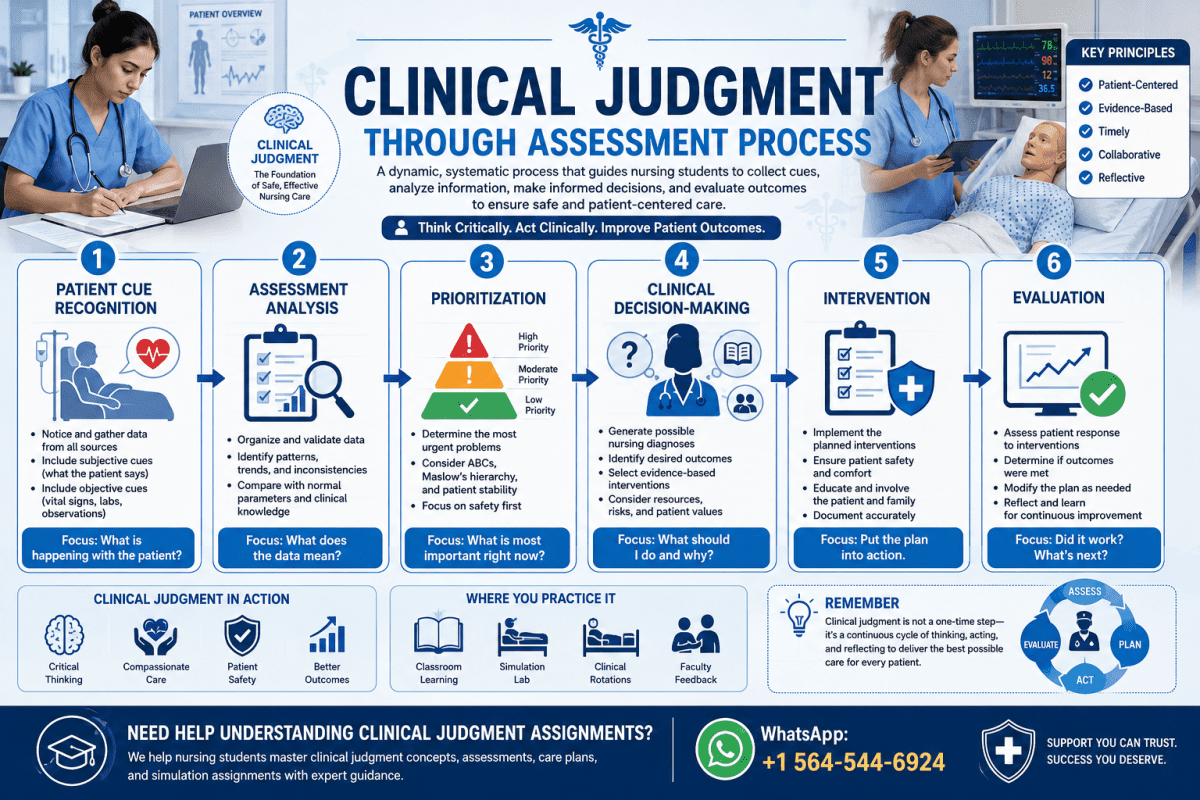
The CJMM was developed by the NCSBN to define and measure the clinical judgment competencies expected of entry-level nurses. It forms the structural backbone of the Next Generation NCLEX and is increasingly embedded in Walden’s assessment design. The model comprises six cognitive steps, each building on the last:
| CJMM Step | Clinical Action | Applied to XH3002 |
| 1. Recognise Cues | Identify relevant patient data and abnormal findings. | Spot changes in vital signs, pain descriptions, lab values, or patient behaviour in the scenario. |
| 2. Analyse Cues | Connect findings to understand what is happening clinically. | Determine what the cues mean together — e.g., elevated BP + chest pain = potential cardiac event. |
| 3. Prioritise Hypotheses | Rank possible diagnoses or concerns from most to least urgent. | Identify the most life-threatening issue first and justify your prioritisation order. |
| 4. Generate Solutions | Develop a range of nursing interventions. | List evidence-based nursing actions and explain which is most appropriate given the patient’s situation. |
| 5. Take Action | Implement the chosen nursing intervention. | Describe what the nurse does and tie each action directly to a clinical rationale. |
| 6. Evaluate Outcomes | Assess whether the intervention was effective. | Reflect on patient response and identify what would be done differently for improved outcomes. |
When you write your XH3002 response, trace your reasoning explicitly through these six steps. Do not assume the reader will infer which step you are performing. Name it, apply it, and cite the clinical evidence that supports your conclusion at each stage.
Tanner’s Clinical Judgment Model
Carol Tanner’s 2006 model, published in the Journal of Nursing Education, remains one of the most widely cited frameworks in nursing education. It organises clinical judgment around four recursive phases that describe how nurses notice, process, and learn from patient encounters:
| Tanner Phase | Core Question | XH3002 Application |
| Noticing | What stands out? What feels different or concerning? | Identify abnormal cues, deviations from baseline, or changes that signal a problem. |
| Interpreting | What does this data mean clinically? Which hypothesis best explains these cues? | Connect findings to a clinical condition or nursing concern with evidence-based reasoning. |
| Responding | What nursing interventions are appropriate and why? | Select prioritised nursing actions and justify each one using clinical standards. |
| Reflecting | How well did this go? What would a better nurse have done differently? | Evaluate care provided and articulate specific improvements for future encounters. |
Tanner’s model is particularly powerful for the Reflection section of XH3002, where students often lose points by writing generic statements. Using the Reflecting phase as a structure compels you to evaluate specific decisions, name what could have been done differently, and explain the clinical reasoning that supports the improvement – exactly what the rubric rewards.
| PRO TIP | You do not need to choose between CJMM and Tanner – use both. Apply CJMM to structure your assessment and action steps, then use Tanner’s four phases to organise your reflective analysis. Together they signal to your instructor that you understand clinical judgment at both an operational and reflective level. |
XH3002 Rubric Breakdown: What Walden Expects at Every Criterion
The table below maps each rubric criterion directly to Walden’s grading expectations and the most common mistakes observed in lower-scoring submissions. Use this as a pre-submission checklist before you upload your work.
| Rubric Criterion | What Walden Expects | Common Mistake |
| Clinical Judgment Summary | Accurately summarise the nurse-patient scenario demonstrating understanding of clinical context and patient situation. | Summarising without clinical relevance or context. |
| Evaluation of Clinical Reasoning | Explain the nurse’s actions and justify each clinical decision with evidence-based rationale tied to patient outcomes. | Listing actions without explaining why they were taken. |
| Cultural Competence & Bias Awareness | Identify implicit biases in the scenario, address how they affect patient care, and demonstrate culturally sensitive reasoning. | Ignoring cultural factors or omitting bias recognition. |
| Use of Clinical Frameworks | Explicitly apply Tanner’s Model or CJMM to structure reasoning and link actions to recognisable nursing theory. | Generic analysis with no reference to established models. |
| Reflection & Improvement | Provide thoughtful reflection on what could be improved, showing higher-order thinking. | Superficial or missing reflection section. |
One of the most effective strategies for earning top marks is to read the rubric language carefully and mirror it deliberately in your submission. If the rubric says ‘justify clinical decisions,’ your response should contain explicit justifications – not just descriptions – of every nursing action you discuss.
Step-by-Step Clinical Reasoning Process for XH3002
The following five-step framework provides a practical structure for working through any XH3002 patient scenario. Each step maps directly to rubric criteria and to the CJMM and Tanner models introduced above.
| 1 | Collect and Organise Patient Data
Separate subjective data (what the patient reports – pain, anxiety, nausea) from objective data (measurable findings – vital signs, lab values, physical assessment results). Document both systematically before drawing any conclusions. This corresponds to the Recognise Cues step in the CJMM. |
| 2 | Identify Clinically Significant Cues
Review your collected data and flag the findings that deviate from normal baselines or from the patient’s established norms. Ask: what stands out? What has changed? What seems inconsistent with the rest of the presentation? This is Tanner’s Noticing phase. |
| 3 | Interpret Your Findings
Connect the significant cues into a coherent clinical picture. What condition or nursing concern do they collectively suggest? Which hypothesis best explains the constellation of findings? Ground your interpretation in evidence – reference clinical guidelines, pathophysiology, or peer-reviewed nursing literature. This maps to Analyse Cues and Prioritise Hypotheses in the CJMM. |
| 4 | Prioritise and Justify Nursing Actions
Determine which nursing interventions are most appropriate and most urgent. Always reason from patient safety first – apply the ABC framework or Maslow’s hierarchy where relevant. For each action, provide a clinical justification that links the intervention to the patient’s specific findings. This is Tanner’s Responding phase. |
| 5 | Reflect and Evaluate Outcomes
After describing the nursing response, reflect on its effectiveness. What was the patient’s response? What would a more experienced nurse have done differently? What systemic or cultural factors may have influenced care? Be specific – name the improvement, explain why it would lead to better outcomes, and tie it back to clinical evidence. This is Tanner’s Reflecting phase and Evaluate Outcomes in the CJMM. |
High-Scoring Response Structure for XH3002
Below is the recommended structure for a top-tier XH3002 submission. This is not a content template – the specific clinical content must come from your assigned scenario. This structure ensures you address every rubric criterion in a logical, readable sequence.
RECOMMENDED SUBMISSION STRUCTURE
|
Common Mistakes Walden Nursing Students Make in XH3002
Understanding where students lose points is as valuable as knowing how to earn them. These are the most frequently observed errors in XH3002 submissions.
| X | Presenting clinical actions without justification. Describing what the nurse did is not the same as analysing why. Every nursing action must be connected to a clinical rationale tied to the specific patient data. |
| X | Omitting or misusing clinical frameworks. Referring to Tanner or CJMM in a single sentence without applying the framework throughout the response will not satisfy the rubric. The framework needs to shape the structure of your reasoning. |
| X | Skipping or superficially addressing cultural competence. Many students treat this criterion as a footnote. Walden faculty look for genuine engagement with how culture, implicit bias, or social determinants of health influenced the clinical encounter. |
| X | Writing a summary instead of an analysis. Retelling the scenario in your own words is not clinical reasoning. The assignment requires interpretation, prioritisation, and justification – not narration. |
| X | Providing a generic reflection. Statements such as ‘I would communicate better with the patient’ earn minimal marks. Effective reflection names a specific decision, explains what a better decision looks like, and ties it to evidence. |
| X | Ignoring the rubric language. If the rubric uses the phrase ‘justify clinical decisions,’ your response must contain explicit justifications. Mirroring rubric language is not cheating – it is demonstrating that you understand what is being evaluated. |
High-Scoring Tips for Your XH3002 Submission
Apply these strategies to every XH3002 submission to maximise your rubric score.
| ✓ | Always connect nursing actions to clinical evidence. Every intervention you describe should reference clinical guidelines, pathophysiology, or peer-reviewed nursing literature. Assertions without evidence do not satisfy the Evaluation of Clinical Reasoning criterion. |
| ✓ | Explicitly name your framework. Write ‘Using the CJMM step of Analyse Cues…’ or ‘In Tanner’s Noticing phase…’ – do not leave the framework implied. Explicit application signals to your instructor that you understand the model, not just the content. |
| ✓ | Mirror rubric language precisely. Before submitting, compare your response sentence by sentence against the rubric. If a criterion uses the word ‘justify,’ make sure your response contains explicit justifications. If it says ‘identify implicit bias,’ use that phrase or a clear equivalent. |
| ✓ | Lead with patient safety. When prioritising nursing actions, always address the most life-threatening concern first and state explicitly why it is your priority. This demonstrates the safety-first reasoning that nursing programs require. |
| ✓ | Write your reflection last and treat it as a separate analytical task. Go back to your strongest clinical decision in the response and ask: what would have made this even better? Name the alternative action, explain the clinical reasoning, and predict the impact on outcomes. |
| ✓ | Review for nursing language consistency. Use precise clinical terminology throughout. Do not write ‘the patient felt dizzy’ when you can write ‘the patient reported orthostatic lightheadedness.’ Precision in language reflects precision in clinical thinking. |

| Need Expert Help with XH3002?
Gradevia.com provides professional academic writing support for Walden University nursing students. Our specialists understand the CJMM, Tanner’s Model, and every rubric criterion inside out. Send us WhatsApp message on to Quick Get Expert Help for Walden Nursing Assignments |