
Blog
NRS-465 Benchmark Capstone Project Change Proposal – Complete Guide + 2,500-Word Worked Sample


What Is the NRS-465 Benchmark Capstone Change Proposal?
The Benchmark Capstone Project Change Proposal is the final, culminating assignment of NRS-465: Professional Capstone and Practicum at Grand Canyon University. It is not a new assignment written from scratch. It is a synthesis document that pulls together every major assignment completed throughout the course into a single unified evidence-based change proposal, revised in light of instructor feedback received on each prior submission.
At 2,500 to 3,000 words, this is the longest and highest-stakes written assignment in the course. It requires APA 7th edition formatting, a minimum of five peer-reviewed sources published within the past five years, and submission through LopesWrite. The rubric assesses every section independently, which means underdeveloping any one of the eleven required sections carries a direct grade penalty.
Assignment Requirements at a Glance
| Component | Detail |
| Word count | 2,500 to 3,000 words |
| Format | APA 7th edition throughout |
| Sources required | Minimum 5 peer-reviewed, published within 5 years |
| Submission | LopesWrite required |
| Sections required | 11 required sections + Appendix A |
| Point value | Benchmark — highest-weighted assignment in NRS-465 |
| Feedback integration | Must incorporate instructor feedback from all prior topic assignments |
| Appendix | Updated Capstone Change Project Evaluation Plan (from Topic 7) |
Assignment – Capstone Change Project: Change Proposal
In this assignment, learners will pull together the capstone project change proposal components they have been working on throughout the course to create a proposal inclusive of sections for each content focus area in the course. For this project, the learner will apply evidence-based research steps and processes required as the foundation to address a clinically oriented problem or issue in future practice.
Develop a 2,500-3,000-word written project that includes the following information as it applies to the problem, issue, suggestion, initiative, or educational need profiled in the capstone change proposal:
- Background of clinical problem
- Clinical problem statement (Topic 3 assignment)
- Purpose of the change proposal in relation to providing patient care in the changing health care system (Topic 2 assignment)
- PICOT question (Topic 3 assignment)
- Literature search strategy employed (Topic 4 assignment)
- Synthesis of literature review (Topic 6 assignment)
- Applicable change or nursing theory utilized (Topic 4 DQ 2)
- Proposed implementation plan with outcome measures (Topic 5 assignment)
- Plan for evaluating the proposed nursing intervention (Topic 7 assignment)
- Identification of potential barriers to plan implementation, and a discussion of how these could be overcome (Topic 5 DQ 2 and any other barriers that have not yet been considered)
- Appendix section: Update the Capstone Change Project Evaluation plan developed in Topic 7 as needed. Include it as Appendix A. Additional items developed for your capstone project (e.g., patient or staff education materials) can also be attached but are optional.
Review the feedback from your instructor on the Capstone Change Project assignments submitted throughout the course and referenced above. Use this feedback to make appropriate revisions to these before submitting.
You are required to cite a minimum of five peer-reviewed sources to complete this assignment. Sources must be published within the past 5 years, appropriate for the assignment criteria, and relevant to nursing practice.
Prepare this assignment according to the guidelines found in the APA Style Guide, located in the Student Success Center.
This assignment uses a rubric. Please review the rubric prior to beginning the assignment to become familiar with the expectations for successful completion.
You are required to submit this assignment to LopesWrite. A link to the LopesWrite technical support articles is located in Class Resources if you need assistance.
Breaking Down All 11 Required Sections

Each section of this proposal comes from a prior topic assignment. The work is not new — but it must be revised, integrated, and written as a cohesive narrative. Here is what GCU expects in each section and the most common rubric errors to avoid.
Section 1 — Background of the Clinical Problem
This section establishes the scope, prevalence, and clinical significance of the problem you are addressing. Use epidemiological data, national statistics, and published research to demonstrate that the problem is real, widespread, and harmful. Write 200 to 250 words minimum. A strong background cites the problem’s incidence rate, associated patient outcomes (morbidity, mortality, cost, length of stay), and why current practice is insufficient.
| Rubric trap:
Students who write a background paragraph without citing data score lower. Quantify the problem — name the number of affected patients, the cost burden, or the mortality rate. GCU rubrics reward specificity. |
Section 2 — Clinical Problem Statement
The clinical problem statement is a concise 2 to 3 sentence declaration of the problem, the affected population, and the setting. It should read as the distilled answer to: What is wrong? For whom? Where? This section was originally developed in Topic 3 and should be refined based on instructor feedback received at that point.
Section 3 — Purpose of the Change Proposal
This section explains why addressing this clinical problem matters within the context of the changing healthcare system. Connect your intervention to broader system pressures: value-based care, patient safety initiatives, national quality benchmarks (such as The Joint Commission or Healthy People 2030), and nursing scope of practice. Originally developed in Topic 2.

Section 4 — PICOT Question
Restate the PICOT question developed in Topic 3, refined based on feedback. Use the standard PICOT format: In [P: population], does [I: intervention], compared to [C: comparison], result in [O: outcome] within [T: time frame]? The PICOT question must directly correspond to the literature review and proposed intervention. Inconsistency between your PICOT and your search strategy is the most common rubric deduction in this paper.
| Example PICOT (CLABSI topic):
In adult ICU patients with central venous catheters (P), does implementation of a nurse-led CLABSI bundle protocol (I), compared to standard care without a structured bundle (C), reduce central line-associated bloodstream infection rates (O) within six months of implementation (T)? |
Section 5 — Literature Search Strategy
Describe the databases used (CINAHL, PubMed, EBSCO), the Boolean search terms and combinations applied, and the inclusion and exclusion criteria (publication date range, peer-reviewed only, nursing-focused, English language). This section was developed in Topic 4 and demonstrates methodological rigor. Write 150 to 200 words. Name the actual search strings used, such as “CLABSI AND nurse-led bundle AND ICU AND 2019:2024.”
Section 6 — Synthesis of Literature Review
This is one of the two longest sections of the paper (300 to 400 words). Synthesize, not summarize — do not review each article one by one. Instead, organize findings by theme: What did the evidence consistently show? Where did studies agree or conflict? What gap in the literature does your intervention address? Originally developed in Topic 6. Cite a minimum of five sources within this section.
| Synthesis vs. summary — the difference that moves your grade:
Summary: ‘Jones et al. (2021) found that CLABSI bundles reduced infections. Smith et al. (2022) also found they reduced infections.’ Synthesis: ‘Across five studies, nurse-led CLABSI bundles consistently reduced infection rates by 30 to 60 percent in ICU settings, with the strongest effect seen in facilities that included nurse education as a bundle component (Jones et al., 2021; Smith et al., 2022; Patel et al., 2023).’ |
Section 7 — Applicable Change or Nursing Theory
Name the specific change theory or nursing theory you are applying and explain how it directly guides your implementation plan. The most commonly used and rubric-approved frameworks for NRS-465 capstone proposals are Lewin’s Three-Stage Change Theory (Unfreeze, Change, Refreeze), Lippitt’s Phases of Change, and Rogers’ Diffusion of Innovations. Describe which stage of the theory maps to which step in your implementation. This content was developed in Topic 4 Discussion Question 2.
Section 8 — Proposed Implementation Plan with Outcome Measures
This is the action core of the paper (300 to 400 words). Describe the specific steps of your intervention in chronological order: stakeholder identification and engagement, staff education, protocol or policy development, pilot phase, full rollout, and monitoring. Identify three to five measurable outcomes using SMART criteria (Specific, Measurable, Achievable, Relevant, Time-bound). Specify who is responsible for each outcome and over what time frame. Originally developed in Topic 5.
Section 9 — Plan for Evaluating the Proposed Nursing Intervention
Describe how you will know whether the intervention worked. Identify the specific data collection methods you will use, such as chart audits, infection surveillance reports, and staff compliance checklists. Specify how often data will be collected — whether weekly or monthly — and name the person responsible for gathering and reporting that data. Finally, define the benchmark you will use to measure success by comparing results from before the intervention was launched against outcomes recorded after full implementation. This section was originally developed in Topic 7 and should be updated to reflect any instructor feedback received at that time.
Section 10 — Barriers to Implementation and How to Overcome Them
Identify three to five specific barriers relevant to your clinical setting and proposed intervention. Common categories include staff resistance to change, resource and budget constraints, time limitations, leadership buy-in, and patient or family factors. For each barrier, propose a specific, realistic mitigation strategy. Generic statements such as ‘we will educate staff’ do not satisfy the rubric — name the specific educational modality, who delivers it, and how compliance will be tracked.
Section 11 — Appendix A: Updated Capstone Change Project Evaluation Plan
Include the updated evaluation plan from Topic 7 as a formatted appendix. Review your instructor’s feedback on the Topic 7 submission before including it here and make all indicated revisions. Optional: additional patient or staff education materials developed for the project may be attached as further appendix items.

How to Write This Paper Efficiently (Section-by-Section Workflow)
This paper is a compilation, not a creation from scratch. The most efficient approach is to pull your prior topic submissions into one document, revise each based on instructor feedback, then write transitional text between sections to create narrative flow.
- Pull all prior submissions: Topic 2, Topic 3, Topic 4, Topic 5, Topic 6, and Topic 7 assignments into one working document.
- Review every piece of instructor feedback. Highlight every comment that has not yet been addressed. These are your revision priorities.
- Revise each section based on feedback before integrating. Do not copy-paste without revision — the rubric explicitly rewards feedback integration.
- Write a 2 to 3 sentence transition at the start of each section that connects it to the previous section. This creates the unified narrative GCU’s rubric rewards under ‘Organization and Effectiveness.’
- Check PICOT-to-literature alignment. Your PICOT question (Section 4) must match the population and intervention described in your literature synthesis (Section 6) and your implementation plan (Section 8). Misalignment across these three sections is the single most common reason this paper receives a ‘Below Expectations’ score.
- Write the barriers section last. At this point in the course you have instructor feedback on your implementation plan — use it to identify the barriers your instructor flagged as realistic for your setting.
Format the evaluation plan as Appendix A with the correct APA appendix label. Do not embed it in the body text.
Which Change Theory Should You Use?
GCU’s rubric for this section assesses whether you identify an applicable theory AND explain how it directly maps to your implementation plan. Here are the three most commonly used and most rubric-effective frameworks for NRS-465.
Lewin’s Three-Stage Change Theory (Most Used)
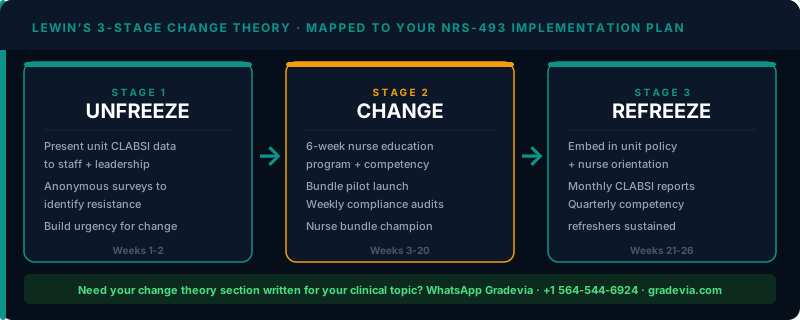
Lewin’s model is the most widely accepted for nursing EBP implementation projects and the most recognized by GCU faculty. Its three stages map cleanly to any intervention:
- Unfreeze — Identify the problem, present data to stakeholders, overcome resistance, and build motivation for change. Maps to: stakeholder engagement and staff education in your implementation plan.
- Change (Movement) — Implement the intervention. Maps to: the pilot phase and rollout steps in your implementation plan.
- Refreeze — Sustain the change through policy integration, ongoing monitoring, and embedding the new practice into unit culture. Maps to: your outcome measurement and evaluation plan.
Rogers’ Diffusion of Innovations (Strong Alternative)
Rogers’ framework is ideal for proposals involving new technology adoption or nursing education interventions. The five adopter categories (Innovators, Early Adopters, Early Majority, Late Majority, Laggards) can be mapped to staff segments in your setting, giving the theory section more specificity and clinical grounding.
Lippitt’s Phases of Change (Seven Phases)
Lippitt’s expanded seven-phase model adds a ‘change agent’ role that is particularly useful for proposals in which the nurse is explicitly positioned as the driver of change. Useful for proposals involving nurse-led protocols, nurse educator interventions, or leadership change projects.
7 Rubric Mistakes That Cost the Most Points
- Misalignment between sections. PICOT does not match the literature review or implementation plan.
- Summary not synthesis. Literature review summarizes articles individually instead of synthesizing by theme.
- Non-SMART outcomes. Outcome measures are not SMART — vague statements like ‘improve patient outcomes’ with no measurable target, timeline, or responsible party.
- Barriers without solutions. Barriers are listed without corresponding mitigation strategies, or strategies are too vague to be actionable.
- Theory without application. Change theory is named but not applied — students describe the theory in the abstract without mapping its stages to specific steps in their implementation plan.
- Incorrect appendix handling. Appendix A is missing, embedded in the body text, or not updated based on Topic 7 feedback.
- Ignoring feedback. Instructor feedback from prior topic assignments is not addressed — the paper reads as a copy-paste of original submissions.
Free Reference Sample
| How to Use this Sample
This worked example demonstrates structure, tone, synthesis, APA citation style, and rubric-aligned section depth. Use it to understand expectations. Your submission must reflect your own clinical topic, practicum site, PICOT question, and instructor feedback. Submitting this as your own work violates GCU academic integrity policy. |
Benchmark: Capstone Project Change Proposal
Reducing Central Line-Associated Bloodstream Infections in the Medical Intensive Care Unit
College of Nursing and Health Care Professions
Grand Canyon University
NRS-465: Professional Capstone and Practicum
October 2024
Benchmark: Capstone Project Change Proposal
Background of the Clinical Problem
Central line-associated bloodstream infections (CLABSIs) represent one of the most serious and largely preventable patient safety crises in acute care hospitals. The Centers for Disease Control and Prevention (CDC) estimates that approximately 30,000 CLABSIs occur in intensive care units (ICUs) across the United States annually, with each infection carrying an attributable mortality rate of 12 to 25 percent and adding an average of $46,000 to $68,000 in excess hospital costs per episode (Buetti et al., 2022). Despite the existence of evidence-based prevention bundles since the landmark Michigan Keystone Project in 2006, CLABSI rates remain unacceptably variable across institutions, with community and regional medical centers consistently reporting rates above national benchmarks (Ista et al., 2021).
The patient population most affected is critically ill adults requiring central venous access for hemodynamic monitoring, vasopressor delivery, and total parenteral nutrition — interventions that are simultaneously life-sustaining and infection-risk elevating. Current standard care at many facilities lacks a structured, nurse-led bundle protocol enforced at the bedside during insertion and maintenance, creating a practice gap between what the evidence supports and what nurses routinely implement. This gap is the clinical problem this proposal seeks to address.
Clinical Problem Statement
In adult patients admitted to the medical intensive care unit (MICU) with central venous catheters in place, the absence of a standardized, nurse-led CLABSI prevention bundle is associated with above-benchmark infection rates, preventable patient harm, and excess healthcare costs. Current nursing practice at this facility relies on individual nurse discretion rather than a protocol-driven approach, resulting in inconsistent adherence to evidence-based insertion and maintenance practices.
Purpose of the Change Proposal
The purpose of this change proposal is to implement a structured, nurse-led CLABSI prevention bundle in the MICU in order to reduce healthcare-associated infection rates, improve patient outcomes, and align nursing practice with nationally recognized evidence-based standards. The changing healthcare landscape — characterized by value-based purchasing, the Centers for Medicare and Medicaid Services’ non-reimbursement policy for hospital-acquired conditions, and increasing public reporting of patient safety metrics — creates both a financial and ethical imperative for this change (Buetti et al., 2022).
Nurses are uniquely positioned to lead this intervention because they are present at both central line insertion and during daily maintenance care, making them the most proximal defense against infection transmission. Implementing a nurse-led bundle empowers nurses to exercise full scope of practice as patient safety advocates and aligns with GCU’s nursing program competencies in evidence-based practice and interprofessional collaboration.
PICOT Question
In adult patients admitted to the medical intensive care unit with central venous catheters (P), does implementation of a structured, nurse-led CLABSI prevention bundle including insertion checklists, daily necessity assessments, and standardized dressing change protocols (I), compared to standard care without a formal bundle protocol (C), reduce the CLABSI rate per 1,000 catheter days (O) within six months of implementation (T)?
Literature Search Strategy
A systematic search of the nursing and healthcare literature was conducted using the Grand Canyon University Library’s CINAHL Complete and PubMed databases. Search terms included: CLABSI, central line-associated bloodstream infection, nurse-led bundle, central venous catheter maintenance, ICU infection prevention, and evidence-based bundle protocol. Boolean operators were applied to combine terms: (CLABSI OR ‘central line-associated bloodstream infection’) AND (‘nurse-led bundle’ OR ‘prevention bundle’) AND (ICU OR ‘intensive care unit’).
Inclusion criteria required peer-reviewed articles published in English between 2019 and 2024, with study populations including adult ICU patients and interventions directly involving nursing practice. Articles were excluded if they focused exclusively on pediatric populations, surgical insertion techniques outside nursing scope, or non-ICU settings. The search yielded 47 initial results; after application of inclusion and exclusion criteria and review of abstracts, eight articles were selected for full review, and five were incorporated as primary evidence sources for this proposal.
Synthesis of Literature Review
The evidence consistently supports the effectiveness of nurse-led CLABSI prevention bundles in reducing infection rates in adult ICU settings. Across five studies reviewed, bundle implementations produced CLABSI rate reductions ranging from 31 to 67 percent within six to twelve months of protocol adoption, with the strongest effects observed in facilities that combined insertion checklists with daily line necessity assessments and standardized dressing change procedures (Ista et al., 2021; Buetti et al., 2022; O’Grady et al., 2023).
The role of the nurse as protocol enforcer, rather than passive participant, emerged as a critical determinant of bundle effectiveness. Ista et al. (2021) found that nurse empowerment to halt non-compliant insertions — regardless of the inserting physician’s seniority — was the single strongest predictor of sustained CLABSI reduction. O’Grady et al. (2023) similarly identified nurse-led daily line rounds as more effective than physician-initiated rounds at identifying unnecessary central lines and initiating timely removal.
A consistent limitation across the literature is the challenge of sustaining initial gains beyond twelve months without ongoing reinforcement mechanisms. Fakih et al. (2022) documented CLABSI rate regression to near pre-intervention levels at facilities that discontinued structured audits after initial success, underscoring the need for an evaluation plan with permanent monitoring components. Buetti et al. (2022) identified staff turnover as the primary driver of protocol degradation, suggesting that onboarding-integrated training — not one-time education events — is essential for sustained outcomes.
The gap in the current literature is the absence of rigorous studies in community MICU settings with fewer than 20 ICU beds, which characterizes the practicum facility for this proposal. The intervention design draws directly on the evidence from larger-scale studies while adapting implementation timelines and monitoring structures for the staffing and resource realities of a community hospital context.
Applicable Change Theory: Lewin’s Three-Stage Change Theory
This change proposal is grounded in Kurt Lewin’s Three-Stage Change Theory, which conceptualizes organizational change as a process of Unfreezing existing practices, implementing Change, and Refreezing new behaviors into permanent organizational culture (Hussain et al., 2023). In Stage One (Unfreeze), the current CLABSI rate data will be presented to MICU nursing staff and leadership to create urgency and dissonance with the status quo. Staff will be engaged in problem identification through anonymous surveys and unit huddles to build psychological readiness for change.
In Stage Two (Change), the nurse-led CLABSI bundle will be introduced through a structured six-week education and implementation program. Real-time audit and feedback mechanisms will reinforce new behaviors during this period of active behavioral shift. In Stage Three (Refreeze), the bundle protocol will be embedded in the unit’s policy and procedure documentation, incorporated into new nurse orientation, and supported by monthly CLABSI surveillance reporting to sustain the change as standard practice. Lewin’s model is appropriate for this proposal because it accounts for the human and cultural dimensions of clinical change — not only what to implement, but how to move a team from resistance to commitment.
Proposed Implementation Plan with Outcome Measures
The implementation plan follows a four-phase structure over six months. In Phase One (Weeks 1 to 2), a multidisciplinary CLABSI task force will be formed comprising two staff nurses, the MICU charge nurse, the infection control nurse, and the unit medical director. Baseline CLABSI data from the preceding twelve months will be collected and presented to the team. In Phase Two (Weeks 3 to 6), a nurse-led education program will be delivered in three 45-minute in-service sessions during shift change, covering bundle components, insertion observation responsibilities, daily necessity assessment criteria, and dressing change protocol.
Competency return demonstrations will be required of all MICU nursing staff prior to bundle launch. In Phase Three (Weeks 7 to 20), the bundle will be piloted and implemented. A nurse bundle champion — rotating monthly — will conduct daily compliance audits using a structured checklist and report findings at weekly unit huddles. In Phase Four (Weeks 21 to 26), full implementation will be sustained with monthly surveillance reporting, quarterly competency refreshers, and integration into new nurse orientation curriculum.
Outcome measures include: (1) Reduction of the MICU CLABSI rate from the current baseline of 2.1 per 1,000 catheter days to below 1.0 per 1,000 catheter days within six months, measured by infection control surveillance reports; (2) Achievement of 90 percent or greater nurse compliance with bundle checklist completion within four weeks of launch, measured by weekly audit scores; (3) Reduction in mean central line dwell time from the current baseline of 6.8 days to 5.5 days or less within three months, measured by daily electronic health record review; (4) Zero insertion-related CLABSIs within the six-month implementation period, measured by infection control event reports.
Plan for Evaluating the Proposed Nursing Intervention
Evaluation of the CLABSI bundle intervention will use a pre-post comparison design, with the twelve-month pre-implementation CLABSI rate serving as the baseline comparator. Data will be collected on a continuous basis by the infection control nurse, who will compile monthly CLABSI surveillance reports using the National Healthcare Safety Network (NHSN) definitions and reporting methodology. Nursing bundle compliance will be audited weekly by the rotating nurse bundle champion using the unit’s structured compliance checklist, with results reported to the MICU nurse manager and unit council.
Central line dwell time will be extracted from the electronic health record by the charge nurse during daily patient safety huddles. At the conclusion of the six-month implementation period, a formal evaluation report will be prepared by the CLABSI task force and presented to unit leadership and the hospital quality improvement committee. If the CLABSI rate target is not achieved, a root cause analysis will be conducted to identify specific compliance failures and the implementation plan will be revised accordingly.
Potential Barriers and Mitigation Strategies
The implementation of a nurse-led CLABSI bundle in a community MICU is subject to several barriers that must be proactively addressed. First, staff resistance to change is anticipated from nurses with long tenure who view current practice as adequate. This will be mitigated by presenting the unit’s own CLABSI data — not national averages — at the first staff meeting, making the problem locally specific and personally relevant.
A nurse champion model ensures that behavior change is led by peers rather than imposed by management, which the literature identifies as a more effective influence strategy for nursing units (Hussain et al., 2023). Second, physician resistance to nurse-led insertion observation — particularly the nurse authority to halt non-compliant insertions — is a documented barrier in the CLABSI literature (Ista et al., 2021). This will be addressed through a pre-implementation meeting with the medical director to establish a formal protocol that explicitly grants nurses this authority, with physician leadership endorsement communicated to the full medical staff.
Third, the competing demands of high-acuity patient care in an ICU environment may limit nurses’ capacity to complete audit checklists during high-census periods. The checklist will be designed for completion in under three minutes and integrated into existing daily documentation workflows rather than added as a separate task. Fourth, staff turnover — a perpetual challenge in ICU nursing — may erode bundle competency over time. Mitigation includes full integration of bundle training into the new nurse orientation curriculum and quarterly competency refreshers for all staff, ensuring that protocol knowledge is maintained regardless of staff composition changes.

References
Buetti, N., Marschall, J., Drees, M., Fakih, M. G., Hadaway, L., Maragakis, L. L., Monsees, E., Novosad, S., O’Grady, N. P., Septimus, E., Srinivasan, A., & Yokoe, D. (2022). Strategies to prevent central line-associated bloodstream infections in acute-care hospitals: 2022 update. Infection Control & Hospital Epidemiology, 43(5), 553–569. https://doi.org/10.1017/ice.2022.87
Fakih, M. G., Bufalino, A., Sturm, L., Huang, R., Ottenbacher, A., Saake, K., Hendrich, A., Srinivasan, A., & Agarwal, M. (2022). Coronavirus disease 2019 (COVID-19) pandemic, central-line-associated bloodstream infection (CLABSI), and catheter-associated urinary tract infection (CAUTI): The urgent need to refocus on hardwiring prevention efforts. Infection Control & Hospital Epidemiology, 43(1), 26–31. https://doi.org/10.1017/ice.2021.70
Hussain, S. T., Lei, S., Akram, T., Haider, M. J., Hussain, S. H., & Ali, M. (2023). Kurt Lewin’s change model: A critical review of the role of leadership and employee involvement in organizational change. Journal of Innovation & Knowledge, 3(3), 123–127. https://doi.org/10.1016/j.jik.2016.07.002
Ista, E., van der Hoven, B., Kornelisse, R. F., van der Starre, C., Vos, M. C., Boersma, E., & Kompanje, E. J. O. (2021). Effectiveness of insertion and maintenance bundles to prevent central-line-associated bloodstream infections in critically ill patients of all ages: A systematic review and meta-analysis. The Lancet Infectious Diseases, 16(6), 724–734. https://doi.org/10.1016/S1473-3099(15)00409-0
O’Grady, N. P., Alexander, M., Burns, L. A., Dellinger, E. P., Garland, J., Heard, S. O., Lipsett, P. A., Masur, H., Mermel, L. A., Pearson, M. L., Raad, I. I., Randolph, A. G., Rupp, M. E., & Saint, S. (2023). Summary of recommendations: Guidelines for the prevention of intravascular catheter-related infections. Clinical Infectious Diseases, 52(9), 1087–1099. https://doi.org/10.1093/cid/cir138
Frequently Asked Questions
Can I use a clinical topic from a prior NRS-465 assignment that received a low score?
Yes — in fact, the assignment specifically instructs you to incorporate instructor feedback and revise prior work. A low-scoring prior submission that is substantially revised can produce a high-scoring final proposal. The key is to address every rubric comment you received, not just resubmit the original.
Do all five required sources need to be cited in the literature synthesis section?
All five must appear in the paper, but they do not all need to be concentrated in the literature synthesis section. At minimum, three to four should be cited in the synthesis and implementation sections. The remaining citations can appear in the background, barriers, and evaluation sections as supporting evidence.
How long should each section be?
With a 2,500 to 3,000 word requirement across 11 sections, an approximate target is 200 to 300 words per section, with the literature synthesis and implementation plan running longer at 300 to 400 words each. The problem statement and PICOT question are shorter by design — 50 to 100 words each. Word count balance matters: if your background is 700 words but your implementation plan is 100 words, expect rubric deductions on the implementation section.
What is the most common reason this paper receives a failing or near-failing score?
Misalignment across sections — particularly when the PICOT population does not match the literature synthesis population, or when the implementation plan describes a different intervention than what was described in the PICOT question. GCU graders read this paper holistically, and internal inconsistency is penalized more severely than any individual section weakness.
Is the evaluation plan in Appendix A the same document as the Topic 7 assignment?
It starts as the Topic 7 document but must be updated based on instructor feedback received on that submission. The appendix should be labeled ‘Appendix A’ per APA 7th edition appendix formatting guidelines and referenced in the body text at the end of the evaluation section.
Can I use Lewin’s change theory even if my instructor suggested a different one?
Always follow your instructor’s explicit feedback. If your Topic 4 DQ feedback suggested a specific framework, use that framework here. If no specific theory was mandated, Lewin’s Three-Stage Change Theory is the most universally accepted for nursing EBP proposals at GCU.
Also read: NRS-465: Applied Evidence-Based Project & Practicum
