
Blog
WGU D218 Task 1 Rubric: How to Understand the Requirements

WGU D218 Task 1 Rubric
You finally have an hour to sit down with D218, you open the rubric, and there it is, a list of requirements that all sound reasonable individually but somehow leave you unsure exactly what a strong response needs to include. The nursing knowledge isn’t the obstacle here. The obstacle is translating rubric language into something specific enough to write toward.
This guide is built around one job: helping you read the current WGU D218 Task 1 rubric the way an evaluator reads it, turn each requirement into a practical writing plan, and check your own draft against it before you submit. It won’t repeat everything already covered in our complete WGU D218 Task 1 guide, that page walks through the whole task. This one stays focused on the rubric itself, the part that trips up most students.
What Is the WGU D218 Task 1 Rubric?
The D218 Task 1 rubric is the set of evaluation criteria WGU uses to determine whether your submission meets each requirement of the assessment. It exists to tell you, in advance, what a satisfactory response actually needs to demonstrate, rather than leaving that guesswork until after you’ve already written and submitted your work.
Treat the rubric as a roadmap you read before writing, not a scorecard you glance at afterward. Reading it first tells you exactly what to gather, what to explain, and how deep each section needs to go, which cuts down on the kind of unfocused rewriting that eats an entire evening.
Why the D218 Task 1 Rubric Matters
It tells you what needs to be demonstrated. A rubric criterion is more precise than the general task topic, it names the specific thing an evaluator is checking for.
It helps you avoid incomplete responses. Multi-part criteria are easy to answer halfway without noticing, the rubric makes each part visible.
It helps you determine the appropriate level of explanation. Some requirements need a sentence, others need real depth, the rubric’s wording is your best signal for which is which.
It helps you self-review. A rubric read after drafting turns into a built-in audit tool, one you can run before submitting instead of after a return notice arrives.
It can reduce unnecessary rewriting. Understanding requirements up front means less time spent guessing, drafting something off-target, and starting over.
It provides a framework for understanding evaluator feedback. If your work is returned, the rubric is exactly what that feedback maps back to.
Writing more does not automatically mean writing better. The goal is satisfying the actual requirement clearly and specifically, not padding a response until it feels substantial.
How to Read the D218 Task 1 Rubric Before Writing
Step 1, read the entire assessment prompt. Don’t start writing after reading only the first section, later requirements sometimes change how you’d approach earlier ones.
Step 2, read the corresponding rubric criteria. Read the task instructions and rubric side by side, not as two separate documents. The instructions tell you what to do, the rubric tells you what the evaluator is checking for while you do it.
Step 3, identify the action verb. Identify, describe, explain, discuss, analyze, evaluate, compare, recommend, each of these implies a different depth of response. What a specific verb requires depends on the wording and context of your current rubric, don’t assume a fixed meaning across every WGU course.
Step 4, identify the subject. What concept, behavior, leadership principle, or topic is this specific criterion actually about?
Step 5, identify the expected evidence or explanation. Ask yourself: what would a reviewer need to see on the page to know I actually answered this?
Step 6, turn the criterion into a question. A rubric line like “discuss two strategies for X” becomes “which two strategies will I discuss, and why these two specifically?”
Step 7, create a mini-outline. Map your planned response directly to the criterion before you draft a single sentence of it.
How to Turn a D218 Rubric Criterion Into a Writing Plan
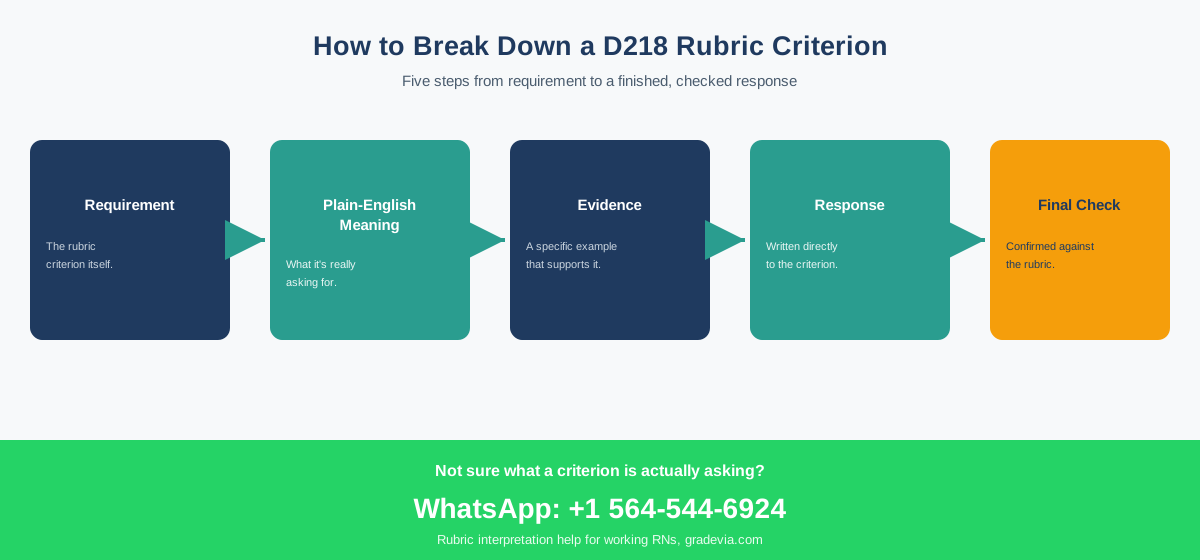
This is the most useful habit you can build for this task. Work through every criterion using this chain:
Rubric requirement leads to what is it asking, which leads to what it means in plain English, which leads to what information I need, which leads to what example or evidence supports it, which leads to what explanation connects that evidence to the requirement, which leads to have I fully answered it.
A generic fictional example: Say a hypothetical criterion reads “describe one strategy you use to manage a specific professional challenge.”
What is it asking? One specific strategy, tied to one specific challenge, not a general list.
Plain English? Name a real difficulty you face at work, then name exactly what you do about it.
Information needed? A real, specific example from your own practice.
Evidence/example? “When I’m assigned a particularly heavy patient load, I prioritize tasks using a rapid triage method I learned early in my career.”
Explanation connecting it? Add a sentence on why this specific approach works for you, not just that it exists.
Fully answered? Check whether the criterion asked for one strategy or more, and whether it wanted the challenge explained too, not just the strategy.
Not sure what your D218 Task 1 rubric is actually asking? Gradevia can help you break the current requirements into a practical checklist and action plan.
Understanding “Competent” in a WGU Assessment
If your current rubric uses performance language like “Competent,” don’t treat that as a mysterious threshold. Focus on what the specific criterion says a satisfactory response needs to demonstrate, not a vague sense of “did I write enough.” The combination that tends to matter across competency-based writing is specificity, relevance, explanation, and evidence where appropriate, not volume. “Just make sure you write enough” isn’t useful advice, “make sure this paragraph clearly answers what the criterion is asking, with a real example behind it” is.
How Much Should You Write for Each D218 Requirement?
There’s no universal rule that every criterion needs the same number of paragraphs. How much a requirement actually needs depends on:
- The complexity of what’s being asked
- The action verb used
- How many separate components the criterion contains
- How much explanation is genuinely necessary to make the point clear
- Your current assessment instructions
Prioritize complete, specific answers over length for its own sake. A tight paragraph that fully addresses a criterion beats three loosely related paragraphs that circle around it. No official WGU word count is assumed here, check your current instructions if one is specified.
How to Identify What the Evaluator Is Looking For
For every requirement, ask:
- What concept must I address?
- What action must I perform, based on the verb used?
- What explanation is needed to make my reasoning clear?
- What evidence or example might strengthen the response?
- What connection must I draw between the evidence and the point?
- Have I answered every part of this, not just the first one?
Keep this list next to you while drafting, it’s faster than it sounds once you’ve run through it a few times.
D218 Task 1 Rubric Breakdown Framework
This is a Gradevia-created planning framework, not an official WGU rubric or template. Populate it using your own current criteria, in your own words, don’t copy language directly from the rubric.
| Rubric Criterion | What It Is Asking | Information Needed | Evidence/Example | Completed? |
|---|---|---|---|---|
| Criterion 1 | Your plain-English interpretation | Key information you’ll need | Relevant example or source | ☐ |
| Criterion 2 | Your plain-English interpretation | Key information you’ll need | Relevant example or source | ☐ |
| Criterion 3 | Your plain-English interpretation | Key information you’ll need | Relevant example or source | ☐ |
Add a row for every criterion your current rubric actually lists.
How to Use the Rubric While Writing
Write criterion by criterion instead of drafting the whole response from memory and checking it afterward. The workflow: read the criterion, plan your response, draft the response, check it against that criterion specifically, move to the next one.
This matters especially for a working student. Writing in short, criterion-sized chunks fits naturally into the fragmented pockets of time a shift schedule actually gives you, a full evening isn’t required to make real progress this way.
How to Use the Rubric After Writing
- Open your current D218 Task 1 rubric.
- Read each criterion individually.
- Locate the corresponding section in your response.
- Highlight or mark exactly where that criterion is addressed.
- Ask whether every component of the criterion has been answered.
- Check whether your explanations are specific rather than vague.
- Check that any evidence used is appropriate and relevant.
- Confirm that examples actually support the point being made, not just sit near it.
- Remove anything that doesn’t serve a specific requirement.
- Do a final proofreading pass.
This is a practical Gradevia workflow, not an official WGU procedure, but it works the same way regardless of which specific criteria your current rubric lists.
D218 Task 1 Rubric Self-Assessment Checklist
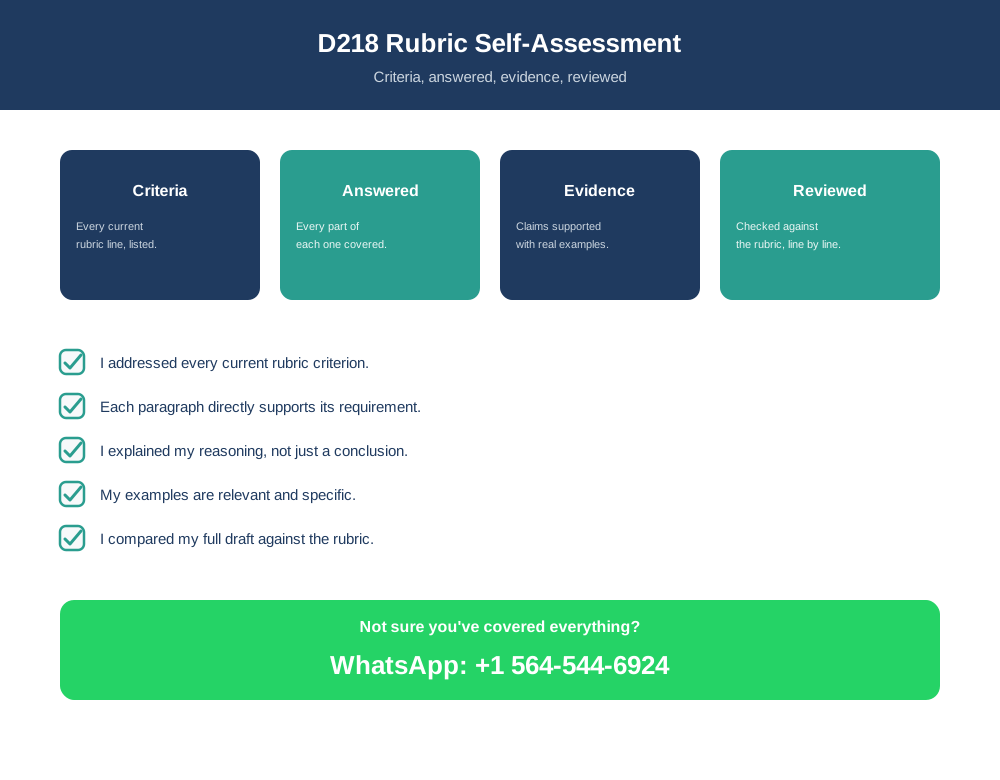
Requirement coverage
- I addressed every current rubric criterion.
- I answered every part of each criterion, not just the first one.
Relevance
- Each paragraph directly supports the requirement it’s under.
- I avoided unnecessary information.
Depth
- I explained my reasoning, not just stated a conclusion.
- I avoided vague, generic statements.
Examples
- My examples are relevant and specific.
- I explained why each example matters, not just included it.
Evidence
- Important claims are appropriately supported.
- Any sources used are credible.
Organization
- An evaluator could easily find where each requirement is addressed.
Formatting
- I followed my current WGU formatting requirements.
Final review
- I compared the entire draft against the current rubric, criterion by criterion.
Finished your draft but still unsure whether you’ve addressed every criterion? Get feedback on your own work before you submit.
Common D218 Task 1 Rubric Mistakes
- Mistake 1, reading the rubric after writing. Fix it by reading the rubric before you outline anything.
- Mistake 2, answering the topic instead of the criterion. Fix it by turning every criterion into a specific question before drafting.
- Mistake 3, addressing only part of a multi-part requirement. Fix it by breaking each criterion into its individual components before you respond.
- Mistake 4, being too vague. Fix it by replacing general statements with specific explanations and real examples.
- Mistake 5, writing too much irrelevant material. Fix it by cutting anything that doesn’t directly help satisfy a specific criterion.
- Mistake 6, confusing description with analysis. Description states what something is, analysis explains what it means or why it matters. Fix it by adding a “so what” sentence after any purely descriptive passage.
- Mistake 7, adding citations without explaining their relevance. Fix it by connecting every piece of evidence explicitly to the point it’s supposed to support.
- Mistake 8, treating an example as a template to copy. Fix it by using examples to understand structure and reasoning, then writing your own response from your own experience.
- Mistake 9, ignoring evaluator feedback on a returned assessment. Fix it by mapping each piece of feedback back to the specific rubric criterion it addresses.
- Mistake 10, submitting without a final rubric audit. Fix it by doing one last criterion-by-criterion review before you upload anything.
D218 Task 1 Rubric vs. Assessment Instructions
| Component | Purpose |
|---|---|
| Assessment instructions | Tell you what the task asks you to do |
| Rubric | Explains what the evaluator looks for while grading it |
| Student response | Demonstrates that the requirements have been met |
| Final audit | Checks the finished response against the current requirements |
Use both documents together. The instructions without the rubric leave you guessing at depth and focus, the rubric without the instructions leaves you missing context for what’s actually being asked.
D218 Task 1 Rubric vs. Example vs. Template
| Resource | Primary Purpose |
|---|---|
| Rubric | Understand evaluation criteria |
| Example | Understand how a response might reasonably be approached |
| Template | Organize your own ideas before drafting |
| Guide | Understand the overall task |
| Help | Receive personalized academic support |
| Revision help | Address feedback on a returned assessment |
Our complete WGU D218 Task 1 guide covers the task overview, the outline framework, and an illustrative example in more depth, this page exists specifically to help you master the rubric piece.
What If Your D218 Task 1 Is Returned?
1. Don’t immediately rewrite everything. A returned assessment usually points to a specific gap, not a total failure.
2. Read the evaluator feedback carefully.
3. Identify the affected criterion.
4. Compare your response with that criterion’s actual wording.
5. Determine what’s specifically missing.
6. Revise the affected section, not the entire document, unless the feedback genuinely spans multiple parts.
7. Recheck the entire rubric, not just the flagged section, since a fix in one area can sometimes affect another.
8. Proofread before resubmitting.
There’s no guarantee this process leads to a passing outcome on any specific attempt, but working through it deliberately beats guessing at what to change.
D218 Task 1 came back for revision? Gradevia can help you understand the evaluator feedback and build a focused revision plan.
D218 Task 1 Rubric Example
Illustrative example only, not an official WGU rubric, WGU answer, or submission-ready response.
Hypothetical requirement: “Explain how a specific personal habit supports your professional effectiveness.”
What it appears to ask: One habit, explained specifically, tied to a concrete effect on your professional performance, not a general statement about self-improvement.
Questions to ask:
- What does this require me to identify? One real habit.
- What explanation is needed? How and why it affects my effectiveness specifically.
- What example could demonstrate the point? A specific situation where the habit made a measurable difference.
Planning notes: Habit, protecting a consistent pre-shift routine. Effect, arriving mentally focused rather than rushed. Example, a specific shift where skipping the routine led to a noticeably rougher start.
What a strong approach would do: Name the habit specifically, describe one real situation illustrating its effect, and explain the connection in a sentence rather than leaving the reader to infer it.
How Busy Working Nurses Can Use the Rubric to Save Time
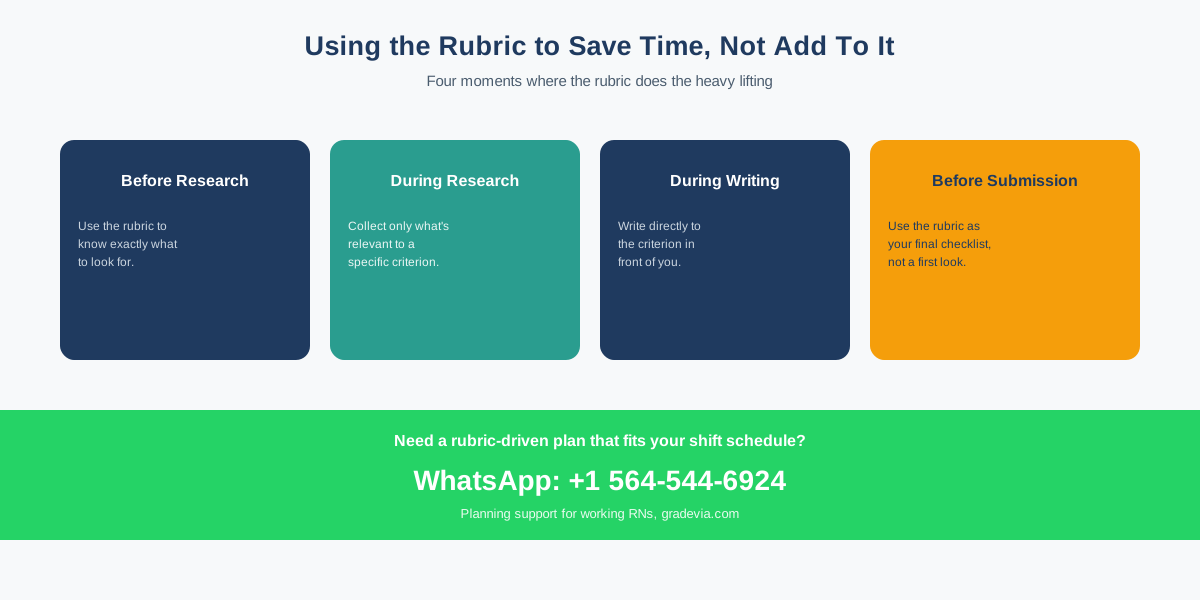
Before research. Use the rubric to figure out exactly what information you actually need, instead of researching broadly and hoping something useful turns up.
During research. Collect only what’s relevant to a specific requirement, not everything tangentially related to the topic.
During writing. Write directly to the criterion in front of you, rather than writing generally and hoping it lines up.
Before submission. Use the rubric as your final checklist, not a document you’re seeing for the first time since orientation.
This approach tends to cut down on wasted research and unnecessary rewriting, though it won’t promise a specific amount of time saved, everyone’s process differs.
A 30-Minute D218 Rubric Audit
This is a Gradevia productivity framework, not a WGU requirement or guaranteed review process.
Minutes 0 to 5, open your current task instructions and rubric side by side.
Minutes 5 to 10, list every criterion in your own words.
Minutes 10 to 20, check whether your draft fully addresses each one.
Minutes 20 to 25, flag any weak or vague sections you notice.
Minutes 25 to 30, check citations, formatting, and overall clarity.
How Gradevia Can Help With the D218 Task 1 Rubric
Working Full-Time and Struggling to Decode D218 Task 1?
You may need help if you don’t understand what a specific criterion is asking, you’re not sure your response actually addresses it, you’re struggling to organize your ideas around the rubric’s structure, or you got feedback back and aren’t sure what it’s pointing to. Gradevia works with busy working RNs on exactly this kind of problem.
Services include:
- Rubric Interpretation, breaking confusing assessment language into practical questions
- Assessment Planning, a personalized plan built around your current requirements
- Outline Support, organizing your own ideas into a rubric-aligned structure
- Research Guidance, identifying efficient strategies and credible source types
- Draft Review, feedback on clarity, organization, relevance, and alignment with your stated requirements
- APA Review, identifying formatting and citation issues
- Revision Support, help understanding returned-task feedback and identifying what actually needs to change
- One-on-One Coaching, personalized support built around a working RN’s real schedule
📱 Working full-time and struggling to decode D218 Task 1? Get personalized academic support designed around your current assessment requirements and your own draft. Message Gradevia on WhatsApp at +1 564-544-6924. No long email chains, no waiting days for a reply, most students hear back the same day.
Using This Rubric Guidance Responsibly
Everything on this page, the breakdown framework, the checklist, the illustrative example, is meant to help you understand and interpret your own current rubric, not replace it and not give you something to copy. Write and submit your own assessment, use examples for learning, use templates for planning, cite sources properly, and follow WGU’s academic policies. Gradevia’s role is helping you understand and strengthen work that’s genuinely yours.
Frequently Asked Questions About the WGU D218 Task 1 Rubric
- What is the WGU D218 Task 1 rubric? It’s the set of evaluation criteria WGU uses to determine whether your D218 Task 1 submission meets each specific requirement of the assessment. Reading it before you write, not after, is what makes it useful.
- How do I understand the D218 Task 1 requirements? Read the task instructions and rubric together, identify the action verb and subject in each criterion, and turn each one into a direct question before you start drafting.
- Should I read the rubric before writing D218 Task 1? Yes. Reading it first tells you what depth of response and what kind of evidence each section actually needs, which reduces rewriting later.
- How do I know if I answered every D218 rubric criterion? Go through your draft criterion by criterion and highlight exactly where each one is addressed. If you can’t point to a specific spot, it likely isn’t answered yet.
- How much should I write for each D218 Task 1 requirement? Enough to fully and specifically address what the criterion asks, no more. Length depends on the complexity of the requirement, not a fixed rule.
- What is the difference between the D218 task instructions and rubric? The instructions tell you what the task asks you to do. The rubric tells you what the evaluator is checking for while grading your response to those instructions.
- Can I use a D218 Task 1 example to help me understand the rubric? Yes, an example can help you see how reasoning and structure come together, but never copy one directly. Our complete D218 Task 1 guide includes an original illustrative example for exactly this purpose.
- What should I do if WGU returns my D218 Task 1? Read the feedback, identify the specific criterion it’s tied to, revise the affected section, recheck the full rubric, and proofread before resubmitting.
- Can someone help me understand the D218 Task 1 rubric? Yes. Legitimate academic support, rubric interpretation, planning help, and draft review, is different from having someone complete your assessment for you. Gradevia focuses on helping you understand and strengthen your own work.
- How can a busy RN save time using the D218 rubric? Use it to focus your research before you start, write directly to each criterion instead of drafting generally, and treat it as your final checklist before submission rather than a document you revisit only if something goes wrong.
Final Thoughts
The D218 Task 1 rubric stops being confusing the moment you stop reading it as one long paragraph and start reading it criterion by criterion, each one turned into a specific question you can actually answer. A rubric checked before you draft saves far more time than one checked only after something comes back for revision.
Working full-time and struggling to decode D218 Task 1? Message Gradevia on WhatsApp at +1 564-544-6924, tell us where you’re stuck, and we’ll help you turn the current requirements into a plan you can actually work from between shifts. If you’re also navigating D219 coursework, our WGU D219 complete guide covers that side of the RN-to-BSN curriculum.
References
- Smart, C., Wall Parilo, D., & Robb, M. (2023). Development and application of a written communication rubric to improve baccalaureate nursing student writing. Nursing Forum, 2023, Article 8868820. https://doi.org/10.1155/2023/8868820
- Hutchinson, J. C., & Pederson, J. (2023). “Writing right”: A workshop approach to improving nursing students’ writing. SAGE Open Nursing, 9. https://doi.org/10.1177/23779608231186059
- Alkhaledi, N. G., Alabdalhai, S. A., Awaji, N. Y., Baker, O. G., Alyasin, A. M., Al Hnaidi, B. J., Alayed, A. S., & Ashour, Y. O. (2024). Utilizing competency-based education to evaluate the research skills of nursing students: A systematic review and meta-analysis. Cureus, 16(6), e62549. https://doi.org/10.7759/cureus.62549
- Ramazanzadeh, N., Ghahramanian, A., Zamanzadeh, V., Valizadeh, L., & Ghaffarifar, S. (2023). Development and psychometric testing of a clinical reasoning rubric based on the nursing process. BMC Medical Education, 23, 98. https://doi.org/10.1186/s12909-023-04060-3
- Hinkley, T., Kuhl, L., & Liebig, D. (2023). Professional identity in nursing: The role of efficacy in navigating the work environment. Nurse Leader, 21(2), 174-178. https://doi.org/10.1016/j.mnl.2022.12.006