
Blog
WGU D219: Complete Guide to Scholarship in Nursing Practice

D219 shows up on a lot of RN-to-BSN term plans as one course, but it rarely feels like one assignment. There’s a CITI certificate to track down, Johns Hopkins modules to work through, a clinical practice problem to define, articles to appraise, and a practice change recommendation to build and defend, all while you’re still working shifts. Most students don’t struggle with the nursing content itself, they struggle with knowing which piece of this course they’re looking at on any given week and what it specifically requires.
This page is the starting point for D219 on Gradevia. It walks through what the course covers, how the individual performance assessments generally connect to each other, and where to go for a detailed breakdown of each one, WGU D219 Task 1, WGU D219 Task 2, and the evidence appraisal and practice change work covered in WGU D219 MYM3 Task 2. Task structure and naming can shift between course versions, so treat this page as a map of how the pieces usually fit together, and confirm the specifics against your own current task instructions before you plan your work.
What Is WGU D219?
D219, Scholarship in Nursing Practice, is a required course in WGU’s RN-to-BSN program built around five competencies:
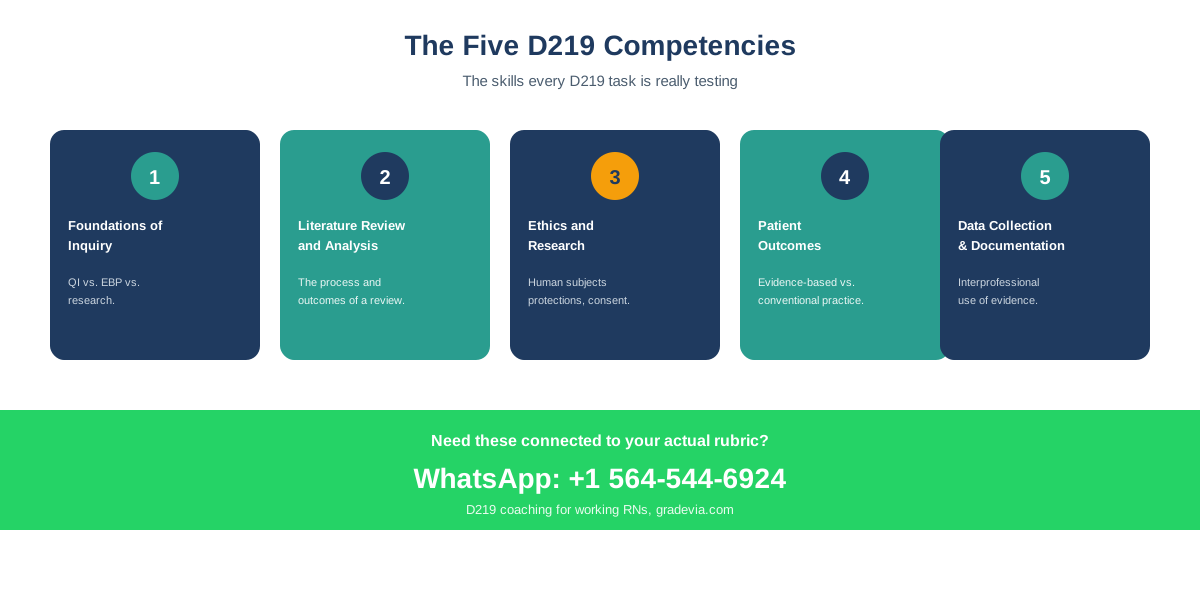
- Differentiating quality improvement, evidence-based practice, and research
- Conducting a literature review
- Understanding research ethics, including human subjects protections and informed consent
- Distinguishing evidence-based standards of practice from conventional practice
- Describing how evidence gets collected, analyzed, and implemented from an interprofessional perspective
Most students move through D219 in a fairly consistent order: Johns Hopkins Evidence-Based Practice (EBP) modules first, a CITI (Collaborative Institutional Training Initiative) certification, then one or more written performance assessments. Some students see this coursework organized under a single assessment code (MYM2), others see later parts of the same work continue under a different code (MYM3). If your dashboard uses different labels than the ones on this page, follow your dashboard.
How the D219 Performance Assessments Fit Together
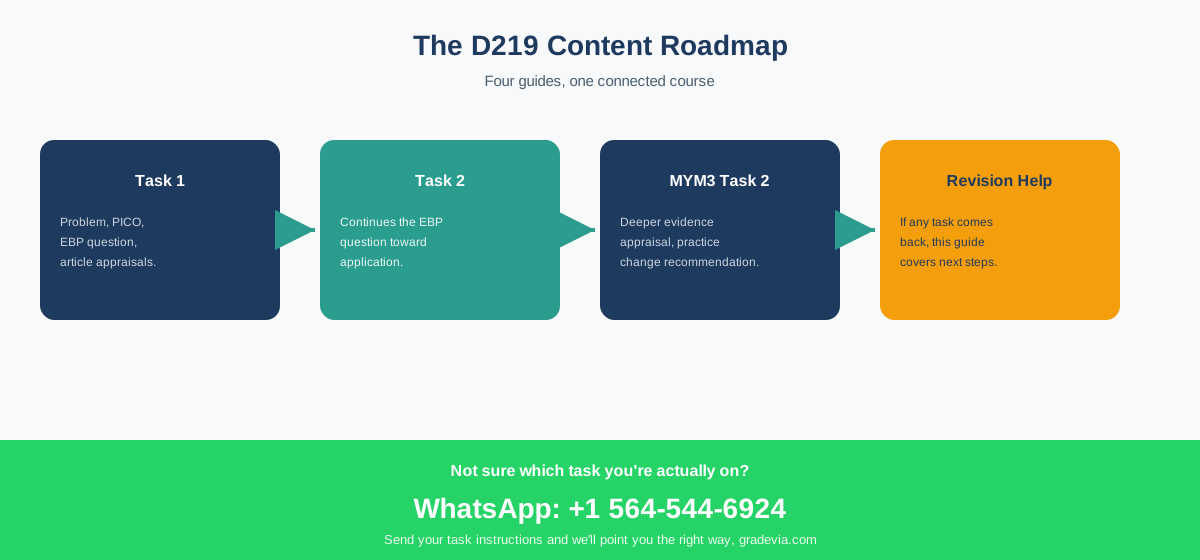
The verified WGU D219 Task 1 (MYM2) instructions we’ve worked from cover a full arc: identifying a clinical practice problem, discussing its impact on the patient and organization, building PICO components and an EBP question, appraising a research-based and a non-research-based article using the Johns Hopkins Nursing Evidence-Based Practice (JHNEBP) model, and recommending a practice change built on both articles, complete with stakeholders, a barrier, a strategy, and a measurable outcome.
Because of that, some students find Task 1 alone covers most of the EBP project end to end. Others see this same body of work split further, with later coursework (sometimes labeled Task 2, sometimes MYM3) asking them to go deeper on evidence appraisal, strengthen the practice change recommendation, or extend the work in a new direction. This isn’t something we can standardize across every course version, so the honest answer is: read your current task instructions closely before assuming which parts apply to you.
What stays consistent across every version we’ve seen is the underlying skill set: a clinical problem stated precisely, a PICO-based EBP question, evidence appraised rather than summarized, and a recommendation that traces back to that evidence. The three guides below break each stage down in detail.
WGU D219 Task 1: Evidence-Based Practice Foundations
Read the full WGU D219 Task 1 guide and example
Task 1 is generally where the groundwork gets laid: your CITI certification, your clinical practice problem and its impact on the patient and organization, your PICO components and EBP question, and the appraisal of one research-based and one non-research-based article. If your version of Task 1 also includes the practice change recommendation, that guide covers stakeholders, barriers, and measurable outcomes as well.
Common questions this guide answers:
- What does WGU actually mean by each lettered part of the task?
- How do you tell a research-based article apart from a non-research-based one?
- What’s the difference between an article’s JHNEBP level and its quality rating?
- What counts toward the originality and similarity limits on your submission?
WGU D219 Task 2: Building the EBP Case
Read the full WGU D219 Task 2 guide and example
For students whose course splits this work into a distinct second assessment, Task 2 generally continues the problem and EBP question from Task 1 and moves further into application, whether that’s a deeper analysis, an expanded recommendation, or a synthesis of your findings into a fuller scholarly paper. Because task structure varies here more than in Task 1, this guide leans on a general, rubric-agnostic workflow, reading the current instructions first, breaking the rubric into a checklist, building a research and evidence matrix, and auditing against the rubric before submission, rather than asserting specific requirements that may not match your course.
WGU D219 MYM3 Task 2: Evidence Appraisal & Practice Change
Read the full WGU D219 MYM3 Task 2 evidence appraisal and practice change guide
Some students see this stage of D219 labeled MYM3, with a heavier focus on the mechanics of evidence appraisal itself, telling level of evidence apart from quality, checking whether a source truly aligns with the EBP question, and building a practice change recommendation as a traceable chain from evidence to implementation. This guide includes an evidence appraisal matrix, a stakeholder table, and an original illustrative example showing the difference between summarizing a source and actually appraising one.
Core Skills That Run Through Every D219 Task
Regardless of which specific task you’re looking at, four skills come up again and again across D219:
A precise clinical practice problem. Vague problems produce vague papers. The tighter your PICO components, the easier every later step becomes.
Evidence appraisal, not summary. Every task rewards students who can say why a source is credible and how strong its evidence is, not just what the source says.
A recommendation that traces back to evidence. A practice change that doesn’t clearly follow from your appraised sources reads as unsupported, no matter how reasonable it sounds clinically.
Consistent APA and citation practice. Citation and reference mismatches are some of the easiest, most avoidable points lost across every D219 assessment. If APA is where you consistently lose time, Gradevia’s APA help is built specifically for WGU nursing papers.
A D219 Timeline for a Working RN
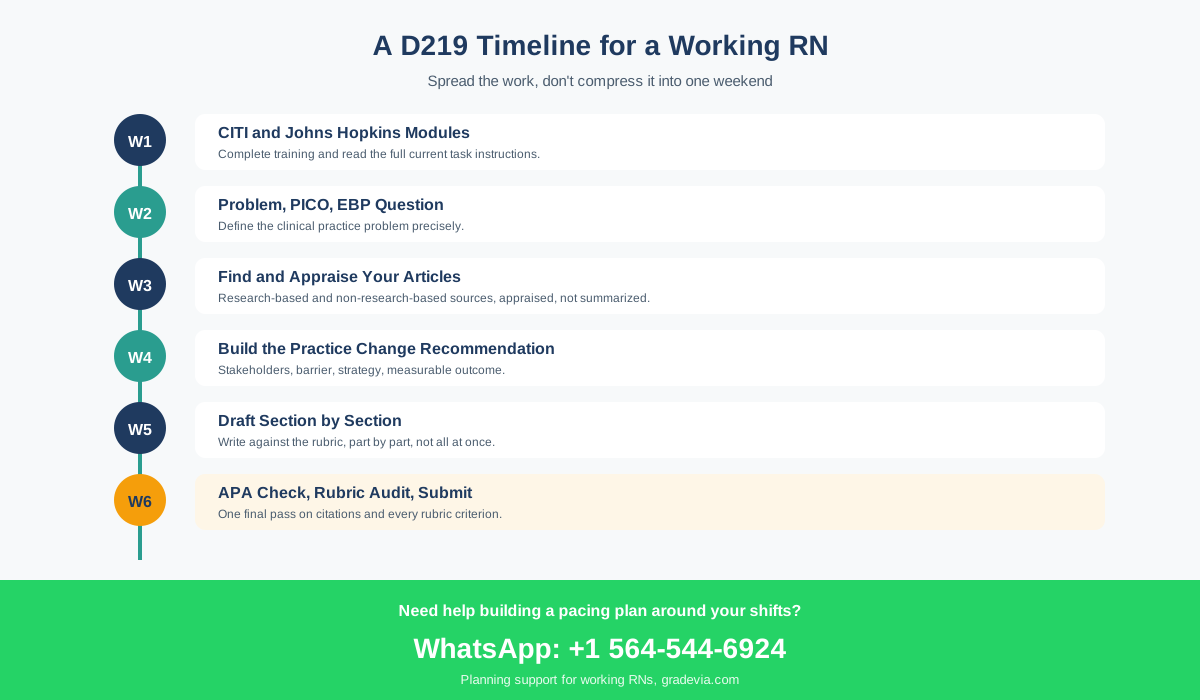
D219 rarely fails because a student doesn’t understand nursing, it usually fails because the writing gets squeezed into whatever hour is left after a shift. A rough pacing plan:
- Week 1, complete CITI and Johns Hopkins modules, read your current task instructions fully before researching anything.
- Week 2, define your clinical practice problem, PICO components, and EBP question.
- Week 3, find and appraise your research-based and non-research-based articles.
- Week 4, build your practice change recommendation, stakeholders, barrier, strategy, and outcome.
- Week 5, draft your full response section by section against the rubric.
- Week 6, check APA, run a full rubric audit, and submit.
Adjust this to your own course’s deadlines, the point is spreading the cognitive load across weeks rather than trying to compress an entire EBP project into one weekend.
What to Do If Any D219 Task Is Returned
The process is largely the same whether it’s Task 1, Task 2, or a MYM3-labeled assessment: read the evaluator feedback carefully, map it to the specific rubric criterion it addresses, revise the affected section with that gap in mind, recheck your evidence and citations, and complete a full rubric audit before resubmitting. Gradevia’s revision help walks through this process in more depth for whichever task you’re working through, and can help you interpret feedback you’re unsure how to act on.
How Gradevia Supports You Through All of D219
Stuck Anywhere in D219? Message Us on WhatsApp
Whether you’re on Task 1, Task 2, or the MYM3 evidence appraisal stage, the same problem tends to show up: you understand the nursing content, but you’re not sure what the rubric wants on paper, or you’re staring at an evaluator comment that doesn’t tell you exactly what to fix. Gradevia works with busy RN-to-BSN students across every stage of D219, not just one task in isolation.
Support across the whole course includes:
- Rubric breakdowns for Task 1, Task 2, and MYM3 Task 2
- PICO and EBP question development coaching
- Research strategy and article-type screening
- JHNEBP leveling and quality-rating guidance
- Evidence and stakeholder matrix development
- Draft review and organization feedback
- APA and citation review
- Evaluator feedback interpretation
- Revision planning after a returned assessment
- One-on-one coaching built around a working RN’s actual schedule
📱 Working full-time and stuck on any part of D219? Upload your current task instructions and rubric to Gradevia and message us on WhatsApp at +1 564-544-6924. No long email chains, no waiting days for a reply, most students hear back the same day.
Frequently Asked Questions About WGU D219
What is WGU D219? D219, Scholarship in Nursing Practice, is a required RN-to-BSN course covering evidence-based practice, literature review, research ethics, and interprofessional evidence use, typically completed through Johns Hopkins EBP modules and one or more written performance assessments.
What’s the difference between D219 Task 1 and Task 2? Task 1 generally establishes the clinical practice problem, PICO components, EBP question, and article appraisals. Task 2, where it exists as a distinct assessment, generally continues that work further into application or deeper appraisal. The exact split varies by course version, so check your current task instructions.
What does MYM3 mean in D219? MYM3 is a naming convention some students see attached to a later stage of D219 coursework inside their WGU dashboard, often connected to evidence appraisal and practice change work. Naming varies by course version, so follow whatever label your own dashboard uses.
How long does D219 usually take a working RN? This varies widely by student and schedule, but spreading the work across several weeks (modules and CITI first, then problem definition, then appraisal, then drafting) tends to go more smoothly than compressing it into a single weekend.
Where can I find the current D219 rubric? Inside your WGU course, alongside your current task instructions. That’s the only version that reflects your actual assessment, this guide and the linked task guides are planning support, not a replacement for it.
Can Gradevia help with D219 even if I’m not sure which task I’m on? Yes. Message us on WhatsApp with your current task instructions and we’ll help you figure out exactly what’s being asked before you plan anything.
Final Thoughts
D219 gets easier to manage once you stop treating it as one enormous, undifferentiated assignment and start treating it as a sequence of specific, learnable skills, a precise clinical problem, a real appraisal of your evidence, a recommendation that follows from that evidence, and citations that hold up under a rubric audit. Each task guide linked above breaks its own stage down in detail; this page exists to help you see how they connect.
Working full-time and stuck anywhere in D219? Upload your current task instructions and rubric to Gradevia and message us on WhatsApp at +1 564-544-6924, tell us where you’re stuck, and we’ll help you find the next step.
References
- Alsadaan, N., & Ramadan, O. M. E. (2025). Barriers and facilitators in implementing evidence-based practice: A parallel cross-sectional mixed methods study among nursing administrators. BMC Nursing, 24, 403. https://doi.org/10.1186/s12912-025-03059-z
- Pitsillidou, M., Noula, M., Roupa, Z., & Farmakas, A. (2023). Barriers to the adoption of evidence-based practice in nursing: A focus group study. Acta Informatica Medica, 31(4), 306-311. https://doi.org/10.5455/aim.2023.31.306-311
- Fontaine, G., Vinette, B., Weight, C., Maheu-Cadotte, M.-A., Lavallee, A., Deschenes, M.-F., Lapierre, A., Castiglione, S. A., Chicoine, G., Rouleau, G., Argiropoulos, N., Konnyu, K., Mooney, M., Cassidy, C. E., Mailhot, T., Lavoie, P., Pepin, C., Cossette, S., Gagnon, M.-P., Semenic, S., Straiton, N., & Middleton, S. (2024). Effects of implementation strategies on nursing practice and patient outcomes: A comprehensive systematic review and meta-analysis. Implementation Science, 19(1), Article 68. https://doi.org/10.1186/s13012-024-01398-0
- Younas, A. (2023). Uptake of innovations in nursing: The necessity for implementation science. Creative Nursing, 29(2), 177-181. https://doi.org/10.1177/10784535231195426
- Zhang, Y., Guo, Z., Xu, S., Yao, M., Feng, X., Lan, M., & Jin, J. (2024). Facilitating evidence-based practice among nurses in a tertiary general hospital: A six-year practice of an implementation strategy informed by the i-PARIHS framework. Journal of Nursing Management, 2024, Article 8855667. https://doi.org/10.1155/2024/8855667