
Blog
WGU D219 Task 2 Example & Complete Guide to Scholarship in Nursing Practice

You already got through D219 Task 1, the clinical problem, the PICO components, the article appraisals, and now you’re staring at D219 Task 2 wondering how much of that work carries forward and what’s actually new here. The nursing content still isn’t the hard part, you know the practice problem inside out. The hard part is translating a fresh set of rubric language into a paper that hits every requirement without spending your entire weekend rereading the same paragraph.
This guide walks you through what D219 Task 2 generally asks of you, how to plan your response before you start writing, how to research efficiently instead of reading forty unrelated articles, and what to do if it comes back for revision, plus an original illustrative example. WGU updates task instructions periodically and some students see this work organized under a different assessment code (MYM2 or MYM3, depending on your course version), so treat your current task instructions and rubric inside your own course as the only final authority. Where this guide can’t verify a specific detail, it says so directly instead of guessing.
What Is WGU D219?
D219, Scholarship in Nursing Practice, is part of WGU’s RN-to-BSN curriculum. It’s built around five competencies: differentiating quality improvement from evidence-based practice and research, conducting a literature review, understanding research ethics and human subjects protections, distinguishing evidence-based standards from conventional practice, and describing how evidence gets collected, analyzed, and implemented from an interprofessional perspective.
If you haven’t already, our WGU D219 Task 1 guide and example covers the first performance assessment in detail, identifying a clinical practice problem, building your PICO components and EBP question, and appraising a research-based and non-research-based article. Task 2 generally continues that same line of work.
What Is WGU D219 Task 2?
At a high level, D219 Task 2 typically asks you to build on the clinical practice problem and evidence-based practice (EBP) question you established in Task 1, moving from appraising evidence toward applying it, whether that’s recommending or evaluating a practice change, discussing implementation, or synthesizing your findings into a scholarly paper. Some students see this organized as a second written assessment within the same MYM2 performance task, others see it as a separate MYM3 assessment. Because the exact structure, lettered parts, and rubric aspects can differ by course version, the only reliable source for what your Task 2 actually requires is the task instructions and rubric currently sitting inside your own WGU course.
Who Typically Takes D219?
D219 is aimed at working RNs finishing an RN-to-BSN degree, which means most students taking Task 2 are already juggling shift work, patient care responsibilities, and a life outside the hospital, on top of whatever momentum (or fatigue) carried over from Task 1. If you’re reading this trying to figure out how a second graduate-level writing assessment fits into a week that’s already full, you’re the exact person this course, and this guide, was built for.
WGU D219 Task 2 Requirements Explained
Because task and rubric structures can vary by course version, use the framework below to read your current rubric rather than as a list of confirmed requirements. Pull up your actual D219 Task 2 task instructions and rubric side by side with this section before you plan anything.
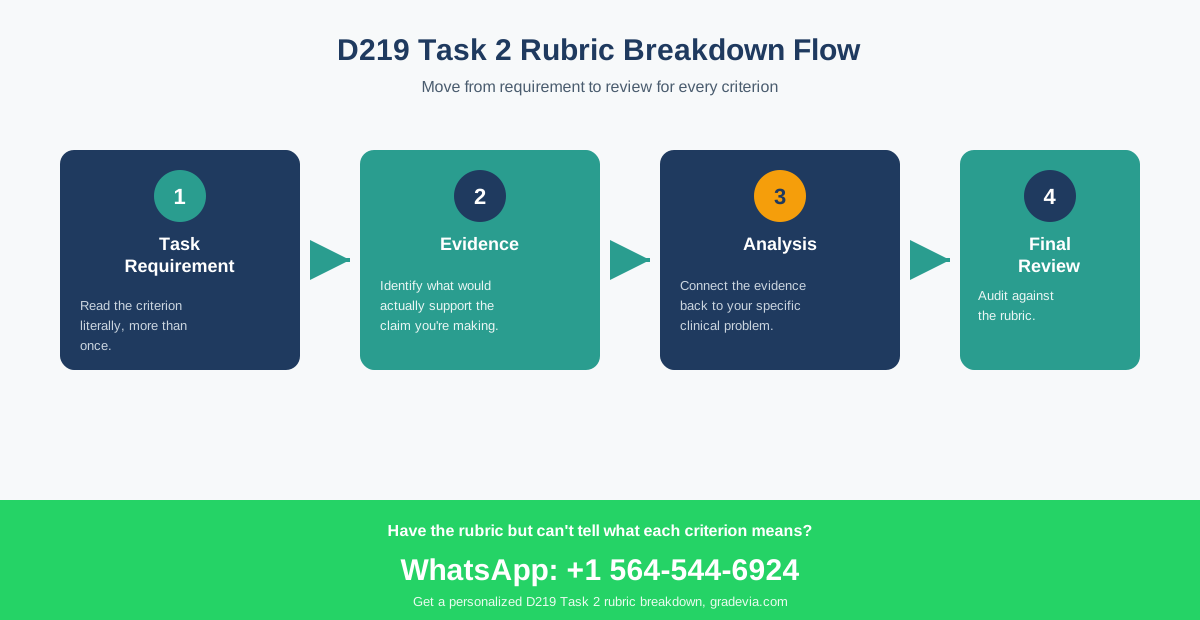
For each rubric criterion in your own task, work through it this way:
What the Requirement Is Asking Read the criterion literally first, more than once. Rubric verbs like “analyze,” “recommend,” or “synthesize” carry specific weight and usually mean more than “describe” or “summarize.”
What You Need to Demonstrate Translate the criterion into something you could point to directly in your paper. If a criterion asks you to connect evidence to nursing practice, that connection needs its own explicit sentence, not an implication left for the evaluator to infer.
Evidence to Consider Ask what would actually support the claim you’re making, a finding from your appraised articles, a clinical guideline, an outcome measure. Every claim of fact needs support; not every sentence needs a citation.
Common Mistake Most students lose points not because they misunderstood the nursing concept, but because the finished paper doesn’t make it obvious where they addressed a requirement. Evaluators grade what’s on the page.
Practical Tip Write the rubric criterion’s key verb next to the paragraph that answers it as you draft. It’s a fast gut check for whether you actually addressed the requirement or just wrote in its general direction.
Not sure how to turn the D219 Task 2 requirements into a workable plan? Gradevia can help you break the assessment into manageable steps.
How to Approach WGU D219 Task 2 Step by Step
Step 1: Start With the Current Assessment Instructions
Don’t start by searching Google for “D219 Task 2 answers” or “D219 Task 2 example.” Task versions and rubric wording change, and building your outline from an outdated or mismatched version is one of the most common reasons students end up redoing work. Start with the instructions and rubric inside your own course.
Step 2: Turn the Rubric Into a Checklist
Convert each requirement into a direct question:
- What is this criterion literally asking me to do?
- What section of my paper will answer it?
- What evidence supports that answer?
Step 3: Understand What the Task Is Really Asking
Separate five things that are easy to blur together: the general topic, the specific task requirement, the rubric language grading that requirement, the evidence you’ll use, and the analysis connecting that evidence to your argument. A strong Task 2 response keeps these distinct instead of letting them blend into one long narrative.
Step 4: Identify the Evidence You Need
Go claim by claim through your planned outline and flag anything that isn’t common nursing knowledge. Those are the spots that need a citation, ideally pulling forward from the articles you already appraised in Task 1 where they’re still relevant.
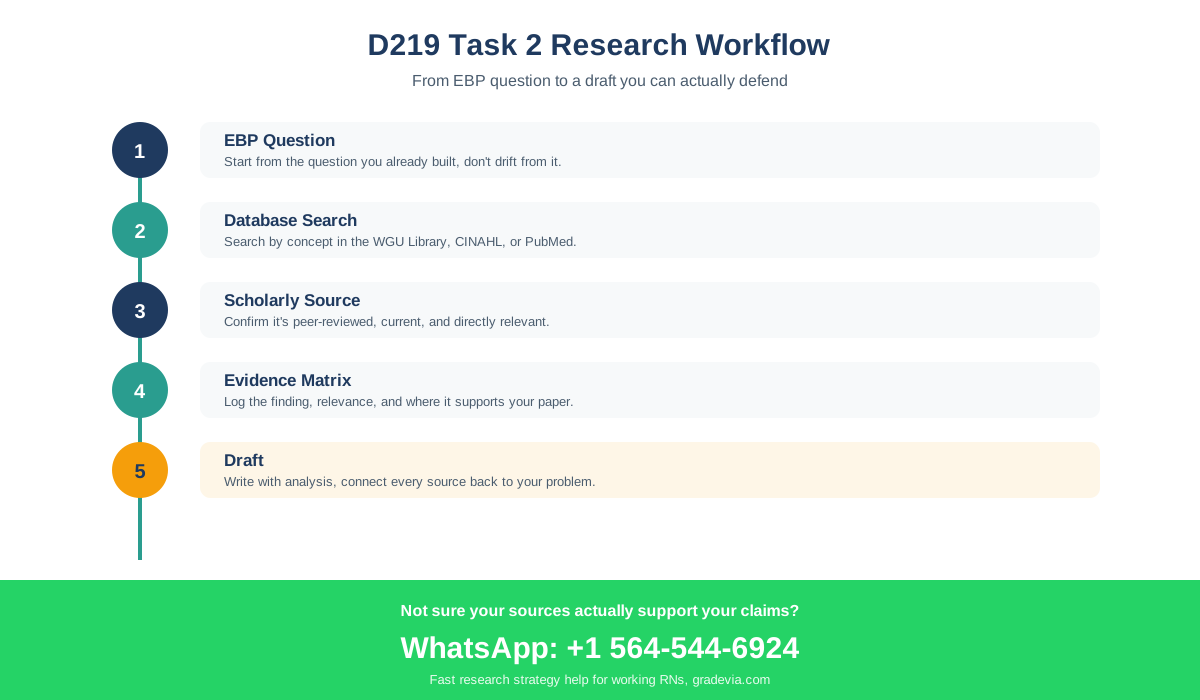
Step 5: Conduct a Focused Literature Search
Search with your EBP question and specific concepts in mind rather than browsing broadly. A focused search of ten relevant results beats an unfocused search of a hundred loosely related ones.
Step 6: Build a Research and Evidence Matrix
This is a Gradevia planning tool, not an official WGU document, use it to organize sources before you draft.
| Source | Main Finding | Relevance | Where It May Support My Response |
|---|---|---|---|
| Article 1 | Key finding in your own words | Concept it connects to | Requirement or section it supports |
| Article 2 | Key finding in your own words | Nursing application | Requirement or section it supports |
| Article 3 | Key finding in your own words | Supporting evidence | Requirement or section it supports |
Step 7: Create Your Outline
Turn your rubric checklist directly into your paper’s section headers. A paper that mirrors the rubric’s structure is simply easier for an evaluator to grade favorably.
Step 8: Draft Your Own Response
Write analytically, not descriptively. Every time you introduce a piece of evidence, follow it with a sentence connecting it back to your specific clinical problem or recommendation.
Step 9: Check APA and Evidence
Confirm every factual claim has a source, every in-text citation has a matching reference entry, and your formatting is consistent throughout.
Step 10: Complete a Rubric Audit
Before you submit, go through every requirement one more time and confirm your paper answers each one explicitly. This step alone catches a surprising number of “Needs Revision” results.
Have the rubric but still can’t tell what each criterion means? Get a personalized D219 rubric breakdown.
WGU D219 Task 2 Outline
This is a planning framework, not an official WGU template, adapt it to whatever structure your current D219 Task 2 rubric actually specifies.
| Section | Purpose | Questions to Ask Yourself |
|---|---|---|
| Introduction | Establish the topic and problem | What is this assessment about? |
| Requirement 1 | Address a specific rubric criterion | What exactly is being requested? |
| Requirement 2 | Develop your analysis | What evidence supports my response? |
| Requirement 3 | Apply evidence to practice | How does this connect to nursing practice? |
| Conclusion | Summarize your key points | What are the key takeaways? |
| References | Document every source cited | Are all sources cited correctly? |
How to Research WGU D219 Task 2
Start With the WGU Library
Your WGU Library is filtered for academic quality and is almost always faster than a general web search, especially once you know which databases (CINAHL, PubMed) cover your topic best.
Use Targeted Search Terms
Search by concept, not by task name. A search for “D219 Task 2 answers” returns unrelated forum posts and outdated papers. A search built around your actual clinical concept returns usable evidence. Try combinations like:
- [your clinical issue] AND evidence-based practice
- [your clinical issue] AND nursing outcomes
- [your intervention] AND systematic review
- [your patient population] AND nursing practice
Prioritize High-Quality Evidence
Favor peer-reviewed research, systematic reviews, meta-analyses, evidence-based clinical guidelines, government health data, and position statements from professional nursing organizations over blogs or general health sites.
Build a Source Matrix
For each source, record the citation, the research question it addresses, the population studied, the key findings, any notable limitations, and how it specifically supports your argument. This turns your research phase into reusable material for drafting instead of a pile of open tabs.
WGU D219 Task 2 Example: How to Use Examples Correctly
Searching for a “WGU D219 Task 2 example” is a reasonable instinct, but treat anything you find online carefully. Old student submissions, outdated templates, and answer-sharing sites often reflect a different task version, a different rubric, or a different course code entirely. Before trusting any example, verify it against your own course code, assessment version, current task instructions, current rubric, and any resources WGU itself has provided. Never copy structure or language from another student’s submission, that’s an academic integrity risk regardless of how closely it seems to match your assignment.
Illustrative example only, not an official WGU answer and not a submission template.
Weak approach: “Evidence shows that patient education helps outcomes. Research supports this and nurses should use it.”
Better approach: “The research-based article identified in this assessment found that structured discharge education reduced 30-day readmissions for heart failure patients by improving self-management confidence. Applied to the unit-level practice change proposed here, that finding suggests a standardized discharge teaching checklist could address the same gap identified in the original clinical practice problem, provided nursing staff receive brief training on its use.”
Why it works better: The second version names the specific finding, ties it to a specific population and outcome, and explicitly connects it back to the practice change being proposed, rather than gesturing at “research” in the abstract.
WGU D219 Task 2 Template
This is a Gradevia planning worksheet, not an official WGU document, use it to organize your thinking before you draft in whatever template your current course provides.
Requirement: What does the rubric ask?
My interpretation: What do I need to demonstrate?
Key point: What is my main idea?
Evidence: Which scholarly source supports this point?
Connection to nursing practice: Why does this evidence matter?
Citation: What source will I cite?
Final check: Does my response directly satisfy the rubric?
APA and Citation Tips for D219 Task 2
Key things to get right:
- Every paraphrased fact needs an in-text citation, and every in-text citation needs a matching reference entry
- Author and date formatting should stay consistent across every citation
- Direct quotes should be rare, paraphrasing in your own words shows you actually understand the source
- Reference formatting (hanging indent, italics, capitalization) should be consistent throughout
Avoiding Citation Problems
- Unsupported claims stated as fact with no citation at all
- Citation dumping, stacking several sources at the end of a paragraph without showing how each one specifically supports the claim
- Over-reliance on one source instead of drawing on multiple pieces of evidence
- References that aren’t cited in the body of the paper, or citations with no matching reference
- Copying language too closely from a source, even with a citation attached
Common WGU D219 Task 2 Mistakes
Mistake 1: Searching for Answers Instead of Understanding the Task
It happens because a finished example feels faster than reading instructions carefully. It matters because task versions and rubrics change, so a mismatched example can send you in the wrong direction entirely. Avoid it by reading your own current task instructions before searching for anything else.
Mistake 2: Writing Before Breaking Down the Rubric
It happens because the deadline feels closer than the reading. It matters because you end up retrofitting a paper to a rubric it wasn’t built for. Avoid it by turning every criterion into a checklist question first.
Mistake 3: Using Sources That Don’t Actually Support the Claim
It happens when a source is topically related but doesn’t actually address the specific point being made. It matters because evaluators check whether cited evidence genuinely supports the claim next to it. Avoid it by rereading each source’s actual finding before citing it.
Mistake 4: Summarizing Research Without Analysis
It happens because summarizing is easier to write than analyzing. It matters because most Task 2 criteria are looking for interpretation and application, not a book report. Avoid it by asking “what does this mean for my recommendation?” after every source you introduce.
Mistake 5: Failing to Connect Evidence to Nursing Practice
It happens when a student stays in the research literature without pulling back to the clinical setting. It matters because this connection is usually a specific, gradable requirement. Avoid it by writing an explicit sentence linking each piece of evidence to your practice problem or recommendation.
Mistake 6: Using Outdated or Low-Quality Sources
It happens when a convenient source doesn’t get checked closely enough. It matters because weak or outdated evidence undermines your entire argument. Avoid it by prioritizing recent, peer-reviewed sources from credible databases.
Mistake 7: Poor APA Citation Practices
It happens because APA feels like a low priority next to content. It matters because formatting and citation errors are graded and easy for an evaluator to spot. Avoid it by running a dedicated APA pass after your content is finished.
Mistake 8: Ignoring One Small Rubric Requirement
It happens when a single line item gets overlooked while you focus on the bigger sections. It matters because even one missed criterion can trigger a full revision. Avoid it by checking off every single rubric line, not just the major ones.
Mistake 9: Submitting Without a Final Rubric Audit
It happens because after days of writing, you’re ready to be done. It matters because this single step catches most preventable revisions. Avoid it by treating the final rubric audit as non-negotiable.
How to Review Your D219 Task 2 Before Submission
Content Check
Does every requirement have a direct, explicit response somewhere in your paper?
Evidence Check
Does every major claim have appropriate, relevant support?
Rubric Check
Can you point to exactly where in your paper each criterion has been addressed?
APA Check
Are your citations and references consistent and complete?
Writing Check
Look for repetition, unclear sentences, weak transitions, grammar problems, excessive quotations, and information that doesn’t serve a specific requirement.
Final Submission Check
Confirm you’ve followed the current WGU submission instructions for file type and format before you upload anything.
What If WGU Returns Your D219 Task 2?
- Don’t panic, a returned assessment is a normal part of the process for a lot of students.
- Read the evaluator feedback carefully, more than once.
- Identify the specific criterion the feedback is tied to.
- Compare the feedback directly against your current rubric.
- Determine exactly what’s missing or unclear.
- Create a short revision plan before touching the paper itself.
- Revise your own work, focused on the flagged sections.
- Recheck your evidence.
- Recheck your APA formatting.
- Perform another full rubric audit before resubmitting.
WGU D219 Task 2 Revision Help
Received evaluator feedback? Gradevia can help you interpret the feedback, identify what’s actually missing, and build a focused revision plan, without doing the work for you. That includes reviewing your own draft’s organization, checking evidence integration, reviewing APA, and helping you strengthen clarity before you resubmit. We won’t promise a guaranteed pass or guaranteed competency, and we won’t write your assessment for you, but we will make sure you’re revising with a clear plan instead of guessing.
How Gradevia Can Help With WGU D219 Task 2
Working Full-Time and Stuck on D219 Task 2? Text Us on WhatsApp
You’re an RN, not a full-time student with a free afternoon to reverse-engineer a rubric. Between shifts, charting, and everything waiting for you at home, you don’t need someone to do the work for you, you need a fast, plain-English answer about what D219 Task 2 is actually asking, from someone who understands what “I have twenty minutes before my next shift” really means. Gradevia provides support without replacing your own work.
Services include:
- D219 Rubric Breakdown, turning the assessment criteria into a practical checklist
- Assignment Planning, a personalized roadmap for approaching the assessment
- Research Strategy, help identifying useful search directions and terms
- Evidence Organization, help organizing sources and findings
- Draft Review, reviewing your own draft for clarity, structure, and alignment
- APA Review, identifying formatting and citation issues
- Revision Coaching, help interpreting evaluator feedback and building a revision plan
- One-on-One Coaching, personalized academic guidance
📱 Working full-time and stuck on D219 Task 2? Upload your current task instructions and rubric to Gradevia and message us on WhatsApp at +1 564-544-6924. No long email chains, no waiting days for a response, most students hear back the same day.
D219 Task 2 Checklist
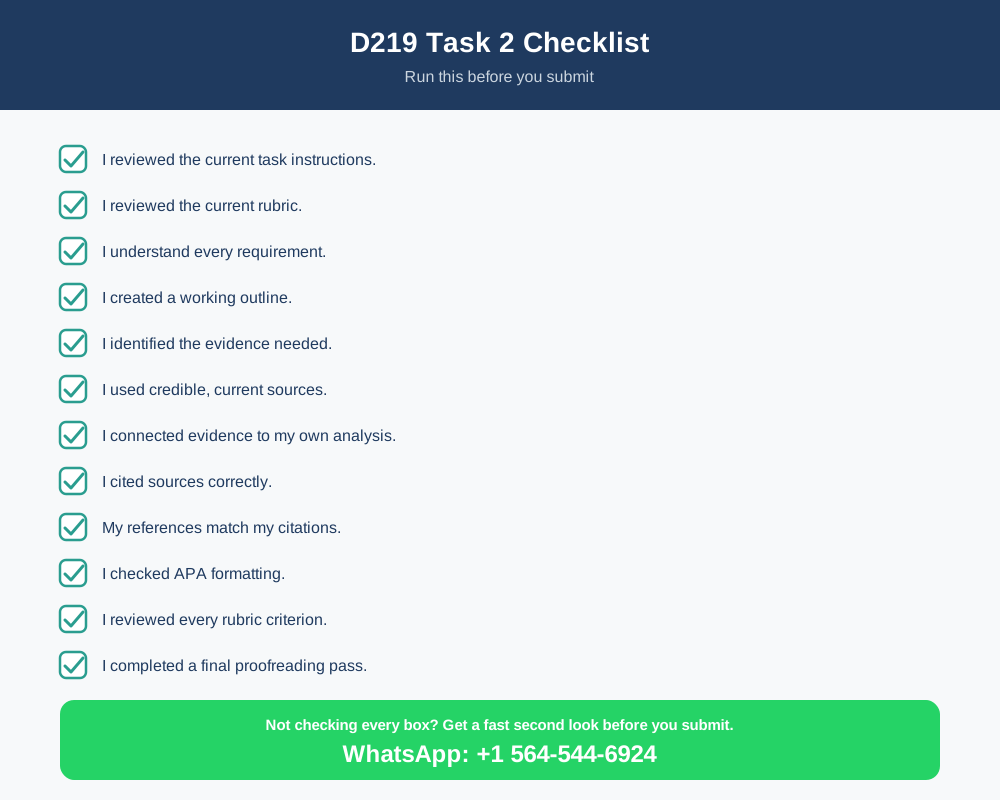
- I reviewed the current task instructions.
- I reviewed the current rubric.
- I understand every requirement.
- I created a working outline.
- I identified the evidence needed.
- I used credible, current sources.
- I connected evidence to my own analysis.
- I cited sources correctly.
- My references match my citations.
- I checked APA formatting.
- I reviewed every rubric criterion.
- I completed a final proofreading pass.
Still checking a box you’re not sure about? WhatsApp us at +1 564-544-6924 and we’ll help you sort it out before you hit submit.
Frequently Asked Questions About WGU D219 Task 2
What is WGU D219 Task 2? D219 Task 2 is a written performance assessment that generally builds on the clinical practice problem and EBP question established in Task 1, moving toward application, recommendation, or synthesis. The exact structure varies by course version, so confirm the specific requirements against your current task instructions.
What is D219 Scholarship in Nursing Practice? D219 is a WGU RN-to-BSN course built around five competencies covering evidence-based practice, literature review, research ethics, evidence-based versus conventional practice standards, and interprofessional data use.
How do I approach WGU D219 Task 2? Start with your current task instructions, break the rubric into a checklist, build your evidence and research matrix, outline around the rubric’s structure, draft with analysis rather than summary, check your APA and evidence, and finish with a full rubric audit before submitting.
Is there a WGU D219 Task 2 example? Real student submissions circulate online, but treat them cautiously since task versions and rubrics change, and copying structure or language from someone else’s paper raises academic integrity concerns. An original, clearly labeled illustrative example (like the one above) is a safer way to understand what a strong response looks like.
Where can I find the D219 Task 2 rubric? Your rubric lives inside your WGU course alongside the current task instructions. That’s the only version that reflects your actual assessment.
How should I structure D219 Task 2? Structure it around your current rubric’s requirements, in the order they’re listed. A paper that mirrors the rubric’s structure is easier for an evaluator to grade favorably.
How many sources are required for D219 Task 2? This depends on your current task instructions, and no fixed number applies across every course version. Use enough credible, relevant evidence to support every major claim you make.
What types of sources should I use for D219 Task 2? Peer-reviewed research, systematic reviews, meta-analyses, evidence-based clinical guidelines, government health sources, and professional nursing organizations are generally strong choices, provided each one directly supports your specific claims.
What should I do if D219 Task 2 is returned? Read the evaluator feedback, map it to the specific rubric criterion it addresses, revise the flagged section with the gap in mind, recheck your evidence and citations, and review the whole paper again before resubmitting.
Can someone help me understand WGU D219 Task 2? Yes, legitimate academic support (rubric breakdowns, research strategy help, draft review, and revision coaching) is different from having someone complete the assignment for you. Gradevia focuses on the former: helping you understand and strengthen your own work.
Final Thoughts
D219 Task 2 becomes far more manageable the moment you stop treating it as one more massive assignment and start treating it as a series of individual rubric requirements, researched deliberately, organized around real evidence, and reviewed systematically before you submit. Busy RNs don’t need to spend an entire weekend figuring out where to even begin.
Working full-time and stuck on D219 Task 2? Upload your current task instructions and rubric to Gradevia and message us on WhatsApp at +1 564-544-6924, tell us where you’re stuck, and we’ll help you find the next step.
Related WGU Resources
WGU C200 Task 1: Personal Leadership Evaluation, Complete Guide + Example
WGU C200 Task 2 Guide and Example: Organization and Leadership Evaluation
WGU C206 Task 2 (Paradigm Toys): Guide + Example
WGU C216 MBA Capstone: Complete Guide to the Simulation & Tasks (2026)
References
- Fontaine, G., Vinette, B., Weight, C., Maheu-Cadotte, M.-A., Lavallee, A., Deschenes, M.-F., Lapierre, A., Castiglione, S. A., Chicoine, G., Rouleau, G., Argiropoulos, N., Konnyu, K., Mooney, M., Cassidy, C. E., Mailhot, T., Lavoie, P., Pepin, C., Cossette, S., Gagnon, M.-P., Semenic, S., Straiton, N., & Middleton, S. (2024). Effects of implementation strategies on nursing practice and patient outcomes: A comprehensive systematic review and meta-analysis. Implementation Science, 19(1), Article 68. https://doi.org/10.1186/s13012-024-01398-0
- Younas, A. (2023). Uptake of innovations in nursing: The necessity for implementation science. Creative Nursing, 29(2), 177-181. https://doi.org/10.1177/10784535231195426
- Zhang, Y., Guo, Z., Xu, S., Yao, M., Feng, X., Lan, M., & Jin, J. (2024). Facilitating evidence-based practice among nurses in a tertiary general hospital: A six-year practice of an implementation strategy informed by the i-PARIHS framework. Journal of Nursing Management, 2024, Article 8855667. https://doi.org/10.1155/2024/8855667
- Lv, F. (2024). From evidence to action: Addressing challenges in implementing EBP in nursing. Journal of Evidence Based Medicine and Healthcare, 11(2), 1-2. https://doi.org/10.18410/jebmh/2024/11/02/113
- Mun, K., Lee, M., & Shim, J. (2024). Effects of work engagement and barriers on evidence-based practice implementation for clinical nurses: A cross-sectional study. Healthcare, 12(22), 2223. https://doi.org/10.3390/healthcare12222223