
Blog
Shadow Health Health History: How to Complete the Tina Jones Assessment

You’re looking at Shadow Health Health History, and you know the shape of it: interview Tina Jones, your first Digital Standardized Patient, document her comprehensive health history, and complete the post-exam activities. With an average completion time of 1 hour and 55 minutes, this is the longest, most involved Shadow Health assignment you’ve likely faced so far. Knowing what to ask, how to organize it, and what to document before you start makes a real difference in how that time gets spent.
This guide walks through the full Shadow Health Health History workflow, from preparing for the Tina Jones interview through documentation, information processing, assessment and plan activities, and submitting your Lab Pass, plus what the “answer key,” “transcript,” and “Quizlet” searches around this assignment are actually looking for, and a more reliable way to get there.
Shadow Health Health History Assignment
In this assignment you will interview your first Digital Standardized Patient, Tina Jones; document her comprehensive health history; and complete post-exam activities. Within the Shadow Health platform, complete Health History. The estimated average time to complete this assignment each time is 1 hour and 55 minutes. Please note, this is an average time. Some students may need additional time.
You can attempt this assignment as many times as you would like. After completing the health history, you will be awarded a Digital Clinical Experience (DCE) score. The DCE score will appear on your Lab Pass which you will submit to the classroom drop box. The DCE score will be used as your percentage grade for this assignment.
You are not required to submit this assignment to LopesWrite.
What Is Shadow Health Health History?
Shadow Health Health History is a Digital Clinical Experience in which you interview Tina Jones, your first Digital Standardized Patient, and document her comprehensive health history. The assignment has three required components: the interview itself, documentation of what you find, and post-exam activities. It all happens inside the Shadow Health platform, and your performance is measured by a DCE score that appears on your Lab Pass.
A few things worth knowing before you start:
- You can attempt the assignment as many times as you would like.
- The DCE score becomes your percentage grade for the assignment.
- The Lab Pass is what you submit to your classroom drop box.
- LopesWrite submission is not required.
- The estimated average completion time is 1 hour and 55 minutes, though some students reasonably need more.
This is a comprehensive health history, not a single-system assessment like HEENT. That scope is exactly why organization matters here more than in a shorter concept lab.
Shadow Health Health History Assignment Requirements
| Requirement | What the Student Does |
|---|---|
| Digital Standardized Patient | Interview Tina Jones |
| Health History | Complete the Shadow Health Health History activity |
| Documentation | Record the information obtained during the interview |
| Post-exam activities | Complete the activities provided after the interview |
| DCE score | Review the score awarded after completion |
| Lab Pass | Submit the Lab Pass to the classroom drop box |
| Attempts | Use additional attempts when needed |
| LopesWrite | Not required |
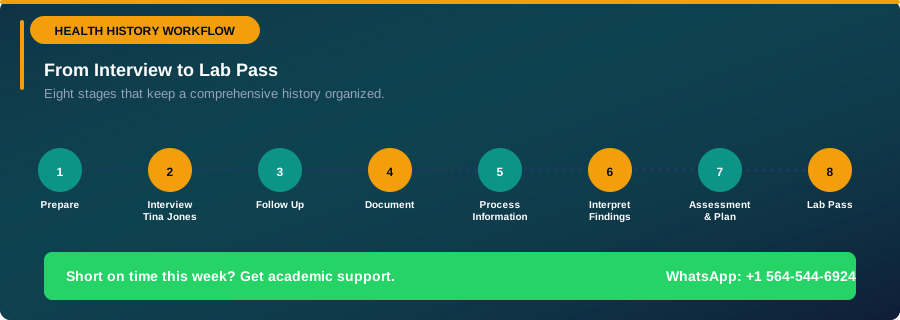
The 1-hour-55-minute figure is an average, not a target. A full comprehensive health history covers more ground than a single-system assessment, so needing more time on your first attempt is normal, not a sign you’re behind.
Working full-time while keeping up with weekly GCU nursing assignments? Get practical academic support when your schedule is already packed. WhatsApp Gradevia: +1 564-544-6924
How to Complete Shadow Health Health History Step by Step
Step 1: Open the Correct Shadow Health Health History Assignment
Confirm you’re working inside Health History specifically, with Tina Jones as your Digital Standardized Patient, before you start clicking through questions. Understand the assignment objective first: you’re not just answering prompts, you’re building a comprehensive history you’ll need to organize and document afterward.
Step 2: Understand What a Comprehensive Health History Requires
Before you start the interview, know the categories you’ll need to cover. A comprehensive health history typically includes:
- Patient identification / introductory information
- Chief concern or reason for the encounter
- History of present concern
- Past medical history
- Surgical history
- Medications
- Allergies
- Immunization-related history where applicable
- Family history
- Social history
- Lifestyle-related information
- Relevant review of systems
- Other information revealed during the conversation
This list is general preparation guidance, not Tina Jones’s actual Shadow Health answers. What she reports in each category, in your specific attempt, is what you’ll document.
Shadow Health Health History Questions: What Should You Ask Tina Jones?
Random clicking through available questions tends to produce a scattered, hard-to-document interview. A logical sequence works better:
Opening questions. Begin the encounter professionally, introduce yourself, and establish the purpose of the conversation before moving into clinical territory.
Broad questions. Use open-ended questions early so Tina can describe concerns in her own words rather than being led toward a specific answer.
Focused questions. Once a concern emerges, narrow in on the details that matter (onset, duration, severity, associated symptoms).
Follow-up questions. Let each response determine your next question rather than working through a fixed script regardless of what she says.
Clarifying questions. If an answer is vague or incomplete, ask a follow-up before moving on rather than documenting an assumption.
Closing questions. Before ending the interview, check whether anything significant remains unexplored.
Below are practice examples, not Tina Jones’s actual Shadow Health responses, showing how each question type works:
- Opening: “Can you tell me a bit about what brings you in today?” (broad, establishes rapport)
- Focused follow-up: “When did that first start?” (narrows a concern that’s already been raised)
- Clarifying: “When you say it comes and goes, how often would you say that happens?” (resolves vague wording)
- Closing: “Is there anything else about your health you think is important for me to know?” (catches anything unexplored)
Short on time and struggling with your Shadow Health Health History assessment? Get help understanding the assignment, organizing your work, and staying on track. Gradevia | WhatsApp: +1 564-544-6924
Tina Jones Shadow Health Health History Interview Guide
| Interview Area | Purpose | Question Strategy |
|---|---|---|
| Opening | Establish communication | Begin broad |
| Chief concern | Identify why the patient is being assessed | Use open-ended questions |
| Current concern | Clarify details | Follow up systematically |
| Medical history | Identify relevant conditions | Ask focused questions |
| Medications | Identify current medication use | Clarify medication details |
| Allergies | Identify potential risks | Clarify reactions |
| Family history | Identify relevant patterns | Ask about significant conditions |
| Social history | Understand lifestyle and context | Use respectful, nonjudgmental questions |
| Review of systems | Identify additional symptoms | Follow a structured approach |
| Closing | Confirm completeness | Ask whether anything important was missed |
This is a questioning strategy, not a copied Shadow Health script. The exact wording Tina Jones uses back to you in your attempt is the platform’s content.
Shadow Health Health History Tina Jones Documentation
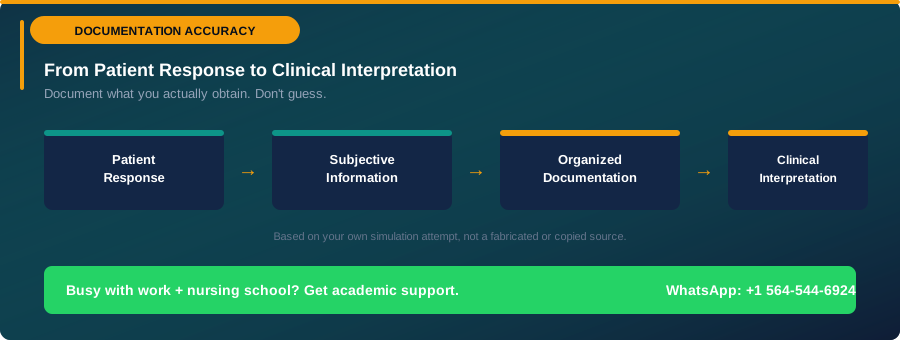
Documentation depends on keeping four things separate:
- What Tina actually tells you (her own words or a close paraphrase)
- What you infer (a reasonable clinical connection you’re drawing)
- What you interpret (what the combined information suggests)
- What you document (which should be grounded in what you actually obtained)
The core rule: document what you actually obtained. Do not guess.
A few specific habits worth avoiding:
- Filling gaps with assumptions instead of following up during the interview
- Changing Tina’s wording in ways that shift the meaning
- Turning a subjective statement into something written as an objective finding
- Adding symptoms she didn’t report because they “seem likely”
- Documenting a diagnosis that was never actually established
- Confusing your own interpretation with the patient’s raw information
Each of these makes your documentation less accurate, and accuracy is what the DCE score is actually measuring.
Shadow Health Health History Information Processing
Information processing is how you mentally organize what you’re hearing while the interview is still happening, not just a step you do afterward. A practical sequence:
Collect → Organize → Identify patterns → Identify missing information → Interpret → Prepare for assessment
This differs from simply recording everything Tina says in the order she says it. Organizing by category as you go (symptom history here, medication information there, family history somewhere else) makes it much easier to notice a gap while you can still ask a follow-up question, instead of discovering it during documentation when the interview is already over.
Practice example, fictional patient, not Shadow Health data: A patient mentions fatigue, then later mentions trouble sleeping, then still later mentions increased stress at work. Processed individually, these are three separate comments. Organized together, they suggest a pattern worth exploring further, possibly connecting sleep quality, stress, and the fatigue complaint, which is exactly the kind of connection information processing is meant to surface.
Shadow Health Health History Tina Jones Interpret Findings
“Interpreting findings” means moving from raw information to clinical meaning. Useful questions to ask yourself as you review what you collected:
- What information is clinically significant?
- What findings belong together?
- What additional information is still needed?
- What findings require attention or follow-up?
- What’s reported information versus your own interpretation of it?
- What information actually supports the clinical reasoning you’re building?
This guide won’t invent Tina Jones-specific findings to interpret, since what you’re interpreting should come from your own attempt. The process above is what you apply to whatever she actually reports.
Shadow Health Tina Jones Health History Assessment and Plan
Assessment and plan activities come after information gathering, not before. The progression:
Patient report → Relevant data → Clinical interpretation → Assessment → Appropriate plan
A common mistake is jumping to an assessment before the information-gathering process is actually complete. If you’re still missing pieces of the history when you start the assessment and plan activities, whatever conclusions you draw are built on an incomplete picture. The specific content you’ll work through in this section should be completed based on what your own simulation attempt actually surfaced, not a generic template.
Shadow Health Health History Tina Jones SBAR
SBAR (Situation, Background, Assessment, Recommendation) is a structured communication format nurses use to hand off patient information clearly:
- Situation: what’s happening right now, briefly
- Background: relevant history that explains the situation
- Assessment: your clinical interpretation of the combined information
- Recommendation: what should happen next
If your Health History activity involves an SBAR-style component, build it from the information you actually obtained during your own interview, not a copied online Tina Jones SBAR.
Practice example, fictional patient, not Tina Jones’s actual data: Situation: patient reports a two-week history of fatigue. Background: recent increase in work stress and reported sleep difficulty. Assessment: fatigue potentially related to sleep disruption and stress, warranting further exploration. Recommendation: follow up on sleep patterns and consider stress management resources.
Shadow Health Health History Transcript: Should You Use One?
Students search for transcripts hoping to preview the interaction or double-check terminology. A few limitations worth knowing:
- Copied transcripts from other students may be incomplete or edited.
- Screenshots and old walkthroughs can reflect a previous platform version.
- Answer-sharing sites aren’t verified against your specific course version.
- What Tina Jones actually says in your attempt is what your documentation should be based on.
No transcript is reproduced or fabricated in this guide. Use the interview framework above instead of memorizing someone else’s transcript, since it transfers regardless of which version of the activity you’re given.
Shadow Health Health History Answer Key and PDF Searches
It’s a reasonable thing to want: certainty about which questions to ask, what Tina will say, what to document, and how to interpret it, all before you’ve spent nearly two hours on the assignment.
The honest issue with answer-key PDFs is reliability, not just ethics. They can be outdated, incomplete, built for a different course version, or copied inaccurately from someone else’s attempt. Since Health History findings are specific to what’s actually entered into your simulation session, a mismatched answer key doesn’t just risk academic integrity, it risks producing documentation that doesn’t match what your own attempt actually showed.
A more durable alternative:
Use a structured interview framework + document actual patient responses + review missed areas + use feedback to improve your next attempt.
Shadow Health Health History Quizlet: Can It Help?
Quizlet sets can be reasonably useful for reviewing:
- Terminology (subjective vs. objective, health-history categories)
- General interview frameworks
- Nursing communication principles
- Clinical vocabulary
They’re a poor substitute for your own attempt when it comes to specific patient responses. There’s a real difference between studying concepts and memorizing simulation answers: the first transfers to your actual attempt and to future patients; the second only works if the leaked material happens to match what you’re given, which isn’t guaranteed.
Shadow Health Health History PDF Resources
PDFs circulating around this assignment fall into a few categories: legitimate study guides covering health-history concepts, instructor-provided materials, personal notes from other students, general health-history references, and unofficial answer compilations. The first four can be genuinely useful for preparation. The last one carries the same reliability problems as any other unofficial answer key. This guide doesn’t reproduce or link to copyrighted or proprietary Shadow Health material.
Not getting the performance you expected from your Shadow Health attempts? Get practical academic guidance before your next attempt. WhatsApp Gradevia: +1 564-544-6924
How to Improve Your DCE Score on Shadow Health Health History
Since multiple attempts are allowed, a deliberate improvement loop works better than repeating the same approach:
Attempt 1: Focus on understanding the patient interaction and the overall structure of the assignment. Your first attempt is a diagnostic as much as a graded submission.
Review: Identify where information was missed or where the interview became inefficient.
Attempt 2: Use a more organized question sequence, applying the interview guide above.
Review again: Look for incomplete history categories and documentation errors specifically.
Final attempt: Prioritize completeness, accuracy, communication quality, documentation, and the post-exam activities together, rather than optimizing for just one of them.
None of this guarantees a specific score, but a structured review between attempts tends to produce steadier improvement than guessing at what went wrong.
Shadow Health Health History: A 1-Hour-55-Minute Time Management Plan
This is a suggested planning framework, not an official Shadow Health time requirement, and the assignment itself notes that some students will reasonably need more time.
| Stage | Suggested Focus |
|---|---|
| Preparation | Understand the task and interview structure |
| Interview | Conduct a systematic history |
| Documentation | Record relevant information accurately |
| Information processing | Organize and review findings |
| Assessment/plan activities | Complete the required post-exam work |
| Final review | Check completeness before finishing |
Common Shadow Health Health History Mistakes
- Starting with overly narrow questions. Correction: open broad, then narrow once a concern emerges.
- Asking disconnected questions. Correction: follow the interview guide’s logical sequence instead of jumping between categories.
- Failing to follow up on patient responses. Correction: let each answer inform your next question.
- Treating the interview like a memorization exercise. Correction: focus on the reasoning process, not a fixed script.
- Skipping important health-history categories. Correction: use the 13-category checklist before you consider the interview complete.
- Assuming information Tina did not provide. Correction: if you don’t know, ask, or leave it undocumented.
- Confusing subjective and objective information. Correction: label what she reports separately from what you assess or infer.
- Documenting interpretations as patient statements. Correction: keep her words and your clinical reasoning clearly separate.
- Failing to review documentation before finishing. Correction: read back through what you wrote and check it against what you actually obtained.
- Moving into assessment before collecting enough information. Correction: complete information gathering first.
- Depending entirely on Quizlet or answer keys. Correction: use them for concept review, not patient-specific answers.
- Ignoring feedback from previous attempts. Correction: read it and address the specific gap it identifies.
- Rushing because of the estimated completion time. Correction: treat 1 hour 55 minutes as an average, not a deadline.
- Forgetting the Lab Pass requirement. Correction: submitting the completed activity isn’t the same as submitting the Lab Pass to your drop box.
Shadow Health Health History Troubleshooting Guide
| Problem | Better Approach |
|---|---|
| I don’t know what to ask next | Return to the health-history framework |
| I am getting incomplete information | Use follow-up and clarification questions |
| I have too much information | Organize it into clinical categories |
| I am unsure what to document | Record only information actually obtained |
| My DCE score is lower than expected | Review missed areas and feedback |
| I keep relying on answer keys | Build your own structured interview process |
| I run out of time | Use a logical sequence instead of random questioning |
| I am confused by assessment/plan | Complete information gathering before interpretation |

Shadow Health Health History Final Checklist
Interview
- I introduced myself appropriately.
- I established the purpose of the encounter.
- I used appropriate open-ended questions.
- I followed up on relevant responses.
- I clarified incomplete information.
- I covered the required health-history areas.
- I closed the interview appropriately.
Documentation
- I documented information actually obtained.
- I did not invent findings.
- I separated patient-reported information from interpretation.
- I reviewed my documentation for omissions.
Post-exam activities
- I completed all required activities.
- I reviewed my information processing.
- I interpreted relevant findings appropriately.
- I completed required assessment/plan activities.
- I reviewed the final submission requirements.
Submission
- I reviewed my DCE score.
- I located my Lab Pass.
- I submitted the Lab Pass to the classroom drop box.
- I understand that LopesWrite submission is not required for this assignment.
Working Full-Time + Nursing School + Weekly Assignments? You don’t need to wait until the deadline to look for academic support. Get practical coursework support from Gradevia. WhatsApp: +1 564-544-6924
Frequently Asked Questions
1. What is Shadow Health Health History? A Digital Clinical Experience in which you interview Tina Jones, your first Digital Standardized Patient, document her comprehensive health history, and complete post-exam activities.
2. How long does Shadow Health Health History take? About 1 hour and 55 minutes on average, though some students reasonably need more time.
3. Who is Tina Jones in Shadow Health Health History? Your first Digital Standardized Patient, used to practice a comprehensive health-history interview and documentation.
4. What questions should I ask during Shadow Health Health History? Work through opening, broad, focused, follow-up, clarifying, and closing questions in sequence, covering the major health-history categories (chief concern, medical history, medications, allergies, family history, social history, and review of systems).
5. Is there a Shadow Health Health History answer key? No verified official answer key is published for students. Patient responses are specific to your own attempt, so a structured interview framework transfers more reliably than a copied answer set.
6. Can I use a Shadow Health Health History Quizlet? For terminology and concept review, yes. As a source of specific patient answers, no, since it may not match your version of the activity.
7. Is a Shadow Health Health History transcript necessary? No. Your own interview, conducted using a structured framework, is a more reliable basis for documentation than someone else’s transcript.
8. What should I document during the Tina Jones health-history interview? Only the information you actually obtained, kept separate from your own inferences or interpretations.
9. What is the Shadow Health Health History assessment and plan? The post-interview activity where you move from the information you gathered to a clinical interpretation and appropriate plan, completed only after the information-gathering process is finished.
10. What is the DCE score? The Digital Clinical Experience score you receive after completing the assignment. It’s used as your percentage grade.
11. Can I retake Shadow Health Health History? Yes, the assignment allows multiple attempts.
12. Do I need to submit Shadow Health Health History to LopesWrite? No, LopesWrite submission is not required for this assignment.
13. What is the Lab Pass? The document showing your DCE score, which you submit to your classroom drop box.
14. How can I improve my Shadow Health Health History performance? Use a structured interview sequence, document only actual findings, read feedback carefully between attempts, and address specific gaps rather than repeating the same approach.
Conclusion
Shadow Health Health History is the longest Shadow Health assignment you’ve likely encountered so far, and it rewards the same thing a real comprehensive history-taking encounter does: organization. Interview Tina Jones with a logical sequence, document only what you actually obtain, process information as you go rather than all at once afterward, and complete assessment and plan activities only once the information-gathering is genuinely finished. Skip the search for an unverifiable answer key or transcript, since patient-specific findings here come from your own attempt, and use the completion framework in this guide instead. It’s a more reliable path to both your DCE score and the clinical reasoning skills this assignment is actually building.
More Gradevia Resources for GCU Nursing Students
If Health History is one of several Shadow Health assignments on your plate this term, a few other Gradevia guides may help: our guide to the Shadow Health Conversation Concept Lab and our guide to the Shadow Health Respiratory Concept Lab cover two other commonly assigned concept labs using a similar completion-framework approach.
References
- Orgun, F., Özkütük, N., Akkoç, C. P., & Çonoğlu, G. (2024). Use of standardized patients in patient education practices of senior nursing students: A mixed-methods study. Nurse Education Today, 139, 106212. https://doi.org/10.1016/j.nedt.2024.106212
- Yang, H., Xiao, X., Wu, X., et al. (2023). Virtual standardized patients versus traditional academic training for improving clinical competence among traditional Chinese medicine students: Prospective randomized controlled trial. Journal of Medical Internet Research, 25, e43763. https://doi.org/10.2196/43763
- Dawood, E., Alshutwi, S. S., Alshareif, S., & Abo Shereda, H. (2024). Evaluation of the effectiveness of standardized patient simulation as a teaching method in psychiatric and mental health nursing. Nursing Reports, 14(2), 1424-1438. https://doi.org/10.3390/nursrep14020107
- Chabrera, C., et al. (2024). The use of simulation in nursing education programs: A cross-sectional interuniversity study. Nursing Forum, 2024, 1091530. https://doi.org/10.1155/2024/1091530
- Cabañero-Martínez, M. J., Escribano, S., Sánchez-Marco, M., & Juliá-Sanchis, R. (2023). Effectiveness of a standardised patient simulation programme in undergraduate nursing students 6 months after implementation: A quasi-experimental study. Nursing Open, 10(7), 4747-4755. https://doi.org/10.1002/nop2.1726