
Blog
Shadow Health Conversation Concept Lab: How to Complete It

If you have a Shadow Health Conversation Concept Lab sitting on your weekly assignment list, the task sounds straightforward: complete the concept lab, learn how open and closed questions work in nursing communication, receive your DCE score, and submit the Lab Pass. The part that causes problems is usually knowing how to approach the communication questions rather than simply clicking through the activity.
This guide walks through exactly what the Shadow Health Conversation Concept Lab requires, how open and closed questions function in nursing communication, how to reason through the question-type activities, how the Digital Clinical Experience (DCE) score works, and what a lot of the “answer key,” “Quizlet,” and “Rachel Adler” searches around this lab are actually looking for, plus a more reliable way to get there.
Shadow Health Conversation Concept Lab Assignment
In this assignment you will be introduced to the functions of open and closed questions in effective nursing communication. Within the Shadow Health platform, complete the Conversation Concept Lab. The estimated average time to complete this assignment is 40 minutes. Please note, this is an average time. Some students may need additional time.
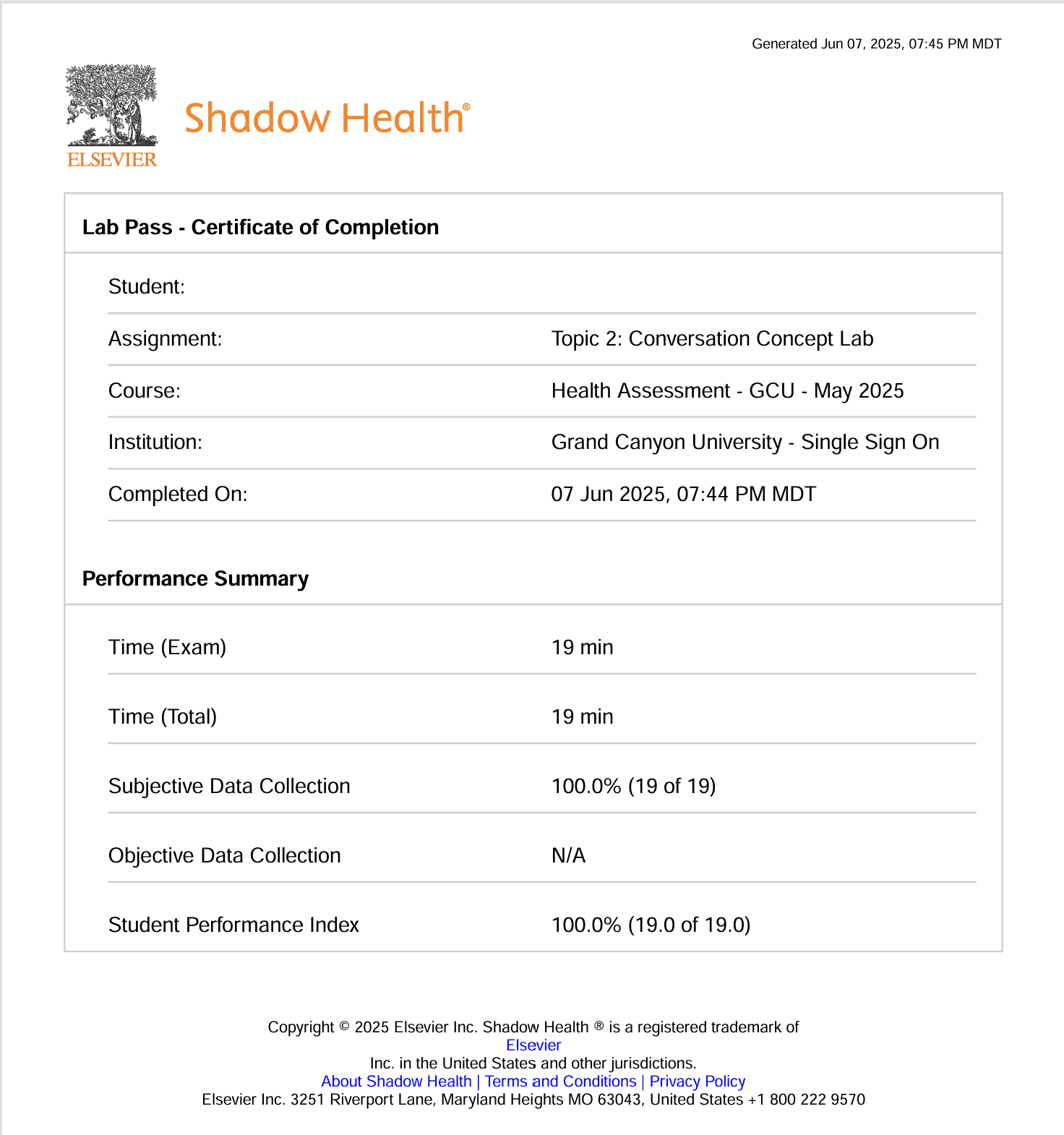
You can attempt this assignment as many times as you would like. After completing this concept lab, you will be awarded a Digital Clinical Experience (DCE) score. The DCE score will appear on your Lab Pass which you will submit to the classroom drop box. The DCE score will be used as your percentage grade for this assignment.
You are not required to submit this assignment to LopesWrite.
What Is the Shadow Health Conversation Concept Lab?
The Conversation Concept Lab introduces students to the functions of open and closed questions in effective nursing communication. Unlike Shadow Health’s full patient-case simulations, a concept lab isolates one specific communication skill rather than walking you through an entire documented patient interview.
Recognizing the difference between open and closed questions matters well beyond this one assignment. In real patient encounters, the wrong question type at the wrong moment can shut down information a patient would otherwise have shared, or waste time when you actually just need a quick fact confirmed. The lab is built to train that judgment, not just the vocabulary.
What the Assignment Actually Requires
| Requirement | What You Need to Do |
|---|---|
| Platform | Shadow Health |
| Activity | Conversation Concept Lab |
| Main topic | Open and closed questions in nursing communication |
| Estimated time | About 40 minutes (average, not a hard limit) |
| Attempts | Multiple attempts allowed |
| Performance measure | Digital Clinical Experience (DCE) score |
| Where score appears | Lab Pass |
| What gets submitted | Lab Pass |
| Submission location | Classroom drop box |
| LopesWrite | Not required |
The 40-minute figure is an average estimate, not a guaranteed completion time. Students unfamiliar with open and closed question distinctions often need longer on a first attempt, and that’s a normal part of learning the skill rather than a sign something’s wrong.
Working full-time while keeping up with weekly nursing assignments? Get practical academic support when your schedule is already packed. WhatsApp Gradevia: +1 564-544-6924
Shadow Health Conversation Concept Lab Example
How to Complete the Shadow Health Conversation Concept Lab
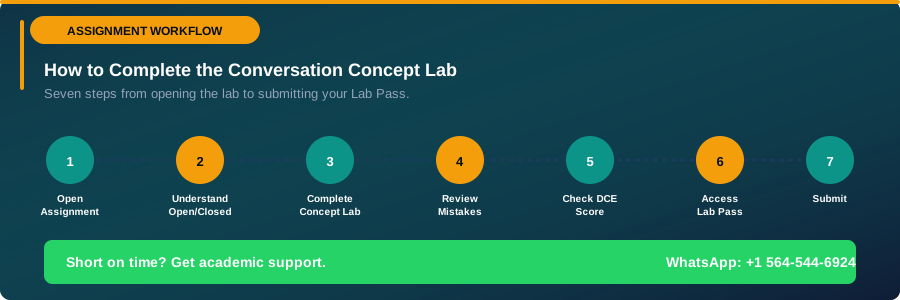
Step 1: Open the Correct Conversation Concept Lab
Confirm you’re opening the specific activity assigned in your course. Shadow Health hosts multiple concept labs and full patient simulations, and it’s easy to click into the wrong one, especially if your course covers several Shadow Health assignments in the same term. If your instructions say “Conversation Concept Lab,” don’t substitute study material built around a different activity, even if it also involves nursing communication.
Step 2: Understand the Objective Before Answering
The core learning objective is understanding how open and closed questions function in effective nursing communication, not memorizing a specific script. Going in with that framing changes how you approach each item: you’re being asked to reason about why a question is open or closed, not just guess a label.
Step 3: Learn the Difference Between Open and Closed Questions
Open Questions
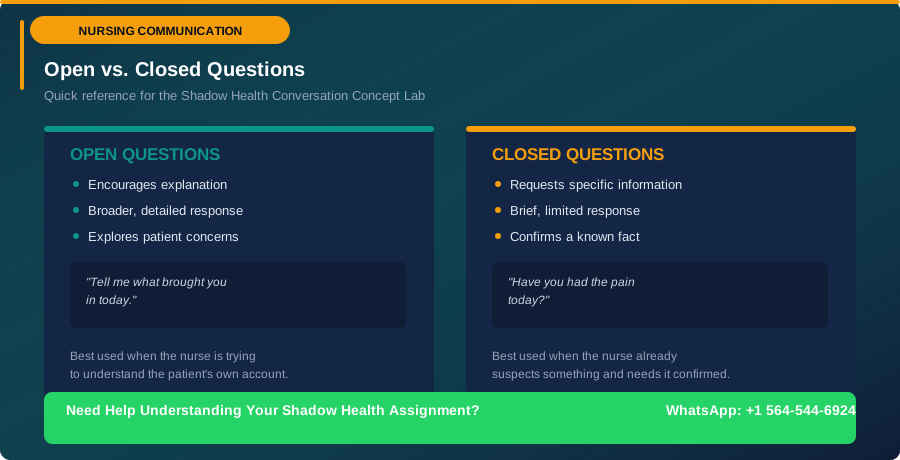
Open questions invite the patient to elaborate in their own words. They don’t suggest a specific answer and typically can’t be answered with a single word. They’re most useful when you’re exploring a concern, trying to understand a patient’s perspective, or gathering context you don’t yet have.
Example: “What concerns brought you in today?”
Closed Questions
Closed questions request a specific, limited piece of information, often answerable with yes, no, or a short factual response. They’re most useful when you already know roughly what you’re looking for and need to confirm or narrow it down.
Example: “Have you had any chest pain today?”
Neither type is inherently better. Effective nursing communication depends on choosing the type that fits the purpose of that moment in the conversation.
Open vs. Closed Questions in Shadow Health
| Feature | Open Question | Closed Question |
|---|---|---|
| Expected response | Broad, detailed | Brief, specific |
| Patient expression | Encourages elaboration | Limits the response |
| Best use | Exploring concerns | Confirming facts |
| Example | “Tell me what brought you in today.” | “Did the pain begin today?” |
How to Recognize the Correct Question Type
Run each item through the same short sequence of questions:
- Can the patient answer with a simple yes or no?
- Is the question asking for one specific fact?
- Does the question invite the patient to explain or describe?
- Could the patient reasonably give a detailed, multi-part response?
- Is the nurse trying to explore new information, or confirm something already suspected?
A “yes” to questions 1 or 2 usually points to closed. A “yes” to questions 3 or 4 usually points to open. Question 5 tells you why the nurse chose that type, which is often what the lab is actually testing.
Shadow Health Conversation Concept Lab Questions: How to Approach Them
The specific items inside your version of the lab are Shadow Health’s proprietary content, so this guide won’t reproduce them. What’s more useful, and more durable across different versions of the activity, is practicing the reasoning process on original examples.
Below are eight practice examples (not actual Shadow Health questions) with the reasoning worked out for each:
- “What concerns brought you to the clinic today?”, Open. It invites the patient to describe their situation in their own words rather than confirming a single fact. Designed to explore, not confirm.
- “Have you experienced dizziness today?”, Closed. Answerable with yes or no; designed to confirm a specific symptom.
- “Can you walk me through how your pain has changed over the past week?”, Open. Invites elaboration over time rather than a single data point.
- “Are you currently taking any prescription medications?”, Closed. Requests a specific, confirmable fact.
- “How would you describe the pain you’re feeling?”, Open. Invites the patient’s own words and interpretation rather than a yes/no.
- “Did the swelling start after your surgery?”, Closed. Asks the patient to confirm a specific timeline detail.
- “What has this symptom been like for you day to day?”, Open. Invites a broader, more personal account.
- “Is your pain worse in the morning or evening?”, Closed. Offers a limited set of specific response options rather than an open invitation to elaborate.
Notice that length isn’t the deciding factor. Question 8 is a full sentence but still closed, because it constrains the patient to choosing between two specific options rather than inviting them to describe anything in their own words.
Still unsure how to approach the Shadow Health communication questions? Get help understanding the assignment and organizing your coursework. Gradevia WhatsApp: +1 564-544-6924
How to Improve Your DCE Score
According to the assignment instructions, the DCE score is your percentage grade for this lab, so it’s worth approaching deliberately rather than rushing.
1. Don’t rush through the concept material. The temptation to click through quickly works against you here, since the categorization skill is exactly what’s being assessed.
2. Pay attention to why a question is categorized as open or closed, not just which label it gets. The reasoning is what transfers to the next item.
3. Look at the purpose of the question, not only its wording. A question’s grammatical form is a clue, not the whole answer.
4. Distinguish “exploring” from “confirming.” If the nurse doesn’t yet know the answer and wants the patient’s own account, that leans open. If the nurse suspects something specific and wants it confirmed, that leans closed.
5. Review mistakes between attempts. If the activity gives you feedback, read it before moving on rather than clicking past it.
6. Use another attempt as a learning opportunity, not just a retry. Since multiple attempts are allowed, treat an early attempt as a diagnostic of which distinctions still trip you up.
7. Confirm your final DCE score once you’ve completed the lab, and make sure it matches what’s reflected on your Lab Pass before you submit.
This won’t guarantee a particular score, but deliberate review of why each item is categorized the way it is tends to produce more consistent results than repeated guessing.
Shadow Health Conversation Concept Lab Answer Key: What Students Should Know
It’s a completely understandable thing to search for. When you’re not sure whether something counts as open or closed, wanting to check against something reliable makes sense, especially with a grade attached.
Here’s the catch: Shadow Health activities can vary between course versions, and question-type identification depends on genuinely understanding the purpose behind a question, not memorizing which label goes with which item number. A memorized answer to one version of the activity may not transfer to yours, and it does nothing to build the skill you’ll actually need in clinical practice, where there’s no answer key at the bedside.
The “Answer-Key Method” for Determining the Correct Response
Instead of searching for a matched answer list, work through this sequence on every item:
Read the question → identify the response it expects → determine whether it invites elaboration or requests a specific fact → classify it as open or closed → consider the communication purpose behind it.
That sequence works regardless of how a specific item is worded or presented, which a copied answer list can’t guarantee.
Shadow Health Conversation Concept Lab Answer Key PDF
Students search for PDFs hoping for a fast, verified reference. Be cautious about any site claiming to offer an “official” answer key PDF for this lab. Shadow Health content is platform-owned, so no third-party PDF is an official source, and even an accurate PDF for one version of the activity may not match yours. If you want something reliable to study from, the identification framework above is built to transfer across versions, since it’s based on the underlying communication concept rather than a specific set of item answers.
Shadow Health Conversation Concept Lab Quizlet
Quizlet-style study sets can be a reasonable way to review terminology and drill the open-vs-closed distinction, but don’t assume every flashcard set reflects your current assignment. A better way to use them:
- Review terminology (open, closed, exploring, confirming)
- Test yourself on original examples, not just memorized items
- Compare question types side by side
- Explain out loud why an answer is correct, not just what it is
- Return to your official course activity to verify anything you’re unsure about
Shadow Health Conversation Concept Lab: Rachel Adler
Some students searching around this lab also encounter “Rachel Adler” in Shadow Health-related searches, along with terms like Rachel Adler objective data, Rachel Adler SBAR, or a Rachel Adler transcript. It’s worth being precise here: the assignment instructions provided for this guide describe the Conversation Concept Lab in terms of open and closed questions, with no patient name specified. If your specific course’s version of this lab does involve a named patient, verify that detail against your own course instructions rather than assuming it matches what another student’s search results describe.
More importantly, don’t pull content from a different Shadow Health activity into your work on this one just because the keywords overlap. Rachel Adler-based objective data, SBAR reporting, or transcripts belong to whatever specific assignment they were built for, which may not be this Conversation Concept Lab at all.
Rachel Adler Shadow Health Objective Data and SBAR
Objective data and SBAR (Situation, Background, Assessment, Recommendation) are concepts that show up across multiple nursing and Shadow Health assignments. SBAR itself is a standardized communication framework nurses use to hand off patient information clearly and completely; it’s a useful concept to understand generally, but it isn’t part of what the Conversation Concept Lab’s own instructions describe.
If your course instructions don’t explicitly connect SBAR or a specific patient’s objective data to this lab, treat those as separate assignment territory, and don’t try to build your Conversation Concept Lab responses around fabricated Rachel Adler clinical findings from an unofficial source. This guide doesn’t invent or reproduce any such content, and neither should the study material you use.
Shadow Health Communication and Documentation Tutorials
Beyond this specific lab, general communication and documentation tutorials, whether from Shadow Health’s own resources or your nursing program, can support the same underlying skills this lab is building: recognizing question types, practicing therapeutic communication, gathering information efficiently, and documenting what you learn accurately. When you use outside tutorials, keep the connection tight to what you’re actually being graded on here: question-type identification and communication purpose, not a broader documentation curriculum.
Other Shadow Health Searches Students Commonly Mix Up
Shadow Health hosts many distinct learning activities, and it’s easy for search results to blend them together. A few worth explicitly separating from this Conversation Concept Lab:
- Shadow Health antihypertensive concept lab transcript answer key, a different concept lab, focused on antihypertensive medication concepts, not question types.
- Shadow Health advanced pharmacology conversation concept lab, some programs use a conversation-style concept lab within an advanced pharmacology course; verify whether your assignment is this general communication lab or a pharmacology-specific variant before using outside study material.
- Shadow Health conversation concept lab (part 1 of 1), some course platforms label single-part assignments this way; it typically just confirms there’s no second part to complete, not a different activity.
- Shadow Health assignment conversation concept lab, usually just a generic phrasing of the same assignment covered in this guide.
Before using any outside study material, verify: course → assignment → activity name → any named patient → submission requirement. That sequence prevents you from accidentally studying answers built for the wrong Shadow Health assignment.
What Is the Lab Pass?
After you complete the Conversation Concept Lab, you receive a DCE score. That score appears on your Lab Pass, and the Lab Pass is what you submit to your classroom drop box. The DCE score itself becomes your percentage grade for the assignment.
Do You Need to Submit Anything to LopesWrite?
No. The assignment instructions state that LopesWrite submission is not required for this lab.
Can You Attempt the Shadow Health Conversation Concept Lab More Than Once?
Yes, the assignment explicitly allows multiple attempts. Use that intelligently rather than just repeating the same approach:
Attempt → identify your weak area → review that specific concept → retry → compare performance.
An extra attempt doesn’t automatically produce a better score. It only helps if you’ve actually addressed whatever caused the lower score the first time.
How Long Does the Conversation Concept Lab Take?
The stated estimate is about 40 minutes on average. Some students finish sooner; others reasonably need more time, especially if open vs. closed question distinctions are still new. Rushing to hit the 40-minute mark can work against you if it means clicking through without actually reasoning through each item, since that’s the skill the lab is meant to build.
A 40-Minute Study Plan for Busy Nursing Students
This is a suggested workflow, not an official Shadow Health timing requirement:
- Minutes 0–5: Read the instructions and identify the objective.
- Minutes 5–15: Review open vs. closed questions using the framework above.
- Minutes 15–30: Work through the concept lab carefully, applying the five-question identification sequence to each item.
- Minutes 30–35: Review any errors or uncertain items.
- Minutes 35–40: Finish the activity and verify your DCE score and Lab Pass information.
10 Mistakes That Can Hurt Your Performance
- Confusing open questions with closed questions. Why it happens: the terminology feels abstract until you practice it. Better approach: run every item through the five-question identification sequence instead of guessing.
- Assuming longer questions are automatically open-ended. Why it happens: length feels like a proxy for complexity. Better approach: judge by whether the patient is invited to elaborate, not by sentence length.
- Looking only for yes/no wording. Why it happens: it’s the most obvious surface clue. Better approach: also consider whether the question limits the patient to a narrow set of options, even without literal yes/no phrasing.
- Ignoring the purpose of the question. Why it happens: it’s easier to focus on wording than intent. Better approach: ask whether the nurse is exploring or confirming.
- Rushing through the concept material. Why it happens: the 40-minute estimate creates pressure to move fast. Better approach: treat the estimate as a guide, not a deadline.
- Treating an unofficial Quizlet as an authoritative answer source. Why it happens: it’s readily available and feels verified by other students. Better approach: use it for terminology review only, and verify anything graded against your actual course activity.
- Using answers from another Shadow Health simulation. Why it happens: overlapping keywords make search results blend together. Better approach: confirm course, assignment, and activity name before applying outside material.
- Confusing Rachel Adler content with the assigned concept lab. Why it happens: search results connect the two even when they’re separate assignments. Better approach: verify against your own course instructions before assuming a named patient applies here.
- Forgetting to check the DCE score. Why it happens: it’s easy to close the activity once it says “complete.” Better approach: confirm the score before moving on, since it’s your actual grade.
- Forgetting to submit the Lab Pass. Why it happens: completing the activity feels like the finish line. Better approach: treat the Lab Pass submission to the classroom drop box as a separate, required step.
Working 40+ hours a week and still trying to keep up with nursing school? Don’t let another weekly assignment become a last-minute problem. Get academic support from Gradevia. WhatsApp: +1 564-544-6924
Final Shadow Health Conversation Concept Lab Checklist
- I opened the correct Conversation Concept Lab
- I understood the purpose of open questions
- I understood the purpose of closed questions
- I practiced distinguishing the two
- I completed the assigned concept lab
- I reviewed mistakes where necessary
- I used additional attempts if needed
- I checked my DCE score
- I confirmed the score appears on my Lab Pass
- I submitted the Lab Pass to the classroom drop box
- I did not submit the assignment to LopesWrite because it is not required

FAQ
1. What is the Shadow Health Conversation Concept Lab? A Shadow Health activity that introduces students to the functions of open and closed questions in effective nursing communication.
2. What does the Conversation Concept Lab teach? How to recognize and appropriately use open questions (which invite elaboration) and closed questions (which request specific facts) during patient communication.
3. How long does the Shadow Health Conversation Concept Lab take? About 40 minutes on average, though some students reasonably need more time, especially on a first attempt.
4. Can I retake the Conversation Concept Lab? Yes, the assignment explicitly allows multiple attempts.
5. What is the DCE score? The Digital Clinical Experience score you receive after completing the lab. It’s used as your percentage grade for the assignment.
6. Where does the DCE score appear? On your Lab Pass, which you submit to the classroom drop box.
7. What do I submit after completing the lab? Your Lab Pass, which reflects your DCE score. LopesWrite submission is not required.
8. Do I need LopesWrite for this assignment? No. The assignment instructions state it isn’t required.
9. What is the difference between open and closed questions? Open questions invite the patient to elaborate in their own words; closed questions request a specific, limited piece of information, often answerable with yes, no, or a short fact.
10. Is there a Shadow Health Conversation Concept Lab answer key? No verified official answer key is published for students. Unofficial versions circulate online but may not match your specific activity, so using the identification framework in this guide is more reliable.
11. Is the Shadow Health Conversation Concept Lab answer key PDF official? No. Treat any unofficial PDF with caution; it isn’t an official Shadow Health or school resource.
12. Can Quizlet help with the Conversation Concept Lab? It can help you review terminology and drill the open-vs-closed distinction, but shouldn’t be treated as a verified answer source for your graded attempt.
13. Is Rachel Adler part of the Conversation Concept Lab? The assignment instructions for this lab describe open and closed questions without specifying a named patient. If your version references a specific patient, verify that against your own course instructions rather than assuming it matches unrelated search results.
14. What are Rachel Adler objective data and SBAR searches about? These generally relate to other Shadow Health assignments or general nursing communication concepts, not necessarily this Conversation Concept Lab. Verify against your course instructions before mixing content from different assignments.
15. What should I do if I get a low DCE score? Review which items you missed, revisit the open-vs-closed distinction for those specific cases, and use another attempt. Since attempts are unlimited, treat the first as a diagnostic rather than a final result.
16. Can I complete the lab in less than 40 minutes? Possibly, especially if you’re already comfortable with open and closed question concepts, but don’t treat 40 minutes as a ceiling to rush toward if you’re still learning the distinction.
Related Content
Shadow Health Respiratory Concept Lab: How to Complete It
NRS-465: Applied Evidence-Based Project and Practicum
NRS-465 Capstone Change Project: PICOT Question Development, Complete Guide + Examples
NRS-465 Literature Evaluation Table: Complete Guide + Fully Worked Example (Topic 4)
Conclusion
The Shadow Health Conversation Concept Lab comes down to one core skill: recognizing when a question invites a patient to elaborate and when it’s requesting a specific fact, and understanding why that choice matters in the moment. Work through the five-question identification sequence on every item, verify that any outside study material actually matches this specific assignment (not Rachel Adler content, antihypertensive concepts, or advanced pharmacology material built for a different lab), and submit the Lab Pass, not LopesWrite, when you’re done.
Skip the search for an unverifiable answer key and spend that same time on the reasoning framework in this guide instead; it will get you a more reliable DCE score on this attempt and actually transfer to your next one.