
Blog
Shadow Health HEENT: Tina Jones Interview Guide, Documentation, and DCE Score Tips

Updated on: Sep 26, 2026
In GCU’s Shadow Health HEENT assignment, you interview and examine Tina Jones, a Digital Standardized Patient, about her head, eyes, ears, nose, and throat, document your findings, and complete post-exam activities. Students spend about an hour and fifteen minutes on average. You can attempt it as many times as you like, and the Digital Clinical Experience (DCE) score on your Lab Pass becomes your percentage grade. Submit the Lab Pass to the classroom drop box; LopesWrite is not required. The fastest way to a strong DCE score is a structured interview: a full history of present illness, a region-by-region review, and short empathetic or teaching responses whenever Tina shares a worry.
If you are a working nurse in GCU’s RN-to-BSN program, you are probably opening Shadow Health after a shift, with a Lab Pass due soon. This guide gives you a plan you can follow in one sitting: how the assignment works, a Shadow Health HEENT Tina Jones interview guide with the questions to ask, what counts as subjective and objective data, how to earn education and empathy credit, and how to document without copying anyone else’s findings.
Shadow Health HEENT Assignment
In this assignment you will assess the Head, Eyes, Ears, Nose and Throat (HEENT) system of Tina Jones, a Digital Standardized Patient. Interview and examine the patient, document your findings, and complete post-exam activities. Within the Shadow Health platform, complete HEENT. Students spend, on average, an hour and fifteen minutes on this assignment. Some students may need additional time.
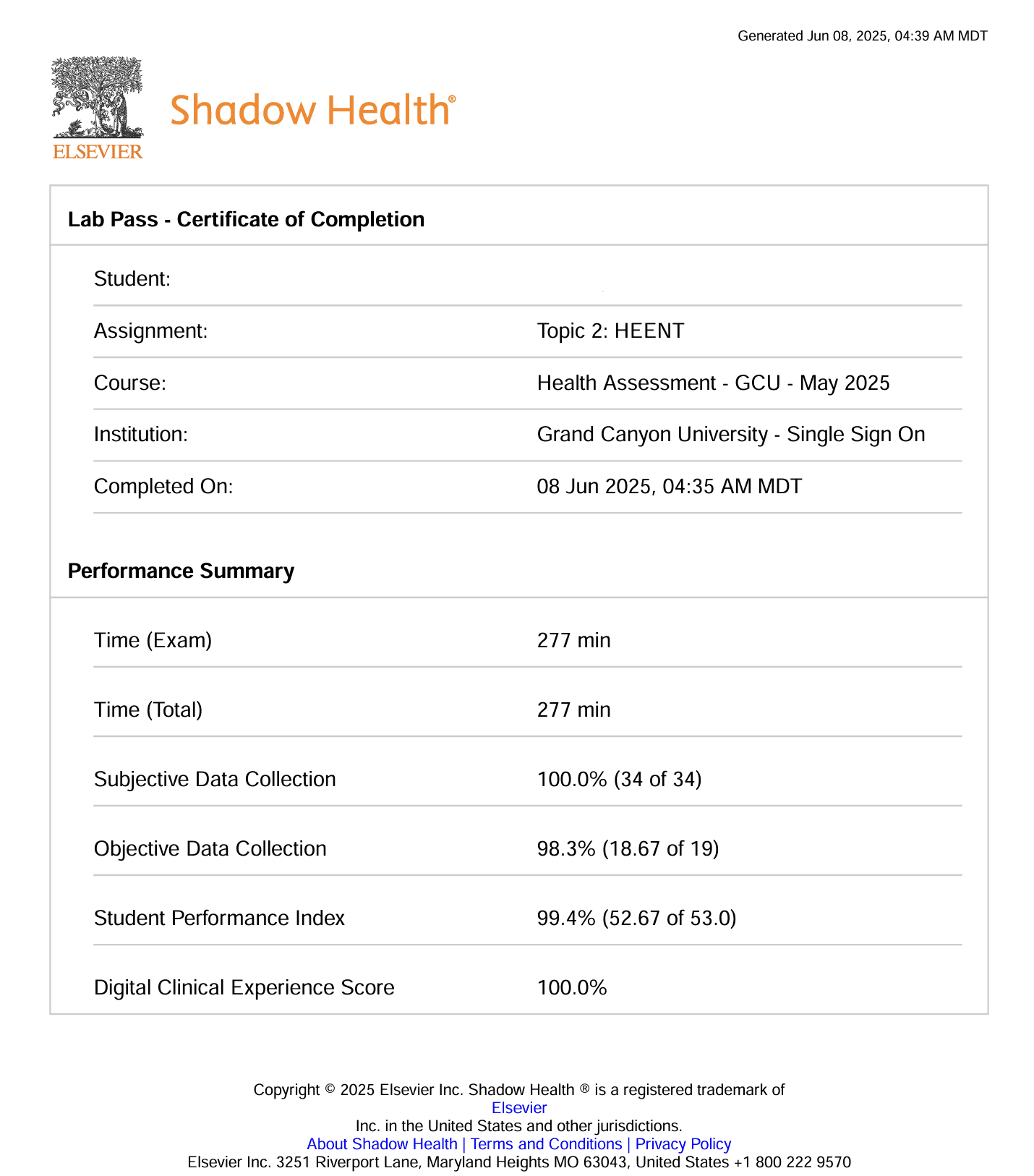
You can attempt this assignment as many times as you would like. After completing the HEENT, you will be awarded a Digital Clinical Experience (DCE) score. The DCE score will appear on your Lab Pass which you will submit to the classroom drop box. The DCE score will be used as your percentage grade for this assignment.
You are not required to submit this assignment to LopesWrite.
Need Help with Your Shadow Health HEENT Assignment? Reach Out to Us on WhatsApp: +1 564-544-6924
How the GCU Shadow Health HEENT assignment works
| Item | What GCU’s instructions say |
|---|---|
| Patient | Tina Jones, a Digital Standardized Patient |
| System | Head, eyes, ears, nose, and throat (HEENT) |
| Tasks | Interview and examine the patient, document your findings, complete post-exam activities |
| Time | About 1 hour 15 minutes on average; some students need more |
| Attempts | As many as you would like |
| Grade | Your DCE score is used as your percentage grade |
| Submission | Lab Pass (showing your DCE score) to the classroom drop box |
| LopesWrite | Not required |
Why this matters for your grade: because the DCE score is your percentage grade and attempts are unlimited, the smartest approach is a thorough first attempt followed by targeted fixes based on the feedback, not rushing through several careless attempts.
Tina Jones is the same Digital Standardized Patient you may have met in the Health History assignment, so her background (medical history, medications, allergies, and social history) can come up again. Treat HEENT as a focused exam: build on what you know, but ask again, because Shadow Health scores what you ask in this assignment. For the full history workflow, see our Shadow Health Health History: Tina Jones guide.
Shadow Health HEENT Tina Jones interview guide
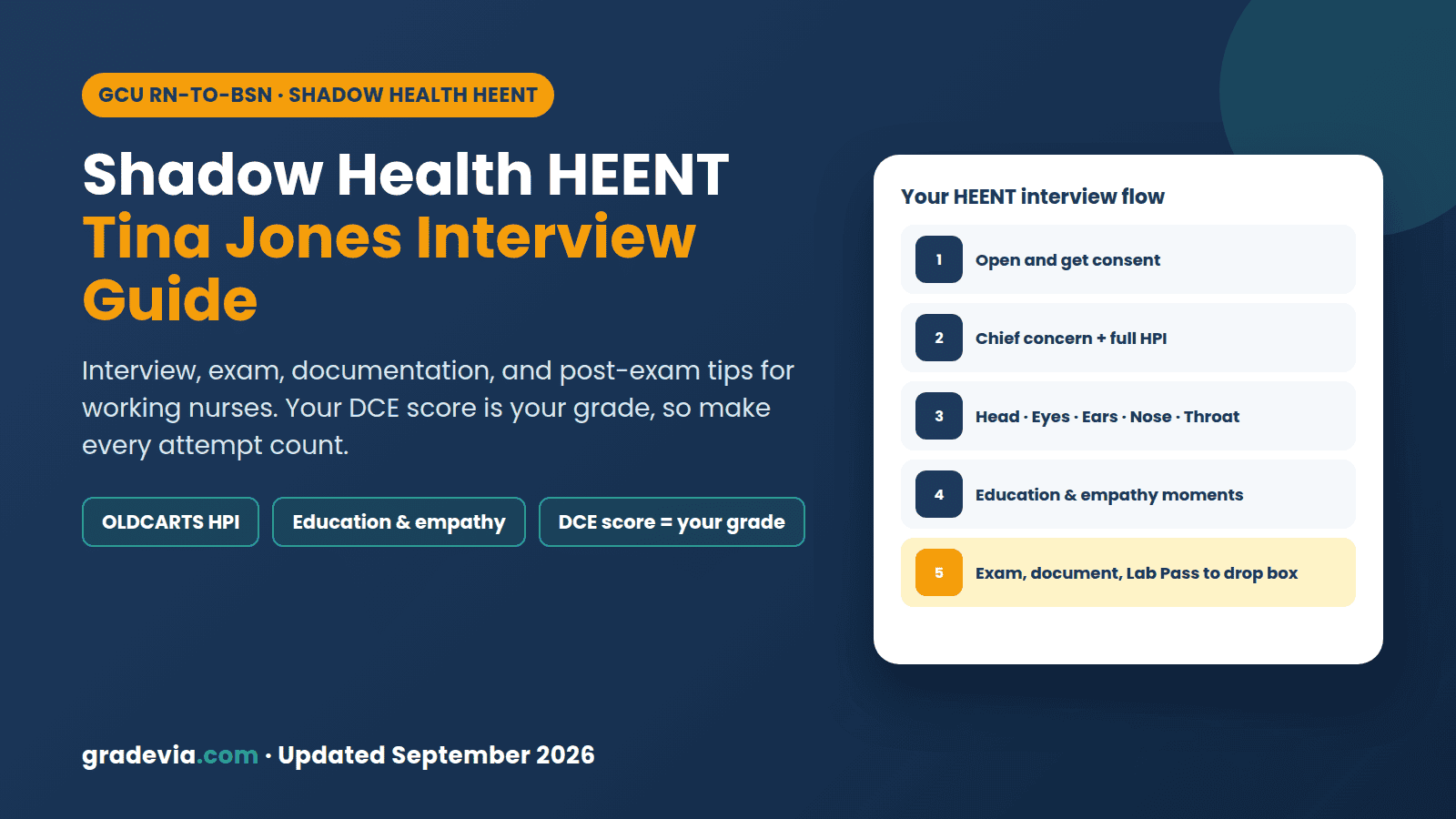
The interview earns most of your subjective data points. Use this five-step flow so nothing is missed.
- Open professionally. Introduce yourself, confirm the patient’s name, explain what you will do, and ask permission.
- Explore the chief concern. Ask an open question (“What brings you in today?”) and let the patient finish before you narrow down.
- Complete the history of present illness for every active symptom (see the OLDCARTS questions below).
- Review each HEENT region, including symptoms the patient did not mention.
- Close well. Summarize what you heard, ask “Is there anything else you’d like me to know?”, and address any remaining concerns.
Ask one question at a time. Shadow Health’s conversation engine matches your wording to specific topics. Double questions (“Do you have ear pain or drainage?”) often get credit for only one item. Short, specific questions score more reliably.
Shadow Health Tina Jones HEENT history of present illness
For each active symptom, work through OLDCARTS. These are adaptable question stems, not a script of the patient’s answers.
| Element | Example questions |
|---|---|
| Onset | “When did this start?” “Did it come on suddenly or gradually?” |
| Location | “Where exactly do you feel it?” “Is it on one side or both?” |
| Duration | “How long does it last?” “Is it constant or does it come and go?” |
| Character | “How would you describe it: sharp, dull, throbbing, pressure?” |
| Aggravating factors | “What makes it worse?” |
| Relieving factors | “What makes it better?” “What have you tried, and did it help?” |
| Timing | “Is it worse at a certain time of day?” |
| Severity | “On a scale of 0 to 10, how bad is it right now? At its worst?” |
Add two follow-ups that are easy to forget: associated symptoms (“Have you noticed anything else along with this?”) and impact on daily life (“How is this affecting work, sleep, or daily activities?”).
Shadow Health Tina Jones HEENT interview questions by region
Ask about each region even if the patient has no complaint there. A pertinent negative (“denies vision changes”) is still data.
| Region | Questions to cover |
|---|---|
| Head | Headaches (frequency, pattern), head injury, dizziness or lightheadedness |
| Eyes | Vision changes, blurred or double vision, eye pain, redness, discharge, itching, glasses or contacts, date of last eye exam |
| Ears | Hearing changes, ear pain, drainage, ringing (tinnitus), fullness, balance problems, ear-cleaning habits, noise exposure |
| Nose and sinuses | Congestion, runny nose, postnasal drip, nosebleeds, sinus pain or pressure, sense of smell, seasonal allergies |
| Mouth and throat | Sore throat, difficulty or pain swallowing, mouth sores, bleeding gums, dental problems, date of last dental visit, voice changes |
| Neck | Swollen glands, neck pain or stiffness, lumps |
| Related history | Current medications (including over-the-counter and eye or nasal products), allergies and reactions, relevant chronic conditions, smoking or vaping, family history of eye or hearing problems |
For a deeper list of subjective question wording by region, see our Shadow Health HEENT subjective questions guide.
Tina Jones HEENT Shadow Health subjective data vs. objective data
Mixing these up is one of the most common documentation errors.
Tina Jones HEENT Shadow Health subjective data
Subjective data is what the patient tells you: symptoms, history, medications, allergies, habits, and concerns. It comes from the interview and belongs in the subjective section of your documentation, written in the patient’s terms (“reports,” “denies,” “states”).
Shadow Health HEENT Tina Jones objective data
Objective data is what you observe, measure, or examine. In the HEENT exam, work head to throat and compare left and right sides:
| Area | Techniques and what to note |
|---|---|
| Head and face | Inspect shape, symmetry, scalp, and skin; palpate for tenderness or masses |
| Eyes | Visual acuity (Snellen), visual fields by confrontation, extraocular movements, pupils (size, shape, reaction to light and accommodation), conjunctiva and sclera, fundoscopic exam |
| Ears | External ear inspection and palpation, otoscopic exam of canal and tympanic membrane, hearing screening (whisper test, Weber and Rinne if available) |
| Nose and sinuses | Inspect nasal mucosa, septum, and turbinates; palpate frontal and maxillary sinuses |
| Mouth and throat | Lips, gums, teeth, tongue, buccal mucosa, palate, uvula, tonsils (including size), posterior pharynx |
| Neck | Palpate lymph nodes (preauricular, postauricular, tonsillar, submandibular, cervical chains) and the thyroid |
Rule of thumb: if you could only know it by asking, it is subjective. If you could know it by looking, listening, feeling, or measuring, it is objective.
Shadow Health Tina Jones HEENT education and empathy
Education and empathy opportunities appear when the patient shares a worry, a feeling, a frustration, or a knowledge gap. Responding well is scored, and it is the same therapeutic communication you use at the bedside.
How to recognize an opportunity: the patient mentions being worried, embarrassed, stressed about cost or time, frustrated with a symptom, or unsure why something matters.
Empathy responses name the feeling and validate it:
- “It sounds like this has been really frustrating for you.”
- “I can understand why you’d be worried about that.”
- “That must be hard to manage on top of work and everything else.”
Education responses give brief, accurate teaching tied to what the patient said:
- Explain why a follow-up matters (“Regular eye exams can catch changes early, especially with a chronic condition that affects blood vessels.”)
- Correct a risky habit gently (“Cotton swabs can push wax deeper and irritate the ear canal. A few drops of warm water in the shower is usually safer.”)
- Connect a symptom to an action (“If your vision changes suddenly, that’s a reason to be seen right away.”)
Keep teaching statements short and specific. One accurate sentence at the right moment is worth more than a paragraph of generic advice.
Tina Jones HEENT Shadow Health documentation
Document only what you obtained in your own interview and exam. Your findings must match your attempt, and they will not match a file someone else posted.
How to write strong HEENT documentation
- Separate subjective and objective data. Subjective: “reports,” “denies,” “states.” Objective: what you observed and measured.
- Be specific. “PERRLA” or “Tympanic membranes pearly gray with visible landmarks bilaterally” beats “eyes normal” or “ears fine.”
- Include pertinent negatives for each region.
- Use left and right wherever a finding could differ between sides.
- Keep it concise. Clinical phrases, not full paragraphs.
Documentation example (fictitious patient, not Tina Jones)
This example uses a fictitious patient created by Gradevia to show format and level of detail. It does not contain Tina Jones’s responses or findings.
Subjective: 34-year-old female reports 3 days of left ear fullness and muffled hearing after a cold. Rates discomfort 3/10, dull and constant. Tried a decongestant with mild relief. Denies ear drainage, dizziness, tinnitus, fever, or vision changes. Reports mild nasal congestion; denies sore throat or difficulty swallowing. No known drug allergies. Takes no daily medications.
Objective: Head normocephalic, atraumatic; no sinus tenderness. Visual acuity 20/20 OU; PERRLA; EOMs intact; conjunctivae clear. Right TM pearly gray with light reflex and landmarks visible. Left TM dull and slightly retracted with an air-fluid level; no erythema or bulging. Whisper test: hears whispered words on the right, decreased on the left. Nasal mucosa pink and mildly edematous with clear discharge; septum midline. Oral mucosa moist and pink; tonsils 1+; pharynx without erythema or exudate. No cervical or preauricular lymphadenopathy.
Notice how every objective line is something the nurse saw, measured, or tested, and every subjective line is attributed to the patient.
Get support raising your Shadow Health HEENT DCE score before the due date

Looking for a Tina Jones HEENT Shadow Health transcript?
Searches for a “Tina Jones HEENT Shadow Health transcript” or an answer key usually lead to files copied from someone else’s attempt. We do not publish one, for three practical reasons:
- They go out of date. Shadow Health updates its cases, and older files may not match the current Tina Jones HEENT assignment.
- They don’t match your attempt. Your score depends on what you ask, examine, and document. Copied findings create mismatches that instructors notice.
- Copying can violate your school’s academic integrity policy, and a flagged assignment costs far more time than the simulation itself.
What works better: keep your own interview log as you go. Jot down each question you asked and the key point of each answer, grouped by region. After the attempt, your log becomes your documentation draft, and it shows you exactly which regions you covered and which you skipped.
How to raise your Shadow Health HEENT DCE score (your percentage grade)
- Complete a full HPI for every active symptom, not just the chief concern.
- Cover every region, including pertinent negatives.
- Ask one question at a time in plain language.
- Respond to every education and empathy moment with a short, specific statement.
- Perform every exam technique available for each region, and compare sides.
- Document only your own findings, separated into subjective and objective.
- Read the feedback line by line before any new attempt. It lists the topics you missed, which becomes your checklist.
- Use unlimited attempts strategically. Fix the specific gaps from your feedback on each new attempt, and confirm with your instructor which attempt’s Lab Pass to submit.
A 75-minute plan for working nurses
| Time | Task |
|---|---|
| 0 to 5 min | Open the HEENT assignment for Tina Jones and set up your interview log |
| 5 to 30 min | Interview: open, chief concern, HPI, region-by-region review, close |
| 30 to 50 min | Physical exam, head to throat, comparing sides |
| 50 to 65 min | Documentation and post-exam activities |
| 65 to 75 min | Review your DCE score and feedback; download the Lab Pass |
GCU notes that some students need more than 75 minutes, so block 90 minutes if you can.
If you are post-shift and tired, remember that attempts are unlimited: a careful attempt when you are rested usually beats a rushed one tonight.
Final checklist before you submit
- HEENT assignment for Tina Jones opened in Shadow Health
- HPI completed for every active symptom (OLDCARTS plus associated symptoms and impact)
- Every HEENT region reviewed, including pertinent negatives
- Medications, allergies, and relevant history asked in this assignment
- Education and empathy opportunities answered
- Every exam technique completed and sides compared
- Documentation separated into subjective and objective, based only on your attempt
- Post-exam activities completed
- DCE score reviewed (it becomes your percentage grade)
- Lab Pass uploaded to the classroom drop box (no LopesWrite submission needed)
Urgent Shadow Health HEENT study guide support for working nurses on WhatsApp
Frequently asked questions
Who is the patient in the GCU Shadow Health HEENT assignment? GCU’s Shadow Health HEENT assignment uses Tina Jones, a Digital Standardized Patient. You interview and examine her head, eyes, ears, nose, and throat, document your findings, and complete post-exam activities.
How long does Shadow Health HEENT take? GCU says students spend about an hour and fifteen minutes on average, and some need more time. Plan a 75 to 90 minute block for the interview, exam, documentation, and post-exam activities.
What is the difference between subjective and objective data in Shadow Health HEENT? Subjective data is what the patient tells you in the interview, such as symptoms, history, and concerns. Objective data is what you observe, measure, or examine, such as visual acuity, pupil response, otoscopic findings, and oral cavity inspection.
What are education and empathy opportunities in Shadow Health? They are moments in the interview when the patient shares a worry, feeling, or knowledge gap. Responding with an empathetic statement or brief, accurate teaching counts toward your score and reflects real-world therapeutic communication.
Is there a Tina Jones HEENT Shadow Health transcript I can follow? Unofficial transcripts circulate online, but they are often outdated and do not match your attempt, and copying them can violate your school’s academic integrity policy. Use an interview framework, keep your own interview log, and document only what you obtained.
How do I improve my Shadow Health HEENT DCE score? Cover every HEENT region, complete a full HPI for the chief concern, respond to education and empathy opportunities, perform every exam technique, and document only your own findings. Review the feedback carefully before any additional attempt.
What do I submit for the GCU Shadow Health HEENT assignment? Submit your Lab Pass, which shows your Digital Clinical Experience (DCE) score, to the classroom drop box. The DCE score is used as your percentage grade. You do not submit this assignment to LopesWrite.
Can I retake the GCU Shadow Health HEENT assignment? Yes. GCU’s instructions allow as many attempts as you would like. Use the feedback from each attempt to fill gaps, and confirm with your instructor which attempt’s Lab Pass to submit if you complete more than one.
More Shadow Health and GCU nursing guides
- Shadow Health Health History: Tina Jones
- Shadow Health HEENT subjective questions
- Shadow Health Conversation Concept Lab
- Shadow Health Respiratory Concept Lab
- NRS-465 assignment help
- PICOT question development
References
Ball, J. W., Dains, J. E., Flynn, J. A., Solomon, B. S., & Stewart, R. W. (2023). Seidel’s guide to physical examination: An interprofessional approach (10th ed.). Elsevier.
Elsevier. (n.d.). Shadow Health: Health assessment. https://www.elsevier.com/products/shadow-health/health-assessment
Jarvis, C., & Eckhardt, A. (2024). Physical examination and health assessment (9th ed.). Elsevier.
Gradevia provides coaching and study support. This guide does not reproduce Shadow Health case content, and the documentation example uses a fictitious patient. Follow your school’s academic integrity policy.