
Blog
NRS-465 Capstone Change Project: PICOT Question Development, Complete Guide + Examples


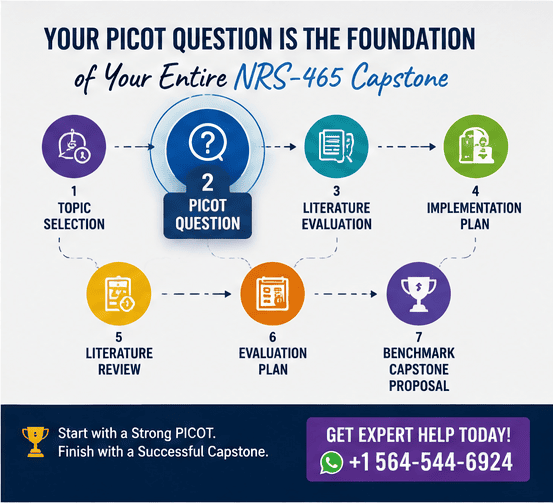
The Capstone Change Project: PICOT Question Development assignment is due in Topic 3 of NRS-465 and requires you to fill out GCU’s official template with a fully constructed PICOT question, plus a supporting problem statement and literature-grounded discussion. It is submitted to LopesWrite, requires a minimum of two peer-reviewed sources from the past five years, and is the single most important structural decision you make in the entire capstone sequence. Every downstream assignment, the literature evaluation table, implementation plan, capstone change project resources, evaluation plan, and the benchmark capstone project change proposal, is anchored to the PICOT question you write here.
This guide explains what each PICOT element requires in a nursing capstone context, shows you how to construct a complete and rubric-aligned PICOT question from scratch, and includes four fully worked capstone PICOT question examples across different clinical topics so you can see what a passing submission looks like before writing your own.
This assignment is part of the NRS-465 capstone sequence at GCU. For a complete guide to every NRS-465 assignment from the ISP through the final presentation, see the NRS-465 Applied Evidence-Based Project and Practicum guide.
NRS-465 Capstone Change Project: PICOT Question Development Assignment
The purpose of this assignment is to develop a PICOT question. A PICOT (Patient, Intervention, Comparison, Outcome and Time) question starts with a designated patient population in a particular clinical area and identifies clinical problems or issues that arise from clinical care. The intervention used to address the problem must be a nursing practice intervention. Include a comparison of the proposed or new nursing intervention to another nursing intervention or standard practice, and specify the timeframe needed to implement the change process.
Using the “Capstone Change Project; PICOT Question Development” template, formulate a PICOT question applying the PICOT format that addresses the approved clinical nursing problem from Topic 2 assignment: Capstone Change Project – Topic Selection and Approval.
The PICOT question will provide a framework for your capstone project change proposal.
Include at least two peer-reviewed research articles published within the last 5 years and relevant to nursing practice to support your problem statement and discussion.
While APA style is not required for the body of this assignment, solid academic writing is expected, and documentation of sources should be presented using APA formatting guidelines, which can be found in the APA Style Guide, located in the Student Success Center.
This assignment uses a rubric. Please review the rubric prior to beginning the assignment to become familiar with the expectations for successful completion.
You are required to submit this assignment to LopesWrite. A link to the LopesWrite technical support articles is located in Class Resources if you need assistance.
What the Capstone Change Project: PICOT Question Development Assignment Requires
| Component | Detail |
|---|---|
| Format | GCU’s official “Capstone Change Project: PICOT Question Development” template |
| Sources | Minimum 2 peer-reviewed, published within past 5 years |
| Submission | LopesWrite required |
| APA format | Not required for body, required for references and in-text citations |
| Built from | Topic 2 Benchmark Capstone Change Project: Topic Selection and Approval |
| Used in | Topic 4 Literature Evaluation Table, Topic 5 Implementation Plan, Topic 6 Literature Review, Topic 7 Capstone Change Project Evaluation Plan, Topic 8 Capstone Project Change Proposal |
The template asks you to complete five things:
- Your clinical nursing problem statement (2 to 3 sentences)
- Each PICOT element defined and applied to your clinical problem
- Your complete PICOT question written out in full sentence format
- A brief discussion of the evidence supporting the problem and intervention
- APA-formatted references
What Is a PICOT Question in Nursing?
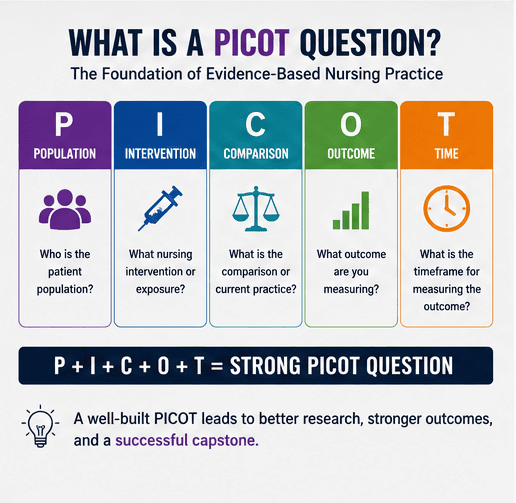
A PICOT question in nursing is a structured clinical research question that frames an evidence-based practice problem in a format that drives literature searches and anchors all downstream project decisions. PICOT stands for:
- P, Population: the specific patient group or nursing population affected by the problem
- I, Intervention: the evidence-based nursing practice change being proposed
- C, Comparison: the current standard practice or alternative intervention being compared against
- O, Outcome: the measurable result the intervention is expected to produce
- T, Time: the period over which the intervention will be implemented and outcomes measured
The critical rule for NRS-465 capstone PICOT questions: the intervention must be a nursing practice intervention, something nurses can implement, lead, or directly influence within their scope of practice. A physician-ordered medication change is not a nursing intervention. A nurse-led patient education protocol, a nursing bundle, a structured rounding protocol, or a nurse-driven assessment tool are all appropriate interventions.
How to Write Each PICOT Element for Your Capstone
P – Population
Name your population with clinical specificity. Generic populations fail the rubric. Include age range, diagnosis or condition, care setting, and any relevant clinical characteristics.
| Weak (fails rubric) | Strong (passes rubric) |
|---|---|
| “Hospitalized patients” | “Adult patients aged 65 and older admitted to medical-surgical units with documented fall risk scores of 45 or higher on the Morse Fall Scale” |
| “Patients with diabetes” | “Adult patients aged 30 to 65 with Type 2 diabetes attending a community outpatient clinic in an underserved urban area” |
| “ICU nurses” | “Registered nurses working 12-hour shifts in a 20-bed medical intensive care unit at a tertiary care hospital” |
I – Intervention
Name the specific nursing practice intervention with enough detail that a colleague could replicate it. Do not say “improved care” or “better education.” Name the protocol, tool, bundle, or structured process.
Strong intervention examples:
- A six-week nurse-led mindfulness-based stress reduction (MBSR) program delivered during shift-change overlap periods
- A structured CLABSI prevention bundle including nurse-completed insertion checklists, daily necessity assessments, and standardized dressing change protocols
- A bilingual nurse-delivered discharge education program using teach-back methodology for Type 2 diabetes patients
C – Comparison
State the current standard practice, what nurses are doing now without the proposed intervention. This is your control condition.
Standard comparison examples:
- Standard fall precaution protocols without a structured bundle
- Standard care without a formal nurse-led education program
- Current unit practice without structured hourly rounding documentation
Avoid comparing to “no intervention” unless truly applicable, GCU rubrics reward specificity in the comparison element.
O – Outcome
State the primary measurable result you expect the intervention to produce. The outcome must be quantifiable, not “improved patient safety” but “reduction in inpatient fall rate per 1,000 patient-days.”
Strong outcome examples:
- Reduction in CLABSI rate from the current baseline of 2.1 to below 1.0 per 1,000 catheter days
- Decrease in nurse burnout scores on the Maslach Burnout Inventory (MBI) emotional exhaustion subscale by 15% or more
- Improvement in 30-day medication adherence rates from baseline in patients with Type 2 diabetes
The outcome you write here becomes the primary target in your capstone change project evaluation plan in Topic 7. Write it measurably from the start.
T – Time
Specify the implementation and measurement period. In most NRS-465 capstone projects, this is 4 to 6 months, enough time to implement, monitor, and measure change while remaining feasible within a practicum period.
Strong time examples:
- Within six months of protocol implementation
- Over a three-month pilot period
- Within 90 days of bundle launch
The Full PICOT Question Sentence Format
Once you have defined all five elements, write your complete PICOT question as a single sentence in this format:
“In [P], does [I], compared to [C], result in [O] within [T]?”
This is the standard format GCU uses across all capstone courses. Keep the question to one sentence. Do not add sub-questions. Do not write multiple PICOT questions, the template asks for one.
Four Capstone PICOT Question Examples, Fully Written
The following capstone change project: PICOT question development examples cover the most commonly chosen NRS-465 capstone topics. Study the element breakdown and the full sentence for each, these are examples of PICO questions in nursing that follow the exact format GCU expects.
Capstone PICOT Example 1, Fall Prevention (Leadership Track)
| Element | Application |
|---|---|
| P | Adult patients aged 65 and older admitted to a 36-bed medical-surgical unit at an acute care community hospital |
| I | Implementation of a structured nurse-led fall prevention bundle including hourly rounding documentation, Morse Fall Scale reassessment at each condition change, and a post-fall debrief huddle protocol |
| C | Standard fall precautions including Morse Fall Scale at admission only, yellow non-slip socks, and bed alarms without structured rounding documentation |
| O | Reduction in inpatient fall rate per 1,000 patient-days from the current baseline of 4.8 to below the national benchmark of 3.3 |
| T | Within six months of bundle implementation |
Full PICOT question: In adult patients aged 65 and older admitted to a medical-surgical unit (P), does implementation of a structured nurse-led fall prevention bundle including hourly rounding documentation, Morse Fall Scale reassessment at each condition change, and post-fall debrief huddles (I), compared to standard fall precautions without structured rounding protocols (C), reduce inpatient fall rates per 1,000 patient-days from the current baseline of 4.8 to below the national benchmark of 3.3 (O) within six months of implementation (T)?
Capstone PICOT Example 2, CLABSI Prevention (Leadership Track)
| Element | Application |
|---|---|
| P | Adult patients in a 20-bed medical intensive care unit (MICU) with central venous catheters in place |
| I | A nurse-led CLABSI prevention bundle including an insertion checklist, daily line necessity assessment, and standardized dressing change protocol enforced by a rotating monthly nurse bundle champion |
| C | Standard care without a formal nurse-led bundle protocol, relying on individual nurse discretion for insertion and maintenance practices |
| O | Reduction in CLABSI rate per 1,000 catheter days from the current baseline of 2.1 to below 1.0 per 1,000 catheter days |
| T | Within six months of protocol implementation |
Full PICOT question: In adult patients with central venous catheters in a 20-bed MICU (P), does implementation of a nurse-led CLABSI prevention bundle including insertion checklists, daily necessity assessments, and standardized dressing change protocols enforced by a monthly nurse bundle champion (I), compared to standard care without a formal bundle protocol (C), reduce CLABSI rates from the current baseline of 2.1 to below 1.0 per 1,000 catheter days (O) within six months of implementation (T)?
Capstone PICOT Example 3, Nurse Burnout Reduction (Leadership Track)
| Element | Application |
|---|---|
| P | Registered nurses working 12-hour shifts on a neurology-stroke unit with Maslach Burnout Inventory (MBI) emotional exhaustion subscale scores above 27 (high burnout threshold) |
| I | A six-week nurse-led mindfulness-based stress reduction (MBSR) program delivered in 30-minute sessions twice weekly during shift-change overlap, with bilingual materials available in English and Spanish |
| C | Standard employee wellness resources including an optional employee assistance program (EAP) without structured group-based intervention |
| O | Decrease in mean MBI emotional exhaustion subscale scores from baseline by at least 15% |
| T | Within 12 weeks of program launch |
Full PICOT question: In registered nurses on a neurology-stroke unit with MBI emotional exhaustion scores above 27 (P), does a six-week nurse-led mindfulness-based stress reduction (MBSR) program delivered in 30-minute sessions twice weekly during shift-change overlap with bilingual materials (I), compared to standard employee wellness resources without structured group-based intervention (C), reduce mean MBI emotional exhaustion subscale scores by at least 15% from baseline (O) within 12 weeks of program launch (T)?
Capstone PICOT Example 4, Diabetes Medication Adherence (Community Track)
| Element | Application |
|---|---|
| P | Adult patients aged 30 to 65 with Type 2 diabetes attending a community health clinic in an underserved urban area, with self-reported medication adherence below 70% |
| I | A nurse-delivered bilingual diabetes medication adherence program using teach-back methodology, delivered over four weekly 30-minute sessions, with culturally adapted printed materials in English and Spanish |
| C | Standard diabetes education at discharge without structured follow-up or teach-back methodology |
| O | Improvement in 30-day medication adherence rate, measured by the 8-item Morisky Medication Adherence Scale (MMAS-8), from below 70% to 80% or above |
| T | Within three months of program implementation |
Full PICOT question: In adult patients aged 30 to 65 with Type 2 diabetes and self-reported medication adherence below 70% attending a community health clinic (P), does a four-week nurse-delivered bilingual teach-back medication adherence program (I), compared to standard diabetes education without structured follow-up (C), improve 30-day medication adherence scores on the MMAS-8 from below 70% to 80% or above (O) within three months of implementation (T)?
How the PICOT Connects to Every Other Capstone Assignment
Understanding the downstream connections changes how carefully you write your PICOT. Every element you define here is referenced in later assignments:
| Assignment | PICOT Connection |
|---|---|
| Capstone change project introduction and proposal (Topic 2) | The problem you identified in Topic 2 is the foundation for your PICOT P and O elements |
| Literature Evaluation Table (Topic 4) | Every article must address at least one PICOT element, Row 11 explicitly asks for PICOT alignment |
| Implementation Plan (Topic 5) | The I element becomes your nursing practice intervention; the T element becomes your timeline |
| Literature Review (Topic 6) | The literature review synthesis is organized around your PICOT to show what evidence exists |
| Capstone change project evaluation plan (Topic 7) | The O element becomes your primary outcome measure; the T element determines the evaluation timeframe |
| Capstone project change proposal (Topic 8) | The benchmark proposal requires all five PICOT elements to appear explicitly, aligned to the literature |
| Capstone project change proposal presentation (Topic 9) | Slide 3 of the presentation displays the PICOT in a formatted table, the exact question from Topic 3 |
If any element of your PICOT is vague, every downstream assignment inherits that vagueness. A specific, measurable PICOT question is the highest-leverage thing you can do in the first three weeks of NRS-465.
Problem Statement: What to Write Before the PICOT

GCU’s template asks for a clinical nursing problem statement before the PICOT elements. This is 2 to 3 sentences that establish:
- The clinical problem (what is happening)
- The affected population (who is affected)
- The consequence (why it matters clinically)
Strong problem statement example (fall prevention): “Patient falls among hospitalized adults aged 65 and older represent a persistent quality and patient safety crisis in acute care nursing, with an estimated 700,000 to 1,000,000 falls occurring annually in U.S. hospitals (AHRQ, 2023). The medical-surgical unit at the practicum site currently reports a fall rate of 4.8 per 1,000 patient-days, exceeding the national benchmark of 3.3 by 45%. Three of six falls documented during the practicum semester resulted in injury, including one hip fracture requiring surgical intervention, underscoring the urgent need for a structured, nurse-led prevention approach.”
This problem statement establishes the gap between current performance and the benchmark, the same gap your PICOT question proposes to close.
Discussion Section: What to Write After the PICOT
The template also asks for a brief discussion of the evidence supporting your problem and proposed intervention. This is where your two required peer-reviewed sources appear. The discussion should:
- Confirm the scope and significance of the problem using published data
- Identify what the evidence says about the proposed intervention
- Explicitly connect the evidence to your PICOT’s intervention and outcome elements
Do not: list references and summarize each one separately. That is a summary, not a discussion. Synthesize across your sources, what did they collectively find about this intervention in populations similar to yours?
Strong discussion paragraph (fall prevention): “A systematic review by Melin et al. (2022) examining multicomponent nurse-led fall prevention bundles in adult inpatient settings found consistent fall rate reductions of 25 to 42% across 12 of 14 included studies, with the strongest effects in units combining risk assessment tools with structured hourly rounding and patient education components. These findings align with AHRQ’s (2023) evidence-based toolkit for hospital fall prevention, which identifies nurse-led bundle implementation as the highest-priority intervention for facilities operating above the 3.3 per 1,000 patient-days benchmark. Together, this evidence supports the proposed PICOT intervention and provides a plausible mechanism for achieving the targeted outcome within the six-month timeframe.”
Worked Complete Template Submission, Fall Prevention PICOT
This worked example is for educational reference only. Your submission must be original, specific to your practicum site and clinical problem, and based on your own Topic 2 Topic Selection approval. Need a custom PICOT development paper written for your clinical topic? WhatsApp us: +1 564-544-6924
Capstone Change Project: PICOT Question Development
Grand Canyon University: NRS-465
Clinical Nursing Problem Statement
Patient falls among hospitalized adults aged 65 and older represent a persistent quality and patient safety crisis in acute care nursing, with an estimated 700,000 to 1,000,000 falls occurring annually in U.S. hospitals (AHRQ, 2023). The 36-bed medical-surgical unit at the practicum site currently reports a fall rate of 4.8 per 1,000 patient-days, exceeding the national benchmark of 3.3 per 1,000 patient-days by 45%. Three of six falls documented during the practicum semester resulted in patient injury, including one hip fracture requiring surgical intervention, underscoring the urgent need for a structured, nurse-led prevention approach.
PICOT Elements
P (Population): Adult patients aged 65 and older admitted to a 36-bed medical-surgical unit at an acute care community hospital, with Morse Fall Scale scores of 45 or higher on admission.
I (Intervention): Implementation of a structured nurse-led fall prevention bundle including hourly rounding documentation using a standardized 4 Ps script (pain, position, personal needs, placement), Morse Fall Scale reassessment at each clinical condition change, and a structured post-fall debrief huddle protocol within 24 hours of any fall event.
C (Comparison): Standard fall precautions currently in place at the practicum site, including Morse Fall Scale assessment at admission only, yellow non-slip socks, bed alarms for high-risk patients, and fall risk signage on doorways, without structured hourly rounding documentation or post-fall debriefs.
O (Outcome): Reduction in inpatient fall rate per 1,000 patient-days from the current baseline of 4.8 to below the national benchmark of 3.3, and reduction in injury-related falls by at least 30%.
T (Time): Within six months of structured bundle implementation.
Complete PICOT Question
In adult patients aged 65 and older with Morse Fall Scale scores of 45 or higher admitted to a 36-bed medical-surgical unit (P), does implementation of a structured nurse-led fall prevention bundle including hourly rounding documentation, Morse Fall Scale reassessment at each condition change, and post-fall debrief huddles (I), compared to standard fall precautions without structured rounding or debrief protocols (C), reduce inpatient fall rates from the current baseline of 4.8 to below the national benchmark of 3.3 per 1,000 patient-days and reduce injury-related falls by at least 30% (O) within six months of bundle implementation (T)?
Discussion
A systematic review and meta-analysis by Melin et al. (2022) examining multicomponent nurse-led fall prevention programs in adult inpatient settings found consistent fall rate reductions of 25 to 42% across 12 of 14 included studies, with the strongest effects in facilities combining standardized risk assessment tools with structured hourly rounding protocols and nurse-delivered patient education. Critically, the authors identified post-fall debrief processes as an underutilized component that independently predicted lower fall recurrence rates in facilities where it was implemented alongside other bundle elements.
These findings are supported by AHRQ’s (2023) evidence-based fall prevention toolkit, which identifies nurse-led structured bundles as the highest-priority intervention for acute care facilities operating above the 3.3 per 1,000 patient-days benchmark. The AHRQ toolkit specifically identifies the combination of structured hourly rounding, dynamic fall risk reassessment, and call light accessibility as the three elements with the strongest published evidence base. The proposed PICOT intervention directly incorporates all three. Together, these sources provide a strong evidence foundation for the proposed capstone project change proposal and establish the plausibility of achieving the targeted outcome within a six-month implementation period.
References
Agency for Healthcare Research and Quality. (2023). Preventing falls in hospitals: A toolkit for improving quality of care. U.S. Department of Health and Human Services. https://www.ahrq.gov/patient-safety/settings/hospital/fall-prevention/toolkit/index.html
Melin, C. M., Pearce, L., & Raleigh, M. F. (2022). Falls prevention in hospitalized older adults: A systematic review of multicomponent interventions. Journal of Nursing Care Quality, 37(2), 118-126. https://doi.org/10.1097/NCQ.0000000000000604
Common PICOT Mistakes That Generate Revision Requests
| Element | Common Mistake | The Fix |
|---|---|---|
| P | Too broad, “hospitalized patients” or “nurses” | Name unit type, age range, diagnosis, and relevant clinical characteristics |
| I | Not a nursing intervention, physician-ordered medication, lab protocol | Reframe as nurse-led, nurse-delivered, or nurse-driven |
| C | “No intervention” or “nothing” | Name the actual current standard practice at your site |
| O | Unmeasurable, “improved safety” or “better outcomes” | State a specific metric, a target value, and a comparison to baseline |
| T | Missing or vague, “eventually” or “over time” | State an explicit timeframe: “within six months of implementation” |
| Full question | Written as multiple questions | One sentence, one question mark, all five elements present |
Frequently Asked Questions
What are examples of PICO questions in nursing for a capstone?
The four capstone PICOT examples above (fall prevention, CLABSI prevention, nurse burnout, diabetes medication adherence) are representative pico question examples directly formatted for GCU’s NRS-465 capstone template. Each includes a fully written sentence and element-by-element breakdown. These are the most commonly successful capstone nursing PICOT topics because peer-reviewed evidence is plentiful and interventions are within nursing scope of practice.
What is the difference between PICO and PICOT in a nursing capstone?
PICO includes Population, Intervention, Comparison, and Outcome. PICOT adds the Time element (T). GCU’s NRS-465 capstone uses PICOT specifically, and the rubric checks for all five elements. Omitting the time frame in your full PICOT question sentence is a common revision trigger.
Can I reuse my PICOT from NRS-445?
If you took NRS-445 previously at GCU, you developed a PICOT question there as well. You can use the same clinical topic as a starting point, but your NRS-465 PICOT must be updated to reflect your specific NRS-465 practicum site, the current standard of care at that site, and a new literature base published within the past five years. Submit it as original work specific to your current capstone.
How specific does the population element need to be?
Specific enough to identify one cohort, not a general category. If you can describe the population in one sentence and a colleague could identify which patients you mean without clarification, the specificity is right. “Adult ICU patients” is too broad. “Adult patients aged 18 and older admitted to a 20-bed MICU with central venous catheters in place for more than 48 hours” is correctly specific.
What counts as a nursing intervention in a capstone PICOT?
Any intervention that: (1) is implemented or led by registered nurses, (2) falls within nursing scope of practice, and (3) does not require a physician order to initiate. Nurse-led protocols, education programs, rounding structures, bundle checklists, risk assessment tools, and structured communication frameworks are all acceptable. Medication changes, diagnostic ordering, and surgical protocols are not nursing interventions for capstone purposes.
Where can I find nursing capstone project examples as a PDF?
The complete worked example on this page is available as a PDF download on request via WhatsApp (+1 564-544-6924). All four capstone PICOT question examples above can also be downloaded as a reference document. Always use these as models, not submissions, your LopesWrite submission must be original and specific to your practicum site.
What are some good topics for a capstone project in nursing?
The strongest nursing capstone topics are clinically observable at your practicum site, supported by peer-reviewed evidence from the past five years, and actionable through a nursing practice intervention. High-scoring choices across both leadership and community practicum tracks include:
Leadership track: Inpatient fall prevention in older adults, CLABSI prevention via nurse-led bundles, nurse burnout reduction through structured wellness programs, sepsis bundle compliance improvement, medication administration error reduction, pressure injury prevention protocols, and SBAR-based handoff communication standardization.
Community track: Diabetes medication adherence education using teach-back methodology, vaccine hesitancy reduction in elderly or underserved populations, heart failure readmission reduction through nurse-led discharge coaching, hypertension self-monitoring education for community clinic patients, and maternal health literacy improvement.
For GCU’s NRS-465 specifically, the best topic is one your preceptor has already identified as an unmet need at the practicum site. A topic grounded in a real, locally observed gap is easier to justify in Section 4 (priority justification) and produces more authentic writing throughout the capstone sequence.
Why develop a PICOT question?
A PICOT question structures an evidence-based practice problem into a standardised, searchable format that drives the entire research and project development process. Without it, literature searches produce unmanageable volumes of loosely related articles. With it, every database search can be built directly from the PICOT elements, and every article you find can be evaluated against whether it addresses your specific population, intervention, comparison, outcome, and timeframe.
In the NRS-465 capstone context specifically, the PICOT question performs three functions. First, it forces specificity at the start of the project, preventing the vague problem framing that makes later assignments harder to write. Second, it becomes the anchor all six downstream assignments reference explicitly, from the literature evaluation table’s PICOT alignment row through to Slide 3 of the capstone project change proposal presentation. Third, it demonstrates to GCU faculty that you have moved from identifying a problem to asking a researchable question with a testable intervention, which is the core competency this assignment is designed to assess.
What are some good ideas for capstone projects in occupational therapy?
While this guide focuses on GCU’s NRS-465 nursing capstone, occupational therapy (OT) capstone projects follow a similar evidence-based practice framework and the PICO question format applies directly. Strong OT capstone project ideas typically target a functional limitation or participation barrier in a specific population and propose a structured occupational therapy intervention:
Pediatric settings: Sensory processing intervention programs for children with autism spectrum disorder in school settings; fine motor skill development using occupational therapy play-based interventions; handwriting intervention programs for children with developmental coordination disorder.
Adult and geriatric settings: Home modification assessment programs to reduce fall risk and support aging-in-place for adults 65 and older; cognitive rehabilitation programs for adults with mild traumatic brain injury returning to work; energy conservation education for adults with multiple sclerosis.
Mental health settings: Structured daily routine development for adults with schizophrenia in community residential settings; occupational therapy-led social skills groups for adults with depression; meaningful occupation interventions for veterans with post-traumatic stress disorder.
The PICOT format applies to all of these: define the population, name the OT-specific intervention, identify the comparison (standard care or no structured program), state the functional or participation outcome, and specify the timeframe. The GCU nursing capstone criteria described throughout this guide (interprofessional collaboration, evidence-based intervention, measurable outcomes) are directly applicable to OT capstone projects as well.
What are some examples of PICOT questions?
Beyond the four fully worked nursing capstone PICOT examples earlier in this guide, here are six additional concise PICOT question examples across different clinical topics to illustrate the format across settings and populations:
1. Pressure injury prevention (leadership track): In adult patients aged 60 and older admitted to a long-term acute care hospital with Braden Scale scores of 18 or below (P), does implementation of a nurse-led two-hourly repositioning protocol with moisture barrier cream application (I), compared to standard pressure injury precautions without structured repositioning documentation (C), reduce the incidence of hospital-acquired pressure injuries Stage 2 or above (O) within three months of protocol implementation (T)?
2. Hand hygiene compliance (leadership track): In registered nurses and nursing assistants on a 30-bed medical-surgical unit (P), does a nurse-led hand hygiene audit-and-feedback program using direct observation and monthly compliance reporting to staff (I), compared to standard hand hygiene reminders and signage without structured audit feedback (C), increase hand hygiene compliance rates from the current baseline of 64% to 80% or above (O) within four months of program launch (T)?
3. Sepsis bundle compliance (leadership track): In adult patients presenting to the emergency department with suspected sepsis (P), does implementation of a nurse-initiated sepsis alert system enabling nurses to activate the 1-hour sepsis bundle without physician pre-authorization (I), compared to standard physician-initiated sepsis protocol activation (C), improve 1-hour bundle completion rates from the current baseline of 52% to 75% or above (O) within six months of implementation (T)?
4. Smoking cessation (community track): In adult patients aged 18 to 65 who smoke and attend a community health clinic (P), does a four-session nurse-delivered motivational interviewing smoking cessation program (I), compared to standard brief physician counselling and cessation pamphlet distribution (C), increase smoking cessation rates at 30-day follow-up from the current clinic baseline of 8% to 20% or above (O) within three months of program implementation (T)?
5. Pediatric asthma education (community track): In children aged 6 to 12 with moderate persistent asthma and their primary caregivers attending a pediatric outpatient clinic (P), does a nurse-led structured asthma action plan education program using teach-back methodology (I), compared to standard asthma education without structured teach-back confirmation (C), reduce asthma-related emergency department visits by at least 25% (O) within six months of program implementation (T)?
6. Post-surgical pain management (leadership track): In adult patients aged 18 and older in the first 48 hours post-surgery on an orthopaedic unit (P), does implementation of a nurse-led non-pharmacological pain management protocol incorporating scheduled positioning, ice therapy, and guided deep breathing (I), compared to standard pain management relying primarily on PRN opioid administration (C), reduce average reported pain scores on the Numeric Rating Scale from baseline by at least 1.5 points and reduce PRN opioid administration frequency by 20% (O) within four months of protocol implementation (T)?