
Blog
Herzing BH700 Unit 1: Identify Topic and Setting Guide + Example

This guide is part of the Herzing University BH700 Foundations of Integrated Behavioral Health Course Guide, which covers the full course structure, grading breakdown, and all eight units of BH700. This page focuses specifically on the Unit 1 Assignment: Identify Topic and Setting.
The assignment is worth 20 points and asks for 1-2 pages, formatted in APA 7th edition and submitted through Canvas as a PDF or Word document. Section headings are permitted. But the page length and formatting are the easy part. What actually determines your score is whether you build one connected line of reasoning rather than a checklist of unrelated facts:
Setting → Population → Services → Gap → Priority Need → Impacted Population → Stakeholders → Ethical/Cultural/Equity Implications → Focus Questions
Every section of your submission should visibly connect to the one before it. A setting that does not produce a specific population, a population that does not produce a specific gap, or a gap that does not produce specific focus questions is what separates a Competent score from a Proficient or Exemplary one on this assignment’s rubric. This guide walks through each link in that chain before you start writing.
Unit 1 Assignment Prompt
Assignment Instructions
- Choose a site or system (clinic, hospital unit, direct care program, or system); obtain site contact and preliminary permission.
- Identify the priority need or challenges for integrating healthcare into the site or system.
- Provide the site description (setting, population, services). Include demographic information. State the identified setting, identified gap, priority need, and stakeholders, impacted population
- For each prioritized gap, list potential ethical concerns (consent, confidentiality).
- Identify cultural or equity implications (access barriers, language, stigma)
- Include two to three focus questions that identify the gap(s) and priority needs in the system for integrated health care.
Example: Riverside Family Health is a busy, urban primary care clinic serving 22,000 patient visits/year with a high proportion of Medicaid and uninsured patients. Recent internal data show rising rates of uncontrolled depression (PHQ‑9 ≥10), low follow‑up after positive screens, and high emergency department use for behavioral crises.
BH700 Unit1 Identify Topic Setting Example
Every figure, date, contact, and organizational detail below is invented for instructional purposes only. Replace every detail with verified information about your own selected site before submission.
BH700-Unit1-Identify-Topic-Setting-Example Click to Download
What Is the BH700 Unit 1 Identify Topic and Setting Assignment?
This assignment is not a research paper about integrated behavioral health in general. It asks you to examine a real or appropriate site or system, such as a clinic, hospital unit, direct care program, or larger healthcare system, and identify a specific opportunity or problem related to integrating behavioral health into that setting.
It connects directly to the Unit 1 themes of BH700: defining principles of integrated behavioral health, the goals of integration, and the roles and responsibilities of behavioral health care providers. The site you select and the gap you identify become the foundation you carry forward, since much of the analytical work in this course builds on being able to name a specific problem in a specific setting rather than discussing integration abstractly.
What the Assignment Requires
| Requirement | What You Need to Do |
|---|---|
| Select a site/system | Identify an appropriate clinic, hospital unit, direct-care program, or healthcare system |
| Preliminary permission | Identify the site contact and obtain preliminary permission |
| Site description | Explain the setting, population, services, and relevant demographics |
| Identify the gap | Define the specific problem or deficiency |
| Identify the priority need | Explain why the gap requires attention |
| Identify stakeholders | Identify people or groups involved in or affected by the issue |
| Identify impacted population | Specify who is most affected |
| Ethical concerns | Address relevant concerns such as consent and confidentiality |
| Cultural/equity implications | Address access, language, stigma, or other relevant concerns |
| Focus questions | Develop 2-3 questions that investigate the gap and priority need |
| Length and format | 1-2 pages, APA 7th edition, submitted through Canvas as a PDF or Word document; section headings are permitted |
The assignment instructions include one illustrative example: a busy urban primary care clinic serving a high volume of Medicaid and uninsured patients, with rising rates of uncontrolled depression and low follow-up after positive screens. That example is meant to show the level of specificity expected, not to be copied. Your submission needs to reflect your own selected site.
Start With the Setting, Not the Topic
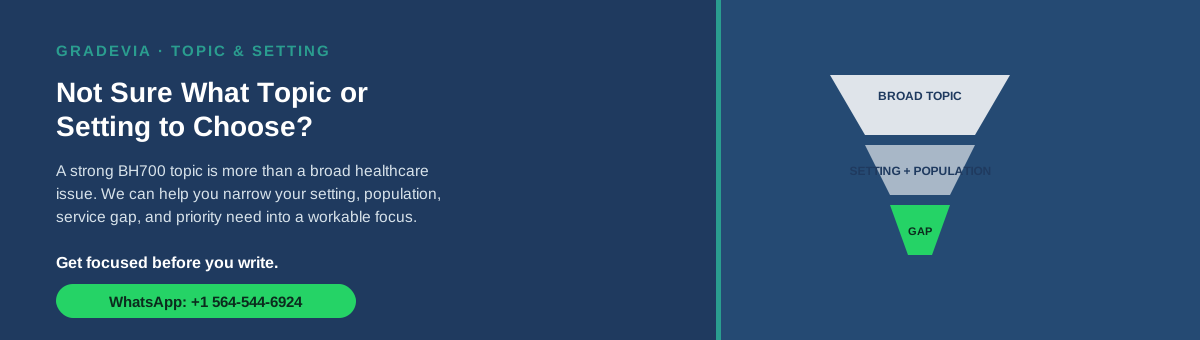
Beginning with a broad idea like “I want to study behavioral health integration” makes the rest of the assignment harder, because everything downstream, the gap, the stakeholders, the focus questions, stays vague until the setting is specific. Narrow the idea before you start writing:
Broad topic: Behavioral health integration
Setting: Primary care clinic
Population: Adults receiving chronic disease care
Potential service issue: Behavioral health screening identifies patients who need additional support
Potential gap: Patients who screen positive are not consistently connected with behavioral health services
Priority need: Improve the transition from screening to behavioral health care
This is an illustrative reasoning pathway, not a claim about your actual site. Run your own site through the same narrowing sequence before drafting.

How to Identify a Strong Gap
A topic and a gap are not the same thing, and the rubric rewards the second one.
Weak: “Behavioral health integration is important.”
Better: “The clinic provides behavioral health screening but does not have a consistent process for connecting patients with behavioral health services after a positive screen.”
A strong gap is specific, observable, connected to the selected setting, connected to an identifiable population, relevant to integrated behavioral health, and capable of being investigated through the focus questions you write later.
Do not invent internal statistics to make the gap sound more precise. If you do not have access to your site’s actual data, do not manufacture percentages, patient counts, wait times, or referral completion rates. A gap described honestly in qualitative terms scores better than a gap propped up with fabricated numbers.
Information You Need Before Writing
Gather this information before you start drafting. It maps directly onto the site description, permission, and stakeholder requirements in the rubric.
Site
- Site or system name
- Location
- Type of healthcare setting
- Site contact
- Contact’s role
Permission
- Whether preliminary permission has been obtained
- Date and method of permission (email approval, verbal agreement pending a formal letter, signed site agreement, etc.)
Population
- Who the site serves
- Relevant age groups
- Relevant demographic characteristics
- Relevant language or access considerations
Services
- Services currently offered
- Behavioral health services specifically
- Relevant healthcare services
- Existing integration, or lack of it, between services
Problem/Gap
- What is not working
- What is missing
- Where the current process breaks down
- Who is affected
Stakeholders
- Patients
- Providers
- Behavioral health professionals
- Administrators
- Care coordinators
- Other groups that actually apply to your selected setting
Only include stakeholders relevant to your specific site. A generic stakeholder list that could apply to any clinic signals that the gap has not been developed enough yet.
How to Define the Priority Need
Identifying a gap is not the same as explaining why it deserves attention. The rubric specifically rewards a well-reasoned justification for the prioritized need, not just a description of what is wrong.
Use this framework: Current condition → Gap → Consequence → Priority need
Illustrative example:
Current condition: Patients are screened for behavioral health concerns.
Gap: There is no consistent process for connecting patients who screen positive to behavioral health services.
Consequence: Patients may leave the screening process without timely follow-up.
Priority need: Develop a reliable integrated-care workflow connecting screening with behavioral health follow-up.
This is an illustrative example only. Your own priority need statement should follow the same current condition, gap, consequence, priority need logic applied to your actual site.
Identify the Impacted Population and Stakeholders
These are two different things, and the rubric checks for both.
The impacted population is the group experiencing the consequences of the gap. The stakeholders are the individuals or groups involved in delivering, managing, supporting, or otherwise connected to the process where the gap occurs.
Avoid writing something like “stakeholders include patients, nurses, doctors, and administrators” without further explanation. That sentence could apply to almost any clinic and will not score well under the rubric’s analysis criterion. Instead, connect each stakeholder to the specific gap: name the role, and name what that role has to do with the problem you identified.
Ethical Concerns
The assignment asks you to identify potential ethical concerns for each prioritized gap, with consent and confidentiality given as examples. This analysis needs to be connected to the gap you identified, not written as a general statement about healthcare ethics.
Generic and weak: “Healthcare workers must maintain confidentiality.”
Connected to the gap: If behavioral health information is shared across an integrated care team as part of the workflow you identified, consider how patient consent and appropriate information-sharing practices apply to that specific process, not to information sharing in general.
This guide is not legal advice. Verify the applicable organizational, professional, and regulatory requirements that govern consent and confidentiality at your specific site or within your state, since these can vary.
Cultural and Equity Implications
Identify cultural or equity implications relevant to your selected setting and population. Potential considerations include:
- Language access
- Transportation
- Insurance or coverage-related access barriers
- Stigma
- Geographic isolation
- Cultural perceptions of behavioral health
- Digital access
- Availability of behavioral health professionals in the area
You do not need to address every item on this list. The analysis should match whatever is actually relevant to the population you identified, not a generic sweep through every possible equity factor.
How to Write the Two or Three Focus Questions
Focus questions should emerge directly from the gap you identified, not introduce new problems the rest of your submission has not set up. A useful framework:
- What is causing or contributing to the gap?
- Who is most affected?
- What evidence-informed improvement could address the gap?
A good test: if a focus question would still make sense with your site swapped out for a different one, it is too broad. “How can behavioral health integration be improved?” could apply to any setting. “What specific language-access barriers affect a defined population’s ability to complete a referral following a positive screen at this site?” could not.
Fictional Example of the Identify Topic and Setting Assignment
Fictional Example for Illustration Only. This section uses a clearly labeled illustrative example, Riverside Community Health Center, to demonstrate the level of specificity and analysis the assignment requires. This site is entirely fictional. Its name, location, population figures, contact, and internal data are invented for instructional purposes only and must not be submitted as your own work. Every detail below, not just the obvious placeholders, needs to be replaced with verified information about your actual selected site before submission.
Identify Topic and Setting
Site and Population
(Illustrative example) Riverside Community Health Center is a fictional federally qualified health center (FQHC) providing primary care, pediatrics, and limited on-site behavioral health services to a socioeconomically diverse, majority Hispanic/Latino community in Riverside County, California. The center serves approximately 14,000 patients annually, roughly 60% of whom identify as Hispanic/Latino and primarily Spanish-speaking, with about 55% covered by Medicaid and 20% uninsured. The largest age band served is adults 18 to 44, though the pediatric panel is also substantial. Preliminary permission was obtained from the Director of Clinical Operations on March 3, 2026, with a formal site agreement pending.
Identified Gap and Priority Need
Riverside screens for depression and anxiety at intake, consistent with recommended practice, but lacks a structured, real-time warm hand-off connecting patients who screen positive to its single part-time behavioral health clinician. Referrals instead enter a scheduling queue with a one- to two-week delay. Internal scheduling data reviewed informally with the site contact indicate that fewer than half of referred patients, an estimated 40%, attend a first behavioral health appointment. Structured, same-day warm hand-offs are associated with improved engagement following a positive screen (Nguyen et al., 2024), which makes this a priority need rather than a peripheral issue: it determines whether a positive screen translates into actual care. The population most affected is patients, particularly Spanish-speaking adults and adolescents, routed into the delayed queue. Key stakeholders include Riverside’s primary care providers, its behavioral health clinician, the medical director, care coordination staff, and the patients and families whose engagement depends on this hand-off.
Ethical, Cultural, and Equity Considerations
Two ethical concerns are specific to this workflow. First, informed consent: a patient introduced to a behavioral health clinician days after screening needs a clear explanation of what information will be shared and with whom, not reliance on a signature from an earlier intake form. This matters more where substance use is involved, since 2024 revisions to federal confidentiality protections now permit a single consent to cover future treatment, payment, and care coordination disclosures, raising the stakes of the patient genuinely understanding that consent at the point of hand-off (U.S. Department of Health and Human Services, 2024). Second, confidentiality: a rushed hand-off conversation in shared clinic space risks disclosure to other patients or staff, a distinct risk requiring its own safeguard, such as a reserved private space.
Culturally, the same delay is compounded for Spanish-speaking patients, since hand-offs are not currently conducted in Spanish without separately coordinating interpreter support. Research on stigma in integrated behavioral health indicates patients disengage more readily when a referral feels like a separate, specialty step rather than a continuous part of the visit already underway (Phelan et al., 2023). A delayed, queue-based referral reintroduces exactly that separation. Health equity guidance similarly stresses that workflow design, not service availability alone, determines whether marginalized populations experience equitable access (Agency for Healthcare Research and Quality, 2022). At Riverside, the gap is therefore a workflow and design problem, not simply a staffing shortage, and it disproportionately affects Spanish-speaking and lower-income patients.
Focus Questions
- To what extent does the absence of a same-day warm hand-off protocol, rather than overall staffing capacity, explain the gap between positive behavioral health screens and completed first appointments at Riverside?
- What specific language-access and consent-related barriers most affect Spanish-speaking patients’ ability to understand and complete a behavioral health referral immediately following a positive screen?
- Which evidence-informed warm hand-off or same-day access models could be adapted to a single part-time behavioral health clinician’s schedule to improve engagement among Riverside’s impacted population without requiring additional staffing?
References
Agency for Healthcare Research and Quality. (2022). Health equity and behavioral health integration [Topic brief]. Academy for Integrating Behavioral Health and Primary Care. https://integrationacademy.ahrq.gov/products/topic-briefs/health-equity
Nguyen, A. M., Klege, R. A., Menders, T., Verma, C., Marcello, S., & Crabtree, B. F. (2024). Strategies for implementing integrated behavioral health into health centers. Journal of the American Board of Family Medicine, 37(5), 833-846. https://doi.org/10.3122/jabfm.2023.230417R1
Phelan, S. M., Salinas, M., Pankey, T., Cummings, G., Allen, J.-S. P., Waniger, A., Miller, N. E., Lebow, J., Dovidio, J. F., van Ryn, M., & Doubeni, C. A. (2023). Patient and health care professional perspectives on stigma in integrated behavioral health: Barriers and recommendations. Annals of Family Medicine, 21(Suppl 2), S56-S60. https://doi.org/10.1370/afm.2924
U.S. Department of Health and Human Services, Office for Civil Rights, & Substance Abuse and Mental Health Services Administration. (2024). Confidentiality of substance use disorder (SUD) patient records; Final rule. Federal Register, 89(33), 12472-12631. https://www.federalregister.gov/documents/2024/02/16/2024-02544/confidentiality-of-substance-use-disorder-sud-patient-records
Not sure whether your selected setting and gap are specific enough for a submission like the one above? Gradevia can help you review the assignment requirements against your draft and identify areas that need clarification before you invest more time writing. WhatsApp +1 564-544-6924.
How to Use Sources in This Assignment
Scholarly evidence has a specific job in this assignment. Use it to support:
- Why the identified gap matters
- Why the population may experience a particular barrier
- Why an integrated-care approach may be relevant to the setting
- The ethical or equity considerations you raised
- The areas you propose to investigate further
Do not add citations simply to make the submission look more scholarly. Every citation should be doing work at the exact point it appears, the way Nguyen et al. (2024) supports a specific claim about warm hand-offs in the example above rather than sitting in a general paragraph about integrated care. Prefer current peer-reviewed literature, ideally from the last five years, unless an older source is foundational enough to justify its use.
Common Problems That Weaken the Assignment
- Choosing a topic instead of identifying a gap.
- Selecting a setting without enough information about its population or services.
- Inventing site statistics.
- Using generic ethical statements not connected to the gap.
- Discussing culture without connecting it to the affected population.
- Naming stakeholders without explaining their relationship to the gap.
- Writing focus questions that are too broad.
- Identifying multiple unrelated gaps instead of prioritizing one coherent problem.
- Using citations that do not actually support the claim they are attached to.
- Treating the fictional example above as a template to copy rather than an illustration of the reasoning process.
- Failing to obtain or document preliminary site permission when required.
- Writing about a site you cannot realistically access or understand well enough to describe accurately.
Have your BH700 Identify Topic and Setting draft ready? Gradevia can review the draft for requirement coverage, organization, evidence, and areas that need strengthening. WhatsApp +1 564-544-6924.
Rubric Alignment / Final Review
The assignment is scored out of 20 points across four criteria:
| Criterion | Points | What It Covers |
|---|---|---|
| Site description, permission, population, demographics, setting/gap/priority need/stakeholders | 7 | Complete site identification, documented preliminary permission, thorough description of setting and population with demographic data, and a clearly stated gap, priority need, and stakeholders that tie directly to the site |
| Priority needs, focus questions, ethical concerns, cultural/equity implications | 7 | Two to three incisive focus questions tied to the prioritized gap, well-reasoned justification for the priority need, specific ethical concerns with mitigation ideas, and thorough analysis of cultural and equity implications |
| Writing and organization | 3 | Clear, doctoral-level writing, logical section order, and complete coverage of required items |
| APA and scholarship | 3 | Properly cited sources, an APA 7th-edition-compliant reference list, and sources that genuinely support the claims made |
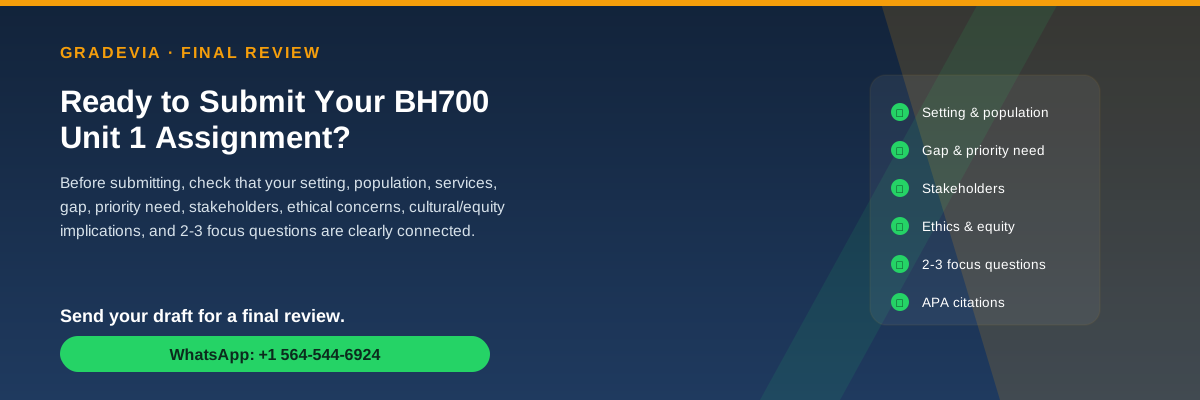
Before submitting, confirm each of the following:
- Site/system identified
- Site contact identified
- Preliminary permission addressed
- Setting described
- Population described
- Relevant demographics included
- Services described
- Specific gap identified
- Priority need explained
- Stakeholders identified
- Impacted population identified
- Ethical concerns addressed
- Cultural implications addressed
- Equity implications addressed
- Two to three focus questions included
- Scholarly evidence supports important claims
- No fabricated site data
- APA citations and references checked
- Submission is 1-2 pages, APA 7th edition, and saved as a PDF or Word document for Canvas
- Assignment instructions and current course materials verified
Unit 1 also includes an introductory discussion focused on the behavioral health workforce. That is a separate graded activity from this assignment. See the BH700 Unit 1 Discussion: Introduction Guide for a full breakdown of that discussion’s five required elements.
For the complete course structure, grading breakdown, unit topics, and all BH700 assessments, see the Herzing University BH700 Foundations of Integrated Behavioral Health Course Guide.
Before You Submit
Before submitting a major doctoral assignment, have the draft checked against the actual requirements rather than discovering missing elements after submission. Gradevia offers BH700 assignment review for working doctoral students managing this coursework alongside a full-time schedule.
WhatsApp: https://wa.me/15645446924+1 564-544-6924