
Blog
Shadow Health HEENT Subjective Questions: Interview Guide and Documentation Tips

Shadow Health HEENT Subjective Questions
Subjective data collection is the part of Shadow Health HEENT where the grade is decided by how you ask, not just what you ask. A vague question gets a vague answer, and a vague answer is hard to document well. This guide focuses specifically on the subjective interview: how to structure HEENT questions, move from broad to focused, clarify a positive response, recognize where education and empathy fit, and turn what the patient tells you into documentation that actually holds up.
It does not re-cover the physical examination, DCE scoring mechanics, or Lab Pass submission. For that, see the complete Shadow Health HEENT assessment guide.
What Are Shadow Health HEENT Subjective Questions?
Subjective data is information the patient reports, in their own words, about symptoms, history, and how they perceive their own condition. Objective data is what you obtain through observation or physical assessment. The two are collected at different points in the encounter and documented differently.
Nursing Skills, an NCBI Bookshelf resource, describes a health history as the process of using directed interview questions to obtain symptoms and perceptions from the patient, and notes that information obtained this way is subjective data by definition (Ernstmeyer & Christman, 2023). That distinction matters more than it might seem, because the purpose of subjective questioning isn’t to work through a fixed list. It’s to collect whatever relevant information the patient’s own responses lead you toward, within the HEENT region.
Subjective data = what the patient reports. Objective data = what you observe, measure, or obtain during the physical exam.
Shadow Health HEENT Subjective Data
A HEENT-focused interview covers five regions: head, eyes, ears, nose and sinuses, and mouth and throat. Within each, certain symptom categories come up often enough to be worth screening for in most encounters. These are areas to explore, not a fixed checklist every patient requires.
Head: headache, head injury, dizziness. Eyes: vision changes, eye pain, blurred or double vision. Ears: hearing changes, ear pain, tinnitus, vertigo. Nose and sinuses: nasal congestion, nasal drainage, nosebleeds, sinus symptoms. Mouth and throat: mouth pain, sore throat, difficulty swallowing, voice changes.
Not every patient needs every question in every category. What you ask should be guided by the patient’s own responses and by what your specific assignment requires. If a patient denies any eye symptoms after a direct screening question, there’s no reason to keep probing that region; move on to the next.
Shadow Health HEENT Subjective Questions
For each HEENT region: what to assess, an example opening question, focused follow-ups, what a positive response should prompt you to clarify, and what belongs in your documentation.
| HEENT area | Initial question | Follow up | Information to clarify | Documentation focus |
|---|---|---|---|---|
| Head | “Have you had any headaches recently?” | “Where is it located, and how would you describe it?” | Onset, location, severity, associated symptoms | Patient-reported symptoms, in their words |
| Eyes | “Have you noticed any changes in your vision?” | “Is it blurred, double, or something else? One eye or both?” | Vision change type, pain, onset, laterality | Patient-reported symptoms, in their words |
| Ears | “Have you noticed any changes in your hearing?” | “Any ear pain, drainage, or ringing?” | Hearing change, pain, drainage, tinnitus, vertigo | Patient-reported symptoms, in their words |
| Nose | “Have you had any nasal congestion or sinus problems?” | “Is it constant or does it come and go? Any nosebleeds?” | Congestion pattern, drainage, bleeding, sinus symptoms | Patient-reported symptoms, in their words |
| Throat | “Have you had any sore throat or trouble swallowing?” | “Trouble with solids, liquids, or both? Any voice changes?” | Pain, swallowing difficulty type, voice changes | Patient-reported symptoms, in their words |
These are practice examples for study purposes. They are not a reproduction of Shadow Health’s actual scored interview content, and your assigned encounter may present different topics, wording, or response options.
How to Ask Better Shadow Health HEENT Questions
Broad opening question: invites the patient to describe a symptom area in their own words. “Have you noticed any changes in your vision?”
Focused question: narrows to a specific symptom once the patient has responded broadly. “Is the blurriness constant or does it come and go?”
Clarification question: follows up on something the patient already mentioned but didn’t fully explain. “You mentioned it started last week. Has it gotten better, worse, or stayed the same?”
Follow-up question: connects a new question to information already given. “Since you mentioned the headache, have you also noticed any dizziness with it?”
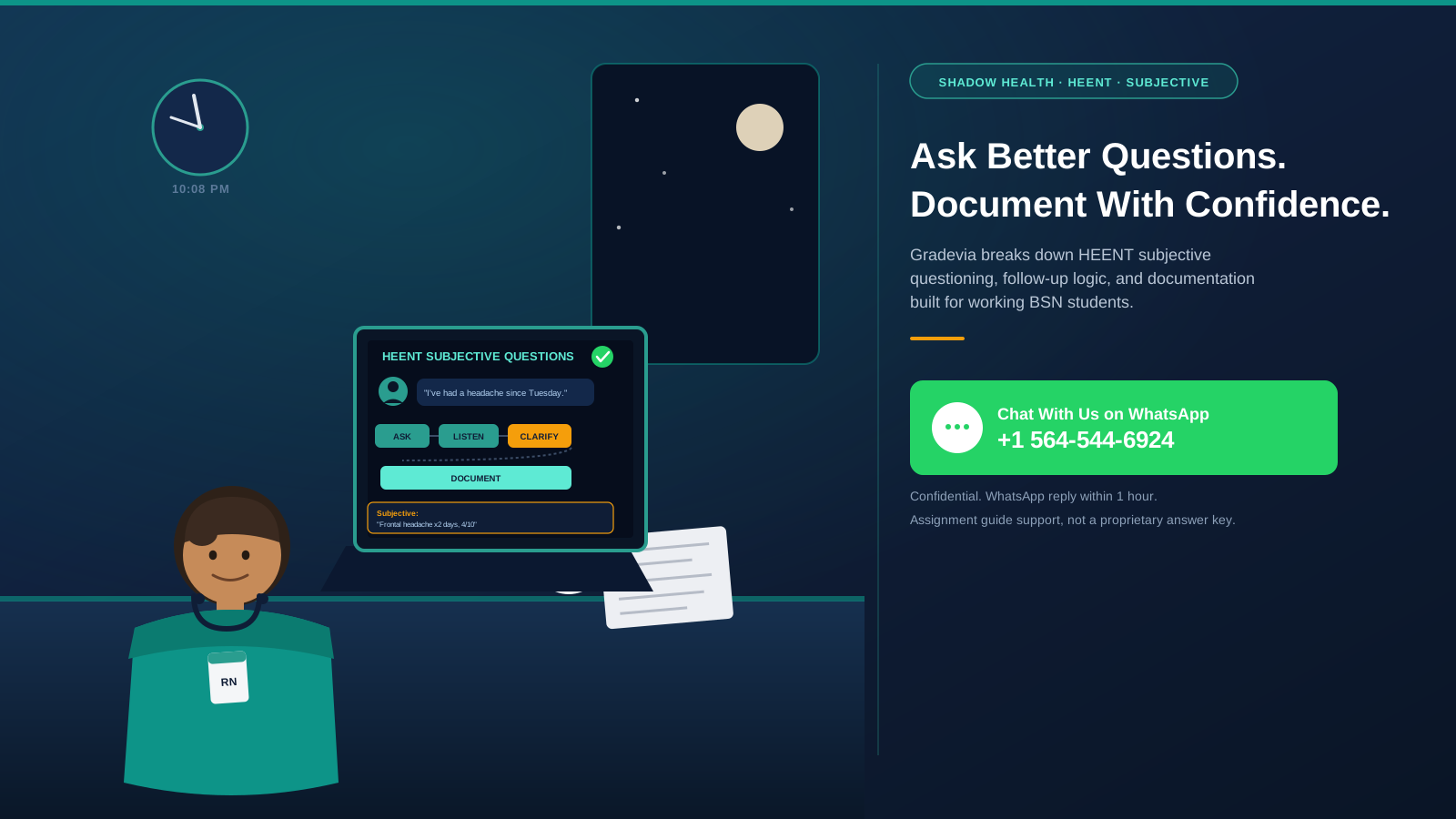
Ask → Listen → Clarify → Document.
A practical habit worth building: ask one thing at a time. Shadow Health’s platform guidance is that questions should contain enough context to be understood clearly and should generally address a single topic, since combining several unrelated questions into one sentence, or using vague pronouns like “it” or “that,” can be interpreted literally by the virtual patient rather than the way you intended (Elsevier, n.d.-a). “Do you have headaches, and does your vision ever get blurry too?” is two separate questions competing for one answer. Ask them separately.
Need help organizing your Shadow Health HEENT subjective interview before you start the encounter? Gradevia offers practical nursing academic support. WhatsApp: +1 564-544-6924.
Shadow Health HEENT Interview Guide
The interview guide is a platform feature, not a separate document, that can help you organize subjective data collection during the encounter itself. Depending on how your instructor configures the assignment, it may display as a full guide, a partial guide, or not be available at all.
Based on current official Shadow Health documentation for how the interview guide functions across assignment configurations: a full interview guide shows the high-level topics you need to cover and reveals the specific scored subjective findings as an explicit checklist; a partial interview guide shows the topics but keeps the specific scored findings hidden until you uncover them yourself through questioning; with no interview guide, you’re working from your own clinical reasoning and the assignment instructions alone (Elsevier, n.d.-b).
Whichever version you have, the guide is meant to support organization, not replace clinical judgment. Knowing that “vision changes” is a topic you need to cover doesn’t tell you how to phrase a good question about it or how to follow up on what the patient says. That part is still on you.
Shadow Health HEENT Education and Empathy
Education and Empathy are typically scored as a distinct component from subjective data collection, separate from simply asking the right list of questions. Official Shadow Health product information describes each patient scenario as having specific therapeutic outcomes, with students scored on recognizing when to respond with empathy or to educate the patient on a relevant health literacy gap (Elsevier, n.d.-c).
The practical principle: when a patient gives a response that’s concerning, uncomfortable, or emotionally significant, acknowledge it before moving straight to your next question. Some of these moments are time-sensitive within the platform, meaning the appropriate response needs to happen close to when the patient shares the information, not several questions later.
A few practice examples of what an empathetic acknowledgment can sound like, not proprietary Shadow Health dialogue, just the general shape of an appropriate response:
- Patient reports pain: “I’m sorry you’re dealing with that. Let’s talk through it.”
- Patient expresses worry about a symptom: “That sounds like it’s been on your mind. I want to understand what’s going on.”
- Patient mentions a symptom is affecting daily life: “That sounds like it’s been really disruptive. Tell me more about how it’s been affecting you.”
Not every HEENT assignment scores Education and Empathy identically; what counts as an appropriate response depends on the specific scenario and patient.
Shadow Health Tina Jones HEENT Subjective Questions
This search phrase deserves a direct, accurate answer rather than an assumption. Current official Shadow Health product information for the undergraduate Health Assessment collection identifies Kellan Clarke, a 16-year-old male presenting with a sore throat, as the standardized patient for the single-system HEENT assessment, while Tina Jones is the standardized patient for the separate Health History assignment (Elsevier, n.d.-a). This structure is also reflected in Elsevier’s current Faculty Debriefing Guide for the Health Assessment DCE, which separates a “Debrief: Health History (Tina Jones)” section from a “Debrief Single System Assessment: HEENT (Kellan Clarke)” section.
That said, course configurations and product versions can differ, and some programs may reference an HEENT experience built around Tina Jones depending on which Shadow Health product or course bundle is assigned. The reliable approach either way:
- Confirm which standardized patient and which specific activity your course actually assigns before you start.
- Use the region-by-region subjective questioning framework above regardless of which patient you’re assigned.
- Base your documentation entirely on what your own patient reports in your own encounter, not on assumptions carried over from search results or another student’s experience.
If your assigned HEENT experience uses a different patient than what you expected based on something you read online, that’s a normal reflection of how Shadow Health’s product lineup is structured, not an error on your end.
Shadow Health Tina Jones HEENT Objective Data
Students frequently mix this up with subjective data, so it’s worth stating plainly: objective data is what you personally observe, measure, or obtain during the physical examination portion of the encounter, not something the patient tells you. Pupil response, otoscopic findings, and oral mucosa appearance are all objective; they come from your exam, not your interview.
No objective findings for any specific patient are reproduced here, since exam findings are specific to your own encounter. See the complete Shadow Health HEENT assessment guide for the physical examination component in full.
Shadow Health HEENT Documentation
Subjective interview findings get translated into documentation using a consistent structure: symptom, onset, location, duration, severity, frequency, associated symptoms, aggravating factors, relieving factors, relevant history, and the patient’s own perception of the problem. Not every category applies to every symptom, but working through the list keeps documentation specific instead of vague.
Documentation example (fictional, for illustration only): “Patient reports intermittent frontal headache for the past three days, rated 4/10, worse in the afternoon, relieved somewhat by rest. Denies associated vision changes or dizziness.”
Three rules that matter specifically in Shadow Health:
- Document what the patient actually reported. Not what you assume they’d say, and not a generic normal finding.
- Don’t convert an unanswered question into a negative finding. A symptom you never asked about can’t be documented as denied.
- Don’t mix physical exam findings into the subjective section. If you observed it rather than heard it from the patient, it belongs in objective documentation, not here.
Nursing Skills reinforces this same distinction generally: subjective data should be documented with attribution to the patient, using language such as “the patient reports,” rather than being stated as fact on its own (Ernstmeyer & Christman, 2023).
Not sure how to organize your subjective findings into clear documentation before your encounter ends? Gradevia provides practical support for exactly this kind of assignment. Message us on WhatsApp: +1 564-544-6924.
Shadow Health HEENT Transcript
The transcript is a record of your interactions with the patient during the encounter, including the questions you asked, the patient’s responses, and any actions you took. Reviewing your own transcript after completing the encounter is a genuinely useful self-review step, separate from searching for someone else’s transcript online.
Used well, your own transcript lets you:
- Review which questions you actually asked, in what order.
- Identify HEENT areas you may have skipped or under-explored.
- Check whether you followed up appropriately after a positive response, or moved past it too quickly.
- Compare your interview flow against the regions you were supposed to cover.
- Spot repetitive or vague questions you asked without realizing it.
- Notice any missed Education and Empathy opportunities you could handle differently next time.
This is a self-review tool, not a resource to copy from another student’s attempt. A transcript from someone else’s encounter reflects their patient interaction, which may not match yours even if you’re both assigned the same activity.
Shadow Health HEENT Answer Key and Answer Key PDF
Searches for a Shadow Health HEENT answer key, an answer key PDF, a subjective questions PDF, or a transcript usually lead to unofficial third-party material circulating outside the platform. A few practical reasons these are worth treating with caution:
- They may reflect an older version of the assignment or a different Shadow Health product configuration.
- They may be built around a different standardized patient than the one your course assigns.
- They may omit requirements specific to your assignment or rubric.
- They may contain findings that don’t match what your own encounter actually presents.
- Using them risks documenting information you didn’t personally obtain, which is a real accuracy problem in a patient-specific simulation, not just an academic integrity one.
The more durable alternative: use your assignment instructions, the interview guide if your course provides one, your own encounter’s actual responses, and a solid grasp of HEENT subjective questioning logic. That combination works regardless of which product version or patient your specific course presents, which an outdated PDF can’t guarantee.
Common Shadow Health HEENT Subjective Question Mistakes
- Asking a question without enough context. Give the patient enough framing to answer meaningfully.
- Combining multiple unrelated questions in one sentence. Ask one thing at a time.
- Using vague pronouns (“Does it hurt?” without establishing what “it” refers to).
- Moving on after a positive response without clarifying it. A “yes” needs a follow-up.
- Repeating the same question unnecessarily. If it’s already been answered, don’t ask again.
- Treating silence or an unanswered question as a negative finding. Only document what was actually asked and denied.
- Confusing subjective and objective data. Keep patient-reported information separate from exam findings.
- Documenting findings that weren’t actually obtained. Accuracy beats completeness.
- Copying an online transcript. Base documentation on your own encounter.
- Relying on an outdated answer key. It may not match your assigned patient or activity.
- Ignoring Education and Empathy opportunities. A concerning response deserves acknowledgment, not just the next question.
- Skipping the transcript review before submission. It’s the fastest way to catch what you missed.
A Fast Shadow Health HEENT Subjective Interview Framework
- Establish the purpose of the interview.
- Start broad in each region.
- Identify positive symptoms as they come up.
- Ask focused follow-up questions.
- Clarify important details (onset, severity, associated symptoms).
- Acknowledge education or empathy opportunities as they arise.
- Document the information accurately, in the patient’s own words where possible.
- Review the transcript and check for missed areas before submitting.
This is designed as a quick reference to scan before starting the encounter, not a script to follow line by line.
Shadow Health HEENT Subjective Questions Checklist
- Head: headache, injury, dizziness
- Eyes: vision changes, pain, redness, discharge
- Ears: hearing changes, pain, drainage, tinnitus, vertigo
- Nose: congestion, drainage, nosebleeds, sinus symptoms
- Throat and mouth: sore throat, swallowing, voice changes
- Positive responses clarified (onset, severity, associated symptoms)
- Relevant history connected to HEENT findings
- Education or empathy opportunities acknowledged
- Documentation reflects only what the patient actually reported
- Transcript reviewed before submission
Balancing clinical hours, a job, and a full course load on top of Shadow Health assignments? Gradevia’s academic support is built around a schedule that doesn’t have extra hours to spare. WhatsApp: +1 564-544-6924.
Shadow Health HEENT Subjective Questions FAQ
What are Shadow Health HEENT subjective questions? Interview questions designed to collect what the patient reports about symptoms in the head, eyes, ears, nose, and throat regions. They produce subjective data, meaning information based on the patient’s own account rather than your observation.
What is subjective data in Shadow Health? Information the patient tells you directly, such as a reported symptom, its onset, or how it’s affecting them. It’s distinct from objective data, which comes from your physical examination.
What questions should I ask during a Shadow Health HEENT interview? Start broad in each region (head, eyes, ears, nose, throat), then narrow based on the patient’s response. See the region-by-region table above for practice examples in each area.
Does Shadow Health provide an HEENT interview guide? Depending on your course configuration, yes. A full guide shows scored subjective findings explicitly; a partial guide shows topics without revealing findings until you uncover them; some assignments have no interview guide at all.
Are Shadow Health HEENT questions the same for every student? The topics and clinical logic are similar, but the exact scored content, available interview guide level, and assigned patient can vary by course and product configuration.
Is Tina Jones always the HEENT patient? Not necessarily. Current official Shadow Health Health Assessment product information identifies Kellan Clarke as the standardized patient for the single-system HEENT assessment, with Tina Jones assigned to the separate Health History activity. Some course configurations may differ, so confirm your own assigned patient and activity.
What is the difference between subjective and objective data in Shadow Health? Subjective data is what the patient reports in the interview. Objective data is what you personally observe or measure during the physical examination.
How do I document Shadow Health HEENT subjective findings? Record the specific symptom along with relevant detail (onset, location, severity, associated symptoms) using the patient’s own words where possible, and keep it clearly separate from exam findings.
Can I use a Shadow Health HEENT answer key PDF? Treat any unofficial PDF with caution. It may reflect a different patient, product version, or assignment configuration than yours, and using it risks documenting findings you didn’t actually obtain.
How can I review my Shadow Health HEENT transcript? Use it after your encounter to check which questions you asked, whether you followed up on positive responses, whether you covered all five regions, and whether you missed any Education and Empathy moments.
What is Education and Empathy in Shadow Health? A scored component, separate from subjective data collection, that evaluates whether you responded appropriately (with empathy or patient education) to significant or emotionally relevant patient responses.
How can I avoid missing subjective data during a HEENT assessment? Work through each region systematically, screen every region even briefly, follow up on positive responses before moving on, and review your transcript before submitting to catch anything you skipped.
References
- Elsevier. (n.d.-a). Health assessment digital clinical experiences. https://www.elsevier.com/products/shadow-health/health-assessment
- Elsevier. (n.d.-b). Shadow Health in Sherpath Vantage: Assignment options guide. https://evolve.elsevier.com/education/shadow-health-in-sherpath-vantage-assignment-options-guide
- Elsevier. (n.d.-c). Shadow Health. https://www.elsevier.com/products/shadow-health
- Elsevier. (n.d.-d). Shadow Health support hub. https://service.elsevier.com/app/home/supporthub/shadow-health/
- Ernstmeyer, K., & Christman, E. (Eds.). (2023). Nursing skills (2nd ed.), Chapter 2: Health history. Chippewa Valley Technical College. https://www.ncbi.nlm.nih.gov/books/NBK596721/