
Blog
Herzing BH710 Unit 6 Assignment: Case Study (Scenario) Guide + Example

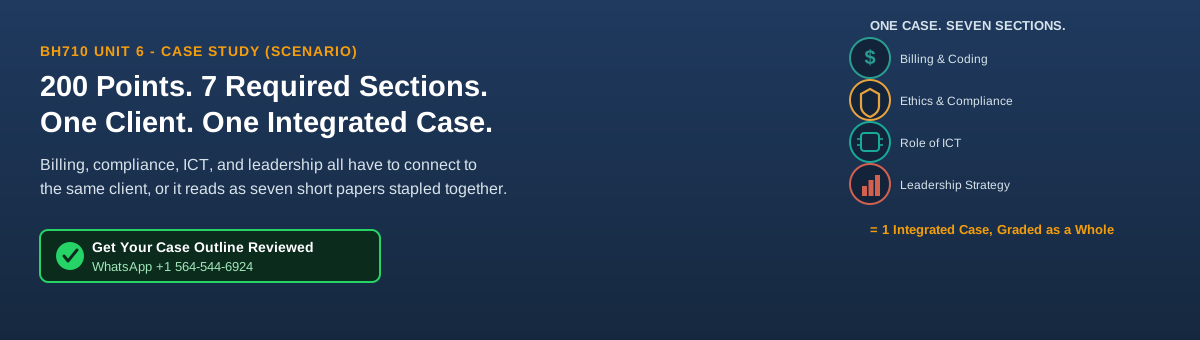
The Unit 6 Case Study is worth 200 points, the single highest-weight assignment in BH710 and more than double any other graded activity in the course. It also lands at the point in the course, alongside Unit 6’s accreditation and measurement-informed care content, where every prior unit’s material (reimbursement models, parity and ethics, regulatory frameworks, coding and billing, and information and communication technology) is meant to converge into one integrated analysis.
According to the assignment instructions, you are given a scenario: an adult client with a chronic, persistent mental illness and an extensive history of recidivism, served by a behavioral health agency that recently implemented a new information and communication technology (ICT) system and is now facing inconsistent documentation, denied claims, compliance risk, fragmented communication, and rising costs. You are asked to analyze that scenario across seven required components and propose a leadership-driven resolution.
This page is part of the Herzing University BH710 Course Guide. Unlike earlier units in this course, Unit 6 does not ask you to carry forward a specific client, site, or gap you built in a previous assignment; the case scenario is given to you fresh in the Unit 6 instructions, which is why the worked example below introduces its own fictional agency and client rather than continuing a thread from an earlier unit guide.
Most students reading this are not full-time graduate students. You are working a job, often a clinical or administrative shift job, while carrying this course, which means the assignment’s own 20-hour estimate is not 20 hours of open calendar space; it is 20 hours carved out of evenings, weekends, or whatever time is left after a full-time role. That constraint is exactly why this guide leads with a time budget before it walks through each required component: knowing where your limited hours produce the most rubric return matters as much as knowing what to write.
Unit 6 Assignment: Case Study (Scenario)
Assignment Instructions
In this assignment, you will develop a comprehensive case study that demonstrates how behavioral health leaders use healthcare billing, coding, documentation practices, and information and communication technologies (ICT) to ensure ethical, compliant, and financially sustainable service delivery. Your case study should integrate leadership decision-making with operational, clinical, financial, legal, and technological considerations. During your breakout sessions, you will have 10 minutes to give an overview of your scenario to your group.
- Analyze healthcare billing, coding, and documentation practices to support ethical, compliant, and financially viable behavioral health service delivery.
Assignment Scenario
Develop a fictional case study involving an adult individual diagnosed with a chronic mental illness (e.g., schizophrenia, schizoaffective disorder, bipolar I disorder with psychotic features, or severe recurrent major depressive disorder) who has experienced extensive recidivism, including repeated psychiatric hospitalizations, emergency department visits, crisis interventions, or involvement with the criminal justice system.
The behavioral health agency has recently implemented a new Information and Communication Technology (ICT) system that includes an electronic health record (EHR), clinical documentation platform, telehealth capabilities, billing software, and reporting dashboards. Agency leadership has identified concerns related to inconsistent documentation, denied insurance claims, compliance risks, fragmented communication among providers, and rising operational costs.
As a healthcare leader, explain how you would address these challenges while improving patient outcomes and organizational performance.
Required Components
Your case study should include the following sections:
Case Background
- Introduce the client and presenting behavioral health concerns.
- Describe the individual’s history of chronic mental illness and repeated recidivism.
- Identify social determinants of health contributing to repeated crises.
- Explain the services currently provided by the behavioral health agency.
Leadership Assessment
Analyze the organizational issues affecting care delivery, including:
- Documentation deficiencies
- Billing and coding errors
- Compliance concerns
- Financial challenges
- Communication breakdowns
- Staff training needs
- Technology adoption issues
Healthcare Billing and Coding
Discuss how leadership would ensure:
- Accurate clinical documentation
- Appropriate diagnostic coding (ICD-10-CM)
- Accurate procedure coding (CPT/HCPCS, when applicable)
- Medical necessity documentation
- Proper reimbursement
- Reduction of claim denials
- Audit readiness
Ethical and Regulatory Compliance
Explain leadership strategies to maintain compliance with:
- HIPAA Privacy and Security Rules
- Ethical documentation standards
- Informed consent requirements
- Confidentiality protections
- Fraud, waste, and abuse prevention
- Organizational policies and accreditation standards
Role of Information and Communication Technology (ICT)
Describe how the agency’s ICT system supports:
- Electronic Health Records (EHRs)
- Clinical decision support
- Care coordination
- Telebehavioral health services
- Secure provider communication
- Population health management
- Data analytics
- Quality improvement initiatives
- Risk management
- Revenue cycle management
Leadership Strategy
Develop a leadership improvement plan that addresses:
- Staff education and competency development
- Change management
- Interdisciplinary collaboration
- Quality assurance
- Performance improvement metrics
- Financial sustainability
- Patient-centered care
- Reduction in recidivism
Support your recommendations using leadership theory and evidence-based practices.
Expected Outcomes
Describe measurable outcomes, such as:
- Reduced psychiatric readmissions
- Improved continuity of care
- Increased documentation accuracy
- Reduced billing errors
- Improved reimbursement rates
- Enhanced patient engagement
- Improved compliance scores
- Better organizational financial performance
Scholarly Analysis
Conclude by discussing how effective leadership integrates healthcare information technology, ethical documentation, billing accuracy, and regulatory compliance to improve behavioral healthcare quality while maintaining financial viability.
Assignment Requirements
-
10–12 pages (excluding title and reference pages)
-
APA 7th edition formatting
-
Minimum of 10–15 current scholarly sources
-
Include course readings and additional peer-reviewed literature published within the last five years when appropriate
-
Use appropriate headings and subheadings
Demonstrate doctoral-level critical analysis, synthesis, and application of leadership principles
Unit 6 Assignment Example
BH710-Unit6-Case-Study-Fictional-Example-APA7
What the Assignment Actually Requires
| Requirement | What the Instructions State |
|---|---|
| Format | 10-12 pages, excluding title page and references |
| Citation style | APA 7th edition |
| Minimum sources | 10-15 current, credible, scholarly sources |
| Depth expected | Doctoral-level critical analysis, not description or summary |
| Structure | Headings and subheadings matching the required components |
| Submission | Word document or PDF |
| Estimated time | Approximately 20 hours |
| Course objective | CLO 5 |
| Scenario given | Adult client, chronic mental illness with psychotic or severe mood features, extensive recidivism (hospitalizations, ED visits, crisis interventions, criminal justice involvement), at an agency that recently implemented a new ICT system now facing documentation, billing, compliance, communication, and cost problems |
The Seven Required Components
| # | Component | What It Must Cover |
|---|---|---|
| 1 | Case Background | The client’s clinical and recidivism history; the agency’s ICT implementation and its current operational problems |
| 2 | Leadership Assessment | How current agency leadership is (or is not) addressing the situation, evaluated against leadership theory |
| 3 | Healthcare Billing and Coding | ICD-10-CM and CPT/HCPCS accuracy, medical necessity documentation, reimbursement mechanics, claim denials, audit readiness |
| 4 | Ethical and Regulatory Compliance | HIPAA Privacy and Security Rules, informed consent, confidentiality, fraud/waste/abuse exposure, accreditation standards |
| 5 | Role of ICT | EHR functionality, clinical decision support, care coordination, telebehavioral health, secure communication, population health management, data analytics, quality improvement, risk management, revenue cycle management |
| 6 | Leadership Strategy | Staff education, change management, interdisciplinary collaboration, quality assurance, performance metrics, financial sustainability, patient-centered care, and recidivism reduction, grounded in leadership theory and evidence-based practice |
| 7 | Expected Outcomes and Scholarly Analysis | What should change if the strategy works, how it will be measured, and a doctoral-level synthesis of the literature supporting the analysis |
Budgeting Your Time Across a 20-Hour, 200-Point Assignment
The assignment’s 20-hour estimate is realistic for the total work involved, but it is not evenly distributed across the seven components, and treating it as “write one page per hour” is how time-pressed students end up with a rushed, thin final third of the paper the night before it is due. The allocation below weights hours toward the components carrying the most rubric points and the most synthesis work, not toward the components that are fastest to type.
| Phase | Hours | What You Are Actually Doing |
|---|---|---|
| Building the scenario and reading the rubric closely | 1.5 | Fixing your client’s history, agency, and ICT problem in writing before drafting anything, so you are not redesigning the scenario mid-paper |
| Source gathering (10-15 sources) | 3 | Pulling sources across all seven domains up front, not one at a time as you reach each section; this is the step most often shortchanged under time pressure |
| Case Background and Leadership Assessment | 3 | Combined, because the Leadership Assessment should be written while the Case Background’s details are fresh, not as a disconnected later section |
| Healthcare Billing and Coding | 3.5 | The component most students underestimate; the sub-topics in the next section of this guide take real time to address individually rather than in one paragraph |
| Ethical and Regulatory Compliance | 2.5 | Includes checking whether your scenario requires 42 CFR Part 2 coverage alongside HIPAA |
| Role of ICT and Leadership Strategy | 4 | The two longest components combined; budget more time here than instinct suggests, since both require connecting back to the Case Background rather than describing functions generically |
| Expected Outcomes, Scholarly Analysis, and APA cleanup | 2.5 | Writing specific, measurable outcomes and synthesizing sources across sections, then a full APA 7 formatting and reference-list pass |
If you only have an evening at a time rather than a full day, the single highest-leverage move is finishing source gathering in one sitting before you draft a single section; switching between “finding a source” and “writing a paragraph” mode is what makes a 20-hour assignment feel like it is taking 30 hours of working-adult time.
How This Assignment Differs From Everything Earlier in BH710
Every prior BH710 assignment isolated one domain: Unit 2 was mental health parity and ethics, Unit 3 was regulatory frameworks, Unit 4 was coding, Unit 5 was ICT. Unit 6 is the first assignment that requires all of it at once, applied to a single client and a single organization, which is also why it carries 200 of the course’s 700 assignment points. A response that handles each of the seven components as an isolated section, without connecting the billing errors to the ICT gaps, or the compliance risk to the leadership failure that allowed it, will read as seven short papers stapled together rather than one case analysis, and will not reach the rubric’s higher bands on Scholarly Analysis or Leadership Assessment, both of which reward demonstrated connections across domains.
Building the Case Background
Two things have to be established clearly before the rest of the paper can work: the client, and the agency.
The client. The assignment specifies chronic, persistent mental illness (schizophrenia, schizoaffective disorder, bipolar I with psychotic features, or severe recurrent major depressive disorder are all defensible choices) with extensive recidivism. “Extensive” is doing real work in that sentence: a single hospitalization or one ED visit does not meet the bar the instructions set.
Build a specific, internally consistent history: a number of hospitalizations, ED visits, and crisis team contacts over a defined period, plus a specific criminal justice involvement (an arrest, a jail stay, a diversion or problem-solving court mandate). Specificity here is not decoration; it is what later lets you connect the case to a documented clinical framework, such as the sequential intercept model used in criminal justice and behavioral health literature (Khalsa et al., 2018), rather than describing recidivism only in the abstract.
The agency. Name the ICT system, name what it replaced, and name a go-live date relative to the case you are writing. “Recently implemented” should mean something concrete, for example six to nine months before the events you are analyzing, because the compliance and billing problems you describe later need to plausibly stem from an implementation still working through adoption issues rather than a mature, stable system. Build the system as an integrated platform (EHR, documentation, telehealth, billing, and reporting dashboards, matching the scenario’s own description) rather than four separate named products, since the assignment’s ICT component depends on these functions being connected, or failing to connect, within one platform.
Evaluating Leadership Against Theory, Not Just Describing It
The Leadership Assessment and Leadership Strategy components together carry 60 of the 200 points, the largest combined share of the rubric. The most common way students lose points here is writing leadership content as narrative description (“leadership should communicate better”) instead of applied theory. Name a specific leadership framework and use it as the lens for your assessment, not as a citation dropped in afterward:
- Transformational leadership is a strong fit for an ICT-adoption crisis specifically, because the model’s core mechanism, inspiring staff toward a shared vision and building individual buy-in rather than relying on positional authority, is directly relevant to why a new system is being under-used or worked around by staff (Xiong et al., 2023).
- Structured change management models (Kotter’s eight-step model and related frameworks reviewed across healthcare settings) give you a concrete sequence to evaluate current leadership against: has the agency created urgency around the ICT problems, formed a guiding coalition, communicated a change vision, and removed the specific obstacles (unclear documentation templates, no coding training) staff are facing, or has it skipped straight to telling staff to “just use the system correctly” (Harrison et al., 2021)?
Use the theory to generate your assessment’s structure: what does this framework predict should be present for successful adoption, what is actually present at your agency, and what is the gap. That is what separates a Leadership Assessment from a leadership opinion.
Getting the Billing and Coding Component Doctoral-Level, Not Just Descriptive
This component asks for ICD-10-CM and CPT/HCPCS accuracy, medical necessity documentation, reimbursement mechanics, claim denials, and audit readiness, five distinct sub-topics that are easy to blur into one generic paragraph about “billing problems.” Treat them separately:
| Sub-Topic | What to Address |
|---|---|
| ICD-10-CM accuracy | Whether diagnosis codes reflect appropriate specificity (for example, correctly distinguishing schizoaffective disorder subtypes or substance use disorder remission status) rather than defaulting to unspecified codes |
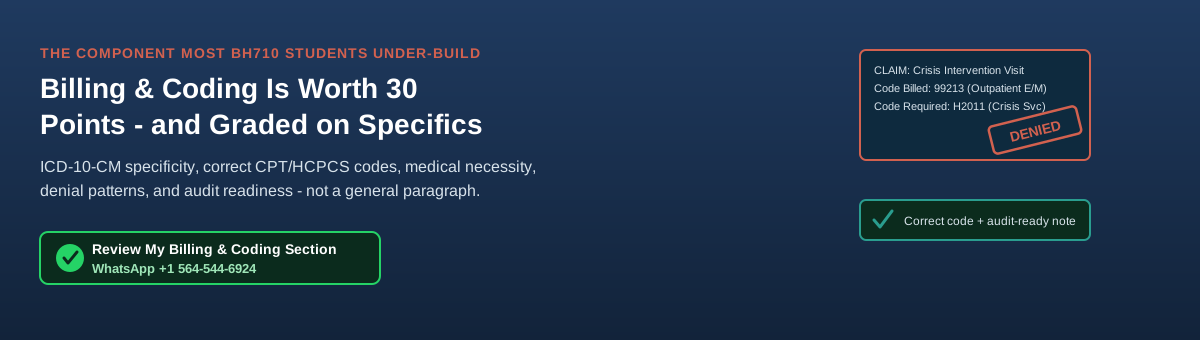
| CPT/HCPCS accuracy | Whether service codes match the service actually delivered (crisis intervention, case management, psychotherapy, and care coordination codes are not interchangeable, and miscoding between them is a realistic, specific failure point) |
| Medical necessity documentation | Whether the clinical note actually supports the billed service and diagnosis, which is the documentation standard payers and auditors evaluate claims against |
| Reimbursement mechanics | How the agency is actually paid: fee-for-service claims, a value-based or bundled arrangement, or a mix, and how that structure interacts with the coding problems you describe |
| Claim denials | A specific, plausible denial pattern (for example, a rising denial rate tied to a specific coding mismatch introduced after go-live) rather than a vague statement that “claims are being denied” |
| Audit readiness | Whether the agency’s documentation, consent files, and coding trail could withstand a payer or regulatory audit as currently maintained |
A useful standard to hold your draft to: for every billing problem you name, you should be able to state which specific document or data field would prove it to an auditor. If you cannot, the problem is still described too generally.
Covering Ethical and Regulatory Compliance Completely
The instructions name HIPAA Privacy and Security Rules, informed consent, confidentiality, fraud/waste/abuse, and accreditation standards. A common gap at this point in the paper is addressing HIPAA generally while missing the specific regulatory layer that applies to behavioral health and substance use treatment records beyond HIPAA: 42 CFR Part 2, which imposes stricter consent requirements on substance use disorder treatment information than HIPAA alone does, and which is directly relevant if your client has any co-occurring substance use history (Medicaid and CHIP Payment and Access Commission, 2018).
If your case includes a co-occurring substance use disorder, a compliance analysis that discusses HIPAA but never mentions 42 CFR Part 2’s separate consent standard is incomplete. Fraud, waste, and abuse should be treated as three distinct concepts, not one phrase: fraud is intentional misrepresentation, abuse is practices inconsistent with accepted standards even without intent to defraud, and waste is overuse or inefficient use of resources; an agency with inconsistent documentation and coding errors is a realistic abuse and waste risk even with no indication of intentional fraud, and that distinction matters for how you frame the organization’s exposure.
For accreditation, ground your discussion in a specific standard set (CARF or Joint Commission behavioral health standards, or SAMHSA’s Certified Community Behavioral Health Clinic certification criteria, which function as a quasi-accreditation quality framework for community behavioral health agencies) rather than referring to accreditation in the abstract (Substance Abuse and Mental Health Services Administration, 2023).
Writing the Role of ICT Component Around Functions, Not Features
The instructions list nine distinct ICT functions: EHR, clinical decision support, care coordination, telebehavioral health, secure communication, population health management, data analytics, quality improvement, risk management, and revenue cycle management. Rather than describing each as a generic capability of “good software,” tie each one back to a specific failure or opportunity in your case. A useful pattern: for each function, state what it should be doing in a well-functioning agency, what is actually happening (or not happening) at your fictional agency, and what that gap costs in clinical, compliance, or financial terms.
Electronic health record implementation research consistently finds that documentation inconsistency and workflow misalignment, not the software itself, are the primary drivers of EHR-related problems in behavioral health settings during the post-implementation period, which is directly useful framing for a case built around a recent go-live (Jung et al., 2021). Care coordination technology specifically has a documented evidence base for reducing exactly the kind of fragmented communication your case should describe between crisis, outpatient, and any criminal-justice-involved care team (Falconer et al., 2018).
Building the Leadership Strategy Component as a Real Plan
This is the largest single sub-component of the assignment, and it is where the Leadership Assessment and the preceding problem analysis should converge into a concrete plan. The instructions list eight elements: staff education, change management, interdisciplinary collaboration, quality assurance, performance metrics, financial sustainability, patient-centered care, and recidivism reduction. Do not write these as eight disconnected bullet points.
Sequence them as a plan would actually unfold: staff education and change management come first (staff need to understand both the new workflow and why it is changing before anything else can hold), interdisciplinary collaboration and quality assurance operationalize the new workflow across roles, and performance metrics, financial sustainability, patient-centered care, and recidivism reduction are the outcomes that plan is ultimately accountable for. Ground the change management portion in the same theoretical framework you used in your Leadership Assessment, so the strategy reads as the direct application of that framework rather than a second, disconnected leadership discussion.
Writing Expected Outcomes and Scholarly Analysis
Expected Outcomes should name specific, measurable changes: a target reduction in claim denial rate, a target reduction in ED visits or hospitalizations for the client specifically and for the broader caseload, improved documentation completion rates, or a defined timeline to audit readiness. Vague outcomes (“billing will improve”) read as unsupported optimism rather than analysis. Scholarly Analysis is a distinct rubric criterion from the rest of the paper’s content, worth 10 points on its own, and it specifically rewards synthesis: showing how your sources relate to each other and to your case, not simply citing one source per paragraph to support an isolated claim. A sentence that connects two sources to explain a single mechanism in your case (for example, how change management theory explains why a new ICT system produces exactly the kind of documentation inconsistency the coding literature identifies as a leading cause of claim denials) demonstrates that synthesis; a string of single-source-per-sentence citations does not.
Common Problems That Weaken This Case Study
- Treating the seven required components as seven separate short papers instead of one integrated analysis of a single case.
- Describing leadership failures narratively instead of evaluating them against a named leadership or change management framework.
- Writing the billing and coding component in general terms without specifying which code type, which documentation standard, or which denial pattern is at issue.
- Discussing HIPAA while omitting 42 CFR Part 2 when the case includes a co-occurring substance use history.
- Treating fraud, waste, and abuse as one undifferentiated phrase instead of three distinct exposures.
- Describing ICT functions generically (“the EHR helps with communication”) instead of tying each named function to a specific gap or outcome in the case.
- Listing the eight Leadership Strategy elements as disconnected bullet points rather than a sequenced plan.
- Citing sources individually without synthesizing across them, which costs points specifically on the Scholarly Analysis criterion.
- Writing Expected Outcomes as general optimism instead of specific, measurable targets.
- Falling short of the 10-12 page target or the 10-15 source minimum by treating any one component too thinly.
Final Submission Checklist
- 10-12 pages, excluding title page and references.
- APA 7th edition formatting throughout, including a title page and reference list.
- 10-15 current, credible, scholarly sources minimum.
- All seven required components present with clear headings and subheadings.
- Case Background establishes a specific client history and a specific agency/ICT implementation.
- Leadership Assessment is evaluated against a named leadership or change management framework, not narrative opinion.
- Billing and Coding component addresses ICD-10-CM accuracy, CPT/HCPCS accuracy, medical necessity documentation, reimbursement mechanics, claim denials, and audit readiness as distinct sub-topics.
- Ethical and Regulatory Compliance addresses HIPAA, informed consent, confidentiality, fraud/waste/abuse as three distinct concepts, and a named accreditation standard; 42 CFR Part 2 addressed if a co-occurring substance use history is present.
- Role of ICT addresses all nine named functions, each tied to a specific gap or outcome in the case.
- Leadership Strategy sequences all eight named elements into one coherent plan grounded in the same framework used in the Leadership Assessment.
- Expected Outcomes are specific and measurable.
- Scholarly Analysis demonstrates synthesis across sources, not single-source-per-claim citation.
- Submitted as a Word document or PDF.
- Reviewed against the actual course rubric before submission.

References Used in This Guide and the Worked Example
Falconer, E., Kho, D., & Docherty, J. P. (2018). Use of technology for care coordination initiatives for patients with mental health issues: A systematic literature review. Neuropsychiatric Disease and Treatment, 14, 2337-2349. https://doi.org/10.2147/NDT.S172810
Harrison, R., Fischer, S., Walpola, R. L., Chauhan, A., Babalola, T., Mears, S., & Le-Dao, H. (2021). Where do models for change management, improvement and implementation meet? A systematic review of the applications of change management models in healthcare. Journal of Healthcare Leadership, 13, 85-108. https://doi.org/10.2147/JHL.S289176
Jung, S. Y., Hwang, H., Lee, K., Lee, D., Yoo, S., Lim, K., Lee, H.-Y., & Kim, E. (2021). User perspectives on barriers and facilitators to the implementation of electronic health records in behavioral hospitals: Qualitative study. JMIR Formative Research, 5(4), e18764. https://doi.org/10.2196/18764
Khalsa, H.-M. K., Denes, A. C., Pasini-Hill, D. M., Santelli, J. C., & Baldessarini, R. J. (2018). Specialized police-based mental health crisis response: The first 10 years of Colorado’s crisis intervention team implementation. Psychiatric Services, 69(2), 239-241. https://doi.org/10.1176/appi.ps.201700055
Medicaid and CHIP Payment and Access Commission. (2018). 42 CFR Part 2: Substance use disorder treatment and integration. https://www.macpac.gov/wp-content/uploads/2018/01/42-CFR-Part-2-Substance-Use-Disorder-Treatment-and-Integration.pdf
Substance Abuse and Mental Health Services Administration. (2023). Certified Community Behavioral Health Clinic certification criteria. U.S. Department of Health and Human Services. https://www.samhsa.gov/communities/certified-community-behavioral-health-clinics/ccbhc-certification-criteria
Xiong, H., Waters, D., Huang, J., Liu, Q., & Lin, S. (2023). Quantitative systematic review of the transformational leadership style as a driver of nurses’ organisational commitment. Nursing Open, 10(7), 4160-4171. https://doi.org/10.1002/nop2.1671
All sources above are real and independently verifiable. Only Meridian Behavioral Health Partners, M.T., and the events described are fictional. The full worked example’s Word document draws on additional verified sources covering reimbursement and billing audit mechanics, HIPAA and 42 CFR Part 2 compliance, accreditation, and recidivism-reduction evidence, listed in full in that document’s reference list.