
Blog
WGU C200 Task 2 (DCM2): Organization and Leadership Evaluation Guide and Example

Updated on: Sep 1, 2026
Managing Organizations and Leading People, C200, is the WGU course, and DCM2 Task 2, Organization and Leadership Evaluation, is the specific performance assessment inside it. Students search for this task under both names, C200 Task 2 and DCM2 Task 2, so this guide uses them interchangeably throughout.
Task 1 asked you to evaluate yourself as a leader. Task 2 flips the lens outward: you’re now analyzing someone else, the current leader of a real organization you’ve personally experienced, through that organization’s strengths, weaknesses, and external environment. Every section needs to demonstrate firsthand experience, not a textbook summary or something pulled from a company’s website. The evaluator is checking whether you can observe, analyze, and evaluate a real leader in a real organizational context.
Three rules catch students off guard more than anything else in this task:
Rule 1, anonymize everything. Never use the real name of the organization, the leader, colleagues, clients, or suppliers. Build plausible fictional names and use them consistently. “Greenbridge Community Health Center” or “Apex Distribution Services” are both reasonable.
Rule 2, use a different theory than Task 1. If you used transformational leadership in Task 1, you can’t use it again here. Pick your Task 2 theory before you start writing and confirm it’s genuinely different.
Rule 3, SWOT follows a strict internal/external rule. Strengths and weaknesses are internal to the organization. Opportunities and threats are external. Getting this backward is one of the most common reasons this task comes back for revision.
C200 Task 2 Assignment: Organization and Leadership Evaluation
Introduction
For this task, you will write a paper on an existing organization with which you have had personal experience. The organization can be a business or a nonprofit, and you may represent any level of the organization (e.g., team, department, division, whole) in your analysis.
You will first describe the chosen organization. Your description of the organization should convey personal experience, rather than information gained from secondhand sources or media coverage. You will then perform a SWOT analysis on that organization. Last, you will analyze that organization’s leadership.
Note: Any information that would be considered confidential, proprietary, or personal in nature should not be included in the actual task submission to WGU. Do not include the actual names of people, suppliers, the organization(s), or other identifiable information. Fictional names should be used. Also, organization-specific data, including financial information, should not be included but should be addressed in a general fashion as appropriate. Work performed for clients and employers is their property and should not be used without written permission.
Requirements
Your submission must represent your original work and understanding of the course material. Most performance assessment submissions are automatically scanned through the WGU similarity checker. Students are strongly encouraged to wait for the similarity report to generate after uploading their work and then review it to ensure Academic Authenticity guidelines are met before submitting the file for evaluation. See Understanding Similarity Reports for more information.
Grammarly Note:
Professional Communication will be automatically assessed through Grammarly for Education in most performance assessments before a student submits work for evaluation. Students are strongly encouraged to review the Grammarly for Education feedback prior to submitting work for evaluation, as the overall submission will not pass without this aspect passing. See Use Grammarly for Education Effectively for more information.Microsoft Files Note:
Write your paper in Microsoft Word (.doc or .docx) unless another Microsoft product, or pdf, is specified in the task directions. Tasks may not be submitted as cloud links, such as links to Google Docs, Google Slides, OneDrive, etc. All supporting documentation, such as screenshots and proof of experience, should be collected in a pdf file and submitted separately from the main file. For more information, please see Computer System and Technology Requirements.You must use the rubric to direct the creation of your submission because it provides detailed criteria that will be used to evaluate your work. Each requirement below may be evaluated by more than one rubric aspect. The rubric aspect titles may contain hyperlinks to relevant portions of the course.
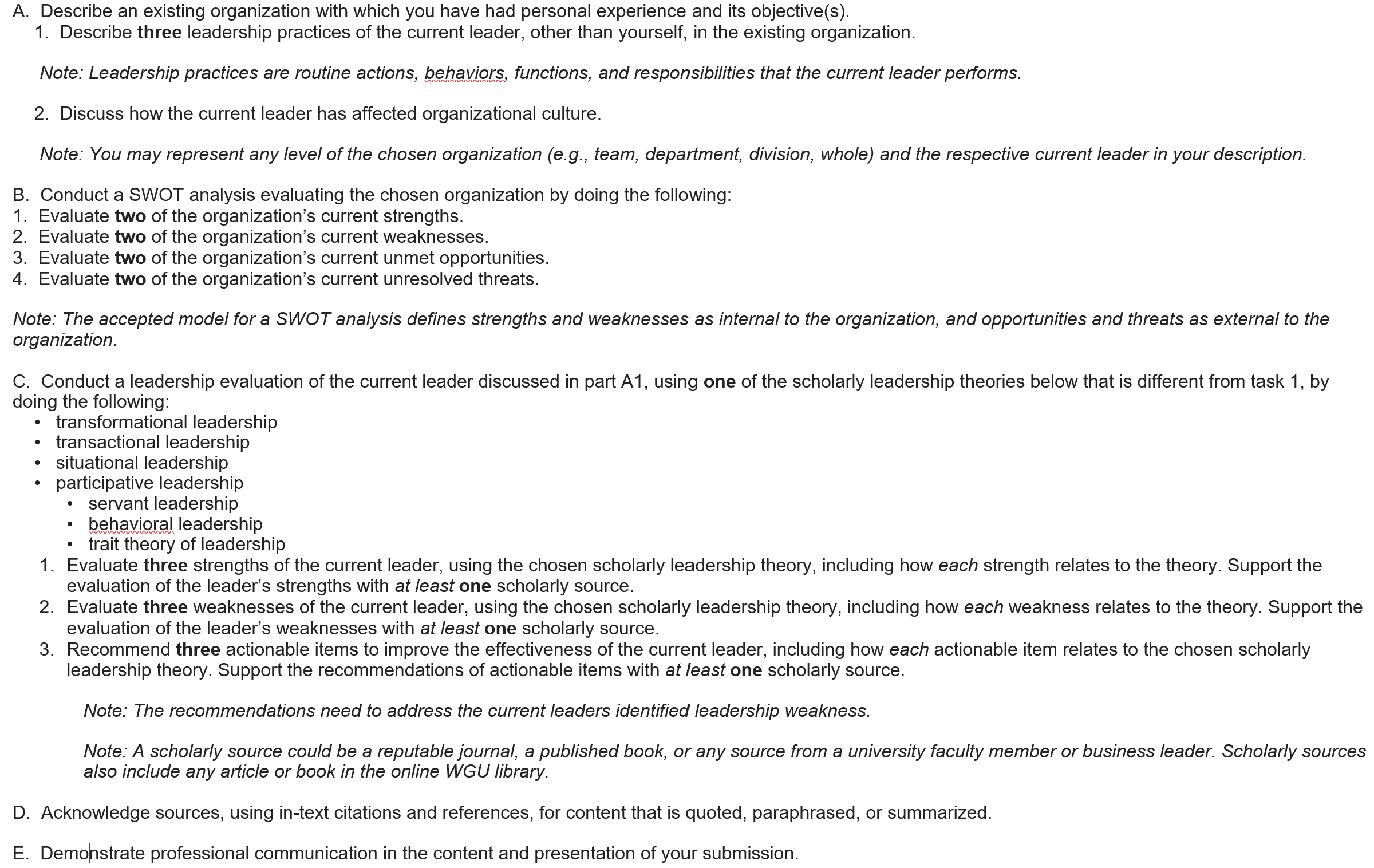
Write a paper (suggested length of 10–16 pages) by doing the following:

Who This Task Is Actually For
C200 sits inside WGU’s MBA curriculum, and DCM2 Task 2 shows up for a wide range of students, healthcare backgrounds are common, but so are retail, logistics, education, nonprofit, and manufacturing backgrounds. The organization you choose should be whatever workplace, volunteer role, or community group you personally know well enough to describe from the inside, not necessarily a clinical setting. This guide uses two fictitious examples, a healthcare unit and a community nonprofit, precisely because the strongest submissions come from whatever organization you actually have direct experience with, not from copying a healthcare-specific template onto an organization you’ve never worked in.
Part A: Organizational Description
Step 1: Choose Your Organization Strategically
Your organization needs to satisfy three conditions at once:
- You have direct personal experience with it, you worked there, volunteered, were a patient, a student, or a regular member
- You can describe its culture, leadership, and operations from firsthand knowledge, not news coverage or a company’s marketing material
- You can write about it without revealing confidential, proprietary, or personally identifiable information
The best fit is usually somewhere you were a staff member or regular participant, a job, internship, volunteer role, community organization, or religious institution all qualify.
The level you choose matters. You don’t need to analyze an entire organization. A specific team, department, unit, or division is fine, and usually gives you richer, more specific detail to write about than trying to describe an organization broadly. Rather than describing an entire 500-person company, describe the department where you worked.
Step 2: Write the Organizational Description (Requirement A)
Your description needs to accomplish three things: establish what the organization is, convey that you experienced it firsthand, and introduce its objectives. Aim for three to five paragraphs.
Include:
- Type of organization, healthcare provider, nonprofit, retail, manufacturing, education, and so on
- Mission or purpose, what it does and who it serves
- Scale, approximate size at the level you’re analyzing, staff count, clients served, geographic reach
- Your personal relationship to it, your role, how long you were involved, how you interacted with it
- Its primary objectives, the stated or operational goals driving the organization
Write in first person where it makes sense. A phrase like “during my three years as a floor technician in this department” establishes personal experience directly. A generic third-person description that reads like an “About Us” page won’t score well.
What not to do: don’t write what the organization claims about itself publicly. Describe what you personally observed, participated in, and experienced.
Illustrative example (fictitious organization).
“Clearwater Regional Medical Center is a mid-sized nonprofit community hospital serving a largely rural population in the southeastern United States. During my two years as a registered nurse on the cardiac care unit, I worked alongside a team of approximately 22 nurses, three advanced practice providers, and a rotating group of attending physicians under the direct supervision of a nurse manager I’ll refer to as Ms. Rivera. The unit’s primary objective was delivering evidence-based cardiac care to patients with acute and chronic cardiovascular conditions, with secondary goals of reducing 30-day readmission rates and improving patient satisfaction scores.”
A second illustrative example, different industry (fictitious organization).
“Harborview Youth Alliance is a small nonprofit providing after-school mentorship and tutoring services to middle school students in a mid-sized urban district. During my eighteen months as a volunteer program coordinator, I worked directly with a staff of six part-time mentors under the direction of an executive director I’ll refer to as Mr. Okafor. The organization’s core objective was improving academic outcomes and school attendance among at-risk youth, with a secondary goal of expanding mentor capacity to reduce the program’s waitlist.”
Step 3: Describe Three Leadership Practices of the Current Leader (Requirement A1)
Describe three specific, observable leadership practices of one named leader (using their fictional name). The rubric defines leadership practices as routine actions, behaviors, functions, and responsibilities, what does this person actually do on a regular basis, not their personality traits or biography.
Strong practice examples:
- Conducts a 10-minute team huddle each morning before shift to communicate priorities
- Personally reviews all incident reports within 24 hours and meets individually with involved staff
- Holds monthly one-on-one development conversations with each team member
- Adjusts staffing schedules in real time based on daily demand
- Facilitates a monthly improvement meeting open to all staff
Weak practice examples to avoid:
- “Is a good communicator”, that’s a trait, not a practice
- “Cares about the team”, that’s a personality description
- “Leads the department”, that’s a job title, not a practice
For each of the three practices, write two to three sentences: name the practice, describe how it’s carried out, and note its purpose or effect.
Step 4: Discuss How the Current Leader Has Affected Organizational Culture (Requirement A2)
This is a separate discussion from the three practices, though it can reference them. Organizational culture covers shared values, norms, unwritten rules, communication patterns, morale, and team identity.
Your discussion should address what the culture is like under this leader’s influence, specific examples of how their behavior shaped that culture, and whether the effect has been positive, negative, or mixed. Honest analysis is fine here, this isn’t a recommendation letter.
Illustrative example.
“Ms. Rivera’s consistent practice of publicly acknowledging staff contributions in team huddles cultivated a culture of recognition within the unit. Staff routinely cited that appreciation as a reason they stayed despite competitive offers elsewhere. However, her reluctance to address interpersonal conflicts directly, often deflecting grievances toward HR rather than facilitating resolution at the unit level, created pockets of unresolved tension that periodically surfaced as reduced collaboration between shift teams.”
Part B: SWOT Analysis
Step 5: Master the SWOT Definitions Before Writing
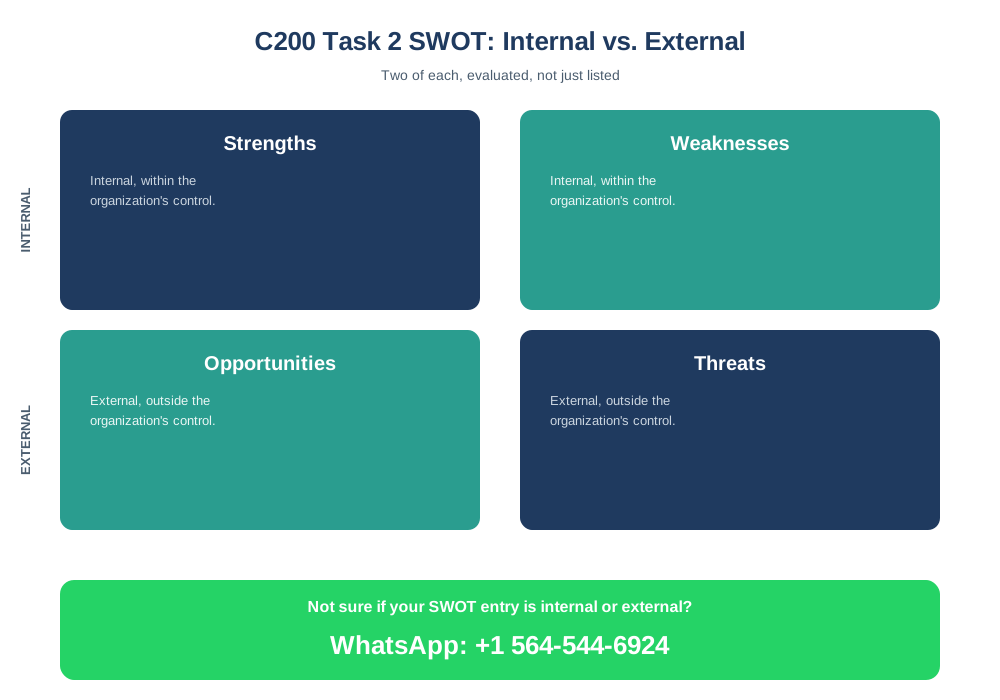
The rubric is explicit about the model it expects:
| Category | Internal or External | Definition |
|---|---|---|
| Strengths | Internal | Positive attributes the organization controls |
| Weaknesses | Internal | Negative attributes the organization controls |
| Opportunities | External | Outside factors the organization could leverage |
| Threats | External | Outside factors that could harm the organization |
The single most common failure in this section is listing an external factor as a strength or weakness. “A growing population in our service area” is an opportunity, you don’t control it. “Our experienced staff” is a strength, it’s internal and within the organization’s control.
Step 6: Write Two Strengths (Requirement B1)
Each strength needs to be internal, observable from your own experience, and evaluated rather than just listed, explain why it’s a strength and what evidence supports it.
Illustrative example.
“A significant internal strength of the cardiac care unit is its low staff turnover. During my two-year tenure, fewer than three nurses left the unit voluntarily, compared to a hospital-wide average that included several units with annual turnover exceeding 20%. This stability gives the unit a deeply experienced workforce that functions cohesively under pressure, reduces onboarding costs, and maintains consistent care standards, a genuine operational advantage internal to this team.”
Step 7: Write Two Weaknesses (Requirement B2)
Same structure, but analyzing internal limitations. Be specific and direct, a vague weakness like “communication could be improved” won’t pass. Name the specific gap, how you observed it, and its operational consequence.
Illustrative example.
“A notable internal weakness is the unit’s continued reliance on paper-based documentation for a subset of care protocols that hadn’t yet migrated to the electronic health record system. During shift handoffs, nurses routinely cross-referenced physical binders and digital records simultaneously, increasing the likelihood of transcription errors and extending handoff duration. This dual-system workflow places an unnecessary cognitive burden on staff and represents a vulnerability entirely within the organization’s capacity to address.”
Step 8: Write Two Opportunities (Requirement B3)
Opportunities are external, trends, market conditions, regulatory changes, demographic shifts, or community needs the organization hasn’t yet fully leveraged.
Illustrative example.
“An unmet external opportunity exists in expanding federal telehealth reimbursement following regulatory changes in recent years. The unit currently provides all follow-up cardiac consultations in person, despite a significant portion of patients living more than 45 minutes from the facility. Expanding into reimbursable telehealth for post-discharge follow-up could reduce readmissions, improve access for rural patients, and generate additional reimbursable encounters, an external opening the organization hasn’t yet pursued.”
Step 9: Write Two Threats (Requirement B4)
Threats are external forces outside the organization’s direct control that could harm its performance or mission.
Illustrative example.
“A persistent external threat is the regional staffing shortage, which has intensified across the region over the past several years. Competing organizations nearby have begun offering incentives the organization currently doesn’t match. While the unit’s internal culture has helped retain existing staff, these external labor market conditions represent a real risk to future recruitment and could erode the workforce stability that currently constitutes the unit’s most important strength.”
Part C: Leadership Evaluation Using a Scholarly Theory
Step 10: Select Your Theory (Must Differ From Task 1)
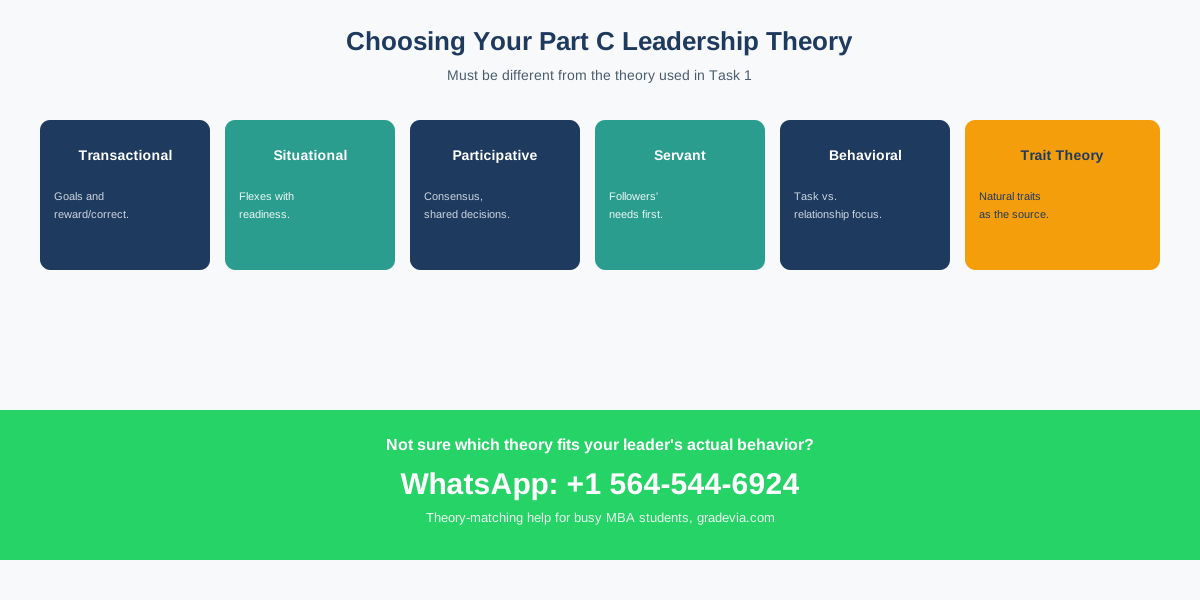
Choose the theory that best fits the leader’s observable behaviors from Part A.
| If the leader’s practices involve | Consider this theory |
|---|---|
| Setting goals and rewarding or correcting performance | Transactional leadership |
| Flexibility based on employee readiness | Situational leadership |
| Group consensus and shared decision-making | Participative leadership |
| Putting followers’ needs first | Servant leadership |
| Specific observable behaviors and task/relationship balance | Behavioral leadership |
| Natural personal traits as the source of effectiveness | Trait theory |
| Vision, inspiration, intellectual challenge | Transformational leadership, only if not already used in Task 1 |
Servant leadership and situational leadership tend to be the two strongest second choices for students who used transformational leadership in Task 1. Both have rich scholarly support and map easily onto healthcare, nonprofit, and retail settings alike.
Step 11: Evaluate Three Strengths of the Current Leader (Requirement C1)
This evaluates the leader from Part A, not yourself. For each strength: name it and describe observable evidence, connect it explicitly to a component of your chosen theory, and cite a scholarly source supporting why that quality matters within the theory.
Illustrative example, Situational Leadership (Hersey and Blanchard).
“One of Ms. Rivera’s observable strengths is her ability to calibrate the level of direction she provides based on each team member’s demonstrated competency and confidence. New graduate nurses consistently received structured orientation check-ins with detailed guidance, while seasoned nurses were given significant autonomy over their patient assignments. This pattern aligns directly with the Situational Leadership model’s core principle that effective leaders match their style to each follower’s developmental level (Hersey et al., 2013). Leaders who demonstrate this adaptive flexibility tend to generate higher follower satisfaction and role clarity than those applying a uniform style across all team members (Thompson & Glasø, 2015).”
Step 12: Evaluate Three Weaknesses of the Current Leader (Requirement C2)
Same structure. Be specific, anchor it to the theory, and cite a source.
As you write these weaknesses, think ahead to what a realistic improvement could look like for each one. C3 needs to directly address the weaknesses you name here, writing a weakness with no plausible solution creates a mismatch evaluators will flag.
Illustrative example, Situational Leadership.
“A notable weakness is Ms. Rivera’s tendency to default to a high-directive, low-support style during high-census periods, even with experienced staff who’ve demonstrated mastery of the relevant tasks. The Situational Leadership model identifies this as a style mismatch, applying a directive style to individuals at a high developmental level undermines their autonomy and signals distrust in their judgment (Blanchard et al., 2013). Several experienced nurses described the manager’s increased directive presence during busy shifts as feeling micromanaging rather than supportive, precisely the follower response the theory predicts under mismatch conditions.”
Step 13: Recommend Three Actionable Items (Requirement C3)
Each recommendation needs to directly address one of the three C2 weaknesses, be specific and concrete rather than vague advice, connect explicitly to the theory, and be supported by at least one scholarly source.
Illustrative example, addressing the style mismatch above.
“To address the leadership style mismatch identified above, Ms. Rivera should implement a brief self-assessment practice, evaluating each team member’s developmental level at the start of a shift and consciously selecting the corresponding leadership approach from the Situational Leadership framework’s four styles. Blanchard and colleagues (2013) recommend leaders use developmental conversations with followers to collaboratively identify the most appropriate style, rather than relying on intuitive judgment under stress. Formalizing this check, even as a brief mental protocol before rounding, would reduce reactive style mismatches and model the intentional, follower-centered practice the theory prescribes as essential to leadership effectiveness.”
Part D and E: Citations and Professional Communication
Citation and Sourcing Requirements
- Use APA 7th edition for all in-text citations and references
- You need at least one scholarly source each for C1, C2, and C3
- In practice, four to six unique peer-reviewed sources across Part C makes for a stronger submission
- Every paraphrase, summary, or direct quote needs a citation
- Sources from Task 1 can be reused if your theory allows it, but including two or three sources specific to your new theory strengthens the analysis
Recommended sources by theory:
For servant leadership: Greenleaf (1977); Northouse (2021), chapter 10; van Dierendonck (2011) in Journal of Management.
For situational leadership: Hersey, Blanchard, and Johnson (2013), Management of Organizational Behavior; Northouse (2021), chapter 5; Thompson and Glasø (2015) in Leadership & Organization Development Journal.
For transactional leadership: Bass and Riggio (2006); Burns (1978); Judge and Piccolo (2004) in Journal of Applied Psychology.
For participative leadership: Vroom and Yetton (1973); Yukl (2013), Leadership in Organizations; Northouse (2021), chapter 6.
For behavioral leadership: Stogdill and Coons (1957); Blake and Mouton (1964); Northouse (2021), chapter 4.
For trait theory: Stogdill (1948/1974); Judge et al. (2002) in Journal of Applied Psychology; Northouse (2021), chapter 2.
Professional Communication (Requirement E)
- Write in a clear, formal academic register throughout, no slang, contractions, or casual phrasing
- Use third person for the leader (Ms. Rivera demonstrated), first person for your own observations (during my tenure, I observed)
- Write each section as connected prose paragraphs, not disconnected bullet lists
- Proofread for grammar, spelling, and APA formatting before submission
- Use clear section headers aligned to the rubric labels, A, A1, A2, B1 through B4, C1 through C3
Complete Paper Structure at a Glance
APA Title Page
Introduction (one paragraph, what organization, what leader, what theory)
A. Organization Description
Type, mission, scale, your personal experience, and objectives
A1. Three Leadership Practices of the Current Leader
Practice 1, 2, 3, each with name, description, and purpose/effect
A2. Leader’s Effect on Organizational Culture
What the culture is like, how the leader shaped it, and evidence
B. SWOT Analysis
B1, B2. Two strengths, internal, description, evidence, why it matters
B3, B4. Two weaknesses, internal, description, evidence, consequence
B5, B6. Two opportunities, external, what it is, why unmet, how to leverage
B7, B8. Two threats, external, what it is, why unresolved, potential impact
C. Leadership Evaluation of the Current Leader Using Your Chosen Theory
C1. Three strengths, observable evidence, theory component, citation
C2. Three weaknesses, observable evidence, theory component, consequence, citation
C3. Three actionable items, each addressing a C2 weakness, theory link, citation
Conclusion (one short paragraph)
References (APA 7, hanging indent)
Top Reasons WGU C200 Task 2 Papers Get Returned
- SWOT internal/external rule violated, an external factor under strengths, or an internal factor under threats, is a near-guaranteed revision.
- Leadership practices that are actually traits. “She is compassionate” isn’t a practice, “she conducts weekly patient safety rounds focused on staff wellbeing” is.
- The same theory as Task 1, verify before you write, this is checked closely.
- C3 actions that don’t address C2 weaknesses. The rubric explicitly requires this connection, misaligned recommendations get flagged.
- An organization description that lacks firsthand voice. It reads like a company profile instead of personal observation.
- Real names or identifying details left in. Anonymization is a rubric requirement, failing to anonymize can get the task returned without evaluation.
- Fewer than the required number of items. Exactly two per SWOT category, exactly three per leadership evaluation section, one short is an automatic revision.
Sample Citation Reference Table
| Citation | Theory/Section | Access |
|---|---|---|
| Northouse (2021) | All theories, A2, C | WGU Library |
| Yukl (2013) | All theories, A, B, C | WGU Library |
| Hersey et al. (2013) | Situational, C1-C3 | WGU Library |
| Thompson & Glasø (2015) | Situational, C1-C2 | Emerald (limited access) |
| Thompson & Glasø (2018) | Situational, C3 | Emerald (limited access) |
| Greenleaf (1977) | Servant, C1-C3 | Paulist Press |
| van Dierendonck (2011) | Servant, C1-C3 | Free, SAGE |
| Saleem et al. (2020) | Servant, C1, C3 | Free, open access |
| Judge & Piccolo (2004) | Transactional, C1-C3 | Journal of Applied Psychology |
| Bass & Riggio (2006) | Transactional, C | WGU Library |
| Judge et al. (2002) | Trait theory, C1-C3 | Journal of Applied Psychology |
Always confirm current WGU Library access for any source before relying on it, database availability changes over time.
WGU C200 Task 2 Requirements at a Glance
The table below summarizes the task in your own planning terms. Your current task instructions and rubric inside your WGU course remain the authoritative source, always compare this table against what’s actually displayed there.
| Part | What It Covers |
|---|---|
| A | Describe an organization you’ve personally experienced and its objectives |
| A1 | Describe three leadership practices of the current leader |
| A2 | Discuss how that leader has affected organizational culture |
| B1-B4 | SWOT analysis, two strengths, two weaknesses, two opportunities, two threats |
| C1-C3 | Leadership evaluation using a scholarly theory different from Task 1, three strengths, three weaknesses, three actionable items |
| D | In-text citations and a matching reference list |
| E | Professional communication throughout |
Frequently Asked Questions About WGU C200 Task 2
What is WGU C200 Task 2? C200 Task 2, assessment code DCM2, is a performance assessment in Managing Organizations and Leading People asking you to describe an organization you’ve personally experienced, perform a SWOT analysis on it, and evaluate its current leader using a scholarly leadership theory different from the one you used in Task 1.
What is DCM2 Task 2 Organization and Leadership Evaluation? It’s the same assessment as C200 Task 2, DCM2 is the internal assessment code some students see attached to it inside their WGU dashboard, while C200 is the public course code.
Is there a WGU C200 Task 2 example? This guide includes original, clearly fictitious illustrative examples throughout, from a healthcare unit and a nonprofit organization, to show how the reasoning and structure come together. Never submit an example as your own work, your organization and observations need to be genuinely yours.
Are there C200 Task 2 answers or a completed C200 Task 2 pdf available anywhere reliable? No verified official answer key exists, and searching for one, or browsing C200 Task 2 results on Studocu or C200 Task 2 threads on Reddit, generally turns up other students’ organization-specific papers that can’t ethically or practically be repurposed for your own experience anyway, since your organization, leader, and observations need to be your own. Working from your own firsthand knowledge with a clear planning framework produces a stronger, more defensible submission than trying to adapt someone else’s paper.
What are the most common C200 Task 2 questions students have? Which theory to choose, how the SWOT internal/external rule works, how many sources are actually required, and what to do if the task is returned for insufficient detail, all covered above.
How is C200 Task 2 different from C200 Task 1? Task 1 evaluates you as a leader using a chosen theory. Task 2 evaluates someone else, the current leader of a real organization you’ve experienced, using a different theory than the one you used in Task 1. If you’re still working on Task 1, see our guide to WGU C200 Task 1.
Can someone help me with my WGU C200 Task 2 paper? Yes. Legitimate academic support, rubric breakdowns, organization and theory selection help, draft review, and APA checks, is different from having someone write the paper for you. Message Gradevia on WhatsApp for planning support built around your own organization and observations.
Working Full-Time and Stuck on WGU C200 Task 2?
You don’t need someone to write this paper for you as much as you need help turning your own workplace observations into a structure that satisfies every rubric line. Message Gradevia on WhatsApp at +1 564-544-6924 and tell us where you’re stuck, whether that’s choosing your theory, wording your SWOT entries correctly, or tightening your APA citations before submission.
References
- Cai, M., Wang, M., & Cheng, J. (2024). The effect of servant leadership on work engagement: The role of employee resilience and organizational support. Behavioral Sciences, 14(4), 300. https://doi.org/10.3390/bs14040300
- Pasaribu, S. B., Goestjahjanti, F. S., Srinita, S., Novitasari, D., & Haryanto, B. (2022). The role of situational leadership on job satisfaction, organizational citizenship behavior (OCB), and employee performance. Frontiers in Psychology, 13, 896539. https://doi.org/10.3389/fpsyg.2022.896539
- Dhlamini, J. (2025). Setting the strategic direction: The role of the mission, vision, values statements and strategic leadership. Journal of Strategy and Management, 18(3), 591-615. https://doi.org/10.1108/JSMA-08-2024-0193
- Larabi, C. (2025). Organizational culture as driver of strategy implementation success: Managerial perspective. Corporate and Business Strategy Review, 6(4), 54-64. https://doi.org/10.22495/cbsrv6i4art5
- Abu Bakir, S. M. (2023). Impact of strategic analysis (SWOT) on the performance of Jordanian public shareholding industrial companies: The mediating role of scenario planning. International Journal of Sustainable Development and Planning, 18(5), 1535-1543. https://doi.org/10.18280/ijsdp.180524