
Blog
MSN 572 HEENT and Neurological SOAP Note: Complete Guide + Example Notes

MSN 572 HEENT and Neuro SOAP Note Guide
MSN 572 HEENT or neurological SOAP note is a structured clinical document with four sections — Subjective, Objective, Assessment, and Plan — that synthesizes your Shadow Health or video exam findings into a formal diagnostic write-up. These are assigned in Weeks 4 and 6 of MSN 572 at United States University (USU) and require precise clinical language, an accurate differential diagnosis, and an evidence-based plan of care.
If you are unsure how to structure your SOAP note, what belongs in each section, or how to avoid the most common point deductions, this guide walks through both the HEENT and neurological formats step by step, with a complete sample note for reference.
What Is a SOAP Note and Why Does MSN 572 Require It?
A SOAP note is a standardized clinical documentation format — Subjective, Objective, Assessment, Plan — first developed by Dr. Lawrence Weed as part of the Problem-Oriented Medical Record. It is the universal language of clinical reasoning: subjective and objective data lead to a diagnostic assessment, which in turn justifies a treatment plan.
In MSN 572, the SOAP note format is used specifically for Weeks 4 (HEENT) and 6 (Neurological), distinguishing it from the simpler objective-only write-ups required in Weeks 3, 5, and 7. The SOAP format demonstrates your ability to move beyond data collection into actual clinical decision-making — the core skill advanced practice nursing programs are built to assess.
How Is a SOAP Note Different From a Body System Write-Up?
A body system write-up documents only objective physical exam findings, while a SOAP note requires a full subjective history, an assessment with differential diagnoses, and a complete plan of care. Students sometimes submit a write-up when a SOAP note is required (or vice versa), which results in significant point deductions. Always confirm which format your specific week requires before starting.
How Do You Structure the Subjective Section?
The Subjective section documents everything the patient reports in their own words, organized into chief complaint, history of present illness, and a complete review of systems.
A strong Subjective section includes:
- Chief Complaint (CC): The patient’s reason for the visit, quoted directly in their own words.
- History of Present Illness (HPI): Use OLDCARTS (Onset, Location, Duration, Characteristics, Aggravating factors, Relieving factors, Timing, Severity) to structure a complete narrative.
- Past Medical History (PMH) and Past Surgical History (PSH): Relevant diagnoses, hospitalizations, and prior procedures.
- Medications and Allergies: Include dosage, frequency, and the specific type of allergic reaction.
- Family History (FH): Particularly relevant for neurological complaints — stroke, migraine, and seizure disorders often run in families.
- Social History (SH): Occupation, substance use, living situation, and support system.
- Review of Systems (ROS): A systematic head-to-toe symptom inventory, even for a focused complaint. Most rubrics require ROS for at least 8-10 systems.
How Do You Document the Objective HEENT Exam?
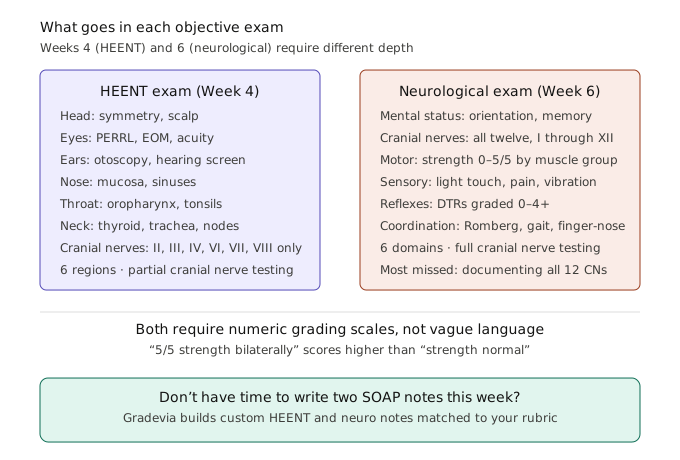
The Objective HEENT exam documents measurable findings from inspection, palpation, and instrument-assisted examination of the head, eyes, ears, nose, and throat.
A complete HEENT objective exam typically includes:
- Head: Normocephalic, atraumatic; symmetry; scalp inspection.
- Eyes: PERRL (Pupils Equal, Round, Reactive to Light), EOM (Extraocular Movements) intact, visual acuity, conjunctivae and sclerae, fundoscopic findings if performed.
- Ears: Otoscopic exam — tympanic membrane color, landmarks, light reflex; gross hearing screen (whisper test or Weber/Rinne if indicated).
- Nose: Nasal mucosa color, septum position, presence of discharge or polyps, sinus tenderness.
- Throat/Oral Cavity: Oropharynx, tonsils, dentition, mucous membrane moisture, any lesions.
- Neck: Trachea midline, thyroid palpation for size/nodules, lymph node survey (submandibular, cervical, supraclavicular).
What Cranial Nerves Are Relevant to a HEENT Exam?
Even though HEENT is not a full neuro exam, several cranial nerves are directly assessed: CN II (visual acuity, pupillary response), CN III, IV, VI (extraocular movements), CN VII (facial symmetry), and CN VIII (hearing). Document each one explicitly rather than grouping them as a single vague statement.
How Do You Document the Objective Neurological Exam?
The objective neurological exam is documented systematically across six domains: mental status, cranial nerves, motor function, sensory function, reflexes, and coordination/gait.
Each domain should be addressed explicitly, even when normal, because omission is interpreted as an incomplete exam rather than a normal finding:
| Domain | What to Document |
| Mental Status | Orientation (person, place, time, situation), memory, attention span, speech fluency. |
| Cranial Nerves | All 12 nerves individually, even when grouped findings are normal — e.g. CN I-XII grossly intact. |
| Motor | Muscle bulk, tone, and strength graded 0-5/5 by muscle group, bilaterally. |
| Sensory | Light touch, pain, vibration, and proprioception; note any dermatomal patterns. |
| Reflexes | Deep tendon reflexes graded 0-4+ (biceps, triceps, brachioradialis, patellar, Achilles), plus Babinski if indicated. |
| Coordination/Gait | Romberg, finger-to-nose, rapid alternating movements, heel-to-shin, gait observation. |
What Grading Scales Should You Use?
Use standardized numeric scales rather than subjective descriptions. Muscle strength is graded 0-5/5; deep tendon reflexes are graded 0-4+; consciousness can be described using the Glasgow Coma Scale when relevant. These scales are what reviewers and rubrics specifically look for — vague language like “strength normal” costs points compared to “5/5 strength bilaterally in upper and lower extremities.”
How Do You Write the Assessment Section?
The Assessment section presents your clinical diagnosis or differential diagnoses, each supported by specific subjective and objective findings from the note above it.
A strong Assessment section follows this structure for each diagnosis:
- Diagnosis with ICD-10 code: State the diagnosis clearly with its corresponding code, e.g., “Acute pharyngitis (J02.9).”
- Supporting evidence: Cite the specific subjective and objective findings that support this diagnosis — do not just restate the diagnosis without justification.
- Differential diagnoses: List at least 2-3 alternative diagnoses that were considered and explain why they were ruled out or remain possible.
Why Do Differential Diagnoses Matter So Much in Grading?
Differential diagnoses demonstrate clinical reasoning — the core competency advanced practice nursing programs are designed to build — and most rubrics weight this component heavily. A note that lists only one diagnosis without considering alternatives reads as a conclusion without reasoning, which is precisely what graduate-level rubrics are built to catch.
How Do You Write the Plan Section?
The Plan section translates your assessment into specific, actionable clinical steps across five categories: diagnostics, treatment, patient education, referrals, and follow-up.
- Diagnostics: Labs, imaging, or additional testing needed to confirm or rule out your differential diagnoses.
- Pharmacologic treatment: Specific medication, dose, route, frequency, and duration — not just a drug class.
- Non-pharmacologic treatment: Lifestyle modification, physical therapy, dietary changes, or other supportive measures.
- Patient education: What you taught the patient and confirmation they understood (“patient verbalized understanding”).
- Follow-up and referrals: Specific timeframe (“follow up in 2 weeks”) and any specialist referrals with rationale.
Sample HEENT SOAP Note (Week 4 Format)
| Patient | M.R. | 34-year-old Hispanic male |
| Visit Type | HEENT-focused complaint visit |
| Provider | Advanced Practice Nursing Student — MSN 572, USU |
S — Subjective
CC: “My throat has been sore and I have had a stuffy nose for about five days.”
HPI: M.R. is a 34-year-old Hispanic male presenting with a five-day history of sore throat and nasal congestion. Symptoms began gradually and have progressively worsened. He describes the throat pain as a 4/10, sharp with swallowing, worse in the morning. Associated symptoms include clear rhinorrhea, mild headache, and low-grade subjective fever. He denies cough, shortness of breath, ear pain, or rash. He has tried over-the-counter acetaminophen with minimal relief. No sick contacts reported at home; reports a coworker with similar symptoms last week.
Medications: Acetaminophen 500 mg PO PRN for pain/fever. No other prescription medications.
Allergies: No known drug allergies (NKDA). No known food or environmental allergies.
PMH: Seasonal allergic rhinitis. No history of recurrent strep throat or tonsillitis.
PSH: Tonsillectomy and adenoidectomy at age 7.
FH: Father: hypertension. Mother: type 2 diabetes. No family history of autoimmune or hematologic disease.
SH: Works as a warehouse supervisor. Non-smoker. Drinks alcohol socially, 1-2 drinks per week. Married, lives with spouse and two children. Exercises 2-3 times weekly.
ROS: Constitutional: Reports mild subjective fever, denies chills or night sweats. HEENT: Positive for sore throat, nasal congestion, mild headache; denies ear pain, vision changes, or dysphagia to solids. Respiratory: Denies cough, dyspnea, wheezing. Cardiovascular: Denies chest pain, palpitations. GI: Denies nausea, vomiting, abdominal pain. Musculoskeletal: Denies myalgia beyond mild generalized fatigue. Skin: Denies rash. Psychiatric: Denies anxiety or mood changes.
O — Objective
Vital Signs: Temp 99.6°F (37.6°C); HR 84 bpm; RR 16/min; BP 118/76 mmHg; SpO2 98% on room air; Pain 4/10.
General Survey: Alert, oriented, well-groomed male in no acute distress. Speaks in full sentences without difficulty.
Head: Normocephalic, atraumatic. No scalp lesions or tenderness.
Eyes: PERRL bilaterally. EOM intact in all six cardinal fields without nystagmus. Conjunctivae clear, sclerae white. No periorbital edema.
Ears: Tympanic membranes pearly gray bilaterally with visible light reflex and intact landmarks. No erythema or effusion. Gross hearing intact to whisper test bilaterally.
Nose: Nasal mucosa erythematous and edematous bilaterally with clear, watery discharge. Septum midline. Mild tenderness to palpation over bilateral maxillary sinuses. No nasal polyps.
Throat/Oral Cavity: Oropharynx erythematous with mild tonsillar erythema; no exudate, no tonsillar enlargement (tonsils absent — surgical history). Mucous membranes moist. No oral lesions. Uvula midline.
Neck: Trachea midline. Thyroid non-tender, no palpable nodules or enlargement. Mild bilateral anterior cervical lymphadenopathy, tender to palpation, approximately 1 cm, mobile.
Relevant Cranial Nerves: CN II: visual acuity grossly intact. CN III, IV, VI: EOM intact, no diplopia. CN VII: facial symmetry intact, no droop. CN VIII: hearing grossly intact bilaterally.
A — Assessment
- Acute viral rhinopharyngitis / common cold (J00): Supported by gradual symptom onset over five days, clear rhinorrhea, mild low-grade fever, and absence of tonsillar exudate. Most consistent with viral upper respiratory infection given the symptom pattern and lack of high fever or purulent findings.
- Differential — Streptococcal pharyngitis (J02.0): Considered given sore throat and cervical lymphadenopathy, but less likely given absence of tonsillar exudate, absence of high fever (>101°F), and absence of absence of cough is a Centor criterion favoring strep — however, the presence of rhinorrhea favors a viral etiology. Centor criteria suggest low-to-moderate probability; rapid strep testing may be considered if symptoms worsen.
- Differential — Acute bacterial sinusitis (J01.90): Considered due to maxillary sinus tenderness, but symptom duration of five days is below the 10-day threshold typically required to favor bacterial over viral sinusitis per clinical guidelines.
P — Plan
- Supportive care: increase fluid intake, rest, and use of saline nasal spray for congestion.
- Continue acetaminophen 500-1000 mg PO every 6 hours PRN for pain/fever, not to exceed 3000 mg/day.
- Consider rapid strep antigen test if symptoms worsen or fever increases above 101°F within 48 hours.
- Patient educated on red flag symptoms warranting return: difficulty swallowing, difficulty breathing, high fever, or symptoms persisting beyond 10 days.
- Educated on hand hygiene and respiratory etiquette to reduce household transmission risk.
- Follow up in 7-10 days if symptoms persist or worsen, or sooner if red flag symptoms develop.
- Patient verbalized understanding of supportive care plan and return precautions.
Sample Neurological SOAP Note (Week 6 Format)
| Patient | J.K. | 47-year-old Caucasian female |
| Visit Type | Neurological-focused complaint visit |
| Provider | Advanced Practice Nursing Student — MSN 572, USU |
S — Subjective
CC: “I have been getting bad headaches almost every week for the past two months.”
HPI: J.K. is a 47-year-old female presenting with recurrent headaches occurring approximately 2-3 times per week over the past two months. She describes the pain as unilateral, throbbing, located in the right temporal region, rated 7/10 at peak intensity. Episodes last 4-6 hours and are associated with photophobia, phonophobia, and occasional nausea without vomiting. She reports visual aura — shimmering zigzag lines — preceding some episodes by 15-20 minutes. Triggers include stress, poor sleep, and skipping meals. She denies fever, neck stiffness, weakness, numbness, or speech difficulty. No recent head trauma.
Medications: Ibuprofen 400 mg PO PRN, used 3-4 times weekly with diminishing effectiveness. No daily prophylactic medication.
Allergies: NKDA.
PMH: Hypertension, well-controlled. No history of stroke, seizure disorder, or head injury.
FH: Mother has history of migraine headaches. No family history of stroke, epilepsy, or aneurysm.
SH: Works as a high school teacher, reports significant work-related stress this semester. Non-smoker. Caffeine intake 2-3 cups coffee daily. Sleep averages 5-6 hours nightly.
ROS: Neurological: Positive for headache and visual aura; denies weakness, numbness, tingling, loss of consciousness, or speech difficulty. Constitutional: Denies fever, weight change. HEENT: Denies vision loss (aura resolves fully), denies hearing changes. Cardiovascular: Denies chest pain, palpitations. Psychiatric: Reports increased stress; denies depression or anxiety diagnosis.
O — Objective
Vital Signs: BP 132/84 mmHg; HR 76 bpm; RR 14/min; Temp 98.4°F; SpO2 99% on room air; Pain 2/10 at time of visit (between episodes).
Mental Status: Alert and oriented x4. Speech fluent and coherent. Attention and short-term memory intact (recalled 3/3 objects at 5 minutes). No cognitive deficits noted.
Cranial Nerves: CN I: not tested (not clinically indicated). CN II: visual acuity 20/20 bilaterally, visual fields full to confrontation. CN III, IV, VI: EOM intact in all fields, no nystagmus, PERRL bilaterally. CN V: facial sensation intact to light touch in all three divisions bilaterally, masseter strength symmetric. CN VII: facial symmetry intact, no droop, able to raise eyebrows and smile symmetrically. CN VIII: hearing grossly intact bilaterally to whisper test. CN IX, X: palate elevates symmetrically, gag reflex intact. CN XI: shoulder shrug and head turn strength 5/5 bilaterally. CN XII: tongue protrudes midline without deviation.
Motor: Muscle bulk and tone normal throughout. Strength 5/5 bilaterally in all major muscle groups, upper and lower extremities, including grip, biceps, triceps, hip flexion, knee extension, and ankle dorsiflexion. No pronator drift.
Sensory: Light touch, pain, and vibration sensation intact and symmetric bilaterally in upper and lower extremities. Proprioception intact.
Reflexes: Deep tendon reflexes 2+ and symmetric bilaterally: biceps, triceps, brachioradialis, patellar, Achilles. Babinski downgoing bilaterally.
Coordination/Gait: Romberg negative. Finger-to-nose intact bilaterally without dysmetria. Rapid alternating movements intact. Heel-to-shin intact bilaterally. Gait steady with normal stride, arm swing, and turning; tandem gait intact.
A — Assessment
- Migraine with aura (G43.109): Supported by unilateral throbbing headache, photophobia, phonophobia, nausea, visual aura preceding episodes, family history of migraine, and a completely normal neurological exam between episodes. The episodic pattern, trigger profile, and aura presentation are classic for migraine with aura per International Classification of Headache Disorders criteria.
- Differential — Tension-type headache (G44.209): Considered, but the presence of aura, unilateral location, throbbing quality, and associated photophobia/phonophobia are inconsistent with the typically bilateral, pressing quality of tension headache.
- Differential — Secondary headache due to intracranial pathology: Considered given new-onset frequent headaches, but ruled out as a high-probability concern given the completely normal neurological exam, absence of red flag features (no fever, no focal deficits, no papilledema symptoms, gradual onset over months rather than sudden “thunderclap” onset), and a pattern fully consistent with primary migraine.
P — Plan
- Initiate migraine-specific abortive therapy: sumatriptan 50 mg PO at headache onset, may repeat once after 2 hours if needed, not to exceed 200 mg/day.
- Discontinue frequent NSAID use to reduce risk of medication-overuse headache; limit ibuprofen to no more than 2 days per week.
- Headache diary recommended to track frequency, triggers, and response to treatment for 4-6 weeks.
- Counsel on trigger management: regular sleep schedule (7-8 hours nightly), consistent meal timing, stress reduction strategies, and caffeine moderation.
- If migraine frequency remains at or above 4 episodes per month at follow-up, consider initiating daily prophylactic therapy (e.g., propranolol or topiramate).
- Educated on red flag symptoms requiring immediate evaluation: sudden severe “thunderclap” headache, fever with neck stiffness, focal neurological deficits, or change in consciousness.
- Follow-up in 4-6 weeks to reassess headache frequency and treatment response; sooner if red flag symptoms develop.
- Patient verbalized understanding of trigger avoidance, medication regimen, and return precautions.
Common Mistakes That Cost Points on HEENT and Neuro SOAP Notes
The most frequent point deductions on MSN 572 SOAP notes come from incomplete differentials, vague objective findings, and a Plan section that does not logically follow from the Assessment.
- Single diagnosis with no differential: Rubrics consistently reward considering and ruling out alternative diagnoses, not just naming one condition.
- Vague objective findings: “Neuro exam normal” is insufficient. Document each cranial nerve, each reflex, and each motor group explicitly.
- Missing ICD-10 codes: Most rubrics require a code alongside each diagnosis listed in the Assessment.
- Plan that does not match the Assessment: Every element of your Plan should trace back to a specific diagnosis or differential named in your Assessment.
- Inconsistent formatting: Mixing first-person and third-person language, or switching between bullet and narrative style inconsistently, signals a rushed note.
How This Connects to Your Other MSN 572 Assignments
Your SOAP note documentation builds directly on the physical exam skills practiced in your Shadow Health Tina Jones modules and the techniques demonstrated in your head-to-toe physical assessment video. Strong performance across all three assignments reinforces the same underlying clinical reasoning skill set the course is designed to build.
Frequently Asked Questions
What is the difference between a HEENT SOAP note and a neuro SOAP note?
A HEENT SOAP note focuses on the head, eyes, ears, nose, and throat, including limited cranial nerve testing relevant to those structures. A neuro SOAP note requires a full neurological exam across six domains: mental status, all twelve cranial nerves, motor, sensory, reflexes, and coordination/gait. Both follow the same four-section SOAP structure.
How many differential diagnoses should I include in my Assessment?
Most MSN 572 rubrics expect at least 2-3 differential diagnoses per chief complaint, each supported by specific subjective and objective findings explaining why it was considered and why it was ruled in or out.
Do I need to include ICD-10 codes in my SOAP note?
Yes. Most graduate-level SOAP note rubrics require an ICD-10 code alongside each diagnosis in the Assessment section. This reflects real clinical documentation standards used in billing and coding.
Can I use the same patient case for both my HEENT and neuro SOAP notes?
Check your specific assignment instructions, but generally no — each week’s SOAP note should reflect a distinct patient encounter or case study relevant to that week’s focused body system, whether from Shadow Health, a video exam, or an assigned case study.
What is the most commonly missed component in neuro SOAP notes?
Complete documentation of all twelve cranial nerves individually is the most frequently incomplete component. Many students group findings as “cranial nerves grossly intact” without addressing each nerve, which costs points on detailed rubrics.
About the Author
Dan Palmer, MSN is a registered nurse and academic writer with over a decade of experience supporting graduate nursing students across MSN, FNP, DNP, and public health programs. He holds a Master of Science in Nursing from Walden University and an undergraduate degree from UC San Diego. Dan is the founder of Gradevia (gradevia.com), a specialized academic support service for working adult students in nursing, public health, business, and education graduate programs.
References
- American Academy of Family Physicians. (2022). Centor criteria for streptococcal pharyngitis. AAFP Clinical Practice Guidelines.
- Bickley, L. S. (2021). Bates’ guide to physical examination and history taking (13th ed.). Wolters Kluwer.
- Dains, J. E., Baumann, L. C., & Scheibel, P. (2022). Advanced health assessment and clinical diagnosis in primary care (6th ed.). Elsevier.
- International Headache Society. (2024). The International Classification of Headache Disorders (3rd ed., ICHD-3). Cephalalgia.
- Jarvis, C. (2020). Physical examination and health assessment (8th ed.). Elsevier.
- LeBlond, R. F., Brown, D. D., & DeGowin, R. L. (2020). DeGowin’s diagnostic examination (11th ed.). McGraw Hill.
- Schoen, R. T. (2020). Lyme disease: Diagnosis and treatment. Current Opinion in Rheumatology, 32(3), 247-254. https://doi.org/10.1097/BOR.0000000000000698
- Seidel, H. M., Ball, J. W., Dains, J. E., & Benedict, G. W. (2023). Mosby’s guide to physical examination (9th ed.). Elsevier.
- United States University. (2023). MSN 572: Advanced physical assessment across the lifespan — course syllabus (Version 2023-06-13). United States University School of Nursing.
- Weed, L. L. (1968). Medical records that guide and teach. New England Journal of Medicine, 278(11), 593-600. https://doi.org/10.1056/NEJM196803142781105
Article Update Log
| Date | Version | Summary |
| June 19, 2026 | 1.0 | Initial publish: full HEENT and neuro SOAP note structure guide, two complete sample notes, scoring tips, and FAQ. |