
Blog
PHI-413V Patient’s Spiritual Needs Case Analysis: Guide + Example

PHI-413V Patient’s Spiritual Needs Case Analysis: Guide + Example
The PHI-413V Patient’s Spiritual Needs: Case Analysis is the benchmark assignment in GCU’s Ethical and Spiritual Decision Making course. Built on the Healing and Autonomy case, it asks you to analyze how a physician should respond when a parent’s faith-based decisions conflict with a child’s medical needs; and specifically, how a spiritual needs assessment can bridge that gap.
This assignment is part of PHI-413V Ethical and Spiritual Decision Making in Health Care at GCU. For a complete guide to every PHI-413V assignment, see the PHI-413V complete course guide.
The deliverable has three sections: a 200–250-word response on autonomy, a 400–500-word response on the Christian worldview and medical intervention, and a 200–250-word response proposing a spiritual assessment with appropriate interventions. This guide focuses on what most students struggle with: understanding spiritual assessment tools, knowing which interventions to propose, and connecting everything back to the rubric.

What Is the Patient’s Spiritual Needs Benchmark?
The Patient’s Spiritual Needs: Case Analysis is the Topic 5 benchmark in PHI-413V that builds directly on the Topic 3 chart you completed using the “Healing and Autonomy” case study. It is worth significant points and is tied to a program competency in spiritual care.
The assignment uses the same case: Mike delays dialysis for his son James to attend a healing service, James’s condition worsens, and Mike must now consider a kidney transplant. The three questions ask you to analyze autonomy, the Christian view of sickness and medical intervention, and how a spiritual needs assessment would help the physician.
While APA style is not required for the body, solid academic writing is expected and sources must be documented in APA format.
What Is a Spiritual Needs Assessment?
A spiritual needs assessment is a structured clinical tool that helps health care providers explore a patient’s or caregiver’s faith, values, and spiritual resources so that care can address the whole person — body, mind, and spirit. It is not a religious evaluation or an attempt to change beliefs; it is a respectful inquiry that informs the plan of care.
The rubric expects you to name and describe a specific tool. The two most commonly used in nursing are:
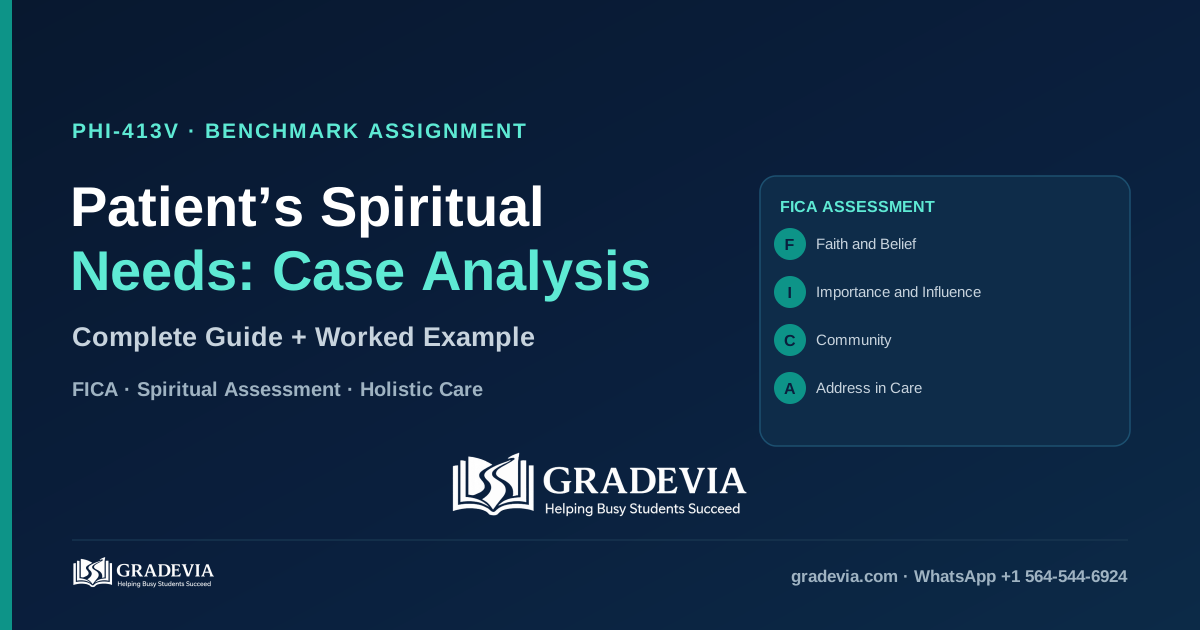
The FICA Spiritual History
Developed by Dr. Christina Puchalski, FICA stands for:
- F — Faith and Belief: What gives the patient’s life meaning? Do they consider themselves spiritual or religious?
- I — Importance and Influence: How important is faith in the patient’s life? How does it influence health decisions?
- C — Community: Is the patient part of a faith community? Does that community provide support?
- A — Address in Care: How would the patient like spiritual issues addressed in their health care?
For Mike, FICA would reveal that his decision to delay treatment stems from sincere faith in divine healing, that his church community is a major source of support, and that he wants his spiritual values honored — not dismissed — in James’s care.
The HOPE Assessment
An alternative tool with four domains:
- H — Sources of Hope: What gives the patient hope, strength, and comfort?
- O — Organized Religion: Is the patient part of an organized faith community?
- P — Personal Spirituality: What personal spiritual practices matter to the patient?
- E — Effects on Care: How do these beliefs affect medical decisions and end-of-life preferences?
Either tool is acceptable for the assignment. The key is naming the tool, explaining its components, and showing how it applies to Mike and James’s situation.
How Does a Spiritual Assessment Help in This Case?
A spiritual assessment helps the physician in three specific ways that the rubric rewards you for articulating:
It transforms conflict into collaboration. Without understanding Mike’s beliefs, the physician may see his refusal as irrational. With the assessment, the physician sees a father acting from genuine faith — and can engage him as a partner rather than an adversary.
It identifies resources for the family. The assessment reveals whether Mike has a pastor, church community, or faith-based counselor who can help him reconcile his trust in God with accepting medical treatment. Involving these resources is a concrete intervention the rubric expects.
It enables holistic care for James. Understanding the family’s spiritual framework allows the care team to incorporate prayer, pastoral visits, and age-appropriate spiritual support into James’s treatment plan, addressing his needs beyond the physical disease.
How Do You Answer Each Section?
Section 1: Autonomy (200–250 words)
Argue a clear position on whether the physician should allow Mike to continue making decisions that appear irrational and harmful. The strongest answers acknowledge Mike’s right to autonomous decision-making while identifying the limit: a child’s right to life-sustaining care overrides parental autonomy when that autonomy causes direct harm. Propose shared decision-making as the middle path.
Section 2: Christian Worldview (400–500 words)
Address how Christians should think about sickness (consequence of the fall, not individual punishment), health (stewardship of the body as God’s temple), and medical intervention (a legitimate means through which God heals). Argue that Mike should authorize treatment while continuing to pray — faith and medicine are not mutually exclusive. Use specific Scripture references.
For detailed guidance on this section, see our Healing and Autonomy guide, which covers the theological analysis in depth.
Section 3: Spiritual Assessment (200–250 words)
Name a specific tool (FICA or HOPE), explain how it would help the physician understand Mike’s beliefs, and propose at least two concrete interventions: involving a chaplain or Mike’s pastor, and incorporating spiritual support into James’s care plan.
How Does This Connect to the Rest of PHI-413V?
The Patient’s Spiritual Needs benchmark is the capstone of the course’s ethical-analysis sequence. In Topic 3, you organized the case using the four principles of principlism. In Topic 4, you analyzed George’s Case Study on Death and Dying from two worldviews. Now in Topic 5, you apply everything — principlism, Christian theology, and practical assessment — to propose holistic, spiritually sensitive care. The benchmark tests whether you can move from ethical theory to clinical action.
PHI-413V Patient’s Spiritual Needs Case Analysis Example
For Reference Use Only: This worked sample is provided as a study reference and example only. Need a custom Healing and Autonomy case analysis written to your own rubric? Reach out to us on WhatsApp for a fast response. Message us on WhatsApp: +1 564-544-6924
Benchmark — Patient’s Spiritual Needs: Case Analysis
[Student Name]
College of Nursing and Health Care Professions, Grand Canyon University
PHI-413V: Ethical and Spiritual Decision Making in Health Care
[Instructor Name]
[Due Date]
Patient’s Spiritual Needs: Case Analysis
Autonomy: Should the Physician Allow Mike to Continue Making Decisions? (200–250 words)
The physician should respect Mike’s autonomy as James’s legal guardian while simultaneously fulfilling the obligation to advocate for the child’s welfare. Under the principle of respect for autonomy, competent decision-makers have the right to accept or refuse treatment based on their own values and beliefs (Beauchamp & Childress, 2025). Mike’s decision to seek spiritual healing before pursuing medical treatment is grounded in his Christian faith, and dismissing it outright would disrespect his deeply held convictions.
However, autonomy is not absolute—it must be balanced against beneficence and nonmaleficence, particularly when the patient is a minor who cannot advocate for himself. James’s deteriorating condition introduces a threshold at which parental autonomy yields to the child’s right to receive life-sustaining care. The physician’s most appropriate response is to engage Mike in a shared decision-making conversation that honors his spiritual perspective while clearly communicating the medical urgency.
A spiritual needs assessment at this juncture would help the physician understand the beliefs informing Mike’s choices and identify common ground between faith and treatment (Canavera et al., 2024). Rather than framing the situation as faith versus medicine, the clinician can help Mike see that accepting medical intervention does not contradict trusting God but can be understood as exercising responsible stewardship of the life God has entrusted to his care.
The Christian Worldview on Sickness, Health, and Medical Intervention (400–500 words)
Within the Christian narrative, sickness and health are understood in the broader context of creation, fall, redemption, and restoration. God created human beings in His image (Genesis 1:27), and the original design included wholeness and flourishing. The entrance of sin into the world through the fall introduced suffering, disease, and death as realities of the human condition (Romans 5:12). Sickness is therefore not a punishment for individual sin but a consequence of living in a fallen world—a distinction Jesus Himself made when He healed the man born blind and told His disciples that the blindness was not caused by anyone’s sin (John 9:1–3).
Because the body is described in Scripture as a “temple of the Holy Spirit” (1 Corinthians 6:19–20), Christians have a stewardship responsibility to care for it. This stewardship extends to seeking medical treatment when it is available and effective. The Bible contains numerous examples of God working through human agents and means to bring healing: the prophet Isaiah prescribed a poultice of figs for King Hezekiah’s illness (2 Kings 20:7), and Jesus acknowledged that “it is not the healthy who need a doctor, but the sick” (Mark 2:17), implicitly affirming the role of physicians. Medical intervention, in this view, is not a failure of faith but a legitimate instrument through which God’s healing purposes can be accomplished.
At the same time, Christianity affirms that ultimate healing belongs to God. Prayer for healing is commended in Scripture (James 5:14–15), and Christians are encouraged to trust in God’s sovereignty even when outcomes are uncertain. The tension Mike faces—between trusting God through prayer and seeking medical treatment for James—is a false dilemma from a mature Christian perspective. Faith and medicine are not mutually exclusive; a Christian can pray fervently for healing while simultaneously authorizing the best available medical care.
The principles of beneficence and nonmaleficence support this integrated approach: doing good for James means pursuing every reasonable avenue of healing, and avoiding harm means not withholding effective treatment when the child’s life is at risk (Beauchamp & Childress, 2025).
Mike, as a Christian father, should reason that trusting God does not require rejecting the means God has provided. Delaying dialysis to attend a healing service placed James at medical risk, and the subsequent worsening of his condition illustrates the real-world consequences of treating prayer and medicine as an either/or choice. A more theologically grounded response would be to authorize treatment immediately while continuing to pray, recognizing that God can work through the hands of physicians just as readily as through miraculous intervention. This approach truly honors both beneficence—actively pursuing James’s good—and nonmaleficence—refusing to allow preventable harm through inaction.
Spiritual Needs Assessment and Appropriate Interventions (200–250 words)
A spiritual needs assessment would help the physician understand the specific beliefs, values, and spiritual resources that shape Mike’s decision-making, enabling more effective communication and more appropriate interventions for James and his family. Tools such as the FICA Spiritual History (Faith, Importance, Community, Address) provide a structured, respectful framework for clinicians to explore a patient’s or caregiver’s spiritual life without imposing judgment (Canavera et al., 2024).
By learning that Mike’s reluctance to pursue treatment stems from a sincere belief in divine healing rather than indifference or neglect, the physician can tailor the conversation accordingly—perhaps involving a hospital chaplain or Mike’s own pastor to explore how faith and medical care can work together. The assessment also reveals whether the family has a faith community that can provide emotional and practical support during James’s treatment, which is a protective factor for both the patient and the caregiver.
For James, understanding the family’s spiritual framework allows the care team to incorporate prayer, pastoral visits, and age-appropriate spiritual support into his care plan, addressing his holistic needs rather than treating only the physical disease. Ultimately, the spiritual needs assessment transforms a potential conflict between the physician and Mike into a collaborative partnership grounded in mutual respect, shared concern for James’s welfare, and a recognition that healing encompasses body, mind, and spirit.
References
Beauchamp, T. L., & Childress, J. F. (2025). Principles of biomedical ethics (9th ed.). Oxford University Press.
Canavera, K., Eshleman, K., Crochet, E., & Ciesielski, H. (2024). Faith, medical decision making, and coping: Bioethics considerations for pediatric psychologists. Clinical Practice in Pediatric Psychology, 12(4), 361–373. https://doi.org/10.1037/cpp0000533
Polakova, K., Ahmed, F., Vlckova, K., & Brearley, S. G. (2023). Parents’ experiences of being involved in medical decision-making for their child with a life-limiting condition: A systematic review with narrative synthesis. Palliative Medicine, 38(1), 85–101. https://doi.org/10.1177/02692163231214414
Unless otherwise noted, all Scripture quotations are from the New International Version (NIV).
Common Mistakes to Avoid
- Not naming a specific assessment tool — writing “the physician should assess Mike’s spiritual needs” without identifying FICA, HOPE, or another framework.
- Treating the spiritual assessment as optional — it is a required section worth significant rubric weight.
- Writing the Christian worldview section without Scripture — generic references to “faith” do not earn full marks.
- Exceeding the word counts — each section has a specified range (200–250 or 400–500).
- Forgetting to propose concrete interventions — chaplain referral, pastoral involvement, and family spiritual support are expected.
Related PHI-413V Assignments
- Healing and Autonomy page → Death and Dying + Patient’s Spiritual Needs
- Death and Dying page → Healing and Autonomy + Patient’s Spiritual Needs
Other GCU RN-to-BSN Course Guides
Taking other courses this term? We have complete assignment guides with worked examples:
- HLT-362V Applied Statistics for Health Care — every assignment with worked examples, Excel formulas, and APA papers.
More course guides publishing soon — bookmark this page or message us on WhatsApp to get notified.
PHI-413V Patient’s Spiritual Needs FAQ
What is the Patient’s Spiritual Needs Case Analysis?
It is the Topic 5 benchmark in PHI-413V that asks you to analyze the Healing and Autonomy case through three questions: autonomy, the Christian worldview on sickness and medical intervention, and how a spiritual needs assessment would help the physician provide holistic care.
What spiritual assessment tool should I use?
Use either the FICA Spiritual History or the HOPE Assessment — both are widely recognized, evidence-based tools. Name the tool, explain its components, and show how it applies to Mike and James’s specific situation.
Is APA format required for this benchmark?
APA style is not required for the body of the assignment, but solid academic writing is expected and all sources must be documented using APA formatting guidelines, including in-text citations and a reference list.
How is the benchmark different from the Topic 3 chart?
The Topic 3 chart organizes the case data by the four principles of principlism. The Topic 5 benchmark uses that chart as a foundation but asks you to write three structured responses that go deeper — analyzing autonomy, applying the Christian worldview, and proposing a spiritual assessment with interventions.
What word count does each section require?
Section 1 (autonomy) requires 200–250 words, Section 2 (Christian worldview) requires 400–500 words, and Section 3 (spiritual assessment) requires 200–250 words, for a total of approximately 800–1,000 words.

About the Author
This guide was prepared by the Gradevia academic team, specialists in nursing and health-sciences coursework support for students at GCU, WGU, Walden, and Liberty University. Our writers hold graduate degrees in nursing, public health, bioethics, and theology. We focus on helping busy working nurses understand the method, not just the answer.
Article Update Log
- June 19, 2026 — Initial publication. Guide to PHI-413V Patient’s Spiritual Needs: Case Analysis benchmark: FICA and HOPE spiritual assessment tools explained in depth, section-by-section writing guidance, how the assessment transforms conflict into collaboration, connection to the Healing and Autonomy case, grading notes, and FAQ.
- June 27, 2026