
Blog
WGU C212 Marketing Task 1 Guide: How to Plan, Write, and Review Your Marketing Assessment


Updated on: Sep 7, 2026
C212 Marketing Task 1 asks you to build a global strategic marketing plan and defend it with evidence, not describe marketing concepts in the abstract. Depending on your specific task version, that means either choosing your own company, market, and products, or working from a WGU-provided scenario with a pre-assigned product line and a choice between two named markets. Both versions test the same underlying skill: whether you can connect a specific market decision to specific evidence, not whether you can define terms like competitive advantage or CRM.
Most students who get a section returned aren’t missing knowledge. They’re missing the connective tissue between sections, a pricing strategy that doesn’t reference the competitor data they gathered earlier, or a promotional channel that doesn’t tie back to the audience they defined. This guide covers the broad workflow: how to confirm which version you have, how to plan before you write, what each rubric area is actually asking for, and how to review your draft before you submit. If your task matches the KLM2 scenario-based version described below, the WGU C212 KLM2 Task 1 guide covers that specific template and rubric in more depth than this page repeats.
WGU C212 Marketing Task 1 Assignment
Introduction
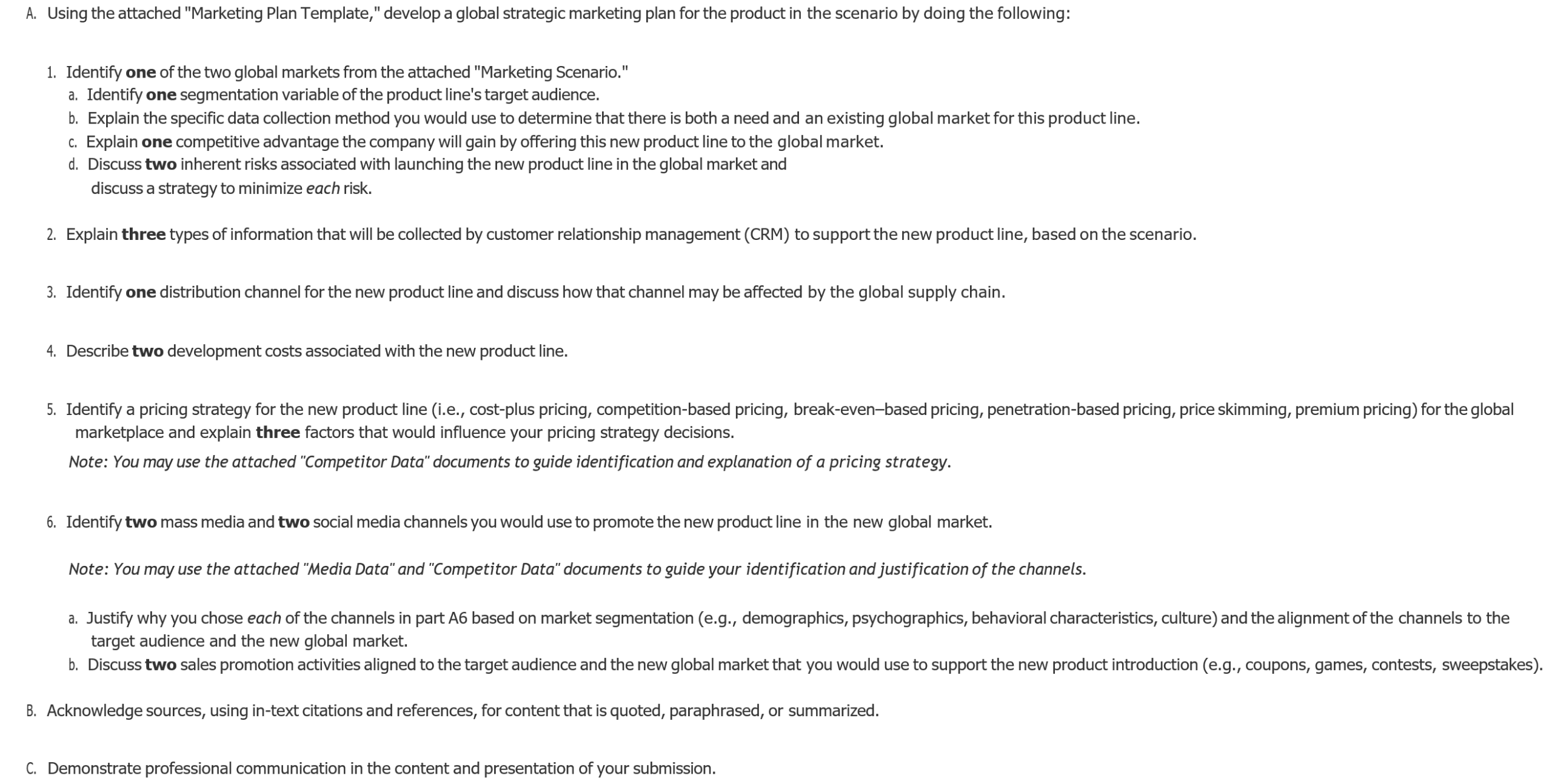
Marketing managers for global organizations are often asked to evaluate the feasibility of new products and services and predict the profitability of those new products for the organization. For this task, you will use the attached “Marketing Scenario” to introduce a new product line of eyewear to attain a competitive advantage in the global market. You will identify the global target market for the new product line, create a strategic marketing plan for the product line, and consider how you would reach that market using traditional mass media and social media for the launch and beyond.
Scenario
See the “Marketing Scenario” in the Supporting Documents section.
Requirements
Your submission must represent your original work and understanding of the course material. Most performance assessment submissions are automatically scanned through the WGU similarity checker.
Studentsarestronglyencouragedtowaitforthesimilarityreporttogenerateafteruploadingtheirworkand thenreviewittoensureAcademicAuthenticityguidelinesaremetbeforesubmittingthefileforevaluation. See Understanding Similarity Reportsfor more information.
A. Using the attached “Marketing Plan Template,” develop a global strategic marketing plan for the product in the scenario by doing the following:

What Is WGU C212 Marketing Task 1?
C212 is a marketing performance assessment in WGU’s MBA program. Task 1 asks you to build a global strategic marketing plan: you work through market research, competitive positioning, risk, CRM, distribution, pricing, and promotion for a product entering a foreign market, and every decision needs to trace back to evidence rather than general marketing knowledge.
The evaluator isn’t checking whether you can recite what a SWOT or a CRM system is. They’re checking whether your pricing strategy is consistent with the competitor data you cited, whether your promotional channels actually fit the audience you defined, and whether your risks come with real mitigation instead of a passing mention. Confirm the exact current format, page expectations, and submission requirements against your own task instructions; this guide won’t repeat specific numeric claims (page counts, turnaround times) that aren’t verifiable as current for your version.
First Check: Which C212 Task 1 Version Are You Completing?
C212 has been documented with at least two different task structures. Confirm which one you actually have before you plan anything, since the two versions ask for different things.
| What You See in Your WGU Instructions | What It Likely Indicates | Which Guide to Use |
|---|---|---|
| You choose your own company (real or fictitious), your own foreign market, and develop two new products/services | The broad, self-directed version this page covers | This guide |
| A “Marketing Scenario” document assigns a specific company and product line, and asks you to choose one of two named global markets | The KLM2-coded version, built around a provided scenario and supporting documents (Competitor Data, Media Data) | WGU C212 KLM2 Task 1 guide |
| Your instructions reference a “Marketing Plan Template” you fill in directly, rather than a freeform paper | Also points to the KLM2 version | WGU C212 KLM2 Task 1 guide |
| You’re not sure, or your instructions don’t clearly match either pattern | Don’t guess | Compare your actual task instructions line by line against both guides, or check with your course instructor |
Students searching “KLM2 Task 1 marketing” almost always have the scenario-based version; if that’s you, the dedicated KLM2 guide walks through its specific rubric items and provided documents in more depth than this page does. This page stays useful either way for the broader planning workflow, research approach, and review process, but the exact rubric labels differ between versions.
What You Should Have Before Writing C212 Task 1
| Item | Why It Matters |
|---|---|
| Current WGU task instructions | Confirms your exact version and requirements |
| Current rubric | Tells you exactly what’s being scored, separate from the task prompt |
| Required template, if your version has one | Some versions require writing directly into a provided template rather than a freeform document |
| Any supporting documents (scenario, competitor data, media data) | If provided, these are required evidence sources, not optional reading |
| Company choice | Needs to be specific enough to research, not so obscure that data doesn’t exist |
| Target market/country | One country, chosen for data availability, not popularity |
| Product/service choices | Needs to be genuinely new to the company and independently viable |
| Research sources lined up | Government stats, industry reports, competitor data, before you start writing |
| Competitor information | Names and prices, not “there are competitors” |
| Pricing information | What comparable products actually cost in your target market |
| Citation system | APA, confirmed against your current course’s citation guidance |
The Best Way to Approach C212 Task 1
Writing section by section in rubric order (A1, then A1a, then A1b) produces disconnected sections, because later decisions depend on earlier ones. Work through it in this order instead:
- Read the task and rubric fully before writing anything.
- Confirm your task version using the table above.
- Select your company.
- Select your target market/country.
- Develop your two products/services (or your one product, if your version assigns it).
- Validate market need with real research.
- Research competitors by name and price.
- Establish a specific, defensible competitive advantage.
- Identify risks that are actually relevant to this market and product.
- Develop your CRM approach.
- Plan distribution.
- Build your pricing strategy, using the competitor data you already gathered.
- Develop your promotional strategy, matched to the audience you defined.
- Write the paper.
- Run a rubric-by-rubric review before submitting.
Steps 12 and 13 specifically depend on steps 6 through 9. If you write pricing before you’ve actually researched competitors, you’ll write a number without a justification, which is exactly the kind of gap a rubric-by-rubric review catches too late to fix quickly.
C212 Task 1 Rubric Map
Rubric labels and exact requirements vary by version; confirm against your own current rubric before treating any row below as fixed. This reflects the structure commonly associated with the self-directed version this page covers.
| Requirement | What the Evaluator Wants | Common Mistake |
|---|---|---|
| Two new products/services | Genuinely new to the company, independently viable, each with a set price | Products that depend on each other to work |
| Market research methods | Specific, named methods (a cited report, a described survey), not “market research” as a method | Writing “we did market research” without naming how |
| Competitive advantage | One specific, defensible advantage tied to this company | Generic claims like “high-quality products” |
| Risks and mitigation | Risks relevant to this specific market and product, each with a real mitigation step | Listing risks with no mitigation attached |
| CRM practices | A specific approach to data, service, and retention, not a list of software names | Naming a CRM tool without explaining what it does for this business |
| Distribution | A specific channel matched to the product type and market | “Online” with no further detail |
| Pricing | A price justified by cost, consumer acceptance, and competitor data together | A price with no connection to the competitor research done earlier |
| Promotion | Channels matched to the specific target audience in the specific country | “Use social media” with no audience-fit reasoning |
How to Choose the Company and Market
Pick a country where you can actually find data: government statistics, industry reports, and competitor pricing information, ideally available in English. A market you chose because it’s a popular WGU example (Canada, the UK, Australia) isn’t automatically weak, but choosing it purely because it’s popular, without checking whether your specific product and industry have real data available there, is.
Also weigh: market size relative to your product, consumer behavior patterns relevant to your product category, regulatory considerations that might complicate your specific industry, cultural factors that affect how your product would be received, and whether distribution is actually feasible for a company your size entering that market.

How to Choose Two Strong Products or Services
Both products need to be genuinely new to your chosen company (not already in its lineup) and independently viable, meaning neither one depends on the other to make sense as a business offering.
For each, you should be able to state: what specific need it meets in your target market, how it differs from what’s already available there, who the target customer is, roughly what it costs and why, how it reaches the customer, and how you’d promote it. If you can’t answer all of these for a product idea, it’s not developed enough yet.
Fictional illustration, do not submit this as your own work: a US outdoor-gear company developing a lightweight, humidity-resistant tent line for a Southeast Asian market, alongside a separate guided-trek booking service, would need to show each stands on its own: the tent line doesn’t require the booking service to sell, and vice versa.
How to Research Market Need
“Market research” is a category, not a method. A method is something specific enough that someone else could go check it: a named government statistical report, a described survey with an actual sample size and audience, a specific industry association’s published data, or a documented set of competitor observations.
Weak: “We conducted market research showing strong demand.”
Stronger: “Analysis of [a specific, named government or industry data source] shows [a specific trend], indicating [a specific implication for demand in this market].”
Categories worth checking: government statistical agencies for your target country, industry and trade association reports, company disclosures from competitors, academic or business research databases, and consumer research you conduct or credibly describe as a proposed method.
How to Build a Competitive Advantage
A competitive advantage has to be something a competitor couldn’t easily copy, tied to something specific about your company, not a claim that could apply to any business.
Weak: “We provide high-quality products.”
Stronger: an advantage tied to a specific, defensible source: proprietary technology, an existing distribution relationship, brand recognition that transfers into the new market, a genuine cost advantage, specialized expertise, or intellectual property protection. Name the specific source and explain why a competitor can’t simply replicate it.
How to Handle Risks
For each risk: name it, explain why it specifically matters for this product and market (not risk in general), cite the evidence behind it, and state a real mitigation step.
Categories worth considering: regulatory risk, cultural or consumer-acceptance risk, currency risk, competitive risk, supply-chain risk, technology risk, and market-acceptance risk. Not all of these apply to every scenario; pick the two (or however many your version requires) that are genuinely most relevant to your specific product and market, not the two that are easiest to write about.
CRM, Distribution, Pricing, and Promotion
CRM
Explain what customer data you’ll collect, how it improves the customer experience, and how it supports retention. “We’ll use Salesforce” names a tool, not a strategy; explain what the data actually does for the business, like flagging early churn signals or personalizing outreach based on purchase history.
Distribution
Explain specifically how the customer receives the product or service in this market: direct e-commerce, local retail partnerships, third-party distributors, or a company-owned presence. Name the mechanism, not just “the customer will be able to buy it.”
Pricing
Address cost (what it actually costs to deliver), what the target customer will realistically pay, what competitors currently charge, how you’re positioning relative to them, and what margin that leaves. A price with no connection to the competitor data you gathered earlier is unsupported, no matter how reasonable the number sounds.
Promotion
Cover audience, channel, message, and rationale together. “Use social media” isn’t a strategy; explain which specific platform fits this audience in this country, and why. A promotional plan built around channels that are popular in the US but not relevant to your target market’s actual media habits is a common, avoidable gap.
WGU C212 Task 1 Example: How to Build One
Educational example only, do not submit this wording as your own.
Company: a fictional mid-size US skincare brand. Market: a fictional entry into a Northern European country. Products: a reformulated moisturizer line adapted for the target climate, and a separate subscription skincare-consultation service.
Market need: cite a specific (illustrative) government or industry statistic on skincare spending trends in that market, plus a described competitor gap.
Competitive advantage: a specific, real ingredient-sourcing relationship the company holds that local competitors don’t have access to.
Risk: import regulation differences for cosmetic ingredients, mitigated by engaging a local regulatory consultant before finalizing the product formulation for that market.
CRM: tracking purchase and consultation data to flag customers likely to lapse and trigger a targeted retention offer.
Distribution: direct e-commerce plus a small number of curated local retail partnerships, chosen because the target demographic in that market still values in-person product testing for skincare.
Pricing: positioned slightly below the identified premium competitor set, justified by the company’s lower US production costs relative to competitors manufacturing locally.
Promotion: a channel mix built around the specific social platforms and beauty-influencer culture documented as dominant in that market, not a default US channel list.
This is a decision-making walkthrough, not a template. Your actual company, market, products, and evidence need to come from your own research.
Marketing C212 Paper Examples: What to Look For
If you’re looking at C212 paper examples anywhere, including this guide, evaluate them for what they teach, not what they say. Check whether the example covers every rubric area, whether claims are specific rather than generic, whether evidence is cited, whether sections logically connect (does the pricing match the competitor research; does the promotion match the stated audience), and whether the country analysis is genuinely specific to that market rather than generic enough to apply anywhere.
Don’t copy an example’s wording, company, or research, even a strong one. A structurally excellent example built around a different company and market doesn’t transfer as evidence for your own paper, and reusing its language creates both an originality problem and a mismatch between your claims and your actual research.
WGU C212 Marketing Task 1 Sample: How to Use It Correctly
A sample can teach you structure, the level of specificity expected, and how sections should connect to each other. It cannot replace your own research, your own company and market choice, or your own citations. Compare any sample you look at against your current rubric rather than assuming it matches your version, and never reuse another student’s company, research findings, or specific wording. Beyond the originality risk, a reused company or market you didn’t actually research will fall apart the moment a section asks you to connect a claim to evidence you don’t actually have.
How to Perform a WGU C212 Marketing Task 1 Review Before Submission
Run these passes in order, not all at once:
Pass 1, requirement check: Can you point to a specific heading or paragraph for every rubric requirement? If you can’t point to where you addressed a specific lettered item, it isn’t finished.
Pass 2, evidence check: Does every major factual claim have a source behind it, not just an assertion?
Pass 3, logic check: Do your product, market, pricing, distribution, and promotion decisions actually fit together, or does one section contradict another?
Pass 4, specificity check: Find and rewrite any sentence that could apply to any company in any market.
Pass 5, citation check: Does every reference actually support the specific claim it’s attached to?
Pass 6, originality check: Is this your own reasoning and wording throughout, not adapted from an example or another student’s work?
Pass 7, formatting check: Headings, tables, references, and any required template fields match your current instructions.
| Pass | What You’re Checking | Done? |
|---|---|---|
| 1. Requirement | Every rubric item has a clear home in the paper | |
| 2. Evidence | Every major claim is sourced | |
| 3. Logic | Sections are consistent with each other | |
| 4. Specificity | No generic, could-apply-to-anyone statements remain | |
| 5. Citation | References support the exact claims made | |
| 6. Originality | Wording and reasoning are your own | |
| 7. Formatting | Headings, tables, and template fields are correct |
Common Reasons C212 Task 1 Papers Need Revision
Common problems to check for include: a missing rubric requirement, generic explanations that could apply to any company, unsupported statistics, thin competitor research, pricing with no connection to cost or competitor data, a contradictory product strategy, country analysis that’s too shallow to be useful, promotion channels that don’t match the target audience, risks listed without mitigation, weak connections between sections, using an example built for a different task version, and copying example language instead of writing original analysis.
C212 Task 1 vs. KLM2 Task 1 Marketing
| C212 Task 1 (This Guide) | KLM2 Task 1 Marketing |
|---|---|
| Broad assignment strategy and planning workflow | Scenario-specific instructions and required template |
| General research and evidence approach | KLM2’s specific supporting documents (Competitor Data, Media Data) |
| General example framework | KLM2-specific rubric item walkthrough |
| Version-agnostic final review process | Detailed section-by-section KLM2 guidance |
If your task instructions match the scenario-based, template-driven pattern, use the detailed KLM2 marketing walkthrough for section-level guidance. For the broader C212 course overview, see the C212 course overview.
Frequently Asked Questions
What is WGU C212 Marketing Task 1? A global strategic marketing plan assessment where you research and justify decisions on products, market need, competitive advantage, risk, CRM, distribution, pricing, and promotion.
Is C212 a paper or an exam? It’s a written performance assessment, not an exam. Confirm the exact current submission format in your own task instructions.
What is the WGU Marketing C212 assessment? The course covering global strategic marketing planning; Task 1 is its first performance assessment.
How should I start C212 Task 1? Confirm your task version first, then work through company, market, and product decisions before drafting any section, using the workflow above.
Can I use a C212 Task 1 example? Yes, to understand structure and expected specificity, never as wording to copy or adapt.
Where can I find a WGU C212 Marketing Task 1 sample? Use any sample only as a structural reference, and verify it matches your current task version and rubric before relying on its format.
How do I review my C212 paper before submission? Run the seven-pass review above: requirement, evidence, logic, specificity, citation, originality, and formatting.
What is KLM2 Task 1 Marketing? A specific, scenario-based version of C212 Task 1 built around a provided company scenario, a required Marketing Plan Template, and supporting documents.
Is KLM2 the same as every C212 Task 1 version? No. Confirm your own task instructions against the version-check table above before assuming either guide matches your assignment exactly.
How many sources should I use? Enough to support every major factual claim you make; there’s no universal number confirmed for every version, so cite what your claims actually need.
Can I use a fictional company? Many students do, since it avoids the complexity of matching an existing company’s actual current product lineup. Confirm whether your specific task instructions require or prohibit this.
How do I avoid copying a C212 paper example? Use examples to understand structure and reasoning only. Every company, market, research finding, and sentence in your submission should come from your own work.
References
- Western Governors University. Current course and assessment information should be verified directly through your WGU student portal, since specific task versions, templates, and rubric details vary and are not independently published for public verification.
- U.S. Census Bureau, U.S. International Trade Administration, World Bank, OECD, and relevant national statistical agencies are appropriate authoritative sources for country-specific market and economic data; select and cite the specific source relevant to your chosen market rather than a generic reference.
- Cite primary company sources directly (competitor websites, pricing pages, annual reports) for any competitor pricing, product, or distribution claim you make.
Still working out which C212 version you have? Start with the C212 course overview, then use the KLM2 Task 1 walkthrough if your instructions match that scenario-based version.
Want rubric-level feedback on your own draft once you’ve written it? Message +1 564-544-6924 on WhatsApp for assignment support and review, not a substitute for your own research and writing.