
Blog
WGU C213 Accounting for Decision Makers: Course & OA Guide

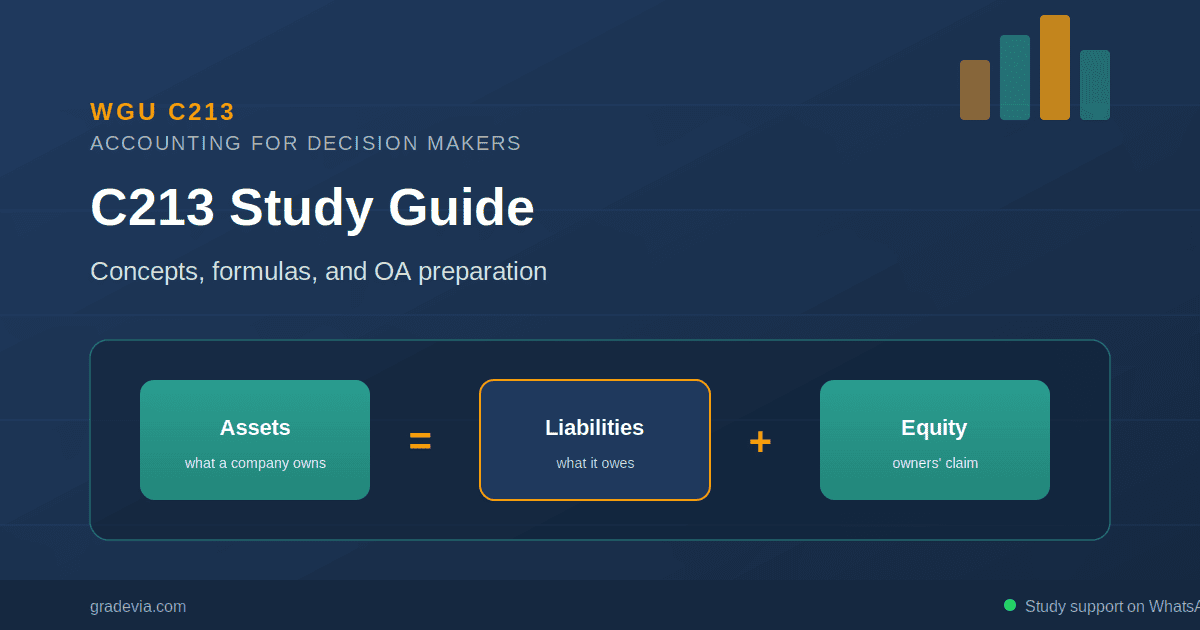
C213 is Accounting for Decision Makers, part of the WGU MBA curriculum. It combines financial accounting and managerial accounting, which means you are asked to read financial statements the way an external stakeholder would and use cost data the way an internal manager would, sometimes in the same problem. Most students who struggle with C213 do not struggle with any single topic. They struggle with switching between concepts and calculations without a clear system for doing it.
This guide covers what C213 is, what it covers, how it is assessed, and what to prioritize while you study. If you want the full formula sheet, worked examples, and a large practice-question set, that lives on the WGU C213 Accounting for Decision Makers Study Guide— this page is the shorter map, that page is the workbook.

What Is WGU C213?
C213, Accounting for Decision Makers, is a 3-credit-unit course in the WGU MBA program. According to WGU’s course description, it provides the accounting knowledge and skills needed to assess and manage a business, covering the accounting cycle, financial statements, taxes, and budgeting, and how accounting information supports planning and business decisions.
The course sits at the intersection of two disciplines. Financial accounting produces standardized reports for people outside the company — investors, lenders, regulators. Managerial accounting produces information for people inside the company who are making operating decisions, like whether a product line is worth keeping or what a break-even volume looks like. WGU MBA C213 teaches both because MBA graduates are expected to interpret financial reports and use cost data, even in roles that never touch the actual bookkeeping.
For students without an accounting background, the course matters less because of any single topic and more because it is often the first time they are asked to move fluently between reading a statement and calculating a number from it.
What Does WGU C213 Cover?
Below is a practical map of the subject areas, not a claim about assessment weighting.
Accounting Fundamentals The accounting cycle, the accounting equation (Assets = Liabilities + Equity), debits and credits, accrual versus cash-basis accounting, and the basic principles that keep financial records consistent.
Financial Statements The income statement, balance sheet, statement of cash flows, and statement of retained earnings, along with how the four connect to each other.
Financial Analysis Liquidity, profitability, leverage (solvency), and activity ratios, and — more importantly — what a change in a ratio actually tells a manager.
Cost Accounting Fixed, variable, and mixed costs; product versus period costs; direct versus indirect costs; manufacturing overhead; job-order costing, process costing, and activity-based costing; the high-low method for separating mixed costs.
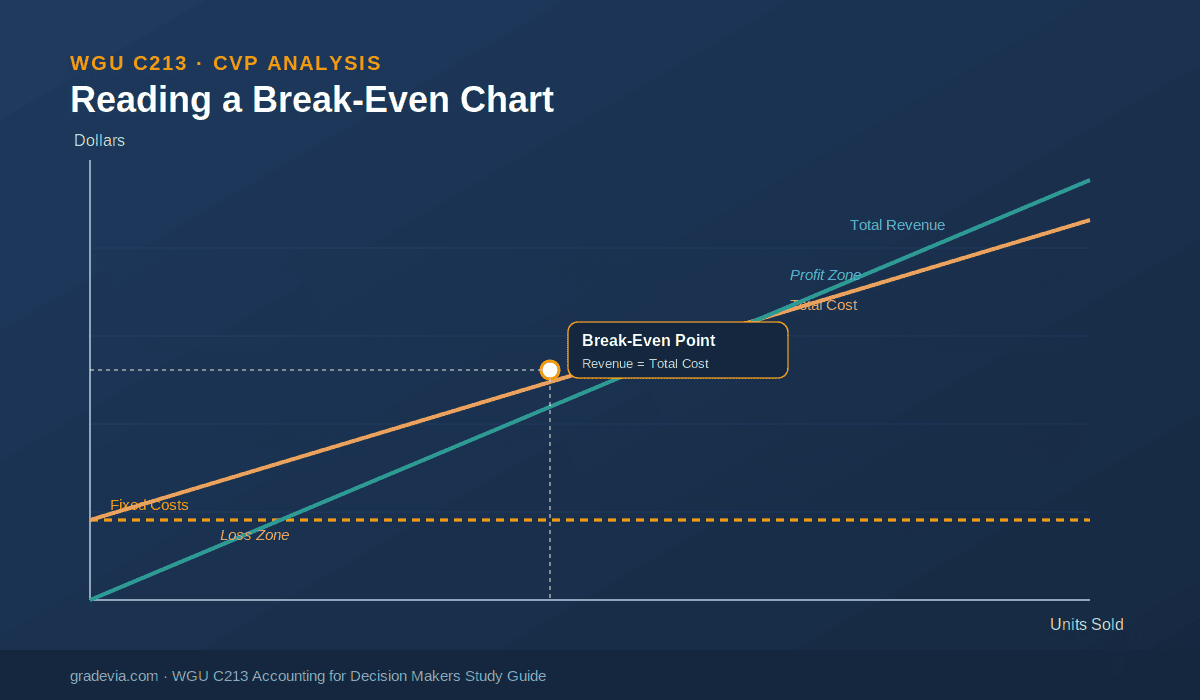
CVP Analysis Contribution margin, contribution margin ratio, break-even point, target profit, margin of safety, and operating leverage.
Budgeting The sales, production, direct materials, direct labor, and overhead budgets that feed into a cash budget, plus the basic idea behind variance analysis.
Taxes WGU’s current course description names taxes as a C213 topic. At the course level, this typically means understanding how tax effects factor into decision-making and cash flow, not preparing a tax return.
Each of these areas gets full formulas and worked calculations in the comprehensive C213 study guide.
WGU C213 Objective Assessment
C213 is assessed through an Objective Assessment (OA), which tests whether you can both explain a concept and apply it. That combination is what trips students up — you can know a definition and still miss a question that asks you to apply it to a scenario.
Expect a mix of:
- Conceptual questions — definitions, classifications, and “why” questions (why a control weakness exists, why a cost is fixed rather than variable).
- Calculation questions — computing a ratio, a break-even point, or a budget line.
- Scenario-based questions — a short business situation where you have to decide what information matters before you can answer.
Read each question twice before answering. A large share of missed points on courses like this come from misreading what is being asked, not from not knowing the material.
We are not going to state a specific number of questions, a time limit, or a passing score here. Assessment details can change between terms, so verify the current format and requirements inside your WGU course before your final review.
WGU C213 Pre-Assessment: How to Use It Properly
The C213 pre-assessment is a diagnostic tool, not a test to simply pass and move on from. Treat your result as information about where to spend your remaining study time, not as a verdict on whether you’re ready.
- Take it seriously and under real conditions, not with notes open.
- Review the coaching report line by line.
- Identify which areas are weak.
- Separate conceptual weaknesses (you don’t understand the idea) from calculation weaknesses (you understand the idea but make errors doing the math).
- Study those specific areas, not the whole course again.
- Practice new problems in that area, not the ones you already saw.
- Reassess your readiness before scheduling the OA.
Do not memorize the pre-assessment answers. Learn why the correct answer is correct; the OA will not ask you the same question the same way.
The C213 Topics You Should Prioritize
This is not a claim about official OA weighting. It’s a practical list of what “ready” looks like for each area.
| Topic | What You Should Be Able to Do |
|---|---|
| Financial statements | Read and interpret basic statements |
| Ratios | Calculate and explain what changes mean |
| Cost behavior | Classify and calculate costs |
| High-low method | Determine variable cost and fixed cost |
| ABC costing | Understand cost pools, drivers, and rates |
| CVP | Calculate break-even and target profit |
| Budgeting | Build and interpret basic budgets |
| Cash flow | Distinguish operating, investing, and financing activities |
| Internal controls | Identify weaknesses and appropriate controls |
| Taxes | Understand the relevant course-level concepts |
If you can do everything in the right column, you are in reasonable shape. If two or three rows feel shaky, that’s your study list.

Why Students Struggle With C213
C213 asks you to move through a chain: definitions → accounting relationships → formulas → calculations → interpretation. Missing any link in that chain is where students lose points, even when they “know the material.”
1. Financial statement relationships. Students can often describe the income statement and the balance sheet separately but struggle to explain how net income flows into retained earnings, or why a profitable company can still be short on cash.
2. Ratio interpretation. Calculating a ratio is arithmetic. Explaining what a rising debt-to-equity ratio means for a company’s risk is a different skill, and it’s the one that’s actually tested.
3. Cost classification. Fixed versus variable, direct versus indirect, product versus period: these three distinctions get crossed constantly, usually because students memorize the labels without practicing on new examples.
4. CVP. Students often know all five CVP formulas and still pick the wrong one, because the question never says “use the break-even formula.” It describes a situation and expects you to recognize which formula fits.
5. Budgeting. A budget is a chain of assumptions. Get the production budget wrong and every number downstream — materials, labor, cash — is wrong too. The skill is tracking how one number feeds the next.
6. Terminology. Students with no accounting background sometimes lose more time decoding what a question is asking than actually solving it. Vocabulary fluency is worth building deliberately, not picking up passively.
How to Study for WGU C213
Step 1 — Learn the accounting language. Assets, liabilities, equity, revenue, expenses, debits, credits, accruals. If these terms still require translation in your head, everything after this step will be slower than it needs to be.
Step 2 — Learn the financial statements. Not just what’s on each one, but what each one tells a manager that the others don’t.
Step 3 — Build the formula foundation. Learn what each formula means, not just what it looks like. A formula you understand survives a reworded question. A formula you memorized does not.
Step 4 — Work problems. Calculate. Reading an explanation of the high-low method is not the same skill as doing it with your own numbers.
Step 5 — Interpret your answers. After every calculation, ask: what does this number tell a manager? This is the step students skip, and it’s usually the one being tested.
Step 6 — Use the pre-assessment diagnostically. Let it tell you where the gaps actually are instead of guessing.
Step 7 — Remediate. Go back to the specific weak topics and practice new problems in that area until they stop feeling shaky.
WGU C213 Formula Categories You Should Know
You’ll need working formulas across a handful of categories:
- Financial ratios (liquidity, profitability, leverage, activity)
- High-low method (variable and fixed cost separation)
- Contribution margin and contribution margin ratio
- Break-even point (units and dollars)
- Target profit
- Margin of safety
- Core budgeting formulas (production needed, cash available, ending cash)
Rather than duplicate the full formula sheet here, the complete reference — with every formula, variable definitions, and worked numbers — is on the WGU C213 Accounting for Decision Makers Study Guide
How to Pass WGU C213 Without an Accounting Background
There’s no shortcut that replaces understanding the material, but there is a sequence that works better than studying topics in random order:
Accounting basics → financial statements → ratios → cost behavior → CVP → budgeting → practice → pre-assessment → remediation → OA readiness.
Each step depends on the one before it. Trying to learn CVP before you’re solid on cost behavior just means relearning cost behavior in the middle of a CVP problem. Following the plan doesn’t guarantee a passing result, but it removes the most common reason students get stuck: attempting advanced material before the foundation is set.
WGU C213 Practice Questions: What to Look For
A practice question is only useful if it makes you do the whole chain, not just recall an answer. A good C213 practice question requires you to:
- Identify which information in the problem is actually relevant.
- Select the correct formula or concept.
- Perform the calculation.
- Interpret what the result means.
If you find yourself recognizing a question by its wording rather than solving it, you’re memorizing answer letters, not building the skill. Rework problems with the numbers changed, not the same set repeated.
Should You Use WGU C213 Quizlet?
Good uses: terminology, definitions, formula recognition, quick review between study sessions.
Poor uses: learning multi-step calculations, understanding how financial statements connect, interpreting what a ratio means, or working through a budgeting problem.
Quizlet can supplement C213 preparation. It shouldn’t replace actually solving problems, because flashcards test recall and the OA tests application.
What About WGU MBA C213 Reddit Discussions?
Reddit threads on C213 can be useful for a sense of what other students found difficult and how they organized their study time. Treat these as individual experiences, not requirements; course structure and assessment format can change between terms, and a post written a year or two ago may no longer reflect your version of the course. For anything about current format, timing, or requirements, your WGU course is the source that matters.
Are WGU C213 OA Answer PDFs Reliable?
If you’ve searched for C213 objective assessment answers or a downloadable answer PDF, here’s the direct answer: be cautious. Sites advertising this kind of material are frequently outdated, inaccurate, or built for a prior version of the course that no longer matches current competencies. Beyond accuracy, relying on unauthorized assessment content raises academic integrity concerns.
A more reliable use of that time is working original practice questions, reviewing the formula sheet, and revisiting the topics your pre-assessment flagged as weak. That path gets you to actual readiness instead of a set of answers that may not even apply to your assessment version.
Is a WGU C213 Bootcamp Worth It?
A bootcamp can be worth it if it gives you structured lessons, coverage of the accounting fundamentals, calculation walkthroughs you can follow step by step, practice problems with explanations, and a revision strategy for the areas you’re weak in. Judge any bootcamp, live or self-paced, by the quality of its teaching and how current it is, not by any claim about having “actual OA questions” — that claim is itself a reason to be skeptical of a resource.
WGU C213 Study Resources
WGU course materials. Your course shell is the primary and most current source for competency details, assessment format, and requirements. Start there for anything specific to your version of the course.
Gradevia C213 study guide. For deeper explanations, the full formula sheet, worked examples, and a larger practice-question set, see the WGU C213 Accounting for Decision Makers Study Guide. That page is built to be the workbook companion to this overview.
Additional practice. If you want more structured practice or one-on-one help working through a specific calculation, Gradevia offers study support you can reach through WhatsApp below.
C213 Study Plan for Busy MBA Students
Days 1–2: Accounting fundamentals + financial statements Get comfortable with the accounting equation, debits and credits, and what each financial statement shows.
Days 3–4: Financial analysis + ratios Calculate the core liquidity, profitability, and leverage ratios, then practice explaining what a change in each one means.
Days 5–6: Cost behavior + costing systems Classify costs, work the high-low method, and understand when job-order, process, or activity-based costing applies.
Day 7: CVP Contribution margin, break-even, target profit, margin of safety, and operating leverage.
Day 8: Budgeting + cash flow Build a basic budget sequence through to a cash budget, and review the three cash flow categories.
Day 9: Practice + weak-area remediation Work practice problems, then go back to whatever categories you’re still missing.
Day 10: Final review + readiness check Run through the checklist below before you schedule the OA.
If you’re working full-time or starting with no accounting background, stretch this to two or three weeks rather than compressing your study time to fit ten days.
C213 Readiness Checklist
You should be able to:
- Explain the accounting equation
- Distinguish financial and managerial accounting
- Read the major financial statements
- Calculate and interpret ratios
- Classify costs
- Perform the high-low method
- Explain ABC costing
- Calculate contribution margin
- Calculate break-even
- Calculate target profit
- Interpret margin of safety
- Understand budgeting
- Interpret cash-flow categories
- Recognize internal-control weaknesses
- Explain relevant tax concepts
- Solve practice problems without relying on answer memorization
WGU C213 Frequently Asked Questions
What is WGU C213? C213 is Accounting for Decision Makers, a 3-CU course in the WGU MBA that covers financial and managerial accounting so students can read financial statements and use cost data to make business decisions.
What does WGU C213 Accounting for Decision Makers cover? The accounting cycle, financial statements, financial ratios, cost behavior and costing systems, CVP analysis, budgeting, taxes, and how all of it supports planning and decision-making.
Is WGU C213 difficult? It’s manageable but genuinely challenging for students without an accounting background, mainly because it requires moving between concepts and calculations rather than mastering either in isolation.
Is C213 an OA or PA course? C213 is assessed through an Objective Assessment.
What is the WGU C213 pre-assessment? A diagnostic tool you can use before the OA to identify which topics need more work, so you can target your remaining study time instead of restudying everything equally.
How do I prepare for the WGU C213 OA? Build the accounting fundamentals first, work through each topic area with real calculations, use the pre-assessment to find your weak spots, and remediate those specific areas before scheduling the OA.
How can I pass WGU C213 if I have no accounting background? Follow the foundation-first sequence: basics, statements, ratios, cost behavior, CVP, budgeting, then practice and diagnostic testing. Skipping ahead to advanced topics before the fundamentals are solid is the most common reason students get stuck.
Is WGU C213 Quizlet useful? For terminology and formula recognition, yes. For calculations, statement relationships, and ratio interpretation, it isn’t a substitute for working problems.
Are WGU C213 OA answer PDFs reliable? Generally no. They’re often outdated or inaccurate, and using unauthorized assessment material raises academic integrity concerns. Original practice and concept review are more reliable.
Where can I find a complete WGU C213 study guide? The WGU C213 Accounting for Decision Makers Study Guide has the full formula sheet, worked examples, and a larger set of practice questions.
Related WGU Content
WGU C200 Task 1: Personal Leadership Evaluation, Complete Guide + Example
WGU C219 Task 1: Investor Presentation Guide + Example (C219 Healthcare Management Capstone)
WGU C216 Task 2: Stockholder Report Guide + Complete Sample (MBA Capstone)
WGU C218 MBA IT Management Capstone Guide: All Three Tasks Explained
WGU C216 Task 1: Complete Investor Presentation Guide + Example (MBA Capstone)
Need More Help With WGU C213?
Need help understanding a C213 calculation or deciding what to study next? Gradevia provides structured academic support and C213 study resources for WGU MBA students who understand the concepts but get stuck on the math, or who just have limited time to figure out where to start.
Message Gradevia on WhatsApp: +1 564-544-6924
Dan Palmer, MBA, develops WGU MBA educational resources focused on accounting and quantitative coursework, with an emphasis on practical, calculation-based preparation for working students.