
Blog
WGU AMT2 Task 4 Example: Service Line Development Feasibility Guide

Updated on: Sep 1, 2026
WGU AMT2 Task 4 puts you in the CEO’s chair for a change. Instead of writing about healthcare management from the outside, you’re assessing whether a specific new service line, an orthopedic center, a cardiovascular center, or a cancer center, is actually worth developing, then presenting your case to a board of directors. That shift in perspective is exactly where a lot of first attempts stumble: this task wants you thinking and writing like an executive making a real capital decision, not a student summarizing a case study.
This guide walks through what AMT2 Task 4 (assessment code KMM1) actually requires, part by part, how to work through the five components of the feasibility analysis, what belongs in your multimedia presentation, and how to avoid the detail-level gaps that most often trigger a revision.
WGU AMT2 Task 4 Assignment
Introduction
A hospital is a complex system of interrelated functions requiring constant movement of people and goods. Functional design of a hospital can promote skill, economy, convenience, and comfort. Nonfunctional design of a hospital can impede activities of all types, detract from quality of care, and raise costs to intolerable levels.
Healthcare facilities management examines challenging key elements, such as contracting outpatient care and quality management systems. Property development puts the focus on patient care.
In this task, you will determine whether to build, buy, or lease space for a new orthopedic service line as discussed in the “Service Line Development Case Study.”
Requirements
Your submission must represent your original work and understanding of the course material. Most performance assessment submissions are automatically scanned through the WGU similarity checker. Students are strongly encouraged to wait for the similarity report to generate after uploading their work and then review it to ensure Academic Authenticity guidelines are met before submitting the file for evaluation. See Understanding Similarity Reports for more information.
Grammarly Note:
Professional Communication will be automatically assessed through Grammarly for Education in most
performance assessments before a student submits work for evaluation. Students are strongly encouraged to review the Grammarly for Education feedback prior to submitting work for evaluation, as the overall submission will not pass without this aspect passing. See Use Grammarly for Education Effectively for more information.
Microsoft Files Note:
Write your paper in Microsoft Word (.doc or .docx) unless another Microsoft product, or pdf, is specified in the task directions. Tasks may notbe submitted as cloud links, such as links to Google Docs, Google Slides, OneDrive, etc. All supporting documentation, such as screenshots and proof of experience, should be collected in a pdf file and submitted separately from the main file. For more information, please see Computer System and Technology Requirements.
You must use the rubric to direct the creation of your submission because it provides detailed criteria that will be used to evaluate your work. Each requirement below may be evaluated by more than one rubric aspect. The rubric aspect titles may contain hyperlinks to relevant portions of the course.

WEB LINKS
Service Line Development – General Case Scenario Service Line Development – Task 1 Artifacts
What Is WGU AMT2?
AMT2, Service Line Development, is part of WGU’s MBA Healthcare Management program. The course is built around five competencies: analyzing international healthcare trends and their local impact, evaluating a healthcare organization’s management of service lines, managing costs and productivity for sustainability, performing net revenue analysis to maximize financial performance, and designing and communicating a healthcare marketing strategy.
If you’re also working through the strategic side of your MBA coursework, our WGU C209 Task 1 guide covers the SWOT and strategic-alignment work that pairs naturally with this kind of feasibility analysis.
What Is WGU AMT2 Task 4?
WGU AMT2 Task 4, also labeled KMM1 Task 4 inside your course, asks you to use the “Service Line Development Case Study” to assess the viability of developing one new service line: an orthopedic center, a cardiovascular center, or a cancer center. You take on the role of a healthcare facility CEO tasked with developing that new service line, and your job is to present your findings to the board of directors for buy-in and approval.
The task breaks into four parts:
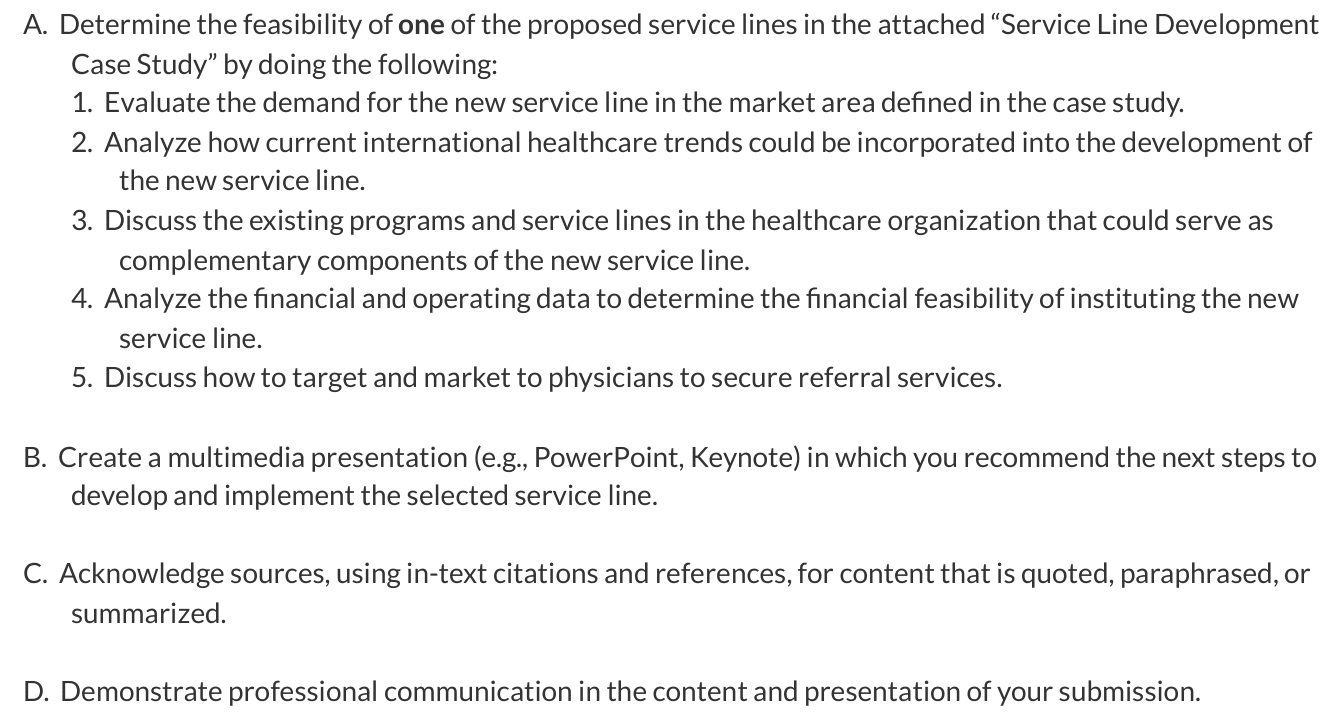
Part A, determine the feasibility of your chosen service line across five specific angles, market demand, international healthcare trends, complementary existing programs, financial and operating data, and physician referral marketing.
Part B, build a multimedia presentation (PowerPoint, Keynote, or similar) recommending next steps to develop and implement the service line.
Part C, acknowledge sources through citations and references.
Part D, demonstrate professional communication throughout.
What Does WGU AMT2 Task 4 Require?
Treat your current official task instructions and rubric as the controlling documents, this table is meant to help you interpret them.
| Requirement | What You Need to Do | Common Mistake |
|---|---|---|
| A1, Demand | Evaluate demand for the new service line in the case study’s defined market area | Describing general industry growth instead of the specific market area’s data |
| A2, International healthcare trends | Analyze how current international trends could be incorporated into the new service line | Listing trends without connecting them to your specific service line’s development |
| A3, Complementary programs | Discuss existing programs that could serve as complementary components | Naming programs without explaining how they’d actually support the new line |
| A4, Financial and operating data | Analyze the case study’s financial and operating data for financial feasibility | Presenting numbers without interpreting what they mean for viability |
| A5, Physician referral marketing | Discuss how to target and market to physicians to secure referrals | Generic marketing advice not specific to physician referral relationships |
| B, Multimedia presentation | Recommend next steps to develop and implement the service line | A presentation that summarizes Part A instead of recommending forward action |
| C, Sources | In-text citations matched to a complete reference list | Citations with no matching reference, or vice versa |
| D, Professional communication | Clear grammar, sentence fluency, spelling, and punctuation | Submitting before reviewing the required Grammarly for Education check |
Not sure how to turn this case study into a board-ready analysis? Gradevia can help you break AMT2 Task 4 into manageable steps.
How to Choose Your Service Line
The case study covers three options, orthopedic, cardiovascular, and cancer, but you only need to fully assess one. Read the demand data, existing organizational capabilities, and financial indicators for all three before committing, the strongest submissions usually pick the option where the market demand signal and the organization’s existing complementary programs line up most clearly, since that alignment makes Parts A3 and A4 easier to argue convincingly.
Part A1: Evaluating Market Demand
This requirement asks you to evaluate demand for your chosen service line specifically within the market area defined in the case study, not the industry nationally. Pull the actual demand figures, projected case volume growth, population trends, or epidemiological data the case study provides for your local market area, and explain what that demand level means for the organization’s decision.
Weak: “Demand for orthopedic services is growing nationwide.”
Stronger: “Within the case study’s defined market area, projected caseload growth for this service line over the coming years suggests sufficient patient volume to support a dedicated center, particularly given the aging demographic trend described in the case study’s population data.”
Part A2: Incorporating International Healthcare Trends
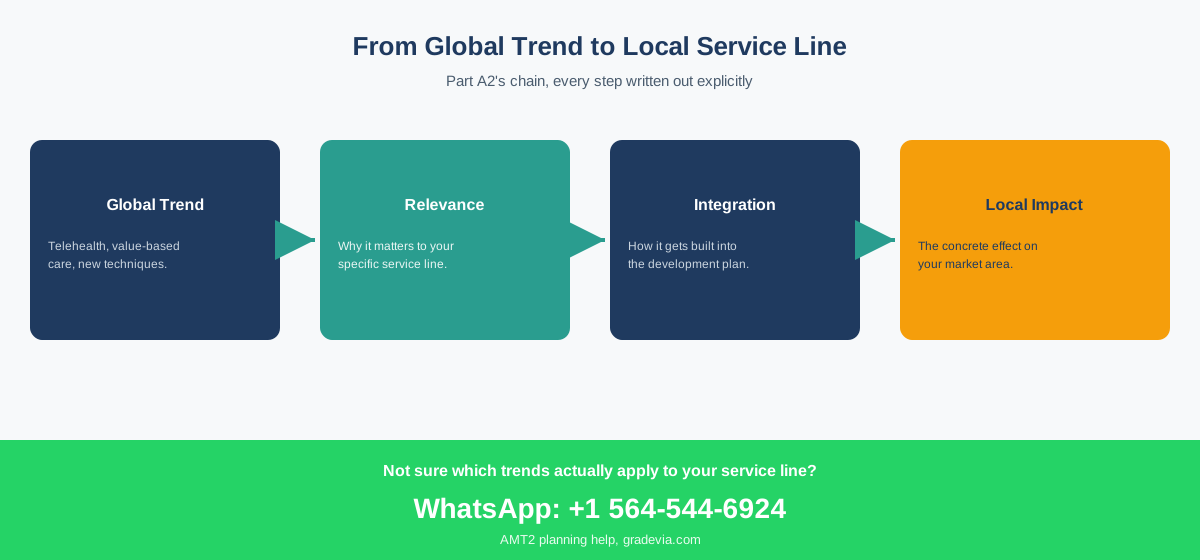
This is the requirement students most often underexplain, because it’s the least intuitive one. You’re being asked to analyze how trends happening in healthcare globally, not just locally, could be incorporated into how you develop this specific service line. Depending on your chosen service line, relevant international trends might include the global expansion of telehealth and remote monitoring, growth in value-based and bundled-payment care models, minimally invasive surgical technique adoption, or international clinical protocol standards for the condition your service line treats.
The key is connecting the trend to your specific development plan, not just describing that the trend exists. If global telehealth adoption is accelerating, explain how a remote pre-surgical consultation or post-discharge monitoring component could be built into your new service line specifically, not just that telehealth is popular.
Not sure which international trends genuinely apply to your chosen service line? Get help connecting the case study data to a real analysis.
Part A3: Existing Programs as Complementary Components
Look at what the healthcare organization in the case study already operates, and identify programs that could realistically support or feed into your new service line. A cancer center, for example, might draw complementary value from an existing imaging department, an existing infusion center, or existing oncology-adjacent specialties. Explain the actual relationship, referral flow, shared resources, overlapping patient populations, rather than just listing department names that sound related.
Part A4: Financial and Operating Data Analysis
This requirement asks you to analyze the case study’s financial and operating data to determine financial feasibility, not just restate the numbers provided. Look at projected revenue, operating costs, expected patient volume, and any reimbursement or payer-mix data the case study supplies, then interpret what those figures mean for whether the service line is financially viable.
Weak: “The projected revenue is $2 million.”
Stronger: “The projected revenue, weighed against the estimated staffing and equipment costs described in the case study, suggests a positive contribution margin within the first operating years, supporting financial feasibility, though this depends on the case study’s underlying volume assumptions holding true.”
Part A5: Targeting and Marketing to Physicians for Referrals
Unlike consumer healthcare marketing, physician referral marketing is relationship- and trust-driven. Discuss how the organization could build awareness and confidence among referring physicians specifically, outreach to primary care practices in the market area, educational events or grand rounds presentations, clear communication of the new service line’s capabilities and outcomes data, and streamlined referral processes that make it easy for a physician to actually send a patient. Ground this in your specific service line and market area rather than generic marketing principles.
Part B: Building the Multimedia Presentation
Part B asks for a multimedia presentation, PowerPoint, Keynote, or similar, recommending next steps to develop and implement your selected service line. This is a distinct deliverable from Part A, it’s forward-looking, not a summary of what you already analyzed. A strong presentation translates your Part A findings into a concrete implementation roadmap: what needs to happen first, what resources are required, what timeline is realistic, and what success looks like.
Keep slides visually clean and board-appropriate, this is meant to read like something you’d actually present to executive leadership, not a slide-by-slide transcript of your written analysis.
Part C: Sources and Citations
Acknowledge every quoted, paraphrased, or summarized source with in-text citations and a matching reference list. Every reference should correspond to something actually cited in your work, and every citation should have a matching reference entry.
Part D: Professional Communication
Most performance assessments run Professional Communication automatically through Grammarly for Education before you can submit for evaluation, and the overall submission will not pass without this aspect passing. Review that feedback before you submit, not after.
Understanding “Competent” vs. “Approaching Competence”
The AMT2 Task 4 rubric uses the same three-tier structure common across WGU performance assessments, Not Evident, Approaching Competence, and Competent. For nearly every criterion in this task, the difference between Approaching Competence and Competent comes down to sufficient detail in an otherwise logical, plausible discussion. A demand evaluation that’s directionally correct but thin on specifics tends to land at Approaching Competence. The same evaluation grounded in the case study’s actual figures and their implications tends to land at Competent.
AMT2 Task 4 Example: A Feasibility Snapshot
Illustrative example only, fictional healthcare organization, not an official WGU case study answer.
Fictional organization: Meridian Regional Medical Center, considering a cardiovascular center.
Demand (A1): Meridian’s defined market area shows a rising incidence of coronary artery disease tied to an aging regional population, suggesting sustained demand growth over the coming years.
International trends (A2): Global adoption of minimally invasive catheter-based interventions has been reducing recovery times and inpatient stays, a trend Meridian’s new center could incorporate directly into its procedural planning and facility design.
Complementary programs (A3): Meridian’s existing diagnostic imaging and cardiac rehabilitation programs would feed directly into a new cardiovascular center, providing both referral flow and shared infrastructure.
Financial feasibility (A4): Projected procedure volume against estimated staffing and equipment costs suggests a viable contribution margin, contingent on the payer mix assumptions in the case study holding steady.
Physician referrals (A5): Targeted outreach to primary care and internal medicine practices in the region, paired with clear communication of the center’s specialized capabilities, would support building the referral pipeline the center depends on.
That’s the shape of a complete feasibility analysis, specific to the market, tied to real data, and building toward an actual recommendation, not five separate general statements about cardiovascular care.
Common AMT2 Task 4 Mistakes
- Analyzing the industry instead of the case study’s market area. The rubric specifically asks about demand “in the market area defined in the case study,” national trends alone don’t satisfy this.
- Listing international trends without connecting them to development. Naming a trend isn’t the same as analyzing how it could be incorporated into your specific service line.
- Restating financial figures instead of interpreting them. The requirement is financial feasibility analysis, not a recitation of the numbers provided.
- Treating the presentation as a Part A summary. Part B specifically asks for next steps and implementation recommendations, a forward-looking deliverable, not a recap.
- Generic physician marketing advice. Physician referral marketing runs on relationships and trust, not consumer advertising tactics, keep A5 specific to that dynamic.
- Skipping the similarity report and Grammarly check. Both are built into whether your submission can even reach an evaluator.
AMT2 Task 4 Submission Strategy
- Confirm your chosen service line and re-read the case study data specific to it.
- Address all five sub-parts of Part A with case-study-specific detail, not general industry commentary.
- Build your presentation around next steps and implementation, not a summary of Part A.
- Verify citations and references match.
- Review your similarity report.
- Review your Grammarly for Education feedback.
- Confirm your file format, Word or PDF for the written portion, a genuine multimedia file for the presentation, no cloud links, with any supporting documentation collected in a separate PDF.
What to Do If AMT2 Task 4 Is Returned
- Read the evaluator feedback carefully.
- Identify which specific rubric criterion, A1 through D, the comment addresses.
- Compare the feedback against that criterion’s rubric language.
- Revise the affected section with the specific gap in mind, usually a need for more case-study-specific detail.
- Recheck the rest of your submission for the same kind of gap.
- Resubmit according to your current WGU procedures.
AMT2 Task 4 First-Attempt Checklist
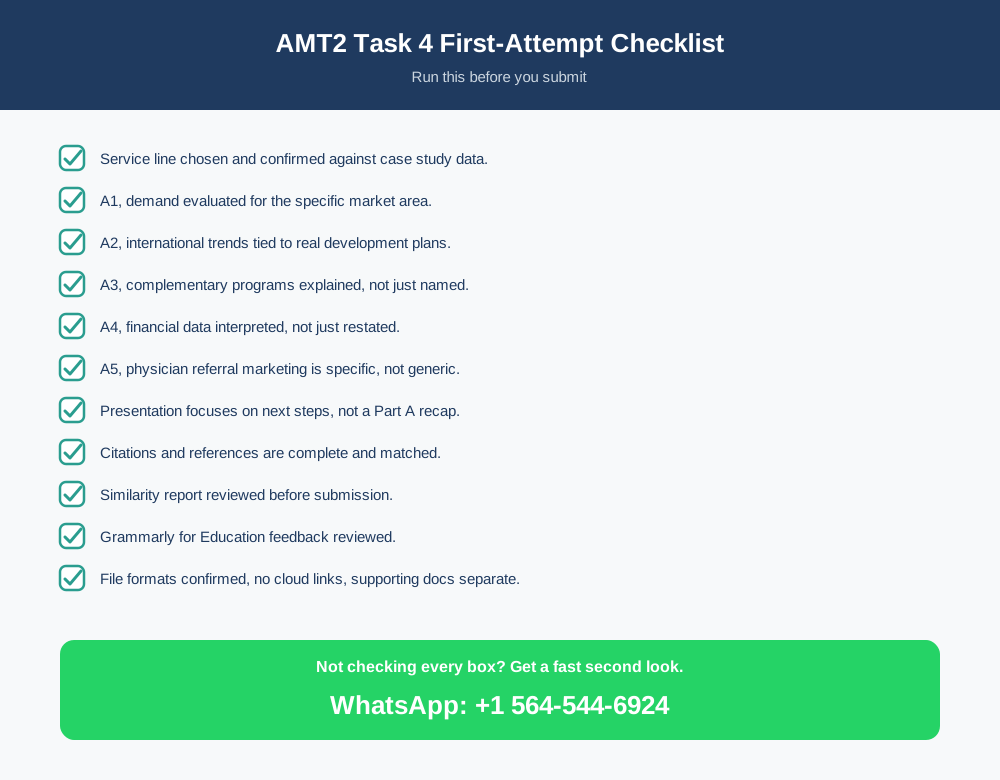
- Chosen service line confirmed against case study data.
- A1, demand evaluated specifically for the defined market area.
- A2, international trends connected to actual development plans.
- A3, complementary programs explained, not just named.
- A4, financial and operating data interpreted, not just restated.
- A5, physician referral marketing specific to the service line and market.
- Multimedia presentation focused on next steps and implementation.
- Citations and references complete and matched.
- Similarity report reviewed.
- Grammarly for Education feedback reviewed.
- File formats and submission requirements confirmed.
Frequently Asked Questions About WGU AMT2 Task 4
What is WGU AMT2 Task 4? A performance assessment (KMM1 Task 4) in AMT2, Service Line Development, asking you to assess the feasibility of a new orthopedic, cardiovascular, or cancer service line using a provided case study, then present your recommendation to a board of directors.
Which service line should I choose for AMT2 Task 4? Whichever option the case study’s demand data, existing complementary programs, and financial indicators most clearly support, that alignment makes several rubric criteria easier to argue convincingly.
What does “international healthcare trends” mean in this task? Trends happening in healthcare globally, such as telehealth expansion, value-based care models, or new clinical techniques, that could realistically be incorporated into how you develop your specific service line.
Does AMT2 Task 4 require an actual presentation file? Yes, Part B specifically requires a multimedia presentation, such as PowerPoint or Keynote, recommending next steps for development and implementation.
What causes AMT2 Task 4 revisions? Most often, insufficient detail rather than incorrect reasoning, generic industry commentary instead of case-study-specific analysis, or a presentation that summarizes Part A instead of recommending next steps.
Is there an AMT2 Task 4 example? An original, clearly labeled illustrative example is included above. Full student submissions found online may not match your current case study version or your chosen service line, and reflect someone else’s original work rather than yours.
How do I pass AMT2 Task 4 on the first attempt? Ground every part of your analysis in the case study’s actual data for your chosen market area, connect international trends to real development decisions, interpret your financial data rather than restating it, and check citations and professional communication before submitting.
Final Strategy for WGU AMT2 Task 4
Choose your service line, evaluate demand in the defined market area, connect international trends to your development plan, identify real complementary programs, interpret the financial data, plan physician referral marketing, build a forward-looking presentation, verify citations, check professional communication, review every rubric criterion.
Working full-time and stuck on WGU AMT2 Task 4? Message Gradevia on WhatsApp at +1 564-544-6924, tell us where you’re stuck, and we’ll help you turn your current case study into a plan you can actually work from.
Related Content
WGU C207 Task 1: Complete Guide + Worked Example (Linear Regression Analysis)
WGU C207 Task 2 Guide: Decision Tree Analysis + Example (2026 Edition)
WGU D218 Task 1 Example & Complete Guide for RN-to-BSN Students
WGU C216 Task 1: Complete Investor Presentation Guide + Example (MBA Capstone)
References
- Liu, Y. (2023). A novel cardio-oncology service line model in optimizing care access, quality and equity for large, multi-hospital health systems. Cardio-Oncology, 9(1), 16. https://doi.org/10.1186/s40959-023-00167-0
- Bahalkeh, E., Chiam, T. C., & Yih, Y. (2023). An interpretable clustering classification approach for assessing and adjusting hospital service lines. Healthcare Analytics, 4, 100255. https://doi.org/10.1016/j.health.2023.100255
- Stubnya, B. G., Schulz, M., Vancsa, S., Szilagyi, G. S., Szatmari, A., & Bejek, Z. (2025). Global trends in joint arthroplasty: A systematic review and future projections. Journal of Clinical Medicine, 14(22), 8214. https://doi.org/10.3390/jcm14228214
- Fernandez-Ortiz, Y. N., & Rodriguez-Hernandez, J. M. (2025). Lower limb arthroplasties in Colombia: Projections for 2050 based on official records. Epidemiologia, 6(2), 24. https://doi.org/10.3390/epidemiologia6020024
- Mojtahedi, Z., Sun, I., & Shen, J. J. (2023). Telehealth utilization and good care among informal caregivers: Health Information National Trends Survey, 2022. Healthcare, 11(24), 3193. https://doi.org/10.3390/healthcare11243193