
Blog
How to Pass WGU C209 Task 1 on Your First Attempt

Updated on: Sep 1, 2026
WGU C209 Task 1
JRM1 Task 1 in C209, Strategic Management, isn’t a conventional academic essay, and treating it like one is where most first attempts go wrong. In a single submission, you’re asked to evaluate what makes a strategy succeed or fail, name and apply at least two analytical tools, build a SWOT analysis for a real company, connect that SWOT to actual strategic decisions, cite your sources correctly, and write it all with professional-grade communication. That’s six distinct evaluated skills stacked into one task.
The biggest mistake students make is writing one long, flowing discussion about strategy instead of methodically working through each rubric requirement on its own terms. This guide breaks JRM1 Task 1 into its actual parts, A1 through E, shows you what a strong response looks like at each stage with fictional teaching examples, and gives you a rubric-first workflow you can use to plan your own original submission.
C209 Task 1 Assignment
Introduction
You will use the various analytical tools presented in the course to provide a SWOT (strengths, weaknesses, opportunities, threats) analysis for a company with which you are familiar or where you are presently employed. Once the SWOT analysis has been generated, you will discuss how this information might be used in terms of making strategic decisions for the company. You will also discuss what makes a strategy either successful or unsuccessful and how the SWOT analysis can affect the overall success or failure of the strategy. Finally, you will use your analysis to create a business strategy for the company in task 2.
Note: Any information that would be considered confidential, proprietary, or personal in nature should not be included in the actual task submission to WGU. Do not include the actual names of people, suppliers, the organization(s), or other identifiable information. Fictional names should be used. Also, organization-specific data, including financial information, should not be included but should be addressed in a general fashion as appropriate. Work performed for a client or an employer is their property and should not be used without written permission.
Requirements
Your submission must represent your original work and understanding of the course material. Most performance assessment submissions are automatically scanned through the WGU similarity checker. Students are strongly encouraged to wait for the similarity report to generate after uploading their work and then review it to ensure Academic Authenticity guidelines are met before submitting the file for evaluation. See Understanding Similarity Reports for more information.
Grammarly Note:
Professional Communication will be automatically assessed through Grammarly for Education in most performance assessments before a student submits work for evaluation. Students are strongly encouraged to review the Grammarly for Education feedback prior to submitting work for evaluation, as the overall submission will not pass without this aspect passing. See Use Grammarly for Education Effectively for more information.
Microsoft Files Note:
Write your paper in Microsoft Word (.doc or .docx) unless another Microsoft product, or pdf, is specified in the task directions. Tasks may notbe submitted as cloud links, such as links to Google Docs, Google Slides, OneDrive, etc. All supporting documentation, such as screenshots and proof of experience, should be collected in a pdf file and submitted separately from the main file. For more information, please see Computer System and Technology Requirements.
You must use the rubric to direct the creation of your submission because it provides detailed criteria that will be used to evaluate your work. Each requirement below may be evaluated by more than one rubric aspect. The rubric aspect titles may contain hyperlinks to relevant portions of the course.
What Is WGU C209 Task 1?
C209 is Strategic Management, and JRM1 Task 1 asks you to use the analytical tools from the course to examine a company’s strategy and perform a SWOT analysis, then use that analysis to discuss the company’s strategic decisions. This groundwork carries forward directly into Task 2, where you’ll build an actual business strategy from what you establish here.
The assessment breaks into five parts:
Part A, what makes a strategy successful or unsuccessful, covering vision/mission/values, leadership buy-in, analytical tools, and strategy-people-culture alignment.
Part B, a SWOT analysis of a company you’re familiar with or currently employed by.
Part C, how that SWOT analysis affects the company’s strategic decisions.
Part D, source acknowledgment through citations and references.
Part E, professional communication.
Your goal isn’t to “write about strategy” in general terms. It’s to satisfy each of these evaluated requirements specifically, with sufficient detail that an evaluator doesn’t have to guess what you mean.
The C209 Task 1 Rubric at a Glance
Base your planning on your current official task instructions and rubric, this table is meant to help you interpret them, not replace them.
| Requirement | What You Must Demonstrate | What Strong Work Looks Like |
|---|---|---|
| A1 | Vision, mission, and values | Explains their specific role in forming the overall strategy |
| A2 | Leadership team buy-in | Explains why leadership commitment actually matters to execution |
| A3 | At least two analytical tools | Explains what each tool reveals and how it supports situational analysis |
| A4 | Strategy, people, and culture alignment | Explains why that alignment matters to the organization |
| A4a | Success or failure | Connects alignment specifically to strategic outcomes |
| B1 | SWOT analysis | Analyzes strengths, weaknesses, opportunities, and threats with real detail |
| C | SWOT and strategic decisions | Explains how your findings should influence actual decisions |
| D | Sources | Uses accurate in-text citations matched to a complete reference list |
| E | Professional communication | Clear grammar, sentence fluency, spelling, and punctuation throughout |
Not sure how to turn this rubric into a plan for your own company? Gradevia can help you break C209 Task 1 into manageable steps.
How to Approach Part A: What Makes a Strategy Successful or Unsuccessful
Part A contains four separate, individually graded concepts. Treating it as one vague discussion about “good strategy” is a common way to lose points across multiple criteria at once.
A1: Vision, Mission, and Values
The actual requirement is to discuss how creating vision, mission, and values statements is critical in forming the overall strategy, not to simply define what each term means.
Think of them this way: vision is the desired future state, mission is the organization’s purpose and direction, and values are the principles that shape behavior and decisions. Your job is to explain how those three elements guide actual strategic priorities.
Illustrative Example, Not an Official WGU C209 Answer.
Northstar Health Services, a fictional company, has a vision of becoming the most accessible preventive-healthcare provider in its region. Its mission centers on affordable preventive services, and its values emphasize accessibility, patient respect, and evidence-based care. Those three elements together would reasonably push leadership toward specific strategic choices: expanding telehealth to improve access, investing in preventive-care programs to match the mission, training employees around patient respect, and prioritizing underserved markets consistent with the accessibility value. That’s the difference between defining the terms and discussing their role in strategy formation, one just states what they are, the other shows what they actually do.
A2: Leadership Team Buy-In
The requirement is to discuss why leadership buy-in matters to the strategy, not just to assert that it does.
Go beyond “leadership support is important” by naming the actual mechanisms: leadership controls resource allocation, sets the tone through communication, holds people accountable to the strategy, and can either remove or reinforce organizational barriers to execution.
Illustrative Example. If Northstar’s executive team is divided on whether to fund the telehealth expansion, middle managers receive mixed signals, budget requests stall, and the strategy loses momentum before it’s ever fully implemented, regardless of how sound the underlying analysis was.
A3: At Least Two Analytical Tools for Situational Analysis
This requirement is explicit: discuss the use of at least two analytical tools in performing a situational analysis. WGU doesn’t require a specific pair unless your current task instructions say so, but common options covered in strategic management coursework include SWOT, PESTLE, Porter’s Five Forces, VRIO, and value chain analysis. Confirm which tools your course materials actually cover before choosing.
For each tool you discuss, explain three things: what it examines, what kind of information it reveals, and how management could actually use that information.
Illustrative Example: PESTLE and Porter’s Five Forces. For Northstar, a PESTLE analysis might reveal regulatory changes around telehealth reimbursement and shifting technology adoption among patients. Porter’s Five Forces might reveal intensifying competitive pressure from other regional telehealth providers entering the same market. Together, these two tools give leadership a broader picture than either alone, PESTLE covers the macro environment, Porter’s Five Forces covers the competitive landscape directly.
Simply naming two tools (“the company can use SWOT and PESTLE”) isn’t enough. A stronger response explains how each tool specifically contributes to understanding this company’s strategic situation.
A4: Strategy, People, and Culture Alignment
The requirement is to discuss why appropriate alignment between strategy, people, and corporate culture matters.
Weak alignment example. A fictional company adopts a strategy centered on premium, high-touch customer service, but continues rewarding employees primarily for speed and transaction volume. The incentive structure directly conflicts with the strategic direction.
Strong alignment example. The same company adjusts its hiring criteria, training programs, performance metrics, leadership behavior, and reward structure so all of them reinforce the customer-service strategy instead of undermining it. Alignment is what makes a strategy realistic to actually execute, not just sound reasonable on paper.
A4a: How Alignment Determines Strategic Success or Failure
This is a separate requirement from A4, and repeating A4’s content here is a common way to lose points on this specific criterion. A4 asks why alignment matters in general. A4a asks about the consequence, the role alignment plays in whether the strategy actually succeeds or fails.
Walk through a cause-and-effect chain: strategic objective leads to required employee behavior, which depends on organizational culture, which shapes execution, which produces the outcome. In an aligned organization, that chain runs smoothly. In a misaligned one, an otherwise attractive strategy fails during implementation because the people, incentives, behaviors, and culture actively contradict what the strategy needs from them.
How to Complete Part B: The SWOT Analysis
Part B requires a SWOT analysis of a company you’re familiar with or currently employed by, analyzing its strengths, weaknesses, opportunities, and threats.
Strengths and weaknesses are internal to the company, capabilities or limitations that exist inside the organization. Opportunities and threats are external, conditions in the market or environment that the company doesn’t directly control but has to respond to.
How to Choose Your Company
Pick a company where you can genuinely discuss its customers, competition, internal capabilities, market conditions, and strategic priorities, not one you only know superficially. The task explicitly instructs you not to include confidential, proprietary, or personal information, and not to use identifiable names for people, suppliers, or the organization itself. Work performed for an employer or client belongs to them and shouldn’t be used without written permission. Use a fictional name for your company and describe organization-specific information, especially financial data, in general terms rather than disclosing it directly.
C209 SWOT Analysis Example
Illustrative Example, Not an Official WGU C209 Answer.
Fictional company: Summit Fitness Centers.
| Strengths | Weaknesses |
|---|---|
| Strong local brand recognition | Limited digital customer engagement |
| Experienced trainers | Heavy dependence on physical locations |
| Loyal membership base | Inconsistent customer experience across locations |
| Opportunities | Threats |
|---|---|
| Growing demand for hybrid fitness | Low-cost online fitness platforms |
| Corporate wellness partnerships | Increasing local competition |
| Digital coaching services | Economic pressure on discretionary spending |
Listing four categories like this is only the starting point. The real work is turning each entry into analysis.
Weak: “A strength is a loyal customer base.”
Stronger: “A loyal customer base can give Summit Fitness a more stable revenue foundation and provide an existing audience to introduce new digital coaching services to, reducing the customer-acquisition cost of launching that offering.”
That’s the pattern to repeat for every SWOT entry: identify the factor, then explain its strategic significance, not just its existence.
Need help making your SWOT company-specific instead of generic? Get a personalized breakdown of your current requirements.
How to Complete Part C: Turning SWOT Into Strategic Decisions
Part C requires you to discuss how your SWOT analysis affects the company’s strategic decisions. This is where a lot of otherwise solid submissions stop too early, they present the SWOT and never explicitly connect it to a decision.
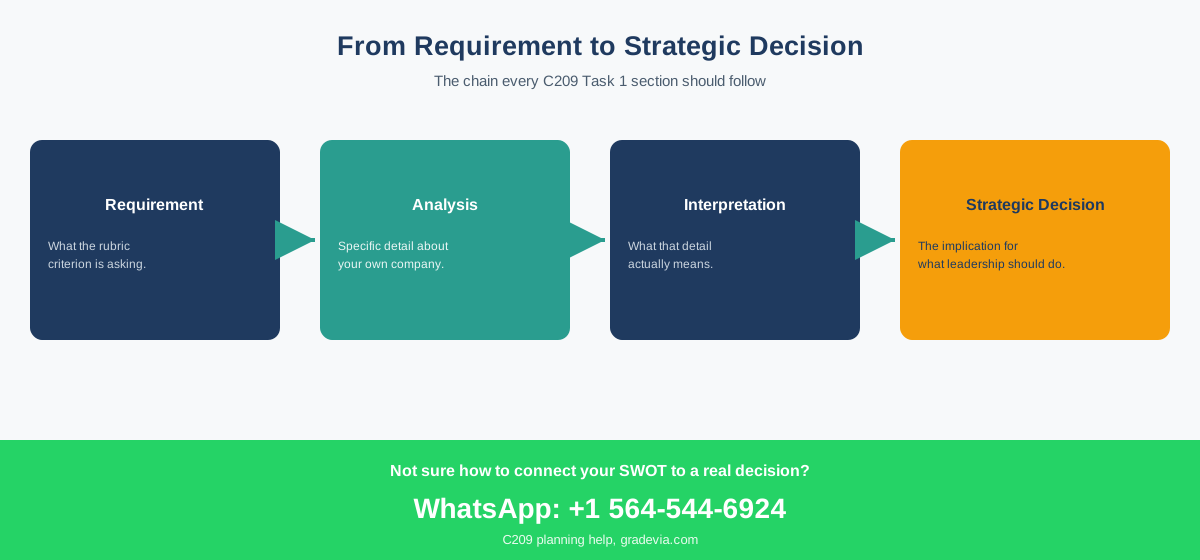
Use the chain: SWOT finding leads to strategic implication, which leads to a decision.
Illustrative Example, continuing Summit Fitness.
Strength: loyal membership base. Opportunity: digital coaching. Strategic implication: the company already has an engaged audience that could plausibly adopt an expanded digital offering. Potential decision: develop a digital coaching service for existing members before pursuing aggressive acquisition of entirely new customers.
Weakness: limited digital engagement. Threat: low-cost online competitors. Strategic implication: this weakness increases the company’s exposure to a growing external threat. Potential decision: invest in digital engagement capabilities as a defensive priority, not just a growth opportunity.
A SWOT analysis becomes strategically useful the moment its findings start influencing priorities, resource allocation, or positioning, not before.
The Biggest Difference Between a SWOT List and a SWOT Analysis
SWOT list: “High customer loyalty.”
SWOT analysis: “High customer loyalty provides an existing customer base that may reduce the difficulty of introducing new services, creating an opportunity to grow revenue from current customers rather than relying solely on new customer acquisition.”
The pattern underneath every strong response in this task is the same: identify, explain, then state the strategic significance. Apply that three-step pattern to every SWOT entry, every analytical tool, and every alignment discussion in the assessment, and most of the “insufficient detail” feedback that triggers revisions disappears.
How to Connect Parts A, B, and C
The strongest submissions don’t treat each part as an isolated question, they build on each other:
Part A establishes what makes strategy successful in general. Part B analyzes this specific company’s strategic situation through SWOT. Part C uses those findings to inform actual strategic decisions.
Within Part A itself, there’s a logical order too: vision, mission, and values set the direction, leadership buy-in makes execution possible, situational analysis (your two analytical tools) reveals the environment, and strategy-people-culture alignment determines whether execution actually works. Keeping that order in mind while you draft, rather than jumping between concepts, tends to produce a submission that reads as one coherent argument instead of five disconnected answers.
C209 Task 1 Example: What a Strong Analysis Looks Like
Illustrative Example, Not an Official WGU C209 Answer. Do not copy this into a submission.
Fictional company: HorizonCare, a regional healthcare organization with a strong reputation, experienced staff, growing demand for virtual care, increasing competition, outdated digital systems, and leadership considering a digital expansion strategy.
A strong response would reason through this roughly as follows: HorizonCare’s mission around patient-centered, accessible care supports a digital expansion strategy directly (A1). Executive buy-in matters because digital investment requires sustained multi-year funding that a divided leadership team could stall (A2). A PESTLE analysis reveals shifting telehealth regulation, while a Porter’s Five Forces analysis reveals new virtual-care competitors entering the market, together painting a fuller strategic picture than either alone (A3).
Existing staff, trained under legacy in-person workflows, would need new incentives and training to genuinely support a virtual-care strategy, or the strategy risks failing at the point of execution despite sound planning (A4/A4a). HorizonCare’s SWOT would likely show strong reputation and experienced staff as strengths, outdated digital systems as a weakness, growing virtual-care demand as an opportunity, and increasing competition as a threat (B1). Those findings point toward a specific decision: prioritize digital infrastructure investment now, while the company’s reputation still gives it room to compete, rather than waiting until competitors have captured more of the virtual-care market (C).
That’s the shape of a complete response, not the actual sentences to submit, your own reasoning needs to reflect your own chosen company.
C209 Task 1 Common Mistakes That Trigger Weak Rubric Performance
The rubric for this task distinguishes between Not Evident, Approaching Competence, and Competent, and the difference between the top two levels usually comes down to a logical discussion with sufficient detail versus one without it.
Mistake 1, defining instead of discussing. “A mission statement explains what a company does” defines the term. Explaining how the mission influences strategic priorities discusses it, that’s the level this task actually wants.
Mistake 2, naming two analytical tools without explaining their use. “The company can use SWOT and PESTLE” names two tools. Explaining what each one reveals and how management could use those findings is what the requirement actually asks for.
Mistake 3, listing SWOT factors without analysis. Every factor needs context and strategic significance attached, not just a label.
Mistake 4, writing a generic SWOT. If your SWOT entries could apply to almost any company in the industry, they’re not specific enough to your chosen company.
Mistake 5, treating the SWOT as the final answer. Part C explicitly requires connecting SWOT findings to strategic decisions, stopping at the SWOT itself leaves the task incomplete.
Mistake 6, repeating A4 in A4a. A4 covers why alignment matters in general. A4a covers the specific role alignment plays in strategic success or failure, write it as a distinct answer.
Mistake 7, making unsupported strategic claims. Recommendations should logically follow from your analysis, not appear as an unexplained conclusion.
Mistake 8, ignoring source requirements. The rubric requires both in-text citations and a matching reference list for anything quoted, paraphrased, or summarized.
Mistake 9, weak professional communication. The communication criterion specifically evaluates grammar, sentence fluency, contextual spelling, and punctuation, not just whether the ideas are good.
How to Use the C209 Task 1 Rubric Before Writing
| Rubric Area | Question to Ask Before Submission |
|---|---|
| A1 | Did I explain how vision, mission, and values shape strategy, not just define them? |
| A2 | Did I explain why leadership buy-in matters, with real mechanisms? |
| A3 | Did I explain how at least two specific analytical tools support situational analysis? |
| A4 | Did I explain why strategy-people-culture alignment matters? |
| A4a | Did I separately explain how alignment affects success or failure? |
| B1 | Did I analyze, not just list, strengths, weaknesses, opportunities, and threats? |
| C | Did I explicitly connect my SWOT findings to strategic decisions? |
| D | Are quoted, paraphrased, and summarized ideas properly cited and referenced? |
| E | Is the submission professionally written throughout? |
Use this table before you draft, while you draft, and one final time before you submit.
C209 Task 1 Sources and Citations
The task requires in-text citations and a reference list for anything quoted, paraphrased, or summarized. Paraphrasing still requires attribution, restating an idea in your own words doesn’t remove the need to credit where it came from. Every source in your reference list should correspond to something actually cited in your paper, and every in-text citation should have a matching reference entry. Prioritize credible sources, and never fabricate a reference to make the paper look more thoroughly researched than it is. No specific number of sources is prescribed here unless your current task instructions say otherwise.
Professional Communication in C209 Task 1
Professional communication in this task covers grammar, sentence fluency, contextual spelling, punctuation, and overall clarity and organization. Most performance assessments run this check automatically through Grammarly for Education, and reviewing that feedback before you submit, not after, is worth the few extra minutes it takes.
Weak: “The strategy don’t work because employees wasn’t supporting it and the company culture were different.”
Improved: “The strategy is unlikely to succeed when employees do not support it and the organizational culture conflicts with the behaviors required for implementation.”
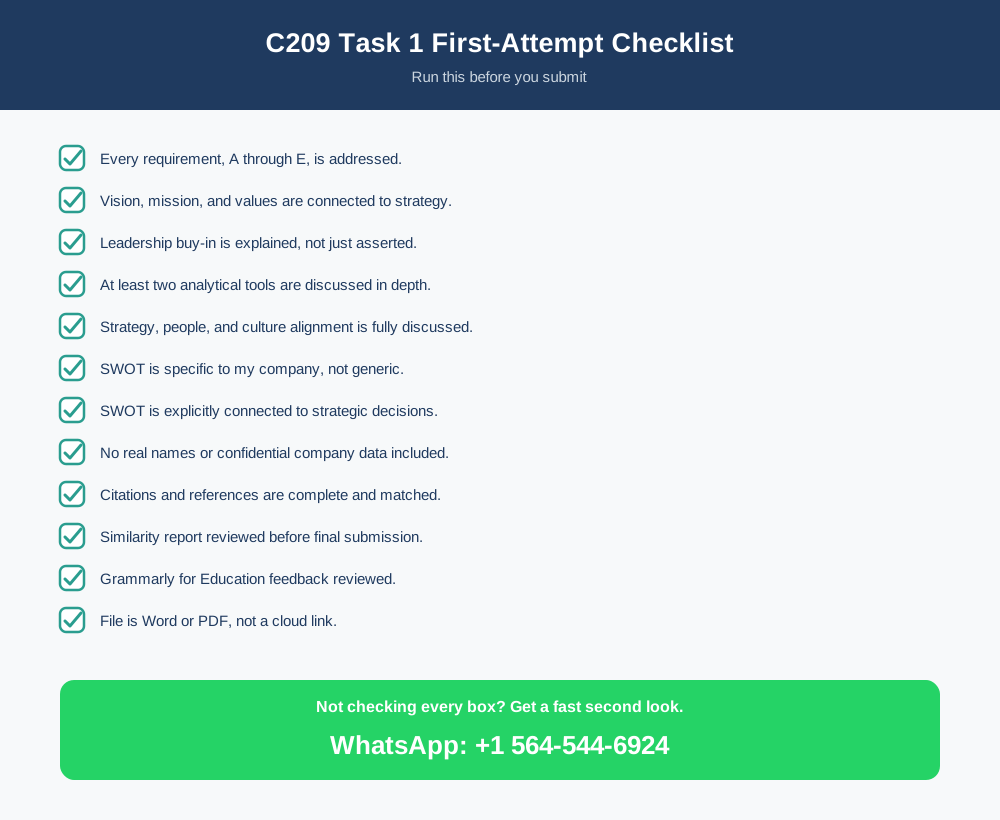
C209 Task 1 Submission Checklist
Strategy analysis
- A1, vision, mission, and values, addressed with real discussion
- A2, leadership buy-in, addressed with real mechanisms
- A3, at least two analytical tools, explained in depth
- A4, strategy-people-culture alignment, addressed
- A4a, success or failure, addressed separately from A4
SWOT
- Strengths analyzed, not just listed
- Weaknesses analyzed, not just listed
- Opportunities analyzed, not just listed
- Threats analyzed, not just listed
Strategic decisions
- SWOT findings are explicitly connected to strategic decisions
Sources
- In-text citations included where required
- Complete, accurate reference list included
- Every citation matches a reference and vice versa
Communication
- Grammar checked
- Sentence fluency checked
- Spelling and punctuation checked
- Professional presentation checked
Academic authenticity
- Submission represents your own original work and understanding
- No confidential or proprietary information included
- Examples used for learning only, not copied into the submission
How to Avoid a C209 Task 1 Revision
No specific approach guarantees a pass, but these reduce the avoidable weaknesses that most commonly trigger one:
- Start with the rubric, not a blank page.
- Break the task into A1 through E before you draft anything.
- Answer every requirement directly and specifically.
- Explain concepts rather than merely defining them.
- Apply every concept to your actual chosen company.
- Make your SWOT analytical, not descriptive.
- Connect your SWOT findings explicitly to strategic decisions.
- Verify every citation matches a reference.
- Run a professional-communication check before submitting.
- Confirm no confidential or proprietary information made it into the final draft.
Can You Use a C209 Task 1 Example or Template?
There’s a real difference between a study example, a planning outline, a writing template, and a completed answer. Your submission has to represent your own original work and understanding, that’s an explicit part of the task instructions, not just general advice. Use an example, including the ones in this guide, to understand analytical depth, organization, strategic reasoning, SWOT construction, and how findings connect to decisions. Then build your own analysis from your own knowledge of your own chosen company.
Frequently Asked Questions About WGU C209 Task 1
- What is WGU C209 Task 1? It’s the JRM1 Task 1 performance assessment in C209, Strategic Management, asking you to evaluate what makes a strategy successful, perform a SWOT analysis of a company you know, and discuss how that analysis affects strategic decisions.
- What is JRM1 Task 1? JRM1 is the assessment code some students see attached to C209 Task 1 inside their course dashboard.
- What does WGU C209 Task 1 require? Five parts: what makes a strategy successful or unsuccessful (vision/mission/values, leadership buy-in, analytical tools, strategy-people-culture alignment), a SWOT analysis, the impact of that SWOT on strategic decisions, source citations, and professional communication.
- What analytical tools can be used in C209 Task 1? Common options in strategic management coursework include SWOT, PESTLE, Porter’s Five Forces, VRIO, and value chain analysis. Confirm which specific tools your current course covers before choosing.
- How many analytical tools are required for C209 Task 1? At least two, explained in enough depth to show how each one supports your situational analysis.
- How do I complete the C209 SWOT analysis? Analyze your chosen company’s strengths, weaknesses, opportunities, and threats, then go beyond listing each factor by explaining its actual strategic significance.
- What is the difference between strengths and weaknesses? Both are internal to the company, strengths are capabilities or advantages, weaknesses are limitations or disadvantages.
- What is the difference between opportunities and threats? Both are external to the company, opportunities are conditions it could exploit, threats are conditions that could hurt it.
- How does SWOT affect strategic decisions? Your SWOT findings should point toward specific decisions, priorities, resource allocation, or positioning choices, explained explicitly in Part C rather than left for the evaluator to infer.
- What causes C209 Task 1 revisions? Most often, insufficient detail rather than incorrect reasoning, definitions instead of discussion, a generic rather than company-specific SWOT, or a SWOT with no explicit connection to strategic decisions.
- Can I use a C209 Task 1 example? Yes, to understand structure and reasoning, but never to copy into your own submission, your work has to represent your own original understanding.
- Do I need citations in C209 Task 1? Yes, for anything quoted, paraphrased, or summarized, with a complete, matching reference list.
- How do I pass C209 Task 1 on the first attempt? Work from the rubric, apply every concept specifically to your chosen company, make your SWOT and alignment discussions analytical rather than descriptive, connect your findings to real decisions, and check citations and professional communication before you submit.
Final C209 Task 1 Strategy
Read the rubric, understand the strategic concepts, select an appropriate company, analyze the situation, discuss at least two analytical tools, build a company-specific SWOT, connect SWOT findings to strategic decisions, verify citations, check professional communication, review every rubric criterion.
The goal isn’t a longer paper, it’s a logical, sufficiently detailed analysis that directly addresses each evaluated requirement.
Working full-time and stuck on WGU C209 Task 1? Message Gradevia on WhatsApp at +1 564-544-6924, tell us where you’re stuck, and we’ll help you turn your current task instructions into a plan you can actually work from.
Related Content
WGU C207 Task 1: Complete Guide + Worked Example (Linear Regression Analysis)
WGU C207 Task 2 Guide: Decision Tree Analysis + Example (2026 Edition)
WGU C206 Task 2 (Paradigm Toys): Guide + Example
References
- Abu Bakir, S. M. (2023). Impact of strategic analysis (SWOT) on the performance of Jordanian public shareholding industrial companies: The mediating role of scenario planning. International Journal of Sustainable Development and Planning, 18(5), 1535-1543. https://doi.org/10.18280/ijsdp.180524
- Puyt, R. W., Lie, F. B., & Madsen, D. O. (2025). From SOFT approach to SWOT analysis, a historical reconstruction. Journal of Management History, 31(2), 333-373. https://doi.org/10.1108/JMH-05-2023-0047
- Dhlamini, J. (2025). Setting the strategic direction: The role of the mission, vision, values statements and strategic leadership. Journal of Strategy and Management, 18(3), 591-615. https://doi.org/10.1108/JSMA-08-2024-0193
- Larabi, C. (2025). Organizational culture as driver of strategy implementation success: Managerial perspective. Corporate and Business Strategy Review, 6(4), 54-64. https://doi.org/10.22495/cbsrv6i4art5
- Antoniadou, M., & Kanellopoulou, A. (2024). Educational approach: Application of SWOT analysis for assessing entrepreneurial goals in senior dental students. European Journal of Investigation in Health, Psychology and Education, 14(3), 749-766. https://doi.org/10.3390/ejihpe14030049