
Blog
XH3003 Health History Across the Lifespan: Guide and Example for Working Walden Nurses

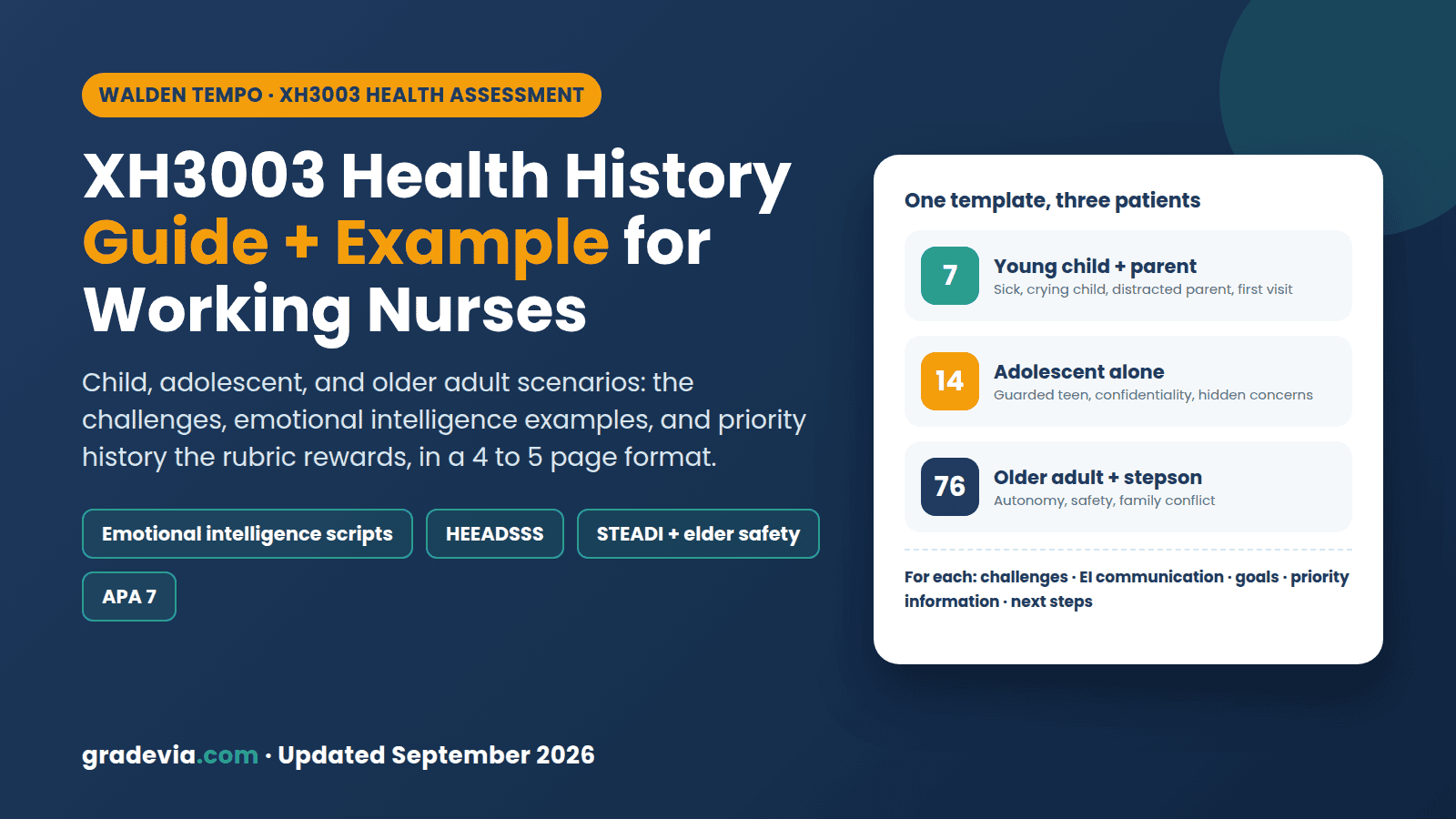
Quick answer: XH3003 asks you to watch three Mursion avatar scenarios at the fictional Neighborhood Clinic (Archie, age 7, with his father; Jasmine, age 14, without her mother; and Colleen, age 76, whose stepson wants to join) and complete one template. For each patient, you analyze the challenges of gathering a health history, the communication skills a nurse needs with specific emotional intelligence examples, your goals, the priority information and why, and your next steps based on how the scenario ends. For Colleen, you also explain what to ask her stepson. The finished document is 4 to 5 pages plus a reference page, with evidence cited for every response.
This guide is for nurses completing XH3003 while working full time on the way through a Walden MSN, often in the hours after a shift. It breaks the rubric into a repeatable answer formula, gives you emotional intelligence scripts you can adapt, lists the priority history for each age group with the reasoning graders look for, and includes a downloadable worked example that uses fictitious patients so you can see the depth and citation style without copying anything. For more step-by-step help with Walden courses, visit our Walden University nursing guides.
XH3003: Health History Across the Lifespan Assignment
Overview
For this Performance Task Assessment, you will analyze three challenging situations with patients across the lifespan for the professional nurse in gathering a detailed health history. You will complete one template document for the three examples. Your patients, including a parent with a young child, will be avatars in Mursion interactive scenarios.
Instructions
To complete this Assessment, do the following:
- Be sure to adhere to the indicated Assignment length.
- Download the Health History Challenges Template Word document.
- Download the Academic Writing Expectations Checklist to review prior to submitting your Assessment.
Before submitting your Assessment, carefully review the rubric. This is the same rubric the Faculty Instructor will use to evaluate your submission and it provides detailed criteria describing how to achieve or master the Competency. Many students find that understanding the requirements of the Assessment and the rubric criteria help them direct their focus and use their time most productively.
Important Information on Interpreting the Assessment Rubric (click to expand)
All submissions must follow the conventions of scholarly writing. Properly formatted APA citations and references must be provided where appropriate. Submissions that do not meet these expectations will be returned without scoring. This Assessment requires submission of one completed template document. Save this file as XH3003_firstinitial_lastname (for example, XH3003_J_Smith). You may submit a draft of your assignment to the Turnitin Draft Check area to check for authenticity. When you are ready to upload your completed Assessment, use the Assessment tab on the top navigation menu.
Important Note: As a student taking this Competency, you agree that you may be required to submit your Assessment for textual similarity review to Turnitin.com for the detection of plagiarism. All submitted Assessment materials will be included as source documents in the Turnitin.com reference database solely for the purpose of detecting plagiarism of such materials. Use of the Turnitin.com service is subject to the Usage Policy posted on the Turnitin.com site.
When Taking a Health History Is a Challenge Recall some of your most challenging patients for gathering a health history. If you include a crying young child with a distracted parent, a moody adolescent, or an older adult with perhaps something to hide, or maybe all three, get ready to revisit those patients for this Assessment. The setting is Neighborhood Clinic, a fictional community health center. The avatar clinic director, Asha Gill, will introduce and conclude each scenario. You will engage with the following avatar patients:
- Archie, age 7, and Gabriel Moore, his father, who are making a first visit to the clinic because a very miserable Archie is sick
- Jasmine Walker, age 14, at the clinic for a high school physical but without her mother, who has previously accompanied her to appointments
- Colleen Hart, age 76, whose stepson may join the appointment, much to her resistance
Each scenario presents a distinct situation for the professional nurse and involves applying emotional intelligence and knowledge of health history information to gather for each patient. To prepare:
- Access the Health History Challenges template document and review the requirements of this Assessment.
- View the video of each scenario as many times as you need. You are encouraged to take notes for details to support your analysis of each scenario. Keep these questions in mind as you view and analyze each scenario:
- What health history information is needed?
- What questions would you ask to obtain it?
- How would you demonstrate emotional intelligence to win trust?
- What may be presenting as a specific problem or need?
- Compete the Assessment based on the interactive media, other Learning Resources, and any additional resources you identify.
To complete the Competency Assessment: Use the Health History Challenges template document to record your responses for each scenario. Base your responses on the Mursion interactive media, Learning Resources, and other resources you identify to support your responses to the following questions. All responses should have evidence cited to support statements made in your document. Your submitted document should be 4–5 pages plus a reference page. You should address the following:
Click each of the items below for more information on this Assessment.
Scenario 1: Health History for a Young Child
Archie, age 7, and his father, Gabriel Moore
- Analyze Scenario 1 for the specific challenges presented in gathering a patient health history of a young child.
- What communication skills does a nurse need in this situation with a parent and young child? Include specific examples based on emotional intelligence.
- Explain your specific goals with this parent and child in terms of obtaining a health history.
- What information would be a priority to obtain for a health history of this child, and why?
- Thinking about the situation in the examining room at the end of Scenario 1, what would be your next steps to get the information you need to make a health assessment of this child? Explain your reasoning.
Scenario 2: Health History for an Adolescent
Jasmine Walker, age 14
- Analyze Scenario 2 for the specific challenges presented in gathering a patient health history.
- What communication skills does a nurse need in this situation with an adolescent? Include specific examples based on emotional intelligence.
- Explain your specific goals with this adolescent in terms of obtaining a health history.
- What information would be a priority to obtain, and why?
- Thinking about the situation in the examining room at the end of Scenario 2, what would be your next steps to get the information you need to make a health assessment of this adolescent? Explain your reasoning.
Scenario 3: Health History for an Older Adult
Colleen Hart, age 76
- Analyze Scenario 3 for the specific challenges presented in gathering a patient health history.
- What communication skills does a nurse need in this situation with an older adult? Include specific examples based on emotional intelligence.
- Explain your specific goals with this older adult in terms of obtaining a health history.
- What information would be a priority to obtain, and why?
- What information would be a priority to obtain from the adult stepson if he joined the appointment, and why?
- Thinking about the situation in the examining room at the end of Scenario 3, what would be your next steps to get the information you need to make a health assessment of this older adult? Explain your reasoning.
Complete and Submit.
What XH3003 actually requires
| Requirement | Details |
|---|---|
| Format | One completed Health History Challenges template |
| Length | 4 to 5 pages plus a reference page |
| File name | XH3003_firstinitial_lastname (for example, XH3003_J_Smith) |
| Evidence | “All responses should have evidence cited,” in APA style |
| Unlock | Submit the pre-assessment and engage substantively with your Faculty Instructor first |
| Grading | 16 content criteria (Meets or Exceeds) plus 3 professional writing criteria |
The difference between “Meets” and “Exceeds” on every content row is two words: accurately and thoroughly. “Thoroughly” means you name specific challenges, specific skills, and specific reasons, tied to what happened in the scenario. “Accurately” means your clinical content matches current evidence. Generic answers such as “be empathetic and build rapport” meet the bar at best.
A realistic plan around 12-hour shifts
| Session | Time | What to finish |
|---|---|---|
| Evening 1 | 60 min | Watch all three scenarios once; complete the note grid below |
| Evening 2 | 90 min | Draft Scenario 1 and Scenario 2 using the five-part formula |
| Day off | 2 hours | Draft Scenario 3, add citations, build the reference page |
| Before submitting | 30 min | Check length, run the Turnitin Draft Check, review the Academic Writing Expectations Checklist |
Watch the Mursion scenarios with a note grid
The instructions give you four questions to keep in mind while watching. Turn them into a grid and fill one row per patient. Pay special attention to the last minute of each video, because the “next steps” prompt asks you to respond to the situation in the exam room at the end.
| Patient | What history is needed? | What questions would I ask? | How do I show EI to win trust? | What might be the real problem? | How does the scenario end? |
|---|---|---|---|---|---|
| Archie (7) + father | |||||
| Jasmine (14) | |||||
| Colleen (76) + stepson |
Write down exact phrases the avatars say. Quoting or paraphrasing a specific moment (“when the father kept checking his phone…”) is the fastest way to show the grader your analysis is based on the scenario and not on a generic template.
The five-part answer formula
Every scenario uses the same prompts, so use the same structure:
- Challenges: What makes this history hard to get? Think developmental stage, who the historian is, emotions in the room, privacy, time, and missing information.
- Communication skills with EI examples: Name the EI skill, then show the exact words or actions.
- Goals: What must you walk away with, and what relationship do you need to build?
- Priority information and why: Rank it. The “why” is where most students lose points.
- Next steps: Respond to how the scenario ends, in a logical sequence, with reasoning.
Emotional intelligence, made specific
Emotional intelligence in nursing is commonly described through self-awareness, self-regulation, motivation, empathy, and social skill, and nurses’ EI is associated with more compassionate communication (Arpacı et al., 2024). The rubric asks for “specific examples,” so pair each skill with a line you would actually say.
| EI skill | What it looks like | Example line |
|---|---|---|
| Self-awareness | Noticing your own frustration or bias | (Internal) “I’m feeling rushed. Slow down.” |
| Self-regulation | Staying calm and nonjudgmental | Lowering your voice, sitting at eye level |
| Empathy | Naming the other person’s feelings | “It sounds like you’re worried about missing work.” |
| Motivation | Staying focused on the patient’s goal | “Let’s make sure you leave with a plan that works for you.” |
| Social skill | Building trust, managing conflict | “I ask all my patients these questions, so it isn’t about you specifically.” |
Scenario 1: A young child and a distracted parent
What to analyze: A sick, miserable 7-year-old on a first visit to the clinic, with his father as the main historian.
Challenges to look for in the video: the child is too ill or upset to give a reliable account; the parent is the primary historian and may be distracted or stressed; a first visit means no baseline records; crying limits both the interview and the exam; and time or attention pressure forces you to prioritize (Jarvis & Eckhardt, 2024).
Communication skills: At 7, a child can describe symptoms in simple, concrete terms, so speak to him directly as well as to the parent. Offer choices (“Do you want to sit on Dad’s lap or the table?”), let him handle equipment first, and use open-ended questions with the father followed by clarifying questions. Treat the parent as the expert on his child, which is central to family-centered care (Butler et al., 2026).
Priority information and why:
| Priority | Why it matters |
|---|---|
| Present illness and red flags (onset, fever, pain, vomiting, lethargy, breathing, rash, stiff neck) | Determines urgency and guides the exam |
| Hydration and medications given (fluids, urination, dose and timing of fever reducers) | Dehydration and dosing errors are common pediatric risks |
| Allergies | Must be known before any treatment |
| Immunizations | Affect possible causes and preventive care |
| Past history, exposures, household, and school | Shape the assessment and identify resources |
Next steps: Respond to the exact situation at the end of the video. Strong answers usually include setting a clear plan with the parent, completing priority questions first, examining from least to most invasive with the child close to the parent, requesting prior records, using teach-back for warning signs, and scheduling follow-up to finish the history (Ball et al., 2023).
WhatsApp help with XH3003 Mursion scenario challenges and priority health history information
Watched the scenario after a long shift and your notes still feel thin? Message us on WhatsApp at +1 564-544-6924 and we will talk through the challenges, EI examples, and priority history with you so you can write it in your own words.
Scenario 2: An adolescent without her parent
What to analyze: A 14-year-old at the clinic for a high school physical without the mother who usually comes with her.
Challenges to look for: a normal drive for independence that makes teens guarded with unfamiliar adults; a routine visit that may hide a real concern; missing parent input on family history and immunizations; and confidentiality, including what you can and cannot promise under your state’s minor consent laws (Grubb & Committee on Adolescence, 2024).
Communication skills: Address her as the patient, normalize sensitive questions, and explain confidentiality and its limits before asking about risks. The American Academy of Pediatrics supports time alone with adolescents and clear explanations of confidentiality because they increase disclosure of health risks (Grubb & Committee on Adolescence, 2024).
A confidentiality script you can adapt:
“What we talk about today stays between us, with a few exceptions: if someone is hurting you, or if you might hurt yourself or someone else. If that happens, I’ll talk with you first about who needs to know.”
Priority information: use HEEADSSS
| Domain | Sample opening question |
|---|---|
| Home | “Who lives at home with you? How do you get along?” |
| Education / employment | “How’s school going? Any changes lately?” |
| Eating | “How do you feel about your body? Any recent weight changes or skipped meals?” |
| Activities | “What do you do for fun? Sports or clubs?” |
| Drugs | “Do any of your friends vape, drink, or use other drugs? Have you tried them?” |
| Sexuality | “Are you in a relationship? Have you ever been sexually active?” |
| Suicide / depression | “Have you been feeling down or stressed? Ever thought about hurting yourself?” |
| Safety | “Do you feel safe at home, at school, and online?” |
Add the physical-specific history: exercise-related chest pain or fainting, family history of sudden cardiac death at a young age, menstrual history, medications, allergies, and immunizations (Ball et al., 2023). Explain why each is a priority: for example, cardiac warning signs must be evaluated before sports clearance, and mood screening matters because depression often presents as vague fatigue in teens.
Next steps: Base them on how the scenario ends. Typical elements include answering her concerns honestly, continuing the psychosocial screen privately, using a validated screen such as the PHQ-A if mood concerns arise, sharing findings with the provider, and involving the parent with the teen’s permission for missing information.
Scenario 3: An older adult and her stepson
What to analyze: A 76-year-old woman who resists her stepson joining the appointment.
Challenges to look for: protecting independence and privacy; possible minimizing of symptoms; hearing, vision, or memory changes that slow the interview; family tension; and the possibility of falls, self-neglect, or elder mistreatment that she may be reluctant to discuss in front of family (National Institute on Aging [NIA], 2024).
Communication skills: Use a formal greeting, sit face to face in a quiet, well-lit room, speak clearly at a lower pitch, and give extra time (NIA, 2023). Show respect for her autonomy out loud: “You decide who joins us today.” Normalize safety questions by asking every patient the same way.
Priority information for the patient:
- Reason for the visit and current symptoms
- Falls: the CDC STEADI screening questions (fallen in the past year, feels unsteady, worries about falling) (Centers for Disease Control and Prevention [CDC], 2024)
- Medication reconciliation, ideally a “brown bag” review
- Nutrition and weight change, mood, and sleep
- Cognition (for example, the Mini-Cog) and daily function (ADLs and IADLs)
- Safety and mistreatment screening, asked privately (NIA, 2024)
- Social support, living situation, and advance directives
Priority information from the stepson (only with her permission): changes he has noticed in memory, mood, function, or weight; falls or injuries; who manages medications, money, groceries, and transportation; his role in her care, including any legal authority such as power of attorney; and the specific concern that made him want to join. Explain why: family members provide collateral information a patient may not report, but interviewing the patient alone first protects her privacy and allows safe screening (Ball et al., 2023; NIA, 2024).
Next steps: Respond to the ending of the scenario. Strong answers sequence a private interview first, asking permission before involving the stepson, comparing accounts, completing screening tools, and following clinic policy and state reporting requirements if abuse, neglect, or exploitation is suspected.
Send your XH3003 draft on WhatsApp for a rubric check of all 16 prompts
Want “Exceeds Expectations” instead of a returned submission? Send your draft on WhatsApp and we will check every prompt against the rubric, flag generic EI examples, and point out missing citations.
Fitting 16 answers into 4 to 5 pages
With 16 prompts, you have roughly 100 to 150 words per answer. A useful budget:
| Section | Approximate words |
|---|---|
| Each “challenges” answer | 120 to 150 |
| Each “communication skills with EI” answer | 130 to 160 |
| Each “goals” answer | 70 to 100 |
| Each “priority information” answer | 120 to 150 |
| Stepson question (Scenario 3 only) | 100 to 130 |
| Each “next steps” answer | 120 to 150 |
Cut filler, not evidence. One precise sentence with a citation beats three general sentences without one.
Writing mistakes that get XH3003 returned
The Academic Writing Expectations Checklist is the list faculty use for scholarly writing. The most common problems in this assessment are:
- Uncited clinical claims. The instructions say all responses need evidence. Cite your health assessment textbook or current guidelines in every answer.
- Copied rubric language. Restating the prompt is not analysis, and Turnitin flags matching text.
- Paragraphs with several ideas. Keep one central idea per paragraph, as the checklist requires.
- APA errors on the reference page: missing DOIs, wrong italics, or no hanging indent.
- Too long or too short. Stay within 4 to 5 pages plus references.
Download the illustrative XH3003 example
Download the XH3003 illustrative example (.docx)
The example is completed in the Health History Challenges template, with all 16 prompts answered in 5 pages plus a reference page. It uses fictitious patients created by Gradevia: Mateo, 6, with his mother; Maya, 15, at a sports physical without her guardian; and Evelyn, 78, whose stepson wants to join her visit. Their situations parallel the Neighborhood Clinic scenarios, so you can study:
- How each challenge is tied to specific moments in the case
- EI examples that name the skill and give the exact words
- Ranked priority information with a clear “why”
- Next steps sequenced around how each case ends
- In-text citations in every response and an APA 7 reference list
Important: The example is for illustration only and should not be submitted for grading. Your responses must be based on the Mursion scenarios you watched, and your document will be checked by Turnitin.
Final checklist before you submit
- Pre-assessment submitted and Faculty Instructor engagement completed
- File saved as
XH3003_firstinitial_lastname - Name and date completed in the template
- All 16 prompts answered, including the stepson question
- Each communication answer names EI skills and gives specific words or actions
- Each priority answer explains why
- Each next-steps answer responds to how that scenario ends
- Evidence cited in every response; APA 7 reference page with hanging indents
- 4 to 5 pages plus the reference page
- Turnitin Draft Check completed and the Academic Writing Expectations Checklist reviewed
XH3003 assignment support for full-time working Walden MSN nurses on WhatsApp
Night shift tonight and XH3003 due this week? Get assignment support built around your schedule: a rubric-aligned review of your Health History Challenges template, including length, citations, and next-step reasoning, before your Faculty Instructor sees it. Chat on WhatsApp at +1 564-544-6924.
Frequently asked questions
What is XH3003 at Walden University? XH3003 Health History Across the Lifespan is a Walden Tempo Learning health assessment competency. Students watch three Mursion avatar scenarios (a young child with a parent, an adolescent, and an older adult) and complete one template analyzing challenges, emotional intelligence communication, goals, priority information, and next steps for each patient.
How long should the XH3003 assessment be? The completed Health History Challenges template should be 4 to 5 pages plus a reference page, saved as XH3003_firstinitial_lastname.
What counts as an emotional intelligence example in XH3003? Name the emotional intelligence skill, such as self-regulation or empathy, then show exactly what the nurse would say or do in that scenario, for example acknowledging a stressed parent’s time pressure before asking focused questions.
What history is a priority for the adolescent in XH3003? Priorities include the reason for the visit, a confidential psychosocial screen such as HEEADSSS (home, education, eating, activities, drugs, sexuality, suicide and depression, safety), and any warning signs raised during the visit, explained with the limits of confidentiality.
What should I ask the older adult’s stepson in XH3003? With the patient’s permission, ask about changes he has noticed in memory, mood, function, falls, medications, and finances, and clarify his role in her care. Interview the patient alone first to respect privacy and screen for safety concerns.
Can I submit XH3003 before talking to my Faculty Instructor? No. The assessment unlocks after you submit the required pre-assessment and engage substantively with your Faculty Instructor about the competency.
Keep your Walden MSN moving
The communication and prioritization skills in XH3003 carry straight into advanced health assessment and practicum courses. When you are ready for the next one, browse our Walden University nursing collection for more guides and examples.
References
Arpacı, R., Karasu, F., & Ayar, D. (2024). Exploring the link between emotional intelligence and compassionate communication in nurses: A cross-sectional study. Western Journal of Nursing Research. https://doi.org/10.1177/01939459241271904
Ball, J. W., Dains, J. E., Flynn, J. A., Solomon, B. S., & Stewart, R. W. (2023). Seidel’s guide to physical examination: An interprofessional approach (10th ed.). Elsevier.
Butler, A. E., Ridgway, L., Henderson, E. M., Hokke, S., Edvardsson, K., Adams, C., Greenwood, E., East, C., Safari, K., Arefadib, N., McKenna, L., & Copnell, B. (2026). Family-centred care research in paediatrics: A scoping review. Journal of Child Health Care. https://doi.org/10.1177/13674935251337492
Centers for Disease Control and Prevention. (2024). STEADI: Older adult fall prevention. https://www.cdc.gov/steadi/
Grubb, L. K., & Committee on Adolescence. (2024). Confidentiality in the care of adolescents: Policy statement. Pediatrics, 153(5), Article e2024066326. https://doi.org/10.1542/peds.2024-066326
Jarvis, C., & Eckhardt, A. (2024). Physical examination and health assessment (9th ed.). Elsevier.
National Institute on Aging. (2023). Talking with your older patients. https://www.nia.nih.gov/health/health-care-professionals-information/talking-your-older-patients
National Institute on Aging. (2024). Elder abuse. https://www.nia.nih.gov/health/elder-abuse/elder-abuse
Gradevia provides coaching and assignment support. Examples on this page are for learning and illustration only. Follow Walden University’s academic integrity policy and submit only your own work.