
Blog
Shadow Health Respiratory Concept Lab: How to Complete It

If you are staring at the Shadow Health Respiratory Concept Lab after a full workday, the assignment can look deceptively simple: spend about 25 minutes identifying normal and abnormal lung sounds, complete the activity, check your Student Performance Index, and submit the Lab Pass. The difficult part is knowing what to listen for, and knowing exactly what needs to be submitted when you are finished.
This guide walks through the Shadow Health Respiratory Concept Lab step by step: what the assignment actually requires, how to tell normal breath sounds from adventitious ones, how to work through the identification activities without guessing, and what a lot of the “answer key,” “transcript,” and “Quizlet” searches around this lab are really trying to solve, plus a more reliable way to solve it.
What Is the Shadow Health Respiratory Concept Lab?
The Respiratory Concept Lab is a shorter, focused activity inside the Shadow Health platform. Unlike the full patient simulations (the kind built around a case like Tina Jones), a concept lab isolates one specific skill set, in this case, recognizing normal versus abnormal lung sounds, rather than walking you through an entire patient interview and documentation workflow. That distinction matters for search purposes too: a lot of what shows up when students search “Shadow Health Respiratory Concept Lab Tina Jones” is actually describing Shadow Health’s separate patient-case simulations, not this concept lab. If your assignment instructions only reference the Respiratory Concept Lab, treat any Tina Jones-specific material you find online as a different assignment, not a shortcut for this one.
Shadow Health Respiratory Concept Lab Assignment
In this assignment you will learn about the differences between normal and abnormal lung sounds. Within the Shadow Health platform, complete the Respiratory Concept Lab. The estimated average time to complete this assignment is 25 minutes. Please note, this is an average time. Some students may need additional time.
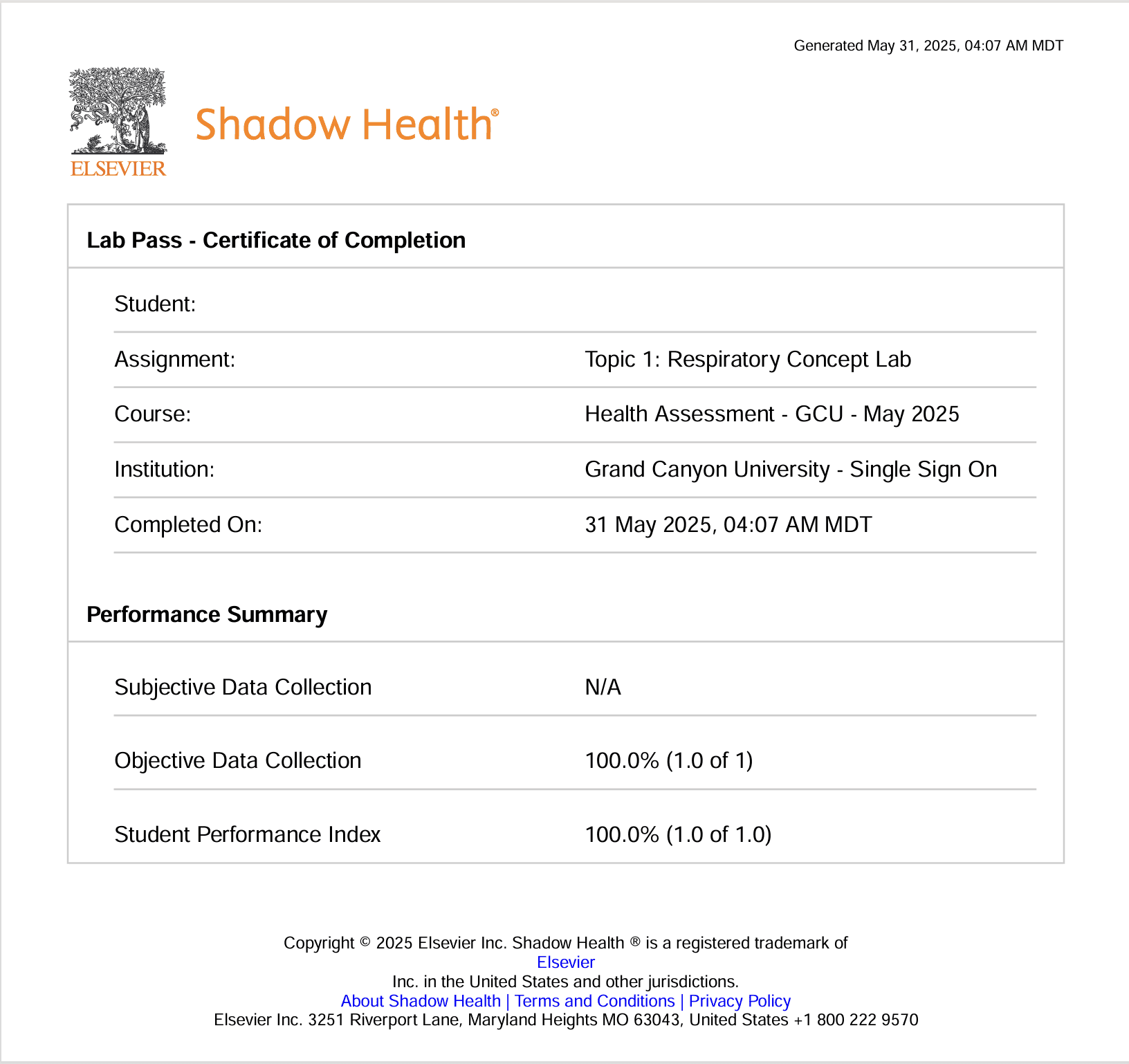
You can attempt this assignment as many times as you would like. After completing this concept lab, you will be awarded a Student Performance Index percentage. This score will appear on your Lab Pass which you will submit to the classroom drop box. The Student Performance Index will be used as your percentage grade for this assignment.
You are not required to submit this assignment to LopesWrite
What the Assignment Instructions Actually Require
Based on the assignment instructions for this lab, here is exactly what’s expected:
- You’ll complete the Respiratory Concept Lab inside the Shadow Health platform.
- The estimated average completion time is 25 minutes, an average, not a hard limit. Plenty of students reasonably need more.
- You can attempt the lab as many times as you want.
- Completion awards a Student Performance Index (SPI) percentage.
- That SPI appears on your Lab Pass, which you submit to your classroom drop box.
- The SPI is your percentage grade for the assignment.
- You do not need to submit this assignment to LopesWrite.
That last point trips more students up than it should. If you’re used to submitting written assignments through LopesWrite for originality checks, it’s easy to assume every assignment needs the same step. This one doesn’t, don’t waste time uploading anything there for this lab.
How to Complete the Shadow Health Respiratory Concept Lab
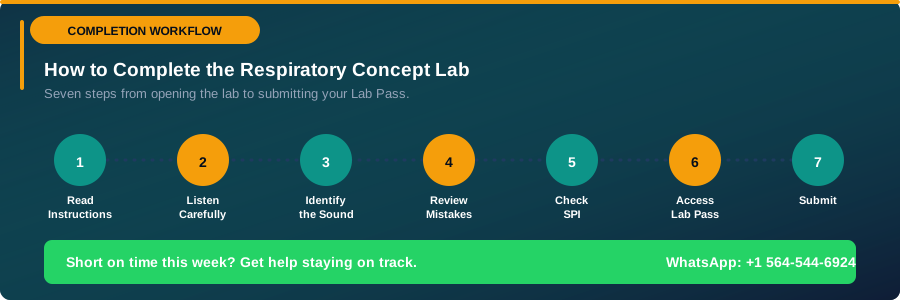
Step 1: Open the Assigned Lab
Before you start, confirm you’re in the correct course and the correct week’s assignment, and that you have an available attempt open. Shadow Health’s exact menu layout can shift between updates, so if something looks different than you expected, check your course’s assignment instructions rather than assuming the platform is broken.
Step 2: Read the Instructions Before Starting
It’s tempting to click straight into the activity, but a minute spent reading the lab’s own on-screen instructions tells you what format the identification activities will take, which matters for how you pace yourself.
Step 3: Work Through the Respiratory Concept Material
Go through the concept material actively rather than passively clicking through slides. If the lab presents audio, actually listen, ideally more than once, instead of skimming a transcript or description. A written description of a crackle is not the same as being able to recognize one when it’s presented differently in the actual activity.
Step 4: Identify Normal and Abnormal Lung Sounds
This is the core of the lab. Use the identification framework later in this guide (continuous vs. discontinuous → pitch → timing → quality → location) rather than pattern-matching to something you half-remember from a study guide.
Step 5: Review Your Responses
If the activity gives you feedback on an answer, read it. This is the fastest way to correct a misunderstanding before it costs you points on a later item in the same lab.
Step 6: Complete the Lab
Finish all required sections of the activity per your course’s instructions.
Step 7: Check Your Student Performance Index
Once you’ve completed the lab, your SPI percentage should be visible. This number is your grade for the assignment, so don’t skip checking it.
Step 8: Find Your Lab Pass
Your Lab Pass is where that SPI score appears in submittable form.
Step 9: Submit the Lab Pass
Submit the Lab Pass to your classroom drop box, this is the deliverable your instructor is grading, not a screenshot of the activity itself or anything from LopesWrite.
Do You Need to Submit Anything to LopesWrite?
No. The assignment instructions explicitly state that LopesWrite submission is not required for this lab. Save yourself the extra step.
Normal vs. Abnormal Lung Sounds
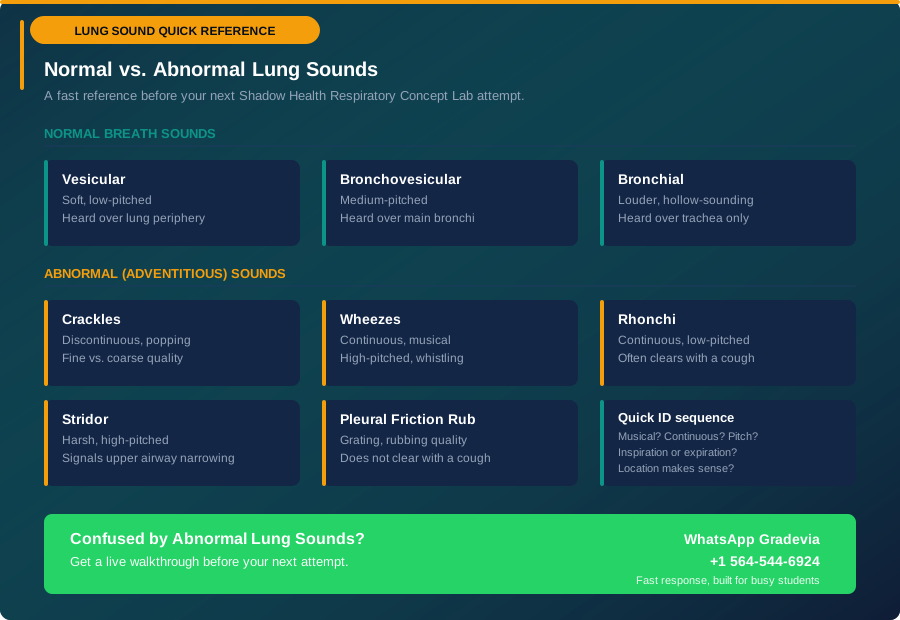
Before you can classify anything correctly in the lab, the underlying categories need to be genuinely familiar, not memorized as isolated labels, but understood well enough that you’d recognize each one out of context.
Normal Breath Sounds
Vesicular Sounds Heard over most of the lung fields, particularly the periphery. Soft, low-pitched, and longer on inspiration than expiration. When you’re listening for this, the giveaway is how quiet and unremarkable it is, vesicular sound is the “background” your ear should be trained to expect over most of the chest.
Bronchovesicular Sounds Heard over the main bronchi, roughly between the shoulder blades posteriorly and near the sternum anteriorly. Medium pitch, with inspiration and expiration close to equal in length. Pay attention to location here, the same sound quality heard somewhere unexpected can actually indicate a problem.
Bronchial Sounds Heard only over the trachea. Louder, higher-pitched, and hollow-sounding, with expiration longer than inspiration. If you hear something with this quality over the lung periphery instead of the trachea, that’s abnormal, location is doing a lot of the diagnostic work.
Abnormal Lung Sounds
Crackles Discontinuous, popping or crackling sounds, think of the sound of hair rubbing between your fingers, or a fire crackling. Fine crackles tend to suggest fluid or fluid-like changes in the smaller airways or alveoli; coarse crackles suggest larger airway involvement. Listen for timing: crackles are often most noticeable during inspiration.
Wheezes Continuous, high-pitched, musical sounds, closer to whistling than popping. Typically associated with narrowed airways and often more prominent on expiration. The “musical” quality is the key differentiator from crackles.
Rhonchi Continuous, but lower-pitched than a wheeze, with a snoring or rattling quality. Often associated with mucus or secretions in the larger airways. As a useful practical clue, rhonchi frequently change or clear after the patient coughs, while wheezes typically don’t.
Stridor A harsh, high-pitched sound usually audible without a stethoscope, generally heard on inspiration. It signals upper airway narrowing or obstruction and is treated as a more urgent finding than the other sounds on this list.
Pleural Friction Rub A grating, rubbing sound, often described as similar to walking on fresh snow or rubbing leather together. It results from inflamed pleural surfaces moving against each other, and it doesn’t disappear with a cough the way rhonchi can.
Keep in mind that no single sound automatically confirms a specific diagnosis on its own, in real clinical practice and in these learning activities alike, lung sounds are interpreted alongside the broader patient context, not in isolation.
Lung Sound Comparison Table
| Lung Sound | What It Sounds Like | When Heard | Key Recognition Clue | Common Association |
|---|---|---|---|---|
| Vesicular | Soft, low-pitched | Throughout lung periphery | Longer inspiration than expiration | Normal finding |
| Bronchovesicular | Medium-pitched | Over main bronchi | Roughly equal inspiration/expiration | Normal finding |
| Bronchial | Louder, hollow | Over trachea only | Longer expiration than inspiration | Normal finding, abnormal if heard elsewhere |
| Crackles | Popping, discontinuous | Often inspiration | Fine vs. coarse quality | Fluid in airways/alveoli |
| Wheezes | Musical, continuous | Often expiration | High-pitched, whistling | Airway narrowing |
| Rhonchi | Low-pitched, continuous | Either phase | Often clears with cough | Mucus in larger airways |
| Stridor | Harsh, high-pitched | Inspiration | Audible without stethoscope | Upper airway obstruction |
| Pleural friction rub | Grating, rubbing | Either phase | Doesn’t clear with cough | Pleural inflammation |
How to Identify Abnormal Lung Sounds Without Guessing
Rather than trying to recall a label from memory, work through the same short sequence of questions every time:
- Is the sound musical or non-musical?
- Is it continuous or discontinuous?
- Is it more prominent on inspiration or expiration?
- Is it high-pitched or low-pitched?
- Does it sound like popping, rattling, squeaking, or a harsh upper-airway noise?
- Does the location on the chest make sense for that sound?
Answering these in order, rather than jumping straight to a guess, turns each identification item into a small, repeatable reasoning process instead of a coin flip. It’s also the exact skill the lab (and later, your clinical rotations) is actually trying to build.
Shadow Health Respiratory Concept Lab Abnormal Lung Sounds Answers: How to Reason Through Them
If you’re searching for “Shadow Health Respiratory Concept Lab abnormal lung sounds answers,” what you’re usually really looking for is confidence that you’re hearing the sound correctly. That confidence comes from the six-question framework above, applied consistently, not from a list of answers matched to a version of the activity that may not even match the one you’re given, since Shadow Health activities can vary in how items are presented. Use the framework, then cross-check your reasoning against the feedback the activity itself gives you after each response.
Working full-time and still not confident telling wheezes and rhonchi apart? Gradevia’s tutors can walk through the sound categories with you directly before your next attempt. WhatsApp Gradevia: +1 564-544-6924
Shadow Health Respiratory Concept Lab Example
Shadow Health Respiratory Concept Lab Answer Key: What Students Should Know
Is There a Shadow Health Respiratory Concept Lab Answer Key?
It’s a completely understandable thing to search for. When you’re not sure whether you’re hearing a crackle or rhonchi correctly, wanting to check your answer against something reliable makes sense, especially when your grade depends directly on the outcome.
Here’s the catch: Shadow Health activities can vary between course versions, and lung-sound identification specifically depends on genuinely recognizing the sound characteristics, not on memorizing which label goes with which item number. A memorized answer to one version of the activity may not transfer to yours, and it does nothing to build the recognition skill you’ll need in clinical rotations and, eventually, as a working nurse, where there’s no answer key at the bedside.
A more reliable approach:
- Use the learning objectives in the lab itself (normal vs. abnormal, and the five common abnormal sound categories) as your study checklist.
- Work through the six-question identification framework above on every item.
- Pay attention to the feedback the activity gives you after each response, that feedback is specific to your version of the activity, unlike a third-party answer list.
- Cross-check anything you study against your course materials, since instructors sometimes supplement the platform’s content with their own emphasis.
Shadow Health Respiratory Concept Lab Answer Key PDF: What Students Should Know
Be cautious about any site claiming to offer an “official” answer key PDF for this lab. Shadow Health content is platform-owned, and no third-party PDF is an official source regardless of how it’s marketed. Even when such a PDF is accurate for one version of the activity, there’s no guarantee it matches yours. If you want something reliable to study from, the lung-sound comparison table and identification framework in this guide are built to transfer across versions, because they’re based on the actual clinical characteristics of each sound rather than a specific set of item answers.
Shadow Health Respiratory Concept Lab Identification Activity Answers
The same caution applies here. Rather than searching for a matched answer list, run each identification item through the framework: continuous vs. discontinuous, pitch, timing, quality, and location. That sequence works regardless of how the specific item is worded or presented.
Shadow Health Respiratory Concept Lab Quizlet Resources
Quizlet sets built by other students can be a reasonable way to drill terminology, the definitions of vesicular, crackles, rhonchi, and so on, but treat them as flashcards for vocabulary, not as a verified answer source for your specific graded attempt. Crowd-sourced sets are frequently outdated, incomplete, or built around a different course’s version of the activity.
Shadow Health Respiratory Concept Lab Transcript and PDF Searches
Shadow Health Respiratory Concept Lab Transcript
Students often look for a transcript hoping it will let them review the activity’s content without listening to the audio again, or to double check terminology after finishing. A transcript, where one exists, can be a reasonable review tool after you’ve already worked through the lab, but it’s a poor substitute for actively listening the first time through, since the whole point of the activity is training your ear to distinguish sounds, not just recognizing written descriptions of them.
Shadow Health Respiratory Concept Lab PDF
Similarly, a PDF summary of lung sound categories can be a useful reference to study from beforehand (the comparison table in this guide serves that purpose), but it isn’t a substitute for actually completing the interactive lab or a verified record of your specific activity content.
Shadow Health Respiratory Concept Lab Tina Jones
As mentioned earlier, Tina Jones is the patient at the center of several of Shadow Health’s full case simulations, which are a different assignment type from a concept lab. If your instructions specifically say “Respiratory Concept Lab” without referencing a patient case, be skeptical of study material that’s actually describing a Tina Jones simulation assignment, it may not apply to what you’ve been assigned.
Confused by abnormal lung sound characteristics or which category something falls into? Get a second explanation before your next attempt. WhatsApp: +1 564-544-6924 | Gradevia
How to Finish the Lab When You Work Full-Time
The assignment lists an average completion time of about 25 minutes, but that’s an average, not a promise, and if you’re unfamiliar with lung sound terminology going in, rushing to hit that number can work against you. A more realistic way to budget the time if you’re fitting this in around a work shift:
- 3–5 minutes: Read the instructions and confirm you’re in the right activity.
- 10–12 minutes: Work through the concept material, actually listening to each sound rather than skimming.
- 5–8 minutes: Complete the identification and review activities using the six-question framework.
- Remaining time: Review anything you got wrong and confirm the lab shows as complete before checking your SPI.
If you finish faster than that, good, but don’t treat 25 minutes as a ceiling you need to force the activity into if you’re still working through unfamiliar sound categories. Since attempts are unlimited, a slightly slower, more accurate first attempt is usually a better use of your time than a fast attempt you have to repeat.
10 Common Mistakes Students Make
- Starting without reading the instructions. Why it matters: you miss format cues that would’ve helped you pace the activity. Do instead: spend the first few minutes orienting before you start answering.
- Treating every abnormal sound as a wheeze. Why it matters: wheeze is the most commonly known term, so it becomes a default guess, and a wrong one. Do instead: run the six-question framework before answering.
- Confusing crackles with rhonchi. Why it matters: both can sound “wet” at first listen. Do instead: focus on continuous vs. discontinuous; crackles are discontinuous and rhonchi are continuous.
- Ignoring inspiration vs. expiration timing. Why it matters: timing is one of the clearest differentiators between sound types. Do instead: note which phase the sound is most prominent in before answering.
- Focusing only on pitch. Why it matters: pitch alone doesn’t distinguish a wheeze from stridor, for example. Do instead: combine pitch with continuity, quality, and location.
- Guessing instead of comparing characteristics. Why it matters: guessing doesn’t build the skill and lowers your SPI. Do instead: work the framework every time, even when you think you already know the answer.
- Clicking through without listening carefully. Why it matters: subtle differences between sound categories are easy to miss on a first, rushed listen. Do instead: replay audio when the platform allows it.
- Assuming an online “answer key” is automatically correct. Why it matters: unofficial answer sources may not match your activity version, and using them skips the actual learning. Do instead: treat any online material as background study, not a verified answer.
- Forgetting to check the Student Performance Index. Why it matters: this number is your grade; skipping it means you don’t know your score until it’s too late to attempt again. Do instead: check the SPI immediately after finishing.
- Submitting the wrong item instead of the Lab Pass. Why it matters: your instructor is grading the Lab Pass specifically, not a screenshot or a different document. Do instead: confirm you’re uploading the actual Lab Pass to the drop box.

Shadow Health Respiratory Concept Lab FAQ
1. What is the Shadow Health Respiratory Concept Lab? It’s a focused Shadow Health activity that teaches and tests your ability to distinguish normal from abnormal (adventitious) lung sounds, separate from the platform’s full patient-case simulations.
2. How long does the Respiratory Concept Lab take? The assignment lists an average of about 25 minutes, but this is an average, some students reasonably need more time, especially on a first attempt.
3. Can I attempt the Shadow Health Respiratory Concept Lab more than once? Yes. Per the assignment instructions, you can attempt it as many times as you want.
4. What is the Student Performance Index? It’s the percentage score you’re awarded after completing the lab, and per the assignment instructions, it serves as your percentage grade for the assignment.
5. Where do I find my Student Performance Index? It appears after you complete the lab and is reflected on your Lab Pass.
6. What is the Lab Pass? It’s the document showing your SPI score that you submit as proof of completion.
7. What do I submit for the Respiratory Concept Lab? After completing the lab, your SPI appears on the Lab Pass, which is what you submit to your classroom drop box. LopesWrite submission is not required.
8. Do I need to submit this assignment to LopesWrite? No, the assignment instructions explicitly state LopesWrite is not required for this lab.
9. What are the main abnormal lung sounds I should recognize? Crackles, wheezes, rhonchi, stridor, and pleural friction rub, each distinguished by continuity, pitch, timing, and quality.
10. Is there a Shadow Health Respiratory Concept Lab answer key? No verified official answer key is published for students. Unofficial versions circulate online but may not match your specific activity, so building real identification skill with the framework in this guide is more reliable.
11. Is a Shadow Health Respiratory Concept Lab answer key PDF reliable? Treat any unofficial PDF with caution, it isn’t an official Shadow Health or school resource, and it may not reflect your version of the activity.
12. Can Quizlet answers help with the Respiratory Concept Lab? Crowd-sourced Quizlet sets can help you drill terminology, but shouldn’t be treated as a verified answer source for your graded attempt.
13. What should I do if I confuse crackles and wheezes? Focus on continuity first: crackles are discontinuous (popping), wheezes are continuous and musical. That single distinction resolves most confusion between the two.
14. What if I need more than 25 minutes? That’s normal, especially on a first attempt, the assignment instructions note 25 minutes is only an average.
15. How can I improve my score after an unsuccessful attempt? Review which sound categories you missed, revisit the specific characteristics that distinguish them, and use another attempt, since attempts are unlimited, treat an early attempt as a diagnostic rather than a final result.
Final Checklist Before Submitting Your Lab Pass
- I opened the correct Respiratory Concept Lab
- I read the assignment instructions
- I listened carefully to the lung sounds
- I reviewed normal versus abnormal sounds
- I completed the identification activities
- I reviewed incorrect responses
- I completed the lab
- I checked my Student Performance Index
- I located my Lab Pass
- I submitted the Lab Pass to the classroom drop box
- I did not submit unnecessary work to LopesWrite
Need Help With Your GCU Coursework?
Between a full-time job and a full course load, a 25-minute lab can still be the thing that doesn’t fit into your week. If you want a second explanation of lung sound categories before your next attempt, or help staying organized across your weekly GCU assignments, Gradevia’s academic support team works with students in exactly this situation.
Get practical academic support, WhatsApp Gradevia: +1 564-544-6924
Conclusion
The Shadow Health Respiratory Concept Lab isn’t complicated once you know what it’s actually asking: recognize the difference between normal breath sounds and the five common abnormal categories, work through each identification item with a consistent framework instead of a guess, and submit the Lab Pass, not LopesWrite, when you’re done. Skip the search for an unverifiable answer key and spend that same five minutes on the framework in this guide instead; it’ll get you a more reliable score on this attempt and actually stick for the next one.
Related Content
NRS-465: Applied Evidence-Based Project and Practicum
NRS-465 Capstone Change Project: PICOT Question Development, Complete Guide + Examples
NRS-465 Capstone Change Project: Implementation Plan, Complete Guide + Sample Paper
NRS-465 Literature Evaluation Table: Complete Guide + Fully Worked Example (Topic 4)
References
- Higashiyama, S., Tamakoshi, K., & Yamauchi, T. (2022). Effectiveness of a new interactive web teaching material for improving lung auscultation skills: Randomized controlled trial for clinical nurses. Nagoya Journal of Medical Science, 84(3), 526–538. https://doi.org/10.18999/nagjms.84.3.526
- Kuriyama, A., Kasai, H., Shikino, K., Shiko, Y., Kawame, C., Takeda, K., Tajima, H., Hayama, N., Suzuki, T., & Ito, S. (2023). The effects of simple graphical and mental visualization of lung sounds in teaching lung auscultation during clinical clerkship: A preliminary study. PLOS ONE, 18(3), e0282337. https://doi.org/10.1371/journal.pone.0282337
- Sarıtaş, E., Aydoğan, S., Tikit, Ö., Gülnar, E., Çalışkan, N., & Baykara, Z. (2024). The effect of simulation on auscultation skills, self-confidence and anxiety levels in nursing students: A randomized controlled trial. Nurse Education in Practice, 78, 104016. https://doi.org/10.1016/j.nepr.2024.104016
- Sreedharan, J. K., Gopalakrishnan, G. K., et al. (2024). Simulation-based teaching and learning in respiratory care education: A narrative review. Advances in Medical Education and Practice, 15, 473–486. https://doi.org/10.2147/AMEP.S464629
- Kawame, C., Kasai, H., Shiko, Y., Kuriyama, A., Takeda, K., Tajima, H., Hayama, N., Saito, M., Ito, S., & Suzuki, T. (2025). The use of graphical lung sound visualizations in medical education: An evaluation of its impact on clinical clerkship. BMC Medical Education, 25(1), 581. https://doi.org/10.1186/s12909-025-07170-2