
Blog
How to Do an Ethical Lens for Performance Task 1: WGU C206 Guide and Example

Updated on: Oct 15, 2026
By Dan Palmer, MBA · Academic strategy consultant for working adult learners · LinkedIn
In WGU Ethical Leadership (C206), you don’t choose an ethical lens. The WGU Ethical Lens Inventory assigns one: you answer 36 forced choices, and your results place you in the Rights and Responsibilities, Relationship, Results, or Reputation lens, or at the Center (Baird & Niacaris, 2014). “Doing” an ethical lens for Performance Task 1 means the next step: taking that result and using it to explain how you make decisions, and then applying it to a real ethical situation at work.
That last part, prompt D4, is where most reflections stay vague. Students describe their lens well, then write a workplace paragraph that never actually uses it. This guide gives working adults a five step, four lens method for applying any ELI result to a decision, shows how it fits each Part D prompt, and ends with a worksheet and a model D4 written by a fictitious learner with a Center Perspective result.
If you haven’t taken the inventory yet, or want help reading your report, start with our Ethical Lens Inventory guide. For the full essay, see our WGU Ethical Leadership Task 1 guide and example.
Where Your Lens Shows Up in WGU Ethical Leadership Task 1
| Prompt | What it asks | What “doing the lens” means here |
|---|---|---|
| D1 | Explain your preferred lens | Describe how your lens shapes your first reaction to a decision |
| D1a | Same lens in different settings? | Test whether that first reaction changes at work, at home, and socially |
| D2 and D2a | One primary value and one classical virtue, compared with personal values | Show where your lens’s values agree or conflict with your own |
| D3 and D3a | One blind spot, risk, double standard, or vice, and two steps to reduce it | Name where your lens can mislead you |
| D4 | Apply your ELI to a workplace ethical situation | Run a real decision through your lens, check the blind spot, and decide |
| E | Your ELI results PDF | Submitted separately |
D4 brings the other prompts together, so this page focuses on it.
The Four Lenses in One Line Each
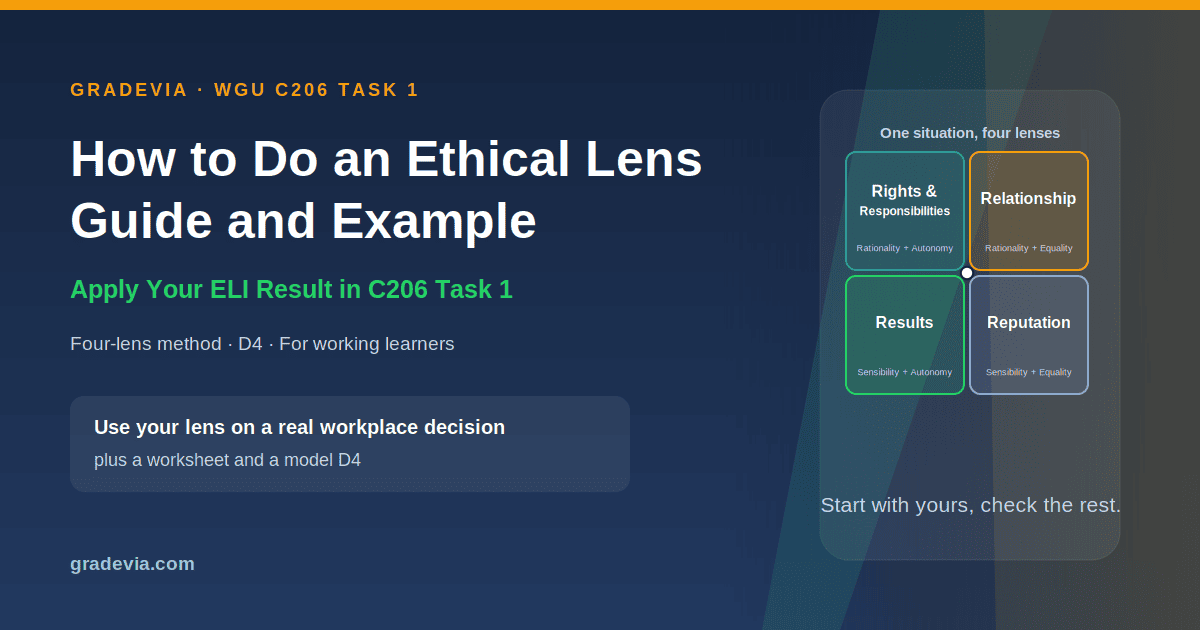
Each lens combines one value from each of two pairs: rationality or sensibility, and autonomy or equality (Baird & Niacaris, 2014). The questions below are our plain language summaries, not EthicsGame’s wording; use the exact terms from your own report in your paper.
| Lens | Values | The question it tends to ask first |
|---|---|---|
| Rights and Responsibilities | Rationality and autonomy | What duty or rule applies, and whose rights are at stake? |
| Relationship | Rationality and equality | What is fair to everyone, especially people with less power? |
| Results | Sensibility and autonomy | Which choice leads to the best outcomes for the people involved? |
| Reputation | Sensibility and equality | What would a person of good character in my role do? |
| Center Perspective | No strong preference | Which priorities fit this particular situation? |
EthicsGame’s reports describe the goal as ethical agility: being able to use all four lenses, not just your own. That’s the habit the method below builds.
The Five Step Method for Applying Your Lens
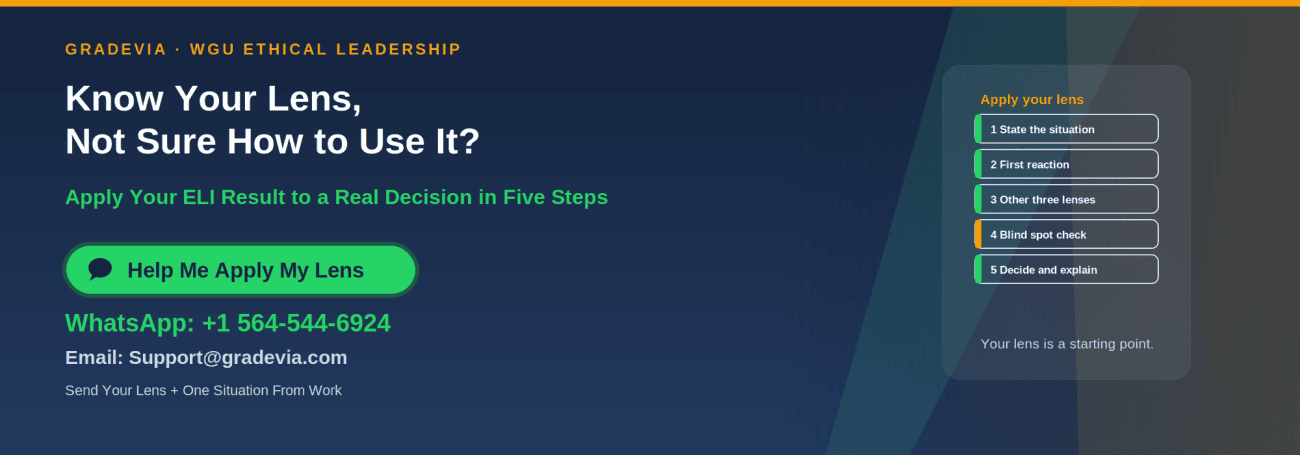
Use these steps on any workplace situation, for D4 or for real decisions at work:
- State the situation and who is affected. One or two sentences: what happened, who is involved, and who could be harmed or helped.
- Write your first reaction from your home lens. Be honest about your instinct, since the ELI measures exactly that.
- Ask the question of each of the other three lenses. Write one sentence per lens. This is where blind spots usually appear.
- Check your report’s blind spot, risk, double standard, or vice. Ask whether it’s at work here, especially in your first reaction.
- Decide and explain. Say what you’d do, whom it protects, and what it costs you.
Vague D4: “My lens would help me make good decisions at work because I value fairness.”
Specific D4: Names the situation, the first reaction your lens produced, the blind spot you caught, what the other lenses added, and the decision you made.
Doing D4 Well
The prompt asks you to “discuss how the information from your ELI could be applied to an ethical situation in the workplace.” A few choices make that easier to support:
- Use a situation from your own work. You know the people, the pressures, and what was at stake, so your examples are specific and clearly yours. If you’re between jobs, use a recent role or the field you’re studying for.
- Choose a situation with a real tension. A clear rule violation with no pressure to ignore it doesn’t show much. A deadline, a well liked coworker, or a manager telling you to let it go gives your lens something to work against.
- Quote your report briefly. A short phrase from your foundational question, blind spot, or risk, cited to your ELI report, shows the evaluator the connection.
- End with a decision. D4 is stronger when the lens leads somewhere, not just to “I would think carefully.”

If Your Result Is the Center Perspective
A dot on or near the center of the grid means you don’t strongly prefer any one lens (EthicsGame, n.d.). The C206 directions allow a Center result to choose any primary value for D2. For applying the lens, EthicsGame’s Center description names a blind spot of complacency and a risk of inaction, “being paralyzed because of the multiplicity of choices,” and suggests noticing your first impulse, pausing, and testing it against the other lenses’ values before acting (EthicsGame, n.d.). The five step method fits that advice closely, which is why our example uses a Center result.
Ethical Lens Versus Ethical Theory
Your lens and the theories in Part B are related but not the same thing. Each lens represents a family of theories: Rights and Responsibilities connects to deontology, Results to consequentialism, Relationship to theories of justice, and Reputation to virtue ethics (Baird & Niacaris, 2014). Part B asks you to apply deontology and consequentialism to the scenario whatever your lens is. Part D asks about your lens. Keep them separate in your paper, though a sentence noting the connection can strengthen D1. For Part B, see our C206 Parts B and C guide.
Ethical Lens Example: Four Lens Worksheet and Model D4
Our ethical lens example is a four page worksheet built around Marcus Bell, a fictitious inventory control lead at a fictitious warehouse, whose ELI result is the Center Perspective. It includes:
- The five step method on one page
- A completed four lens analysis of a practice situation: a forklift operator who skipped a required safety checklist to get a late truck out, and a manager who says to let it go
- A blind spot check using the Center Perspective’s complacency and inaction
- A model D4, with comments explaining what it does
- A blank worksheet for your own situation
Here’s part of the model D4:
Because my report identifies complacency as my blind spot and inaction as my risk, I recognized that my first impulse, to accept that no harm was done and move on, was exactly the pattern it warns about. I paused and looked at the situation through each lens.
The learner, his workplace, and his results are fictitious, so the model can’t be used in your paper. Your D4 has to match your own ELI PDF and your own work.
Download the four lens worksheet and model D4 (.docx)
Where the Lens Goes After Task 1
The ELI belongs to Task 1, but the habit carries forward through WGU Ethical Leadership. In WGU Ethical Leadership Task 2, the current directions describe an ethics audit for a fictional toy company, including an ethical dilemma with two possible solutions to evaluate and an ethics training proposal. The ELI isn’t a requirement there, but running each solution through the four lens questions is a practical way to evaluate it. Our C206 Task 2 guide covers that task, and our C206 Task 3 guide covers the last one. Check your own course page for the current version of each task.
Plan It Around Your Work Week
- Lunch break (about 20 minutes): Pick a workplace situation with a real tension and write step 1.
- Evening one (about 1 hour): Complete steps 2 to 5 on the blank worksheet, using your report’s terms.
- Evening two (about 1 hour): Turn the worksheet into your D4 paragraphs, cite your report, and check that D4 ends with a decision.
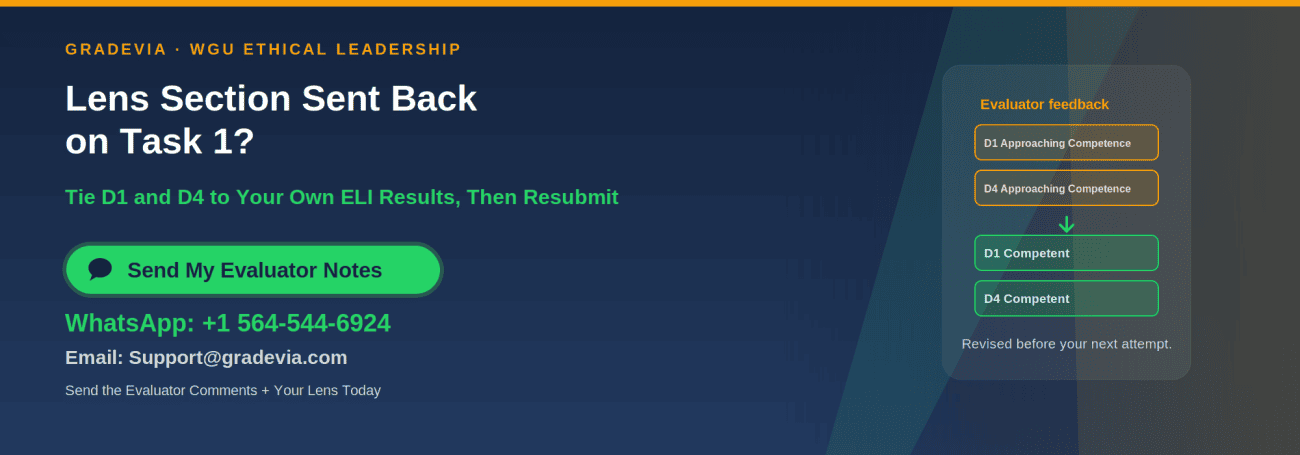
Common Reasons the Lens Section Comes Back
- D1 describes a lens in general terms rather than your own result
- D4 describes a workplace situation but never uses the ELI
- D4 retells the knee joint scenario without showing how your own ELI results apply to it
- The blind spot from D3 never appears in D4, so the reflection feels disconnected
- Lens names or traits don’t match the ELI PDF submitted for Part E
- Your report is quoted at length instead of applied
Pre-Submission Checklist for Your Lens Section
- D1 uses your report’s own name for your lens and its values
- D4 describes a specific workplace situation with a real tension
- D4 shows your lens’s first reaction and the other lenses’ questions
- D4 checks your blind spot, risk, double standard, or vice
- D4 ends with a decision and what it costs or protects
- Your ELI report is cited, and the PDF is uploaded separately for Part E
Related C206 Resources
- Our Ethical Lens Inventory guide covers taking the ELI, reading your report, saving the PDF, and D1 to D3.
- Our WGU Ethical Leadership Task 1 guide and example covers the full essay.
- Our C206 Part A guide and Parts B and C guide cover the rest of Task 1.
- Browse all of our WGU Ethical Leadership (C206) guides.
Frequently Asked Questions
How do you do an ethical lens for C206 Task 1?
Take the Ethical Lens Inventory in the course, then explain and apply your result in Part D. To apply it, describe a workplace situation, show your lens’s first reaction, check it against the other three lenses and your blind spot, and explain your decision.
Can I choose my own ethical lens?
No. Your lens comes from your WGU Ethical Lens Inventory results, and your Part D reflection must match the results PDF you submit.
What workplace situation should I use for D4?
One from your own job, current or recent, with a real tension, such as a deadline, a coworker you like, or pressure from a manager. Specific situations are easier to support than hypothetical ones.
What if my ELI result is the Center Perspective?
The directions let you choose any primary value for D2. For D4, the five step method works well, since EthicsGame’s Center description suggests pausing on your first impulse and testing it against the other lenses.
Does WGU Ethical Leadership Task 2 use the Ethical Lens Inventory?
Not as a requirement. Task 2 is an ethics audit for a fictional organization, but the four lens questions are a useful way to evaluate the two solutions to its ethical dilemma.
Can I submit the model D4 from this page?
No. It describes a fictitious learner, workplace, and ELI result. It’s for illustration only.
Want Help Applying Your Lens?
If you’re working full time and want structured assignment support choosing a D4 situation, running it through the four lenses, or connecting your blind spot to a real decision, message Gradevia on WhatsApp at +1 564 544 6924 or email Support@gradevia.com.
Sources
Baird, C. A., & Niacaris, J. M. (2014). Understanding the Ethical Lens Inventory. EthicsGame. https://faculty.ethicsgame.com/resource/28/ELI_Understanding.pdf
EthicsGame. (n.d.). Ethical Lens Inventory: Center Perspective [Results description]. Retrieved October 15, 2026, from https://faculty.ethicsgame.com/FacultyResourceCenter/PlayersAssessmentEli/EliText/Print