Blog
WGU C206 Task 2 (Paradigm Toys): Guide + Example

Updated on: Aug 23, 2026
WGU C206 Task 2: Developing Organizational Ethics And Socially Responsible Behavior
If you’ve been searching “c206 task 2 answers,” “wgu c206 task 2 pdf,” or “c206 task 2 example,” you’ve probably noticed the same pattern I see across every WGU ethics course: a wall of paywalled documents, all built around the same fixed scenario, none of them actually explaining what the rubric wants from you. WGU C206 Task 2, part of the Ethical Leadership course (also coded EHM2, so you’ll sometimes see it listed as wgu ehm2 task 2), is one of the most writing-intensive performance assessments in the WGU MBA curriculum. This guide breaks down exactly what each rubric section requires, the mistakes that most often trigger a revision request, and a fully worked illustrative example showing what strong analysis looks like at each step.
What WGU C206 Task 2 Actually Requires
Ethical Leadership C206 Task 2 asks you to step into the role of a business manager who has been asked by a board of directors to conduct a full ethics audit and deliver a formal report. That report needs to cover four areas: corporate social responsibility (CSR), ethical leadership and the value of an ethics audit, an ethical dilemma with two evaluated solutions, and an ethics training program proposal, all in 6 to 8 pages, APA 7 format, submitted as a .docx file.
There’s no official standalone wgu c206 task 2 pdf beyond your own task instructions and rubric inside the course itself; those two documents are the actual template you’re being evaluated against, regardless of what any third-party site presents as a shortcut.
C206 Task 2 Assignment: Developing Organizational Ethics And Socially Responsible Behavior
Introduction
As an organizational leader, one of your primary roles is establishing programs and policies that ensure the organization operates under ethical considerations and legal mandates. This responsibility includes informing employees of the organization’s code of ethics, communicating the code of ethics, providing training, and ensuring that operational aspects are administered in a legal and ethical manner.
You will assume the role of a leader and decide what strategies you will use to develop a strong organizational ethical climate. In your position as a leader, you will need to identify primary and secondary stakeholders and satisfy their concerns, understand the organization’s ethical standing, and develop an ethics training program.
Scenario
You are a business manager of Paradigm Toys, a fictional publicly held company that is a retailer and manufacturer of children’s toys. The board of directors has asked you to conduct an ethics audit of the company and report to the board if you find the need for ethics training.
Requirements
Your submission must represent your original work and understanding of the course material. Most performance assessment submissions are automatically scanned through the WGU similarity checker. Students are strongly encouraged to wait for the similarity report to generate after uploading their work and then review it to ensure Academic Authenticity guidelines are met before submitting the file for evaluation. See Understanding Similarity Reports for more information.
Grammarly Note:
Professional Communication will be automatically assessed through Grammarly for Education in most performance assessments before a student submits work for evaluation. Students are strongly encouraged to review the Grammarly for Education feedback prior to submitting work for evaluation, as the overall submission will not pass without this aspect passing. See Use Grammarly for Education Effectively for more information.
Microsoft Files Note:
Write your paper in Microsoft Word (.doc or .docx) unless another Microsoft product, or pdf, is specified in the task directions. Tasks may notbe submitted as cloud links, such as links to Google Docs, Google Slides, OneDrive, etc. All supporting documentation, such as screenshots and proof of experience, should be collected in a pdf file and submitted separately from the main file. For more information, please see Computer System and Technology Requirements.
You must use the rubric to direct the creation of your submission because it provides detailed criteria that will be used to evaluate your work. Each requirement below may be evaluated by more than one rubric aspect. The rubric aspect titles may contain hyperlinks to relevant portions of the course.
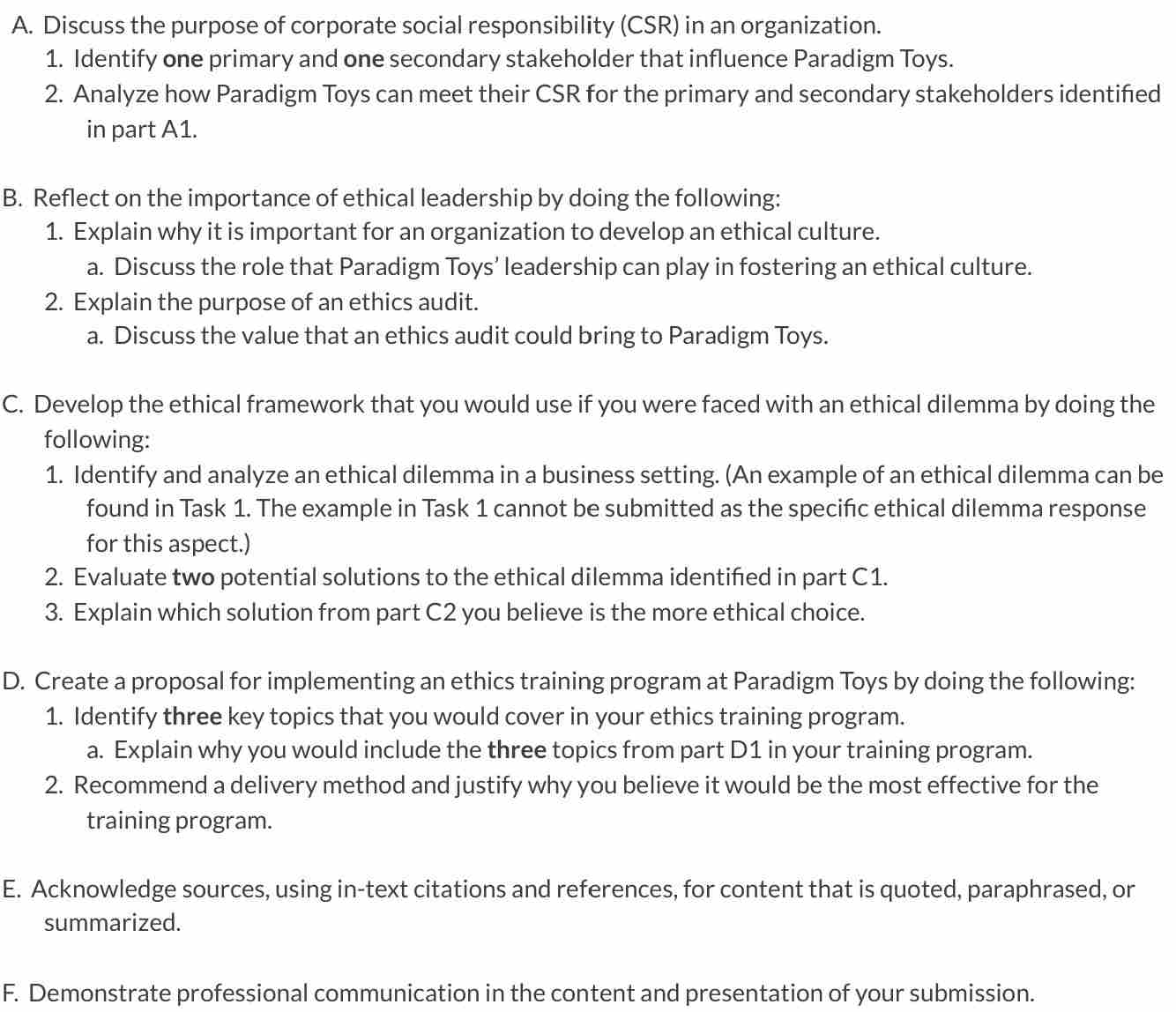
Prepare a report (suggested length of 6–8 pages) for Paradigm Toys in which you do the following:

WGU C206 Task 2 Rubric: Section by Section
Section A: Corporate Social Responsibility. Discuss the purpose of CSR in an organization, identify one primary and one secondary stakeholder, and analyze how the organization can meet its CSR obligations to each. The rubric rewards specificity: a stakeholder analysis that stays generic, rather than tied to the company’s actual industry and risk profile, is the single most common reason this section gets flagged.
Section B: Ethical Leadership and the Ethics Audit. Explain why ethical organizational culture matters, discuss the role leadership plays in fostering it, explain the general purpose of an ethics audit, and discuss the specific value an audit would bring to this organization.
Section C: Ethical Dilemma. Identify and analyze a genuine ethical dilemma in a business setting, evaluate two meaningfully distinct potential solutions using an ethical framework (utilitarianism and deontology are the two most commonly applied), and explain which solution you’d recommend and why. Note that if you’ve already used a dilemma example in C206 Task 1, the rubric requires a different one here; reusing it is an automatic point loss.
Section D: Ethics Training Program Proposal. Identify three key training topics with justification for each, then recommend and justify a delivery method.
Section E: Sources. In-text citations and a matching reference list, APA 7, for anything quoted, paraphrased, or summarized. Aim for four to six credible sources.
Section F: Professional Communication. Run Grammarly for Education before submitting; most performance assessments won’t pass without this specific check clearing first.
Common Revision Triggers
- Section A stays at the level of general CSR theory instead of tying every sentence back to the organization’s actual industry and stakeholder relationships.
- Section C reuses the same dilemma from C206 Task 1, which the rubric explicitly prohibits.
- The two solutions in Section C aren’t meaningfully distinct from each other; evaluators want two genuinely different ethical approaches, not the same choice with minor wording changes.
- Training topic justifications in Section D are generic enough to apply to any company, rather than tied to the specific organization’s risk profile.
- Submissions go out without running Grammarly for Education first, which is a required gate, not an optional polish step.
Why “C206 Task 2 Answers” Isn’t the Shortcut It Looks Like
If your search for a task 2 model answer led you to a paywalled document, here’s the problem beyond the obvious originality-checker risk: this task is graded on how specifically your analysis connects to the organization’s actual industry context, its specific stakeholders, and its specific risk profile. A borrowed answer built around someone else’s dilemma selection and someone else’s training justifications reads as disconnected the moment an evaluator checks whether your analysis actually reflects the assigned scenario, which is exactly the kind of mismatch that triggers a revision request rather than a pass.

Worked Example: How a Complete Response Reads
The following c206 task 2 example uses a fictitious company, Vantage Fitness Equipment, a publicly held manufacturer and retailer of home fitness equipment, to illustrate structure and depth. This is not content to copy; use it to see how a complete, correctly structured response reads, then build your own analysis around your actual assigned scenario.
Section A excerpt (CSR and Stakeholders): As a publicly held manufacturer of home fitness equipment, Vantage Fitness Equipment’s primary stakeholders are its customers, who depend on the company’s products being structurally safe under repeated heavy use. Its secondary stakeholders include the communities surrounding its manufacturing facilities, who are affected by the company’s environmental and labor practices without holding a direct commercial relationship with it. To meet its CSR obligations to customers, Vantage should exceed baseline safety testing standards for load-bearing equipment and maintain transparent recall procedures; to meet its obligations to the surrounding community, Vantage should adopt sustainable manufacturing practices and engage in transparent environmental reporting.
Section B excerpt (Ethics Audit Value): An ethics audit would bring particular value to Vantage Fitness Equipment because the company’s core product category, load-bearing exercise equipment, carries injury risk if manufacturing quality slips. An audit would surface whether existing quality-control policies are actually followed at the manufacturing level, not just documented at the policy level, giving the board an evidence-based picture of risk before a safety failure becomes a public incident.
Section C excerpt (Ethical Dilemma): Vantage’s quality assurance team discovers that a supplier has been substituting a lower-grade steel alloy in a load-bearing component without disclosure, a change that meets minimum safety thresholds but falls short of Vantage’s own internal specification. Reporting this to regulators and voluntarily recalling affected units would cost an estimated $4 million; staying silent risks harm to customers if the substitution is later discovered independently. Evaluated through a deontological lens, Vantage has a duty to disclose regardless of cost, since knowingly allowing a safety-relevant substandard component to remain in the market is impermissible independent of the financial outcome.
(This example is illustrative only. Do not submit this content as your own work; your actual assigned scenario, stakeholders, and dilemma will differ, and every section needs to be grounded in your own specific assignment.)
Frequently Asked Questions
Is there an official WGU C206 Task 2 template or downloadable PDF? No standalone template exists beyond your task instructions and rubric inside the course itself. Those are the actual structure you’re being graded against.
Can I use a wgu c206 task 2 example I found online as a starting structure? Use it only to understand format and depth, the way the worked example above is intended. Never as content to adapt; the rubric checks for analysis specifically grounded in your assigned scenario, not general ethics writing.
What’s the difference between C206 Task 1, Task 2, and Task 3? C206 Task 1 focuses on ethical theories and personal ethical leadership reflection. C206 Task 2 (this guide) covers CSR, an ethics audit, an ethical dilemma, and a training proposal. C206 Task 3 (sometimes listed as c206 ehm2 task 3) shifts to analyzing an organization’s existing code of ethics and legal responsibilities.
How long should C206 Task 2 be? WGU specifies a suggested 6 to 8 pages, not counting the title page and references. Submissions that pass on the first attempt tend to run toward the longer end, since Sections C and D both require substantive, specific analysis.
For rubric breakdowns on the rest of the course, see the C206 Task 1 guide and the C206 Task 3 guide.
Related WGU Guides and Examples
WGU C200 Task 1: Managing Organizations and Leading People, Complete Guide + Example
WGU C207 Task 1: Complete Guide + Worked Example (Linear Regression Analysis)
WGU C207 Task 2 Guide: Decision Tree Analysis + Example (2026 Edition)