
Blog
Herzing BH700 Unit 5 Assignment: Integrated Behavioral Health Gap Analysis Presentation Guide + Example

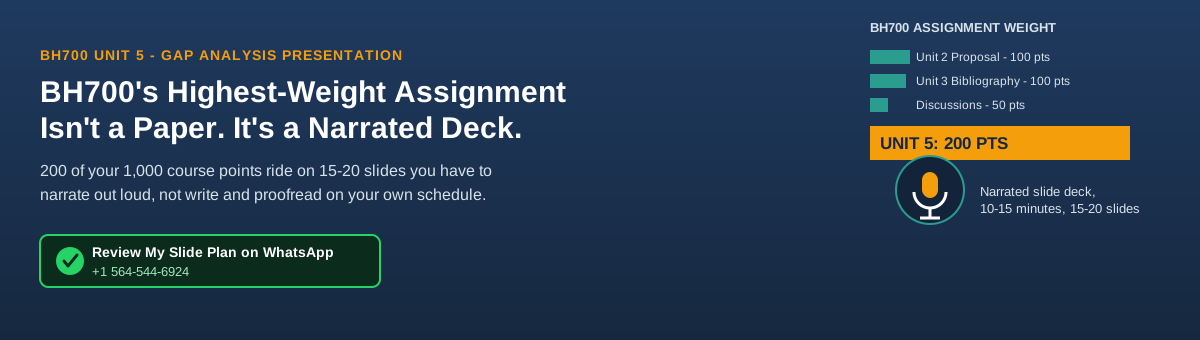
The Unit 5 Integrated Behavioral Health Gap Analysis Presentation is worth 200 points, making it the single highest-weight assignment in BH700, double any other individual deliverable in the course. It is also a format change: a voice-narrated, 15-20 body-slide presentation (minimum 10-15 minutes of audio or video) rather than a written paper. According to the assignment instructions, it asks you to apply the Collaborative Care Model to the clinical site you established in Unit 1, using the gap, population, and evidence base you have been building since Unit 1, and to integrate quality measurement, value-based care alignment, and patient satisfaction strategy into that application.
This page is part of the Herzing University BH700 Course Guide. It builds directly on three prior assignments: the Unit 1 Identify Topic and Setting Guide, the Unit 2 Proposal Guide, and the Unit 3 Annotated Bibliography Guide. If you have not completed those three, Unit 5 will be difficult to build well, because the assignment instructions explicitly require you to cite evidence from your Unit 3 literature review and annotated bibliography, not to search for new sources from scratch.
Unit 5 Assignment: Integrated Behavioral Health Gap Analysis Presentation
Assignment Instructions
Students will develop a doctoral-level narrative presentation analyzing an integrated behavioral health model within a healthcare system.
Students will conduct a systematic gap analysis of behavioral health assessment, treatment, and integration within the chosen clinical site from the Unit 1 assignment (clinic, hospital unit, direct patient care program, or health system). Using mixed methods (document review, workflow observation, stakeholder interviews, and literature synthesis), students will identify key gaps, analyze root causes, evaluate ethical/cultural/policy implications, and propose an evidence-based implementation plan to address at least two prioritized gaps.
The project demonstrates mastery of CLOs 1–6 and establishes a foundation for doctoral-level scholarship. This assignment is a voice-narrated (10-15 minute minimum) audio or video slide deck presentation.
Produce a 15-20 (body) slide presentation that applies the Collaborative Care Model and integrates quality measurement, Value Based care alignment, VBP alignment, patient satisfaction strategies, and behavioral health goals.
Guided Instructions:
Design a Collaborative Care adaptation for specialty settings that specifies: (1) patient identification strategy, (2)registry processes, (3)roles/responsibilities for each team member, (4)care pathways from screening to stepped care, and (5) communication/consultation workflows.
- Explicitly map each team member’s role in patient workflow for a typical case (new positive PHQ‑9 screen to 6-month follow-up).
- Outline required workflow changes step-by-step (who does what, when)
- Use Collaborative Care core principles: population-based registry, measurement-based care, care management, psychiatric consultation, and systematic treatment-to-target. Explain how these core principles will be implemented.
- Apply biopsychosocial and population health frameworks to analyze needs and outcomes
- Address how patient satisfaction will be measured and used to refine services.
- Discuss at least one way the plan supports value-based incentives (e.g., shared savings, pay-for-performance).
- Include ethical, cultural, or equity consideration and how your plan addresses it. List potential ethical concerns (consent, confidentiality).
- Be creative. Include visual images (charts, tables, images).
- Cite evidence in APA 7th edition from literature review/annotated bibliography in Unit 3.
Submit:
- Slide deck (15-20 slides), APA 7th edition format, Microsoft PowerPoint, Zoom recording, or mp4 narrated minimum 10-15 minute presentation using audio or video
Please review the rubric to ensure that your assignment meets criteria.
Unit 5 Assignment Example
FICTIONAL EXAMPLE FOR ILLUSTRATION ONLY. DO NOT SUBMIT. This example continues the Riverside Community Health Center scenario built across the Unit 1, Unit 2, and Unit 3 guides: a fictional federally qualified health center in Riverside County, California. Every figure, timepoint, and organizational detail is invented for instructional purposes only. A complete, fully APA 7-formatted narration script for all 18 body slides plus references, demonstrating the entire workflow map and every required element at full length, is available as a downloadable Word document. Below is the slide-by-slide structure and the content of three representative slides.
Need a Custom Unit 5 Assignment Done? WhatsApp Us On: +1 564-544-6924
BH700-Unit5-Gap-Analysis-Fictional-Example
What the Assignment Actually Requires
| Requirement | What the Instructions State |
|---|---|
| Format | Voice-narrated audio or video slide deck, 15-20 body slides, minimum 10-15 minutes |
| Submission options | Microsoft PowerPoint, Zoom recording, or MP4, narrated |
| Site | The same clinical site (clinic, hospital unit, direct patient care program, or health system) established in Unit 1 |
| Model | Apply the Collaborative Care Model, integrating quality measurement, value-based care/VBP alignment, patient satisfaction strategies, and behavioral health goals |
| Gap analysis method | Mixed methods: document review, workflow observation, stakeholder interviews, literature synthesis |
| Scope | Identify key gaps, analyze root causes, evaluate ethical/cultural/policy implications, propose an evidence-based implementation plan for at least two prioritized gaps |
| CoCM design elements | Patient identification strategy, registry processes, team roles/responsibilities, care pathways from screening to stepped care, communication/consultation workflows |
| Workflow mapping | Explicitly map each team member’s role for a typical case, new positive PHQ-9 screen through 6-month follow-up |
| Workflow change detail | Step-by-step: who does what, when |
| CoCM core principles | Population-based registry, measurement-based care, care management, psychiatric consultation, systematic treatment-to-target, and how each is implemented |
| Frameworks | Biopsychosocial and population health frameworks applied to needs and outcomes |
| Patient satisfaction | How it will be measured and used to refine services |
| Value-based alignment | At least one way the plan supports value-based incentives (shared savings, pay-for-performance) |
| Ethics/culture/equity | At least one consideration addressed, plus listed concerns (consent, confidentiality) |
| Visuals | Charts, tables, images; creativity is explicitly invited |
| Citations | APA 7th edition, drawn from the Unit 3 literature review/annotated bibliography |
| CLOs demonstrated | CLO 1-6 |
Two Discrepancies Worth Flagging Before You Build This
“At least two prioritized gaps.” The assignment instructions ask you to propose an implementation plan addressing at least two prioritized gaps, but Units 1 and 2 of this course guide a student toward identifying one prioritized gap. This is not a contradiction you should resolve by inventing an unrelated second problem. The more defensible approach, demonstrated in the worked example below, is to identify a second gap that is a distinct but related mechanism within the same overall problem, something your Unit 2 ethical/cultural considerations section likely already touched on, rather than manufacturing a disconnected second issue. Confirm with your instructor if you are unsure whether two sub-components of one systemic gap satisfy this requirement at your site.
“Specialty settings.” The guided instructions ask you to “design a Collaborative Care adaptation for specialty settings.” The Collaborative Care Model was originally developed and tested in primary care (Unützer et al., 2002), and the Unit 1/Unit 2 site-selection guidance in this course points toward clinics, hospital units, or health systems generally, not specifically specialty care.
If your selected site from Unit 1 is a primary care setting rather than a specialty clinic, this phrase in the guided instructions may simply be referring to adapting CoCM’s original primary-care design to your specific chosen site’s context, rather than requiring a literal specialty-care setting. The assignment instructions do not clarify this further. Verify this with your instructor before assuming either interpretation, and do not quietly default to whichever reading is easier to write.
How Unit 5 Builds on Units 1 Through 3
| Earlier Unit | What Carries Into Unit 5 |
|---|---|
| Unit 1 | The clinical site itself: setting, population, services, demographics |
| Unit 1/2 | The prioritized gap, now expanded into at least two related, prioritized components |
| Unit 2 | The selected integrated behavioral health model: Collaborative Care Model |
| Unit 2 | Ethical, cultural, and equity considerations, now requiring specific mitigation strategies |
| Unit 3 | The 10-12 source annotated bibliography, now the required citation base for this presentation |
If your Unit 2 model selection was not CoCM, the guided instructions still apply the same way: they are written around Collaborative Care specifically, so if you selected a different model in Unit 2, you will need to either reconcile your model with these CoCM-specific guided instructions or confirm with your instructor how to adapt them. This guide, like the fictional example below, assumes CoCM because that is the model the Riverside scenario selected in Unit 2.
Why This Is a Different Kind of Deliverable
Every earlier BH700 assignment in this sequence has been a written document. Unit 5 is a narrated slide deck, and the rubric’s Presentation & Design criterion, worth 50 of the 200 points, grades things a paper never had to account for: pacing, narration clarity, slide design, and whether your visuals (registry maps, role flowcharts, measurement dashboards) actually clarify the workflow rather than decorate it. A presentation with excellent content but cluttered slides and flat narration will not reach the Exemplary band on this criterion, regardless of how strong the underlying analysis is.
Building the Gap Analysis Through Mixed Methods
The assignment specifies four input types for your gap analysis. Treat these as four distinct lenses, not one combined literature search:
| Method | What It Contributes |
|---|---|
| Document review | Existing workflow documents, screening protocols, referral logs, policies at your site |
| Workflow observation | What actually happens at each handoff point, not what the policy says should happen |
| Stakeholder interviews | Frontline perspective from the roles who would staff the proposed workflow |
| Literature synthesis | Your Unit 3 annotated bibliography, applied to explain why the observed gap matters and what evidence-based practice addresses it |
If you do not have access to conduct real observation or interviews at your site, say so plainly in your narration rather than fabricating stakeholder quotes or observational findings. A presentation that is honest about which inputs were available and which were limited will hold up better under the rubric’s Analysis criterion than one that invents specificity it does not have.
Designing the Collaborative Care Adaptation
The guided instructions ask for five specific design elements. Each one needs its own slide or slide pair; combining several into one dense slide is where the Presentation & Design criterion starts to penalize clutter.
1. Patient identification strategy. How does a patient enter the CoCM pathway in the first place? At most sites, this is a validated screening tool administered at a defined point in the visit (for example, PHQ-9 at intake or at a defined interval), not a referral initiated only when a provider happens to notice a concern.
2. Registry processes. The population-based registry is the operational core of CoCM: a tracked list of every enrolled patient, their current PHQ-9 score, days since last contact, and treatment status, reviewed on a fixed cadence rather than relying on individual provider memory (Unützer et al., 2002).
3. Roles and responsibilities. Name every role that touches the pathway: primary care provider, behavioral health care manager, consulting psychiatrist, and any front-desk or intake role responsible for administering the screen. A role with no defined responsibility in your pathway is a gap, not an oversight to gloss over.
4. Care pathways from screening to stepped care. Map what happens at each score band: a mild elevation might trigger watchful waiting with a re-screen interval, while a severe or worsening score triggers psychiatric consultation and a treatment adjustment. “Stepped care” means the intensity of intervention is matched to measured severity, not uniform for every positive screen.
5. Communication and consultation workflows. Specify how the care manager and consulting psychiatrist actually communicate: a weekly caseload review meeting, a documented consultation note in the shared record, or a defined escalation path for urgent cases. CoCM’s psychiatric consultation function works by caseload review rather than the psychiatrist seeing every patient directly, which is part of what makes the model feasible at sites without an on-site psychiatrist (Unützer et al., 2002).
Mapping the Workflow: Positive PHQ-9 Screen to 6-Month Follow-Up
This is the single most specific, most heavily weighted instruction in the assignment: explicitly map each team member’s role in a typical case from a new positive PHQ-9 screen through six months of follow-up. A generic description of CoCM roles does not satisfy this; the rubric’s Content & Scope criterion specifically credits “explicit 6-month workflow mapping for all members” in its Exemplary band.
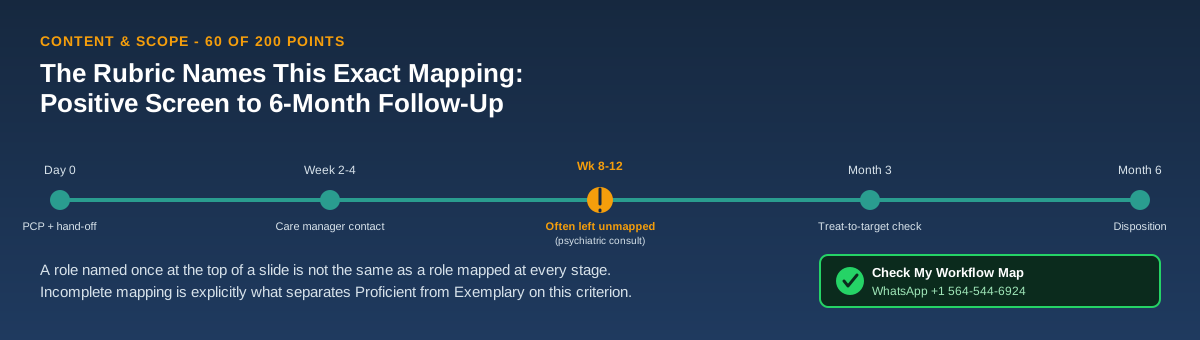
Build this as a timeline, stage by stage, naming who acts at each stage:
| Timepoint | What Happens | Who Is Responsible |
|---|---|---|
| Day 0 | Positive PHQ-9 screen identified | Front-desk/intake staff administer; PCP reviews result during the same visit |
| Day 0 | Warm hand-off to care manager | PCP introduces patient to behavioral health care manager before the visit ends |
| Day 0-3 | Patient enrolled in registry | Behavioral health care manager documents enrollment, baseline score, and contact plan |
| Week 2-4 | First structured follow-up contact | Behavioral health care manager contacts patient to assess engagement and re-screen |
| Week 4-8 | Registry review | Care manager and consulting psychiatrist review caseload; non-responders flagged |
| Week 8-12 | Psychiatric consultation for non-responders | Consulting psychiatrist reviews flagged cases and recommends treatment adjustment |
| Month 3 | Treatment-to-target check | Care manager documents current score against target; adjusts plan if not improving |
| Month 6 | Follow-up and disposition | PCP and care manager determine continued monitoring, stepped-down care, or discharge from active tracking |
Bao et al. (2016) found that early care manager follow-up contact within the first four weeks, and psychiatric consultation for patients not improving between weeks 8 and 12, were the two workflow elements most strongly associated with better depression outcomes and faster improvement. That finding is the evidence basis for placing those two specific actions at those specific timepoints in the table above, rather than placing them arbitrarily.
Explaining the Five CoCM Core Principles
The guided instructions name five core principles and ask you to explain how each will be implemented, not just list them.
| Core Principle | What It Means | How It Shows Up in the Pathway |
|---|---|---|
| Population-based registry | Every enrolled patient is tracked as a defined population, not case by case | The registry table above; no patient falls out of view after the initial hand-off |
| Measurement-based care | Treatment decisions are driven by repeated, standardized outcome measurement | Repeated PHQ-9 administration at each follow-up contact, not a single intake score |
| Care management | A dedicated role actively manages engagement and follow-through | The behavioral health care manager’s contact schedule and registry review duties |
| Psychiatric consultation | A psychiatric provider reviews caseload data rather than seeing every patient | Caseload review at week 4-8, direct consultation only for flagged non-responders |
| Systematic treatment-to-target | Treatment is adjusted until a defined symptom-reduction goal is met, not stopped at a fixed visit count | The month 3 and month 6 checks against a defined target score |
Applying Biopsychosocial and Population Health Frameworks
These are two distinct analytical lenses, and the rubric rewards both being used, not merged into one paragraph.
Biopsychosocial framework. At the individual case level, this means your gap analysis should account for biological (symptom severity, comorbid conditions), psychological (patient engagement, trust, prior experience with behavioral health services), and social (language access, transportation, work schedule conflicts with appointment times) factors driving disengagement, not just the clinical score.
Population health framework. At the site level, this means looking at the pattern across your entire patient population, not one patient’s story. If 60% of your population is Spanish-speaking and your current workflow has no routine interpreter coordination at the hand-off point, that is a population-level root cause of the gap, independent of any individual patient’s motivation (Agency for Healthcare Research and Quality, 2022; Phelan et al., 2023).
Measuring and Using Patient Satisfaction
The assignment asks specifically how patient satisfaction will be measured and used to refine services, not just acknowledged as important. Name an actual mechanism: a brief post-visit experience survey at the point of hand-off, a periodic patient-experience measure tied to the behavioral health pathway specifically (not a generic clinic-wide survey), or structured feedback collected during the care manager’s follow-up contacts. Then specify what you would do with a negative finding: for example, if patients report the hand-off feels rushed, that finding should feed back into how the hand-off script or timing is adjusted, not sit in a report no one acts on.
Aligning the Plan With Value-Based Incentives
The assignment requires at least one concrete way your plan supports value-based incentives such as shared savings or pay-for-performance. CoCM has real, documented payment pathways you can cite rather than describing VBP alignment in the abstract:
- Medicare and a growing number of Medicaid and commercial payers reimburse CoCM through dedicated time-based billing codes for monthly care coordination, which directly pays for the care manager and consulting psychiatrist functions this pathway depends on (Carlo et al., 2018).
- Several state CoCM payment models have used pay-for-performance structures, withholding a portion of payment until a site meets defined quality indicators or documents clinical improvement, which rewards exactly the kind of measurement-based tracking this pathway builds in (Carlo et al., 2018).
Connect whichever mechanism you cite back to your own site’s plan: naming a payment model without explaining how your specific registry and follow-up structure would qualify for it will not satisfy this requirement as fully as showing the connection.

Addressing Ethical, Cultural, and Equity Considerations
The assignment specifically lists consent and confidentiality as concerns to address, in addition to any other ethical, cultural, or equity issue relevant to your site.
Consent. Patients need to understand, at the point of screening, that a care manager other than their usual provider will be tracking their symptom scores and contacting them over time. Federal confidentiality rules updated in 2024 permit a single consent to cover future treatment, payment, and care coordination disclosures, which simplifies this operationally but does not remove the obligation to make sure patients actually understand what that consent covers (U.S. Department of Health and Human Services, 2024).
Confidentiality. A shared registry accessible to a care manager, PCP, and consulting psychiatrist is itself a point of exposure that needs a defined access policy, not an assumption that “the system is secure.”
Culture and equity. A follow-up workflow built without routine interpreter coordination reproduces the same access gap CoCM is meant to close for a majority Spanish-speaking population (Agency for Healthcare Research and Quality, 2022). Cultural humility, approaching every follow-up contact as an ongoing process of self-reflection rather than an assumption of cultural competence already achieved, is directly relevant to how a care manager should be trained to conduct these contacts (Tervalon & Murray-García, 1998).
Building the Slide Deck Itself
This is a working structure, not an official Herzing template. Eighteen body slides fit comfortably inside the 15-20 range while giving every required element its own space.
| # | Slide | Primary Rubric Tie |
|---|---|---|
| 1 | Title slide | — |
| 2 | Agenda and learning objectives | Presentation & Design |
| 3 | Site, population, and services (from Unit 1) | Content & Scope |
| 4 | The gap: two prioritized components | Content & Scope |
| 5 | Historical context of integrated care models | Content & Scope |
| 6 | Gap analysis methodology (mixed methods) | Analysis, Evidence & Rationale |
| 7 | Root cause analysis: biopsychosocial framework | Analysis, Evidence & Rationale |
| 8 | Root cause analysis: population health framework | Analysis, Evidence & Rationale |
| 9 | Selected model and its five core principles | Content & Scope |
| 10 | Patient identification and registry design | Content & Scope |
| 11 | Team roles and responsibilities | Content & Scope |
| 12 | Workflow map: screening to 6-month follow-up | Content & Scope |
| 13 | Step-by-step workflow changes (who, what, when) | Content & Scope |
| 14 | Communication and psychiatric consultation workflow | Content & Scope |
| 15 | Patient satisfaction measurement and feedback loop | Analysis, Evidence & Rationale |
| 16 | Value-based payment alignment | Analysis, Evidence & Rationale |
| 17 | Ethical, cultural, and equity considerations | Analysis, Evidence & Rationale |
| 18 | Implementation plan, metrics, and conclusion | Analysis, Evidence & Rationale |
| — | References | APA, References & Scholarship |
Title and reference slides are conventionally not counted toward a stated “body slide” range, but confirm that assumption against your actual course rubric before finalizing your count, since the instructions do not define “body slide” explicitly.
Visuals That Actually Carry Rubric Weight
The rubric names specific visual types in its Exemplary band: registry/process maps, role flowcharts, and measurement dashboards. A slide with a stock photo of a meeting room does not count toward this. Build at minimum:
- A visual registry/workflow map showing the screening-to-6-month-follow-up pathway (the table above, rebuilt as a flow diagram)
- A role flowchart showing each team member against the pathway stages
- A simple measurement dashboard mock-up showing how PHQ-9 scores would be tracked over time for a caseload
Common Problems That Weaken This Presentation
- Listing CoCM’s five core principles without explaining how each is implemented at your specific site.
- Mapping team roles in general terms instead of against the specific screening-to-6-month-follow-up timeline the rubric names explicitly.
- Treating patient satisfaction and value-based alignment as afterthought bullet points instead of developed slides with a real mechanism named.
- Citing general integrated-care literature instead of pulling forward the specific sources already established in your Unit 3 annotated bibliography.
- Addressing ethics and equity as a generic slide disconnected from the specific consent, confidentiality, and language-access issues your own site’s workflow creates.
- Treating the narration as a read-aloud script of dense slide text rather than a paced explanation that uses the slides as support.
- Fabricating observational findings or stakeholder interview quotes you did not actually collect.
- Resolving the “two prioritized gaps” instruction by inventing an unrelated second problem instead of a related, distinct component of your established gap.
- Submitting cluttered slides with no visual hierarchy because every required element was crammed onto too few slides.
- Running under 10 minutes or well over 20 slides trying to cover everything at once instead of being selective about depth per topic.
Final Submission Checklist
- 15-20 body slides, narrated, 10-15 minutes minimum.
- Submitted as PowerPoint, Zoom recording, or narrated MP4.
- Builds on the exact site, population, and gap established in Unit 1.
- Applies the Collaborative Care Model specifically (or reconciles a different Unit 2 model selection with the guided instructions).
- At least two prioritized gaps addressed with an evidence-based implementation plan.
- Patient identification strategy, registry process, roles, care pathway, and communication workflow all specified.
- Explicit role mapping from positive PHQ-9 screen through 6-month follow-up.
- Step-by-step workflow changes stated (who, what, when).
- All five CoCM core principles named and explained for implementation, not just listed.
- Biopsychosocial and population health frameworks both applied.
- Patient satisfaction measurement mechanism named, with a stated use for the results.
- At least one value-based incentive alignment named and connected to the specific plan.
- Consent, confidentiality, and at least one cultural/equity consideration addressed with mitigation.
- Visuals include a workflow/registry map, a role flowchart, and a measurement dashboard concept.
- All citations drawn from the Unit 3 annotated bibliography, APA 7th edition.
- Reviewed against the actual course rubric before submission.
Fictional Worked Example
FICTIONAL EXAMPLE FOR ILLUSTRATION ONLY. DO NOT SUBMIT. This example continues the Riverside Community Health Center scenario built across the Unit 1, Unit 2, and Unit 3 guides: a fictional federally qualified health center in Riverside County, California. Every figure, timepoint, and organizational detail is invented for instructional purposes only. A complete, fully APA 7-formatted narration script for all 18 body slides plus references, demonstrating the entire workflow map and every required element at full length, is available as a downloadable Word document. Below is the slide-by-slide structure and the content of three representative slides.
BH700-Unit5-Gap-Analysis-Fictional-Example
The Two Prioritized Gaps (Slide 4)
Gap 1 (carried from Units 1-2): Positive behavioral health screens at Riverside do not reliably convert into a completed first behavioral health appointment; an estimated 40% completion rate (fictional, illustrative figure) results from a delayed, queue-based referral rather than a same-day warm hand-off.
Gap 2 (newly prioritized for this presentation): Riverside’s current referral process has no routine Spanish-language interpreter coordination built into the hand-off itself, even though approximately 60% of Riverside’s patient population is Hispanic/Latino and primarily Spanish-speaking. This is a distinct operational gap, not a restatement of Gap 1: a patient could receive a same-day hand-off and still disengage if that hand-off happens without coordinated language access.
Workflow Map Slide, Representative Narration (Slide 12)
“At Day 0, when a patient screens positive on the PHQ-9 during an intake visit, Riverside’s primary care provider will introduce the patient directly to the behavioral health care manager before the visit ends, rather than placing the patient into a scheduling queue. If the patient is Spanish-speaking, this hand-off will route through Riverside’s existing interpreter line rather than defaulting to English-only communication, closing Gap 2 at the exact point where Gap 1 was previously closed only for English-speaking patients. Within the first four weeks, the care manager will make a structured follow-up contact and re-administer the PHQ-9; Bao et al. (2016) found this early contact window is the strongest single predictor of improved depression outcomes in collaborative care. Between weeks 8 and 12, any patient not showing improvement is flagged for consulting-psychiatrist caseload review, the second workflow element Bao et al. (2016) identified as predictive of better outcomes. By month 6, the care manager and primary care provider jointly determine whether the patient is stepped down to routine monitoring or continues active tracking.”
Value-Based Alignment Slide, Representative Narration (Slide 16)
“Riverside’s proposed registry and care manager structure is not only a clinical improvement; it is billable infrastructure. Medicare and a growing number of Medicaid and commercial payers now reimburse Collaborative Care through dedicated monthly time-based billing codes that directly fund care manager and consulting psychiatrist time (Carlo et al., 2018). Several state Collaborative Care payment models have also used pay-for-performance structures, withholding a portion of payment until a site documents measurable clinical improvement across its registry (Carlo et al., 2018). For Riverside, meeting a defined improvement threshold across its behavioral health registry would align this clinical redesign with exactly the kind of value-based incentive structure payers are increasingly using for this model.”
References Used in This Guide and the Worked Example
Agency for Healthcare Research and Quality. (2022). Health equity and behavioral health integration [Topic brief]. Academy for Integrating Behavioral Health and Primary Care. https://integrationacademy.ahrq.gov/products/topic-briefs/health-equity
Bao, Y., Druss, B. G., Jung, H.-Y., Chan, Y.-F., & Unützer, J. (2016). Unpacking collaborative care for depression: Examining two essential tasks for implementation. Psychiatric Services, 67(4), 418-424. https://doi.org/10.1176/appi.ps.201400577
Carlo, A. D., Unützer, J., Ratzliff, A. D. H., & Cerimele, J. M. (2018). Financing for collaborative care-A narrative review. Current Treatment Options in Psychiatry, 5(3), 334-344. https://doi.org/10.1007/s40501-018-0150-4
Heath, B., Wise Romero, P., & Reynolds, K. (2013). A standard framework for levels of integrated healthcare. SAMHSA-HRSA Center for Integrated Health Solutions. https://www.pcpcc.org/sites/default/files/resources/SAMHSA-HRSA%202013%20Framework%20for%20Levels%20of%20Integrated%20Healthcare.pdf
Phelan, S. M., Salinas, M., Pankey, T., Cummings, G., Allen, J.-S. P., Waniger, A., Miller, N. E., Lebow, J., Dovidio, J. F., van Ryn, M., & Doubeni, C. A. (2023). Patient and health care professional perspectives on stigma in integrated behavioral health: Barriers and recommendations. Annals of Family Medicine, 21(Suppl 2), S56-S60. https://doi.org/10.1370/afm.2924
Tervalon, M., & Murray-García, J. (1998). Cultural humility versus cultural competence: A critical distinction in defining physician training outcomes in multicultural education. Journal of Health Care for the Poor and Underserved, 9(2), 117-125. https://doi.org/10.1353/hpu.2010.0233
U.S. Department of Health and Human Services, Office for Civil Rights, & Substance Abuse and Mental Health Services Administration. (2024). Confidentiality of substance use disorder (SUD) patient records; Final rule. Federal Register, 89(33), 12472-12631. https://www.federalregister.gov/documents/2024/02/16/2024-02544/confidentiality-of-substance-use-disorder-sud-patient-records
Unützer, J., Katon, W., Callahan, C. M., Williams, J. W., Jr., Hunkeler, E., Harpole, L., Hoffing, M., Della Penna, R. D., Noël, P. H., Lin, E. H. B., Areán, P. A., … IMPACT Investigators. (2002). Collaborative care management of late-life depression in the primary care setting: A randomized controlled trial. JAMA, 288(22), 2836-2845. https://doi.org/10.1001/jama.288.22.2836
All sources above are real and independently verifiable. Only the Riverside site, its figures, and its workflow details are fictional. The full worked example’s Word document additionally draws on Archer et al. (2012), Nguyen et al. (2024), and Schillok et al. (2025), all previously verified in the Unit 3 Annotated Bibliography Guide, consistent with the assignment’s instruction to cite from that bibliography.

Working Through the Highest-Weight Assignment in BH700?
This is 200 points riding on a format most BH700 students have not had to build yet: a narrated slide deck instead of a paper. Gradevia can review your slide structure, your workflow mapping, and whether your value-based and patient satisfaction content actually meets the rubric’s specific requirements, before you record a single minute of narration.
WhatsApp: +1 564-544-6924