
Blog
WGU D268 Task 2 Guide and Example: Workplace Conflict and Negotiation

By Dan Palmer, MBA · Academic strategy consultant for working adult learners · LinkedIn
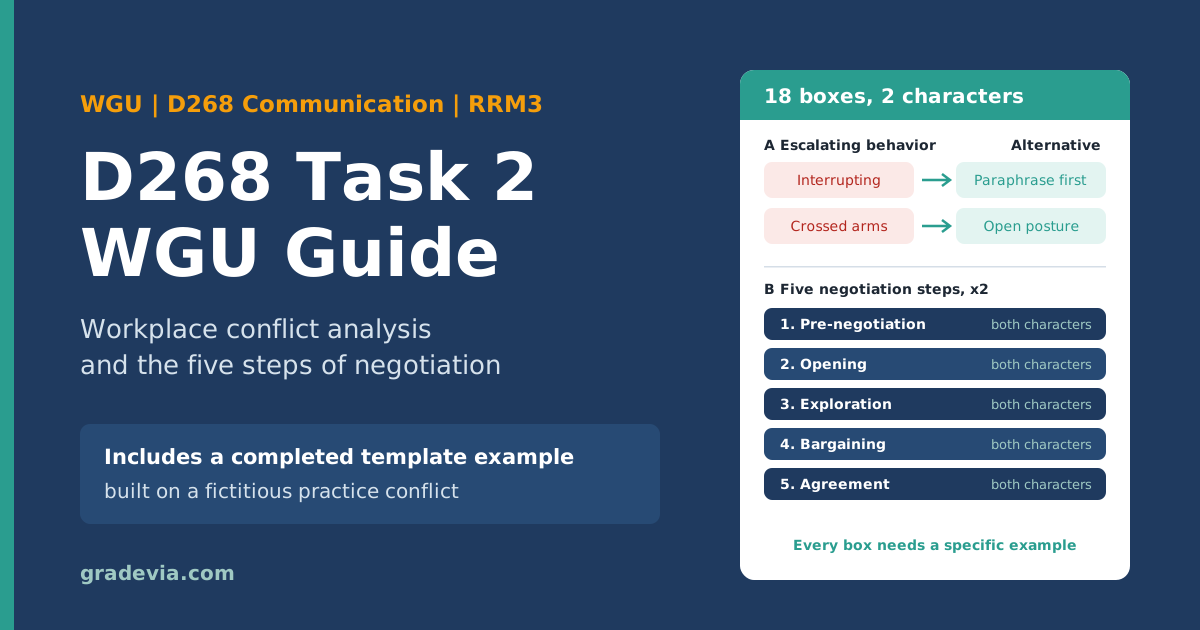
WGU D268 Task 2 is built around a short course video called “Workplace Conflict.” Two managers in a health professions setting, Raymond and Jenna, argue about staff reductions, and you act as an observer in the room. You identify what each of them did to make the conflict worse, suggest what they could have done instead, and then coach each of them through the five steps of negotiation. The template has 18 answer boxes, nine for each character, and a box left vague or a behavior left without its matching alternative is enough to send the task back.
This guide is for working adults who want RRM3 D268 Task 2 finished in a couple of evenings. It explains how to watch the video so you catch both verbal and nonverbal behaviors, how to pair every escalating behavior with a specific alternative, and how to write a WGU D268 Task 2 Section B that gives a concrete example for every step. It ends with a completed template example built on a fictitious conflict, so it shows the reasoning without describing the WGU video.
D268 Task 2 Assignment
Introduction
Conflict is a normal part of life. Managing conflict using effective communication is an important skill for solving problems, innovating, and maintaining productive relationships—particularly in a professional setting. In this task, you will critically analyze the communication in a conflict scenario and provide recommendations for communication strategies to manage and resolve the conflict. Use the RRM3 D268 Task 2 Template located in the Supporting Documents section below the rubric as a guide to complete this task.
Scenario
Two managers in a health professions setting are upset about recent staff reductions and the effect on worker roles. The characters’ discussion is shown in the “Workplace Conflict” video in the Web Links section located below the rubric. As you watch the video, imagine that you are in the room with the two characters, serving as an observer. Provide feedback for each of the two characters on how to negotiate this conflict.
A. Watch the “Workplace Conflict” video in the Web Links section located below the rubric. Then, analyze the interaction shown by doing the following:
- For each character (i.e., Raymond & Jenna) you observed in the video, identify 1 or 2 interpersonal communication behaviors that escalated the conflict.
a. Describe how each of the identified behaviors in prompt A1 escalated the conflict.
Note: The interpersonal communication behaviors could be verbal or nonverbal.
- For each of the interpersonal communication behaviors identified in prompt A1, provide an alternative communication behavior that could have been used to de-escalate the conflict.
a. Describe how each of the identified behaviors in prompt A2 could have been used to de-escalate the conflict.
Note: The suggested length for prompt A is 1–2 pages.
B. Recommend how each of the characters in the video (i.e., Raymond & Jenna) could have spoken or behaved differently to manage and resolve the conflict by specifically addressing each of the 5 steps of negotiation listed below:
- pre-negotiation
- opening
- exploration
- bargaining
- agreement
Note: The suggested length for prompt B is 1–2 pages.
C. Acknowledge sources—using in-text citations and references—for content that is quoted, paraphrased, or summarized.
Note: Sources are NOT required for this task, but if sources are used, they must be acknowledged and cited appropriately.
D. Demonstrate professional communication in the content and presentation of your submission.
WGU D268 Task 2 Example: A Completed Template for a Practice Conflict
Our WGU D268 Task 2 example fills in the RRM3 D268 Task 2 Template for a fictitious practice conflict, not the WGU video. It includes a short practice transcript: Curtis, a front office manager, and Elaine, a housekeeping manager at a fictitious hotel, argue about late checkouts after housekeeping staff cuts.
The example is for illustration only. Your submission must analyze Raymond and Jenna in the WGU video, in your own words.
Need D268 Task 2 Written from Scratch? WhatsApp Us: +1 564 544 6924.
Download the D268 Task 2 example template (.docx)
What D268 Task 2 Asks You to Do
You complete everything in the RRM3 D268 Task 2 Template from the Supporting Documents section. The template gives Raymond and Jenna separate boxes for every requirement.
| Requirement | What you deliver, for each character |
|---|---|
| A1 | 1 or 2 interpersonal communication behaviors that escalated the conflict (verbal or nonverbal) |
| A1a | How each of those behaviors escalated the conflict |
| A2 | An alternative behavior for each behavior in A1 that could have de-escalated the conflict |
| A2a | How each alternative could have de-escalated the conflict |
| B | What the character could have said or done differently at each of the five negotiation steps: pre-negotiation, opening, exploration, bargaining, and agreement |
| C | Citations and references, only if you use sources |
| D | Professional communication |
The suggested length is 1 to 2 pages for Section A and 1 to 2 pages for Section B.
How to Watch the Workplace Conflict Video
Everything in Section A comes from the video, so a single viewing isn’t enough. A three pass approach works well after a long workday:
- First pass: follow the story. What is each manager upset about, and what does each one want?
- Second pass: listen. Note verbal behaviors with timestamps and short quotes: interruptions, blame, sarcasm, absolute words like “always” and “never,” raised volume, or threats.
- Third pass: watch with the sound off. Note nonverbal behaviors: posture, crossed arms, eye contact or the lack of it, facial expressions, gestures, and how close the two sit or stand.
Your timestamped notes become the evidence for A1 and A1a. A behavior described with a short quote or a specific moment (“when Jenna said…” or “as Raymond leaned back and…”) is far stronger than “Raymond was rude.”
Section A: Behaviors That Escalate, and Their Alternatives
The template points you to Section 2, Lesson 4 of the course for interpersonal communication behaviors. In general terms, these are the kinds of behaviors you’re looking for and the alternatives that typically replace them:
| Escalating behavior | Type | Alternative that de-escalates |
|---|---|---|
| Interrupting or talking over someone | Verbal | Letting the person finish, then paraphrasing what they said |
| Blaming “you” statements (“You never…”) | Verbal | “I” statements that describe the specific problem and its effect |
| Sarcasm or dismissive remarks | Verbal | Stating the concern directly and respectfully |
| Raised voice or sharp tone | Verbal | Lowering volume and slowing the pace |
| Crossed arms, turning away, or avoiding eye contact | Nonverbal | Open posture, facing the person, and steady eye contact |
| Eye rolling, sighing, or smirking | Nonverbal | A neutral, attentive expression and nodding to show you’re listening |
| Threatening to escalate (“I’ll take this to…”) | Verbal | Proposing to work on the problem together first |
Use the course’s own terms where they apply, paraphrased rather than quoted, and choose behaviors you actually observed in the video.
Three rules keep Section A from coming back:
- Match every behavior one to one. If you identify two behaviors for Raymond in A1, A2 needs two alternatives for Raymond, one for each, in the same order. The template’s wording, “for each of the interpersonal communication behaviors identified in prompt A1,” is what the evaluator checks.
- Describe how, not just that. A1a should explain the effect on the other person and on the conversation: what it provoked, how the other person reacted, or how it shifted the discussion from the problem to the people.
- Make the alternative a behavior. “Raymond should be nicer” isn’t a behavior. “Raymond could wait until Jenna finished, then say, ‘So your concern is…'” is.

WGU D268 Task 2 Section B: The Five Steps of Negotiation
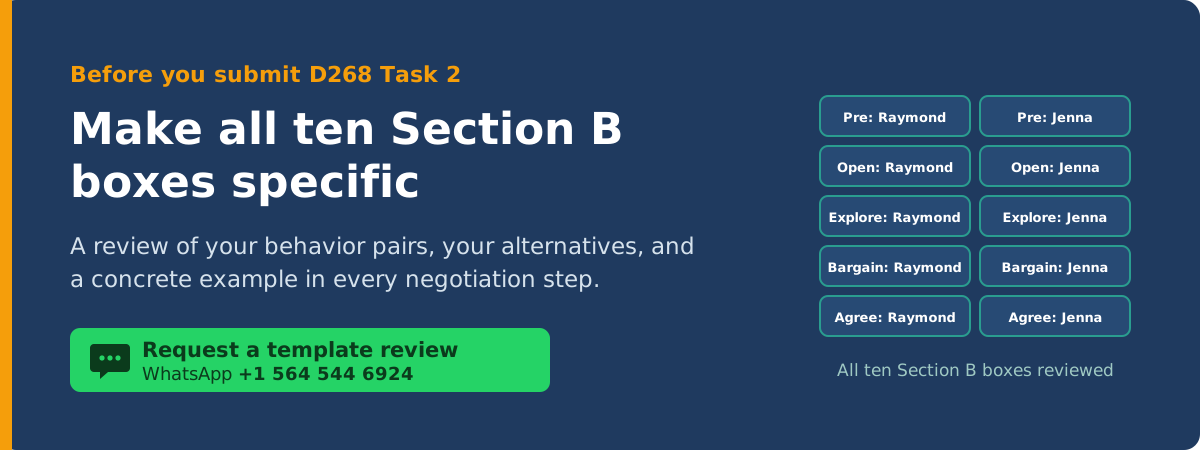
The template is explicit: Section B is not in the video. You’re asked to imagine you’re a conflict consultant meeting privately and separately with Raymond and Jenna, advising each of them how they could have handled the disagreement step by step. The template also asks that each description be “specific and gives an example of what each character could/should have done.”
That’s ten boxes: five steps for each character. The course covers the steps in Section 2, Lessons 3.4 and 3.5, and in its negotiation videos, so use those definitions. In general terms:
| Step | What happens | What a specific example looks like |
|---|---|---|
| Pre-negotiation | Preparing before the conversation: gathering facts, clarifying goals and limits, choosing a time and place | The character brings specific data and asks for a scheduled meeting instead of arguing in the moment |
| Opening | Starting the conversation: setting a respectful tone, stating the purpose, agreeing on ground rules | The opening sentence the character could have used |
| Exploration | Understanding each other’s interests and concerns before proposing solutions | Two or three questions the character could have asked |
| Bargaining | Exchanging proposals and concessions | A specific offer, and what the character could ask for in return |
| Agreement | Confirming the solution and next steps | How the agreement is recorded, who does what, and when they’ll review it |
The most common Section B mistake is advice that could apply to anyone: “Raymond should prepare before the meeting.” The template asks for an example. Give the character’s own words or actions, tied to the staff reduction problem in the video.
Section B should also connect to Section A. If a character’s escalating behavior was interrupting, their opening and exploration advice can show how they’d hold back and listen. That consistency shows the evaluator you understood the conflict as a whole.
Sections C and D: Sources and Professional Communication
Sources are optional. If you use research, cite it in text and list it in the template’s references row. As in Task 1, the template says you don’t need to cite course materials, but don’t quote them directly. Paraphrase with phrases like “Course material explains.” Run Grammarly before you submit, because professional communication is graded.
Why WGU D268 Task 2 Answers and PDFs Are a Bad Bet
Searches for WGU D268 Task 2 answers, a WGU D268 Task 2 PDF, or a WGU D268 Task 2 answer key PDF turn up papers marked “D268 Task 2 passed” on study sites. Every student analyzes the same video, so those papers name the same behaviors at the same moments. That’s exactly the overlap the similarity checker is built to catch, and an evaluator who has read dozens of submissions recognizes the familiar phrasing. Your own timestamped notes from the video are the fastest route to answers that are clearly yours.
WGU D268 Task 2 Example: A Completed Template for a Practice Conflict
Our WGU D268 Task 2 example fills in the RRM3 D268 Task 2 Template for a fictitious practice conflict, not the WGU video. It includes a short practice transcript: Curtis, a front office manager, and Elaine, a housekeeping manager at a fictitious hotel, argue about late checkouts after housekeeping staff cuts. The completed template shows:
- Two escalating behaviors for each manager, one verbal and one nonverbal, each tied to a moment in the transcript
- One matching alternative for every behavior, in the same order, with a sentence the manager could have said
- All ten Section B boxes, each with a specific example of what that manager could have said or done
- A cited source and an APA reference in Section C
- Comments explaining which requirement each part meets
Here’s part of its A2a answer for Curtis:
Paraphrasing would have shown Elaine that Curtis heard her before he made his own point, which lowers defensiveness. Research on workplace listening links high quality listening to stronger trust and better relationships (Kluger & Itzchakov, 2022), and trust was exactly what the conversation lacked.
The example is for illustration only. Your submission must analyze Raymond and Jenna in the WGU video, in your own words.
Download the D268 Task 2 example template (.docx)
Plan It Around Your Work Week
- Evening one: Watch the video three times and take timestamped notes. Fill A1 and A1a for both characters, then A2 and A2a, matching each alternative to its behavior.
- Evening two: Write the ten Section B boxes with a specific example in each, add references if you used any, run Grammarly, and review the similarity report.
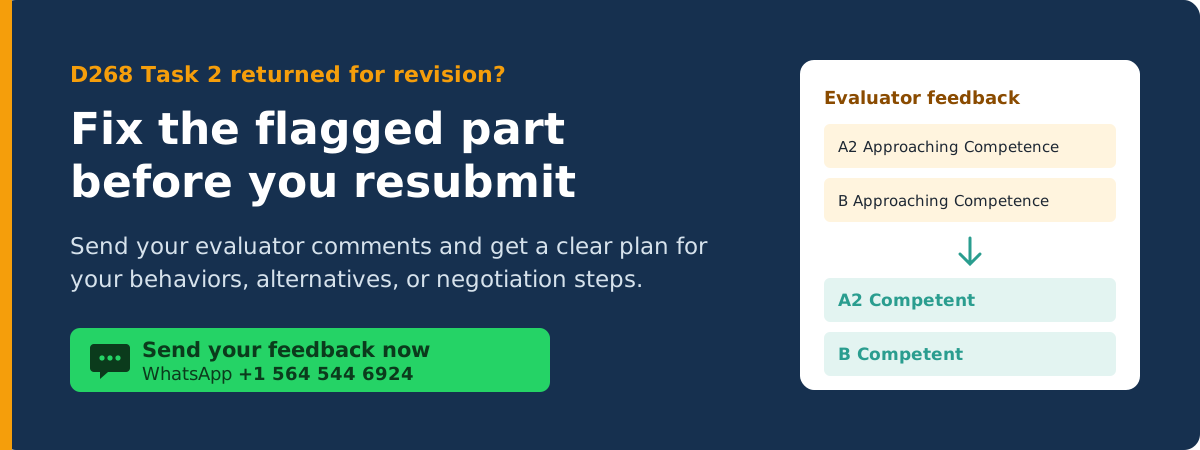
Common Reasons D268 Task 2 Comes Back
- A behavior in A1 has no matching alternative in A2
- A1a says a behavior escalated the conflict without explaining how
- An alternative in A2 is an attitude (“be calmer”) rather than a behavior
- Both characters get the same behaviors and the same advice
- A Section B box gives general advice without an example
- One of the ten Section B boxes is left out or merged with another
- Course materials are quoted directly instead of paraphrased
What Comes Next: WGU D268 Task 3
D268 continues with WGU D268 Task 3, which has its own directions and RRM3 template. If you haven’t finished Task 1 yet, our WGU D268 Task 1 guide covers the two introductory emails and the four communication styles.
Related WGU Guides
- See every D268 guide in one place.
- Active listening and managing your own emotions carry straight into conflict. Our WGU D082 Task 1 guide covers both, including choosing listening behaviors from a course list.
- Our WGU D082 Task 2 guide covers communicating across differences at work.
Pre-Submission Checklist
- All boxes in the RRM3 D268 Task 2 Template are filled for both Raymond and Jenna
- A1 names 1 or 2 behaviors per character, each tied to a moment in the video
- A1a explains how each behavior escalated the conflict
- A2 gives one alternative behavior for every A1 behavior, in the same order
- A2a explains how each alternative would de-escalate the conflict
- Section B has ten boxes, each with a specific example of what the character could have said or done
- Course materials are paraphrased, and any research is cited
- Grammarly Correctness is clear and the similarity report has been reviewed
Frequently Asked Questions
How many behaviors do I need for each character in D268 Task 2?
One or two per character in A1, and one alternative in A2 for each behavior you identify.
Can the behaviors in D268 Task 2 be nonverbal?
Yes. The directions say the interpersonal communication behaviors can be verbal or nonverbal.
Is Section B based on the video?
No. The template says Section B is not in the video. You advise each character as a conflict consultant on how they could have handled each of the five negotiation steps.
Do I need sources for D268 Task 2?
No. Sources are optional. If you use research, cite it. Paraphrase course materials rather than quoting them.
Can I submit the WGU D268 Task 2 example from this page?
No. It analyzes a fictitious practice conflict, not the WGU video, and copying any example would violate WGU’s academic integrity policy.
Want a Second Look Before You Submit?
If you’re working full time and want structured assignment support pairing behaviors with alternatives, making all ten Section B boxes specific, or checking your template before you submit, message Gradevia on WhatsApp at +1 564 544 6924.
Sources
Kluger, A. N., & Itzchakov, G. (2022). The power of listening at work. Annual Review of Organizational Psychology and Organizational Behavior, 9, 121–146. https://doi.org/10.1146/annurev-orgpsych-012420-091013