
Blog
WGU D082 Task 1 Guide and Example: Emotional Intelligence Reflection

By Dan Palmer, MBA · Academic strategy consultant for working adult learners · LinkedIn
Emotional and Cultural Intelligence D082 Task 1 looks like the easiest paper in your business program. You fill in a 24 statement EI Self-Inventory, write about yourself, and explain a listening list. Yet D082 Task 1 WGU papers come back for reasons like an action (“practice mindfulness”) too vague to act on, two “interpersonal” actions that are really self-management habits, or a Part C item from the listening list that describes poor listening.
This guide is for working adults who want D082 Emotional and Cultural Intelligence Task 1 done in one or two evenings and accepted on the first submission. It walks through the EI Self-Inventory, shows what a specific action looks like next to a weak one, gives you two ways to connect EI to business ethics with current sources, and explains the Part C trap. It also includes a D082 Task 1 template of headings and a full WGU D082 Task 1 example written by a fictitious student.
D082 Task 1 Assignment
Competencies
3082.1.1: Emotional Intelligence
The graduate applies emotional intelligence (EI) to improve intrapersonal and interpersonal interactions.
Introduction
Today’s business environment requires emotional intelligence (EI) for intrapersonal and interpersonal interactions. As a business professional, you must apply the principles of EI to positively impact the effectiveness of the organization.
Before completing this task, you will need to complete the “EI Self-Inventory” located in the Supporting Documents section.
Requirements
Your submission must represent your original work and understanding of the course material. Most performance assessment submissions are automatically scanned through the WGU similarity checker. Students are strongly encouraged to wait for the similarity report to generate after uploading their work and then review it to ensure Academic Integrity guidelines are met before submitting the file for evaluation. See Understanding Similarity Reports for more information.
A. Provide a reflection on your results of the self-inventory by doing the following:
- Identify one of the four emotional intelligence (EI) domains you believe is your strongest.
- Identify one of the four EI domains you want to work on for your own personal development.
- Describe two specific actions you can take to improve your EI intrapersonal (i.e., self-awareness and self-management) skills.
- Describe two specific actions you can take to improve your EI interpersonal (i.e., social-awareness and relationship management) skills.
B. Explain two ways EI relates to business ethics within an organization.
C. Explain how using two specific EI actions from the “Goleman’s Active Listening Skills” web link can help someone become a more active listener.
D. Acknowledge sources, using in-text citations and references, for content that is quoted, paraphrased, or summarized.
E. Demonstrate professional communication in the content and presentation of your submission.

What D082 Task 1 Asks You to Do
Before you write anything, the task requires you to complete the “EI Self-Inventory” from the Supporting Documents section. Your paper then covers:
| Requirement | What you deliver |
|---|---|
| A1 | The one EI domain you believe is your strongest |
| A2 | The one EI domain you want to work on for personal development |
| A3 | Two specific actions to improve your intrapersonal skills (self-awareness and self-management) |
| A4 | Two specific actions to improve your interpersonal skills (social awareness and relationship management) |
| B | Two ways EI relates to business ethics within an organization |
| C | How two specific EI actions from “Goleman’s Active Listening Skills” can help someone become a more active listener |
| D | In text citations and references for anything quoted, paraphrased, or summarized |
| E | Professional communication |
Step 1: Complete the EI Self-Inventory Honestly
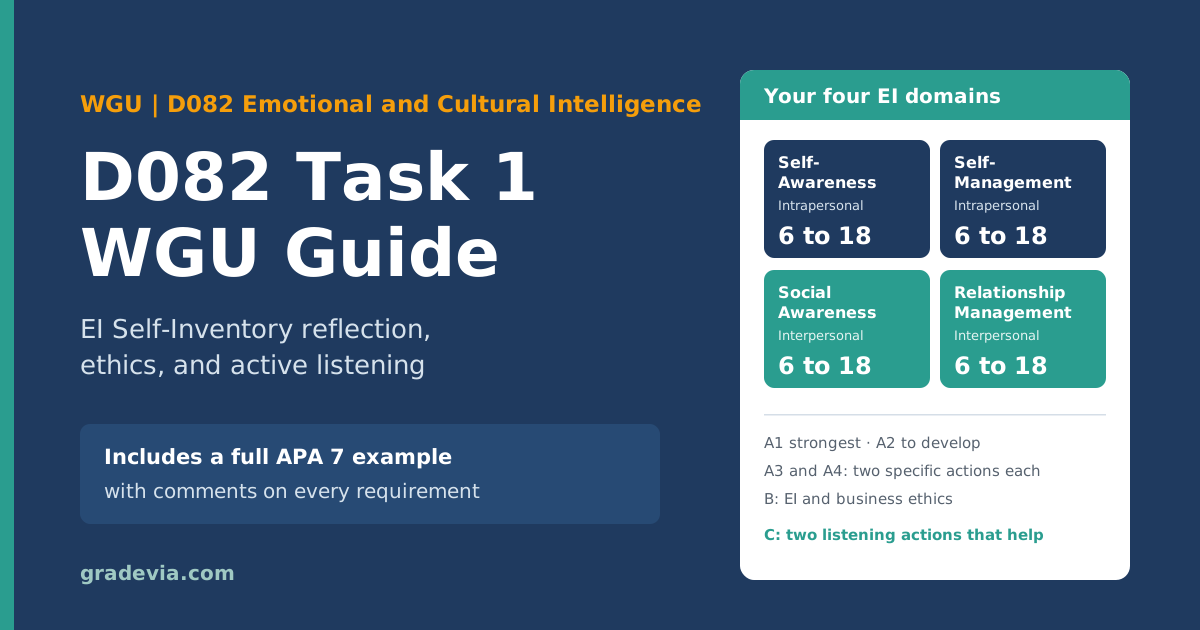
The inventory is built on Goleman’s four quadrants. Each domain has six statements, and you rate each one 1 (Rarely), 2 (Sometimes), or 3 (Often), so every domain total falls between 6 and 18.
| Domain | Type | One statement from the inventory |
|---|---|---|
| Self-Awareness | Intrapersonal | “I am aware of my emotions as they happen.” |
| Self-Management | Intrapersonal | “I think before I react when I’m upset or angry.” |
| Social Awareness | Interpersonal | “I am able to empathize with the emotions of others.” |
| Relationship Management | Interpersonal | “I manage conflicts constructively and try to resolve disagreements fairly.” |
The inventory itself notes that it is a reflection tool, not an assessment, and that a total is not a good or bad score. It shows which domain you engage with most often. That matters for how you write A1 and A2: say what your totals show, then explain with a moment from your own work. Use your real ratings. Your reflection is the evidence the evaluator reads, and an inflated picture of yourself reads as generic.
If two domains tie, the task still asks for one. Pick the one you can support with a clearer work example and say briefly why.
Part A1 and A2: Strongest Domain and Development Domain
For each one, give three things:
- The domain, named exactly as the inventory names it.
- Your total, and one or two statements you rated highest (or lowest).
- A short example from your job or life that shows it.
Weak: “My strongest domain is social awareness because I am a people person.”
Specific: “My strongest domain is Social Awareness, with a total of 16. I rated ‘I can sense when someone’s mood changes suddenly’ a 3, and it shows up on the floor: I usually notice a new hire is overwhelmed before they ask for help.”
Your development domain doesn’t have to be your lowest total, since the task asks which one you want to work on, but if you choose a different one, explain why.
Part A3 and A4: Specific Actions, Sorted Correctly
This is where most D082 Task 1 submissions lose points. Two rules:
Put each action in the right group. A3 actions must target self-awareness or self-management. A4 actions must target social awareness or relationship management. “Count to ten before answering an angry customer” is self-management, so it belongs in A3 even though a customer is involved. “Hold a five minute check in with each team member every Monday” is relationship management, so it belongs in A4.
Make each action something you could put on a calendar. A specific action names what you will do, when or how often, and how you’ll know it’s working.
| Too generic | Specific |
|---|---|
| Practice mindfulness | Before I reply to any escalated email, wait ten minutes and write one line naming what I’m feeling |
| Be more empathetic | In weekly one on ones, ask each person “What’s been the hardest part of your week?” before discussing numbers |
| Work on conflict | When two team members disagree about scheduling, meet with both within 24 hours and have each restate the other’s concern first |
| Journal | At the end of each shift, rate my frustration level from 1 to 5 and note what triggered anything above 3 |
Tie at least one action to a statement you rated low on the inventory. It shows the evaluator your plan comes from your results, not from a list of tips.
Part B: Two Ways EI Relates to Business Ethics
Part B asks for two explanations, and each one should name the EI domain involved, describe what happens in an organization, and cite a source. Two connections that hold up well:
- Self-awareness and self-management support ethical judgment under pressure. Ethical lapses at work often start with an emotion, such as fear of missing a target or anger at a customer, that pushes a quick shortcut. Recognizing that emotion and pausing before acting gives a person room to judge the situation on its merits. In a 2025 study of 207 independent auditors, Kurt, Kupec, and Aytaç found that emotional evaluation and the positive use of emotions significantly predicted ethical judgment, while other EI components did not, so cite it as evidence that specific EI skills matter rather than as proof that EI guarantees ethical behavior.
- Social awareness and relationship management shape whether people speak up and treat each other fairly. Employees report concerns to people they trust, and managers who listen well and handle conflict fairly create that trust. Kluger and Itzchakov (2022) reviewed research linking listening at work to outcomes including trust, the quality of relationships, and employee wellbeing. Doğru’s (2022) review of studies published since 1990 also found that emotional intelligence is positively associated with organizational citizenship behavior, the voluntary conduct that goes beyond formal job duties.
Use a short workplace example for each, such as a sales rep tempted to backdate an order at quarter end, or an employee who reports a safety issue because their supervisor listens without blame.
D082 Task 1 Part C: Goleman’s Active Listening Skills
D082 WGU Task 1 Part C asks you to explain how two specific EI actions from “Goleman’s Active Listening Skills” can help someone become a more active listener. The list has 25 items, and here’s the trap: several of them describe habits that work against listening. Items such as “Interrupt the speaker before he or she is done,” “Get distracted by environmental sounds,” “Look like you are listening when you are not,” and “React emotionally to the speaker’s message” are on the list too. If you pick one of those as an action that helps, the explanation won’t make sense.
Choose two items that clearly build listening, such as:
- “Restate the speaker’s message in your own words.”
- “Ask questions to gain clarity about the message.”
- “Listen without judging or critiquing.”
- “Pay attention to the speaker’s nonverbal communication.”
For each one, quote it as written, cite the course resource, explain how it makes someone a more active listener, and give a short workplace example. “Restating the message lets the speaker correct a misunderstanding before I act on it” explains the how. “Restating is a good listening skill” does not.

D082 Task 1 Template: Headings That Match the Rubric
This D082 Task 1 template keeps every requirement easy for the evaluator to find:
- Title page (student APA 7)
- Introduction (two or three sentences)
- EI Self-Inventory Results (a small table of your four totals)
- A1. Strongest EI Domain
- A2. EI Domain for Personal Development
- A3. Actions to Improve Intrapersonal Skills (Action 1, Action 2)
- A4. Actions to Improve Interpersonal Skills (Action 1, Action 2)
- B. Emotional Intelligence and Business Ethics (Way 1, Way 2)
- C. Active Listening Actions (Action 1, Action 2)
- References
Don’t attach the completed inventory unless your instructor asks for it. A summary table of your totals is enough to support Part A.
D082 Task 1 Template and Tips for a Busy Week
The best D082 Task 1 template and tips come down to finishing in two sittings:
- Evening one (about 90 minutes): Complete the EI Self-Inventory, total each domain, choose A1 and A2, and write one work example for each. Draft your four actions in the generic versus specific format above.
- Evening two (about two hours): Write Part B with two citations, choose two helpful items for Part C, add your references, run Grammarly for Education, and check the similarity report.
Why a “D082 Task 1 Passed” Paper Won’t Pass for You
Students search for a D082 Task 1 passed paper or D082 Task 1 examples to see what the evaluator accepted. That’s useful for structure, but copying is risky here in particular. Part A is about your inventory results and your work, so borrowed scores and borrowed stories don’t match your own submission and are easy to spot. Popular examples are also exactly what the similarity checker compares against. Use any D082 WGU Task 1 example to see the shape of an answer, then write from your own results.
WGU D082 Task 1 Example: A Fictitious Student’s Reflection
Our D082 WGU Task 1 example is written by a fictitious assistant store manager at a fictitious regional hardware chain, Ridgeway Supply. It includes a results table, both domain choices with work examples, four specific actions, two business ethics explanations with citations, and two Part C actions. It’s formatted in APA 7, and comments explain which requirement each section meets.
Here’s part of its A3 section:
Action 1: Before I respond to any escalated customer complaint by email or at the service desk, I will take a ten minute pause and write one line in my phone naming what I am feeling and why. I rated “I avoid making impulsive decisions when I’m feeling emotional” only a 1, and this pause gives me a reliable point to catch my reaction before it reaches the customer.
This emotional and cultural intelligence D082 Task 1 example is for illustration only. Your scores, domains, and examples have to come from your own inventory and experience.
Download the D082 Task 1 example (.docx)
Common Reasons D082 Task 1 Comes Back
- Actions that are too general to act on, such as “be more patient”
- An intrapersonal action listed under A4, or the reverse
- A1 or A2 named without any example or inventory evidence
- Part B gives two examples of the same connection, or none of them is about ethics
- Part C uses a list item that describes poor listening
- Part C names two actions but doesn’t explain how they help
- The listening list or research is paraphrased without a citation
Related WGU Guides
- Reflecting on your own assessment results comes back in the MBA. Our WGU C203 Task 1 guide covers leadership and cultural intelligence assessments.
- Part B overlaps with ethics content in our WGU D078 Task 2 guide on legal and ethical considerations.
- For applying relationship management to a team, see our WGU C205 Task 1 guide on leading teams.
- See our D269 Composition guides for writing help, or browse all WGU assignment guides and samples.
Pre-Submission Checklist
- The EI Self-Inventory is complete, with a total for each domain
- A1 and A2 each name one domain, with inventory evidence and an example
- A3 has two specific actions for self-awareness or self-management
- A4 has two specific actions for social awareness or relationship management
- Part B explains two different ways EI relates to business ethics, with citations
- Part C uses two helpful items from “Goleman’s Active Listening Skills” and explains how each helps
- Every quote, paraphrase, and summary has an APA citation and reference
- Grammarly Correctness is clear and the similarity report has been reviewed
Frequently Asked Questions
Do I have to submit my EI Self-Inventory with D082 Task 1?
The task requires you to complete it before writing. A summary table of your four domain totals in the paper is enough to support Part A unless your instructor asks for the full inventory.
Does my strongest domain have to be my highest score?
The task asks for the domain you believe is your strongest, so your highest total is the natural choice. If you choose a different one, explain why with an example.
Which items should I use for D082 Task 1 Part C?
Choose two items that clearly improve listening, such as restating the speaker’s message or asking clarifying questions. Avoid items that describe poor listening, such as interrupting.
Do I need sources for D082 Task 1?
Yes, whenever you quote, paraphrase, or summarize. Part C quotes the course listening list, and Part B is stronger with current research, so most papers cite at least two sources.
Can I submit the WGU D082 Task 1 example from this page?
No. It’s written by a fictitious student about a fictitious company, and copying any example would violate WGU’s academic integrity policy.
Want a Second Look Before You Submit?
If you’re working full time and want structured assignment support turning your inventory results into specific actions, building Part B, or checking Part C, message Gradevia on WhatsApp at +1 564 544 6924.
References
Doğru, Ç. (2022). A meta-analysis of the relationships between emotional intelligence and employee outcomes. Frontiers in Psychology, 13, Article 611348. https://doi.org/10.3389/fpsyg.2022.611348
Kluger, A. N., & Itzchakov, G. (2022). The power of listening at work. Annual Review of Organizational Psychology and Organizational Behavior, 9, 121–146. https://doi.org/10.1146/annurev-orgpsych-012420-091013
Kurt, Y., Kupec, V., & Aytaç, A. (2025). Emotional intelligence components and ethical judgment levels of independent auditors: The moderating role of extraversion. Accounting and Financial Control, 6(1), 123–139. https://doi.org/10.21511/afc.06(1).2025.11
Western Governors University. (n.d.). Emotional intelligence self-inventory (based on Goleman’s four quadrants) [Course resource]. D082 Emotional and Cultural Intelligence.
Western Governors University. (n.d.). Goleman’s active listening skills [Course resource]. D082 Emotional and Cultural Intelligence.